Past to the Future | Volume 6 | Part 9
Historical Scope: This chapter examines political change in Japan from the late Tokugawa era through the Meiji Restoration of 1868, the reforms of the 1870s, constitutional politics and the rise of imperial expansion. The fictional apprentice Haru, her brother Sota and their family are narrative devices; their conversations and experiences are invented, not historical testimony. Factual grounding includes the National Diet Library of Japan, Japan Center for Asian Historical Records, Metropolitan Museum of Art and academic work on women in Japanese textile production.
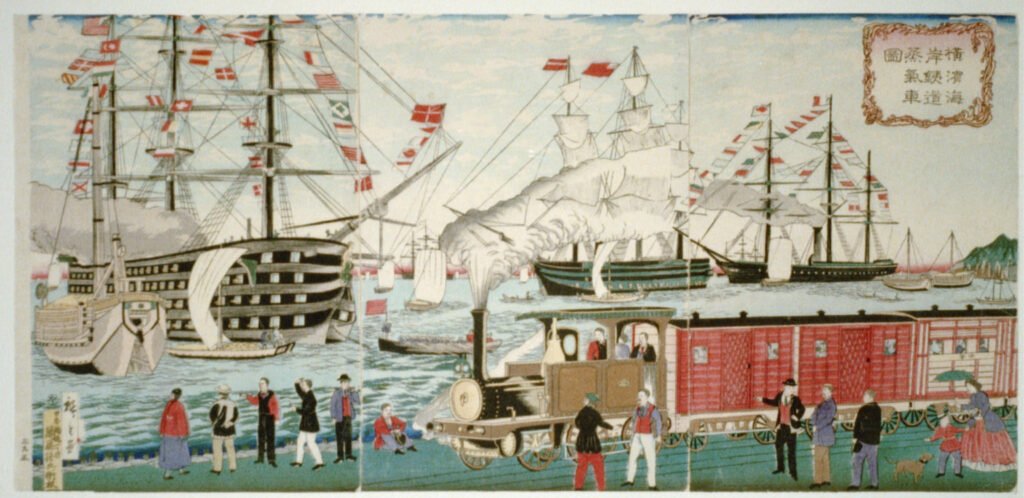
The Steam Train In The Woodblock Print
Haru unfolded a bright sheet of paper at the entrance to her family’s small workshop. A train in the print moved along a coastline in colors that made its steam look almost festive. There were passengers at the windows, buildings by the tracks and a sense that the machine was crossing not only a stretch of land but the distance between two ages.
In the imagined household of early Meiji Japan, Haru’s brother Sota admired the engine. Their mother studied the print for something else: the people who had worked to build the track, the families who would pay to ride, and the trades that might lose customers when travel became faster. None of these characters existed. Their disagreement belongs to the story, not to a surviving letter. But the questions are relevant to Japan’s rapid transformation.
An 1874 woodblock print of the Yokohama railway by Hiroshige III, this chapter’s featured image, captures the visual excitement of new infrastructure. It is not a complete social history. A brilliant picture of a locomotive cannot tell us on its own who paid the taxes, whose land changed hands, or why a household chose between a village livelihood and a factory job.
Japan Before Restoration Was Neither Timeless Nor Closed
Tokugawa Japan was governed through a political order centered on the shogunate and regional domains, with the emperor occupying a different symbolic and institutional role. Local rulers, samurai, farmers, artisans and merchants inhabited a hierarchy that was both structured and dynamic. Cities, markets, roads, publishing and commercial enterprise developed long before the Meiji government made modernization its watchword.
The common image of a completely sealed Japan before 1853 is misleading. The Tokugawa authorities regulated overseas contact strictly, but connections through Nagasaki and other channels involved Dutch and Chinese trade, while relationships with Korea, Ryukyu and the Ainu territories followed their own patterns. Foreign knowledge entered through limited networks, and Japanese scholars explored astronomy, medicine and other subjects. Restrictions shaped these exchanges without eliminating them.
The Metropolitan Museum of Art’s chronology places the nineteenth-century transformation against an existing cultural and institutional world. Remembering that foundation matters: modernization did not begin because a society had no knowledge of trade or technology. It emerged from internal conflicts and established capacities as well as from external pressure.
Black Ships And The Politics Of Unequal Access
Commodore Matthew Perry’s arrival with American warships in 1853, followed by negotiations and agreements in 1854, intensified debates over how Japan should respond to foreign demands. Further treaties in 1858 expanded commercial and diplomatic arrangements and restricted Japanese autonomy in ways that political leaders found troubling. The display of naval power was impossible to ignore, particularly after other Asian states had faced coercive treaties.
Our preceding chapter, Qing China And The Age Of Unequal Treaties, examined how war imposed unequal arrangements on China. Japanese officials learned from these events, but their response was not uniform. Some favored resistance or expulsion of foreigners; others judged that knowledge, weapons and selective negotiation would be essential to avoid a worse defeat. Neither side possessed a safe and simple answer.
Haru’s fictional grandfather argues that the sea has always been there and that only the ships have changed. Sota replies that a ship can carry both books and cannons. The exchange expresses a genuine political problem. Contact with foreign powers could bring tools and information, but the threat of violence shaped which agreements were possible.
The Shogunate Lost Its Political Center
During the 1860s, disputes among the Tokugawa shogunate, regional domains and supporters of imperial political restoration intensified. Leading figures from domains including Satsuma and Choshu played critical roles in the coalition that overturned the old order. Political slogans and loyalties shifted as factions argued over the emperor, foreign relations and the fate of the established administration.
The formal return of governing authority to the emperor in 1867 and the political struggles of 1868 formed part of a contested transition, not a peaceful administrative handover. The Boshin War followed, bringing armed conflict and suffering. Individuals who had served the Tokugawa system faced decisions about loyalty, livelihood and the direction of the country. The National Diet Library’s history of constitutional development traces these critical steps.
Restoration was framed in the emperor’s name, but actual policy emerged from a group of political leaders and institutions. A person living through the change might hear the language of recovering legitimate rule while experiencing new taxes, obligations and unfamiliar officials. Political restoration and revolutionary transformation were joined together in a historically unusual way.
A Charter Of Principles And A State To Build
The 1868 Charter Oath expressed broad commitments, including consultation, public discussion and the pursuit of knowledge. Such principles became important reference points, but they did not immediately create a fully representative democracy. The new government faced the practical task of assembling authority across territories formerly governed through domains and inherited relationships.
In 1871, the abolition of the domains and their replacement by prefectures formed a major step in centralizing administration. A national bureaucracy, new systems of finance and an evolving military gave the central government powers that regional rulers had previously exercised. These reforms were not painless. Displaced officials, former samurai and communities tied to old structures had to find a place within a state being reorganized at remarkable speed.
Looked at from the capital, centralization can appear as administrative clarity. Viewed from a village or town, it might mean new procedures, conscription notices, school requirements and unfamiliar claims on land revenue. In The State, The Tax And The Cost Of War, we considered how governments turn resources into power. The Meiji state made that transformation central to its survival strategy.
The Iwakura Mission And Studying Foreign Institutions
From 1871 to 1873, the Iwakura Mission traveled through the United States and Europe. Its members hoped to learn from institutions, industries, education systems and technology, while also seeking changes to the unequal treaty relationship. The mission did not secure the treaty revisions it wanted immediately, but it exposed leaders to a wide range of alternatives and strengthened debate about how Japan should organize its future.
The National Diet Library documents the mission within constitutional politics, while the Japan Center for Asian Historical Records makes the mission’s participants and institutions accessible for study. These sources reveal a group learning through observation, comparison and disagreement, not a country simply copying a single Western blueprint.
The mission also invites a question about access. Only a small circle could travel as official representatives. Their experience had enormous institutional influence, but the people expected to finance and live under new policies seldom accompanied them. Foreign knowledge entered statecraft through unequal channels of representation.
Land Taxes, Schools And The Obligations Of Citizenship
The Meiji government introduced land tax reforms that altered the fiscal basis of the state, including the use of cash payments calculated in relation to land values. The system aimed to provide more predictable revenue and reshape property relationships. Yet taxpayers faced burdens that varied with prices, harvest conditions and local implementation. Some rural communities protested changes that officials described as necessary foundations of modern government.
National education policies expanded schooling and the ambition to cultivate literate, disciplined subjects. Access and attendance developed unevenly; costs, gender, household labor demands and local resistance all mattered. The desire for education should not be confused with universal, immediate opportunity. Children whose work supported a family’s survival could find a school requirement difficult even if their parents valued learning.
In the fictional workshop, Haru wants to read new textbooks and make her own decisions. Sota’s employer worries about the hours that study will take from paid labor. The disagreement does not correspond to one documented family. It suggests how a program that appears progressive in legislation can create complicated choices when it arrives at the level of household economics.
Conscription And The End Of The Samurai Monopoly
The new conscription system introduced in the 1870s challenged the older military and social privileges of the samurai estate. Former samurai faced changes to stipends, status and the wearing of swords. Some entered government, business or education; others resisted or struggled to adapt. The state’s expanding military could recruit from a wider population, but such recruitment placed obligations on communities that had not previously borne them in the same form.
Resistance was not confined to nostalgic attachment to tradition. People argued about fairness, sacrifice, government legitimacy and the disruption of livelihoods. The Satsuma Rebellion of 1877, associated with Saigo Takamori, was a major armed challenge to the new state. Its defeat strengthened the central government’s military position, but it also marked the human and political costs of consolidating a different order.
The Japan Center for Asian Historical Records chronology records the rebellion alongside constitutional and diplomatic developments. A timeline is useful, but dates alone cannot capture what it feels like when a family’s status, military obligations and claim to respect are renegotiated within a decade.
Factories Were Built With Human Hands
Japan’s industrial transformation is often illustrated through smokestacks, railway lines and new machinery. Those symbols are important but incomplete. State sponsorship, private investment, foreign expertise, commercial traditions and accumulated domestic skills all contributed to the growth of industry. Silk and cotton textile production became especially important in the export economy and in the development of modern factory labor.
Many mill workers were young women from rural households. Their labor was fundamental to industrial success, yet historians document long hours, strict workplace discipline and the constraints imposed by employers and social expectations. Some women used wages to support family goals or develop forms of independence; others experienced severe hardship and limited freedom of movement. There is no responsible account of industrial progress that treats their experiences as a footnote.
Research on female textile workers in modernizing Japan and the broader history of factory girls underscores the importance of listening to labor history alongside state policy. The story of a successful industry must include what workers made possible and what the work cost them.
A Wage Could Travel Home But Not Erase Distance
Haru, in the invented story, leaves the workshop for a textile mill. A month later a letter arrives containing a few coins, news of roommates and a description of the room where she sleeps. The letter is fictional. It is deliberately ordinary: the challenge of labor history is to recognize consequential decisions within acts that rarely become famous.
Her mother counts the money and asks whether the work is worth the separation. No general answer can stand for all Japanese women who entered factories. Employment may have been experienced as duty, opportunity, exploitation, discipline or some mixture of these. Family circumstances, age, employer and region changed the answer. The phrase industrial progress is an abstraction; workers lived its consequences hour by hour.
Our earlier Coal, Cotton And The New Factory introduced the global connection between machinery and labor. In Japan, textile production reveals how industrial development could be both an assertion of national autonomy and a system requiring the intensive labor of people with limited political power.
Railways, Telegraphs And An Altered Sense Of Distance
The railway between Tokyo and Yokohama, opened in 1872, became one of the most visible signs of the new age. Transport infrastructure, telegraph networks and modern communications changed the movement of people, goods and information. They also strengthened the central state’s reach. A train could carry merchants and students, but it could also connect military operations and government offices.
The public domain print by Hiroshige III captures the excitement of the railway without documenting every material consequence. Its aesthetic vision belongs to its historical moment. Printmakers were not merely passive recorders of modernization; their images helped viewers imagine what the new age meant.
Connecting the nation involved decisions about where lines ran and who could afford to use them. Mountain communities, islands and remote settlements did not experience the same pace of change as major ports. Modern infrastructure can integrate populations while deepening inequalities in access and influence.
Constitution, Diet And The Limits Of Representation
Calls for political participation and rights developed alongside centralization and economic reform. Activists associated with the Freedom and People’s Rights Movement argued for broader public involvement and constitutional government. Leaders responded through a combination of concessions, restrictions and institutional planning. The process was political struggle rather than the automatic reward for modernization.
The Constitution of the Empire of Japan was promulgated in 1889, and the Imperial Diet opened in 1890. Its arrangements offered new forums for politics but preserved powerful roles for the emperor and institutions that were not responsible to an electorate in the modern democratic sense. Voting rights were severely restricted, and women were excluded from national electoral participation. The National Diet Library’s documentary history helps distinguish the promise of constitutional government from the specific limits of the system created.
Freedom does not come in a single unit. A state can gain independence in foreign affairs while limiting the rights of its people. It can establish representative institutions while reserving ultimate authority elsewhere. The debate about political belonging that shaped Citizenship, Nationalism And The Revolutions Of 1848 was also relevant in East Asia, but the institutions and political languages were distinctly Japanese.
Modernization Was Not Cultural Erasure
Japanese artists, educators, writers and consumers experimented with new clothing, architecture, printing and forms of entertainment. Older styles did not vanish. Instead, households and public institutions combined inherited practices with new ones in changing proportions. A city street might display foreign-built structures beside familiar shops, while newspapers presented customs as evidence of either progress or loss.
Official policies toward religion, education and identity also sought to produce new forms of loyalty. These programs could be coercive, particularly when they subordinated local traditions to the state’s image of a unified nation. The Meiji transformation was not one effortless collective decision to become Western. It was a struggle over which institutions should survive, which should change and who had authority to define Japaneseness.
In Haru’s fictional home, the old woodblock print remains on the wall beside a new school timetable. Neither item explains the whole country. Their coexistence gives the story a more accurate emotional structure than a simple tale in which modernity arrives and tradition disappears overnight.
Hokkaido, Okinawa And Those Outside The National Story
The modernizing state also expanded and consolidated control over territories and peoples whose histories did not fit a straightforward narrative of national unification. Policies toward the Ainu in Hokkaido included dispossession, settlement and efforts to assimilate communities into state-defined social arrangements. Okinawa’s political incorporation in 1879 followed the dissolution of the Ryukyu Kingdom, disrupting distinctive political relationships and cultural institutions.
These histories require their own voices and scholarship. A story told solely from Tokyo can portray the extension of administrative power as a necessary step in building a modern nation; a community experiencing land loss or forced assimilation may understand it very differently. The ethical challenge resembles that of earlier The Human Cost Of Atlantic Empire: the vocabulary of improvement can conceal the displacement of people who were not invited to define improvement.
Japan’s modern state emerged through internal centralization and external diplomacy, but it also drew boundaries around who counted as part of the nation and on whose terms. Those boundaries were not naturally given, and they did not eliminate the identities they attempted to manage.
From Fear Of Empire To Imperial Ambition
The desire to resist foreign domination helped fuel state building, yet by the late nineteenth century Japan itself pursued a more assertive regional policy. Its strategic interests and expanding military power increasingly affected Korea, China and surrounding territories. The First Sino-Japanese War of 1894 to 1895 ended in Japan’s victory and the Treaty of Shimonoseki, which included Qing China’s cession of Taiwan, among other terms.
The Japan Center for Asian Historical Records and National Diet Library chronology provide documentary footholds for the sequence. Later events, including Japan’s annexation of Korea in 1910, fell beyond the initial restoration era but illuminate the long trajectory of imperial expansion. It is important not to collapse these decades into one inevitable program.
Here lies one of the chapter’s central tensions. A state modernized partly to protect its sovereignty, then used its new capacities to restrict the sovereignty of others. Fear of subordination does not guarantee sympathy for neighbors facing similar pressure. Military security, nationalism and commercial ambition can reshape one another.
The Costs That A State Cannot Display In A Parade
The accomplishments associated with Meiji Japan were substantial: administrative reorganization, expanding education, industrial infrastructure, new political institutions and increased capability to negotiate with foreign states. Those changes also came with burdens: taxation, forced military service, displacement of established social orders, factory hardship and imperial expansion. The historical record demands that both sides of this ledger remain visible.
It would be misleading to argue that every reform made everyone worse off, just as it would be misleading to treat the resulting national power as proof every policy was justified. The strongest historical question is not whether modernization was good or bad in the abstract. It is whose interests it served, how its gains and costs were distributed and which alternative choices were realistically available.
When Sota finally rides the train in the fictional story, he is delighted by the speed. Later, at home, Haru tells him what a day at the mill has cost her. The scenes are invented. Their connection is the argument: a society’s future cannot be measured only by how quickly its machines move.
A New Century With Old Questions
Japan crossed into the twentieth century with expanding institutions, an increasingly capable state and regional ambitions that would bring new conflicts. The Meiji transformation influenced political and economic history far beyond the archipelago, but its path was not a universal formula for other societies to reproduce. Different resources, institutions and political struggles produced different possibilities elsewhere.
The print of the railway returns to the workshop wall. Haru now sees passengers and workers, military planners and families, teachers and farmers, all depending on the same infrastructure without sharing the same power. In the story, she leaves the print hanging because she has learned to read more of it. The choice is fictional, but the historian’s duty is similar.
The next chapter leaves East Asia to examine African societies facing nineteenth-century colonial conquest. The comparative question will remain urgent: when an empire claims to bring technology, order or civilization, who is allowed to accept, refuse or redefine the terms?
Historical Sources And Narrative Boundaries
The story’s characters and dialogue are fictional. Political chronology is based on the National Diet Library of Japan, the National Diet Library chronology and Japan Center for Asian Historical Records. Social and industrial context draws on the Metropolitan Museum of Art and research on women textile workers. The 1874 featured artwork is by Hiroshige III, in the public domain.