
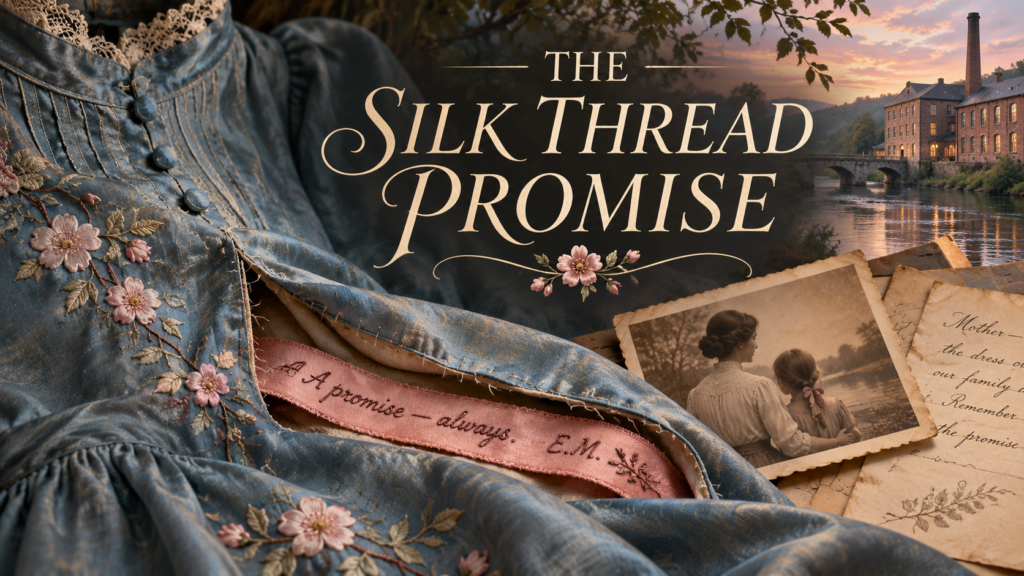
The dress had survived one flood, two removals of the family household and an unfortunate afternoon when somebody attempted to shorten its sleeves with a kitchen knife.
It was not, therefore, in a condition to be worn at a wedding.
Nora Shen explained this to her cousin on a Tuesday morning in the little alteration shop behind the market.
“It’s a hundred years old, May.”
“It’s been in the cupboard for a hundred years.”
“That’s generally what happens to something a hundred years old.”
May looked down at the dress.
The silk had once been blue. It was now the uncertain color of smoke reflected in water. The embroidered branches around the hem were still visible, although many of the blossoms had been reduced to little holes.
“What if you just mend the flowers?”
“They’ll tear the moment you sit down.”
“I’m not going to sit down very much.”
Nora looked at her cousin.
“You’re getting married. At some point during the day, somebody is going to put a chair beneath you.”
May laughed.
She had brought the dress from the house in which their grandmother had lived until her death in February. There were still cupboards to be emptied there, and a collection of old things which the family had attempted to distribute according to a system that became less effective whenever anybody found something they wanted.
The dress belonged to no one in particular.
Their grandmother had said that it belonged to a woman whose name she could never remember.
May wanted to wear it for a photograph before her wedding in June.
Nora promised to examine it properly.
After May went away, Nora laid a clean sheet on the largest table in the shop and carefully unfolded the dress.
She had repaired wedding clothes for fifteen years. Most of the work involved taking in a waist, letting out a seam or persuading a bride that a garment which fit perfectly did not need to be altered because a distant aunt had expressed an opinion about it.
Old fabrics required a different kind of attention.
She looked at the faded embroidery, then turned the skirt inside out.
Along the inner hem were several repairs. One used cotton thread with a slight twist. Another was almost certainly the work of her grandmother, who had made stitches of an astonishingly uniform length when she was young and had allowed them to become somewhat larger during the later years of her life.
Near the back, Nora found a third repair.
The stitches were made with red silk.
They appeared to enclose something.
She fetched a magnifying glass.
There was a small rectangular patch between the outer material and the lining. It was too stiff to have been intended as reinforcement for that part of the garment.
Nora took photographs of the seam before she opened it.
Then she snipped two broken threads and eased the lining back.
Inside was a narrow length of silk ribbon, faded to a dusty pink.
At first, she thought that somebody had used it to repair the hem.
Then she saw the writing.
There were words stitched along the ribbon in tiny black letters. Their shapes were uneven, as though the needle had been too thick for the task.
She lifted the ribbon carefully with the point of a blunt instrument.
Two initials appeared near one end.
L. S.
E. W.
Farther along was a date.
17 October 1926.
Beneath the date were five words.
When the river runs clear.
Nora looked at the ribbon for a long time.
Her great-grandfather, whose name had been Liang Shen, had been born in 1903. She knew this because his photograph stood beside the front door of her mother’s apartment. Every member of the family had been obliged to explain his relationship to them at one time or another to visitors who admired the photograph.
L. S.
Her great-grandmother had been Mei Tan.
Nora was reasonably sure about this.
She telephoned her mother.
“Do you remember the old blue dress from Grandmother’s cupboard?”
“The one with the flowers?”
“Yes.”
“Your aunt wanted that.”
“May brought it here.”
“Hmm.”
“Do you know whose dress it was?”
“Somebody gave it to your grandmother when she was young.”
“Who?”
“I don’t remember.”
Nora looked at the ribbon.
“Was Grandfather Liang ever engaged to somebody before he married Great-grandmother?”
There was a silence.
“Why are you asking me that?”
“I found something in the dress.”
“What sort of thing?”
Nora described the ribbon.
Her mother listened without interrupting.
Then she said, “You should leave the dress alone.”
“I’ve only opened two stitches.”
“Put it away. May doesn’t need to wear it.”
“Do the initials mean anything to you?”
“No.”
The answer came very quickly.
Nora waited.
Her mother asked whether she had remembered to buy rice.
They discussed rice for several minutes.
After the call ended, Nora continued examining the dress.
There was no reason to suppose that L. S. stood for Liang Shen. There had been other members of the family with those initials, and nothing on the ribbon established that either person had been a member of the family at all.
Nevertheless, she felt the little movement in her chest that she experienced when an alteration revealed a seam which somebody had attempted to conceal.
She placed the ribbon on a sheet of acid-free tissue, folded the tissue and put it in a shallow box.
Then she telephoned May to explain that the dress could not safely be worn for the photograph.
May accepted the news with surprising good humor.
“Can we make something like it?”
“Yes.”
“Without the holes?”
“Probably.”
“Wonderful.”
Nora told her about the ribbon.
May became very interested.
“Was it a love letter?”
“I don’t know.”
“Of course it was.”
“It had seven words and a date.”
“People were more efficient in those days.”
She promised to come to the shop after work.
At noon, Nora closed the shutters for twenty minutes and went to see her uncle Edmund.
He had inherited the family papers because he happened to have the largest house and because the other members of the family believed he enjoyed reading old documents.
In fact, Edmund enjoyed being the person who knew where everything was.
He kept the papers in labeled envelopes in a cabinet beside the dining room. He was proud of the labels, although some of them were inaccurate.
Nora found him eating lunch.
He examined the photograph she had taken of the ribbon.
“That’s strange.”
“Do you know the handwriting?”
“It isn’t handwriting.”
“The shapes of the letters.”
He put on his reading glasses.
“No.”
“Was Liang engaged before his marriage?”
“Not that I know of.”
He carried his plate to the kitchen.
Nora followed.
“Do we have any papers from 1926?”
“Probably something.”
“May I look?”
“Don’t move the envelopes.”
He returned to the dining room, unlocked the cabinet and removed a box.
Inside were copies of birth certificates, old photographs and an assortment of papers concerning the small textile business that Liang had established after moving to the town of Bellwater in his twenties.
Nora found his marriage certificate.
Liang and Mei had married in 1929.
She set it aside.
There was a photograph of Liang as a young man, wearing a pale jacket and leaning against an iron railing. On the reverse, somebody had written the name of a place.
East Quay, 1926.
She turned it over.
In the background was a building with two tall windows and a painted sign.
The words on the sign were not entirely legible.
She asked Edmund whether he knew where the photograph was taken.
“Probably the old river district.”
“Was there a textile mill there?”
“Several.”
Nora studied the image.
A woman stood near the doorway of the building. The photograph had been taken at such a distance that her face was indistinct. She wore a dark dress and appeared to be looking at the water.
“Who’s that?”
Edmund leaned over.
“I don’t know.”
He drew the photograph closer.
“Your great-grandfather worked at a mill before he came here. I think it was called the East Quay Silk Works.”
“Do we have any records?”
“Not here.”
He frowned.
“What exactly are you looking for?”
Nora showed him the photograph of the ribbon again.
“There’s a date. And two initials. I thought one of them might be his.”
Edmund looked at the marriage certificate on the table.
“Even if it was, what would that establish?”
“Not very much.”
“Exactly.”
He put down the photograph.
“Your great-grandmother was a good woman.”
“I know.”
“Your great-grandfather was a good man.”
“I know that too.”
“Then I’m not sure what you want to find.”
Nora placed the photograph beside the certificate.
“I haven’t decided what I want to find.”
Her uncle looked at her.
“I only want to know what the thing in the dress means.”
He did not reply.
Before she left, he permitted her to photograph the image of Liang and the marriage certificate.
She put both papers back where she had found them.
The East Quay district had changed considerably in a hundred years.
The silk works were gone. A series of office buildings overlooked the water, and the old road beside the river had been converted into a pedestrian path. A young man sold coffee from a kiosk near the converted pumping station.
Nora went there after closing the shop.
She found the building in the photograph by comparing its windows with those of the former mill offices. Only one of the original two wings remained. The lower half had been painted white.
A sign on the doorway announced that the building belonged to the Bellwater River Heritage Association.
It was open on Thursday afternoons and by appointment.
Nora was reading the notice when a man came out carrying a cardboard box.
“Can I help you?”
She explained that she was looking for information about the old silk works.
He put the box down.
“What sort of information?”
“Employees. Around 1926.”
He smiled.
“That’s unfortunate.”
“Why?”
“Because 1926 is the year the river flooded.”
He pointed towards the water.
“The mill’s ground-floor office was inundated. A lot of the personnel records were lost.”
Nora thought of the words on the ribbon.
When the river runs clear.
“Did the mill close?”
“For a few months. They reopened most of it in the spring.”
He introduced himself as Theo Ward, the association’s part-time archivist.
Nora recognized the surname.
“Have your family lived in Bellwater for long?”
“Longer than they’d probably admit.”
“Was there an E. Ward here in 1926?”
He looked at her.
“There were quite a few Wards.”
“An Eleanor?”
She had no idea why she had chosen that name.
Theo thought for a moment.
“Possibly. I could check the directories.”
He picked up the box.
“Come on. I’ve got twenty minutes before I need to be somewhere else.”
The association occupied two rooms on the ground floor. Maps hung on the walls. A photograph of the flooded mill stood beside an exhibit of spindles and wooden bobbins.
Theo put his box down beside a table.
Nora told him about the ribbon, leaving out her great-grandfather’s name for the moment.
He examined the photograph she had taken.
“Did you say the date was October seventeenth?”
“Yes.”
“That was a few days after the main flood.”
He went to a shelf and removed a folder.
Inside was a collection of newspaper cuttings relating to the damage.
The flood had reached its height on the night of October twelfth. Some families were forced to leave the low streets. Two houses collapsed, and a temporary shelter was established in the railway sheds.
The cutting for October seventeenth described volunteers transporting food to people who had been unable to return to their homes.
A photograph showed a group of women beside a cart.
Theo looked at the caption.
“Here we are.”
He pointed to a name near the end of the list.
Elsie Ward.
Nora looked at him.
“Does that mean anything to you?”
“Elsie was my great-great-aunt.”
“Really?”
“Yes, she worked at the silk works. Sample room, I think.”
He took the photograph to the window.
“I’ve seen a copy of this before. My father had it.”
“Do you know whether she got married?”
“I don’t think so.”
The words seemed to leave an unexpected space between them.
Theo looked at her.
“Why?”
Nora explained about Liang Shen.
He listened.
“Did your great-grandfather work here in 1926?”
“That’s what I’m trying to establish.”
Theo nodded.
“Then we’d need something connecting him to the mill. And something connecting her to the ribbon.”
“Yes.”
He looked at the photograph.
“Elsie didn’t stay in Bellwater. I was told she moved to the coast when she was young. Nobody talked about her very often.”
“Do you know why?”
“No.”
He carried the folder back to the table.
“I can ask my father. He might know more.”
Nora thanked him.
He wrote down the association’s email address.
As she was leaving, he showed her the original photograph of the mill during the flood.
Water filled the street. A wagon stood almost submerged beside the office. The windows of the upper floor were crowded with people looking down.
“The river was filthy for weeks afterwards,” he said. “All the dye from the mills had run into it.”
Nora looked at the water.
“When the river runs clear,” she said.
Theo glanced towards her.
“That’s what’s on the ribbon?”
“Yes.”
He studied the photograph again.
“Interesting.”
That evening, Nora returned to the shop.
She locked the front door and took the blue dress from its box.
The lining had become detached at the waist in several places. As she examined it, she noticed a square of newer fabric beneath the left arm, apparently inserted when the garment was altered to accommodate a different wearer.
She photographed the alteration.
Beneath the edge of the repair was a little manufacturer’s label, woven in white thread.
East Quay Silk Works.
She sat down.
There might have been hundreds of dresses made from the mill’s fabric. The label did not establish who had owned it.
But the ribbon, the date, the initials and the place were no longer entirely separate things.
Her telephone rang.
It was her mother.
“Have you still got the dress?”
“Yes.”
“Your aunt says you want to show it to somebody.”
“I haven’t shown anyone the dress.”
“Good.”
Nora looked at the label.
“Why are you worried?”
“I’m not worried.”
“Then tell me why you asked me to put it away.”
Her mother was quiet.
Then she said, “Your grandmother didn’t want anyone wearing it.”
“I thought she said she’d been given it.”
“She did.”
“By whom?”
There was another silence.
“Her father.”
Nora sat straighter.
“Liang?”
“Yes.”
“Did he tell her who it belonged to?”
Her mother let out a breath.
“She asked him once. He told her he was keeping it for somebody.”
Nora waited.
“Who?”
“Somebody who was supposed to come back.”
Her mother sounded tired.
“That was all she ever said.”
Outside the shop, the market cleaners were sweeping the pavement. Their brooms made long, dragging sounds against the stones.
Nora looked at the blue dress stretched across her table.
She had spent the afternoon looking for evidence of a wedding.
Now she wondered whether the wedding had ever taken place.
“Mother?”
“Yes?”
“Did he ever say when she was supposed to come back?”
“No.”
The cleaners moved past the window.
Nora touched the loose lining.
Her mother spoke again.
“Whatever you find, please remember that your grandmother loved both her parents.”
“I will.”
She ended the call.
For several minutes Nora remained at the table with her hands resting on the clean sheet.
Then she returned the ribbon to its little box.
She did not stitch it back into the hem.
For the first time since she had found it, she understood that the seam might not have been intended to hide a secret forever.
It might have been intended to keep a promise safe until somebody returned to claim it.


