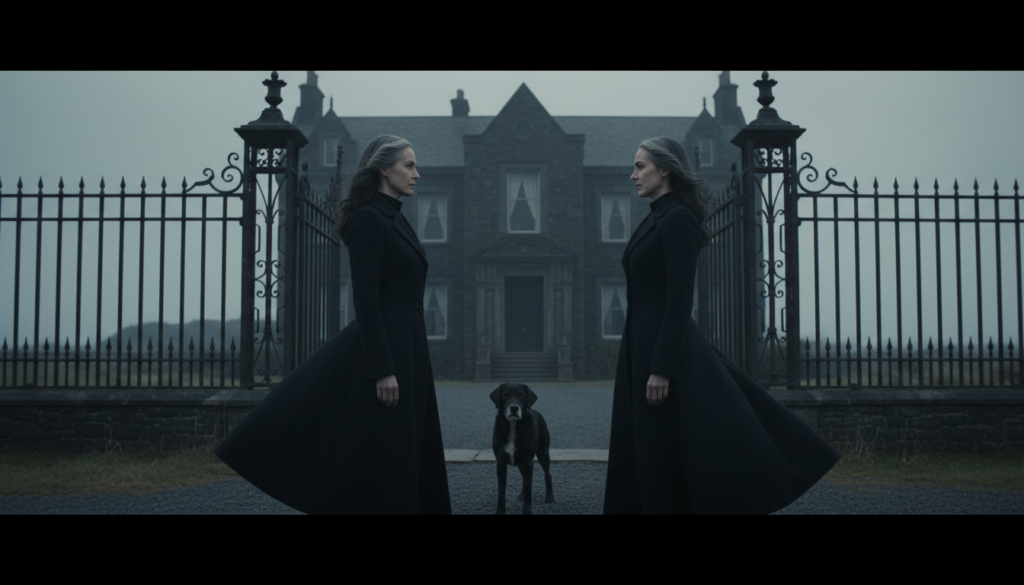
The dog licked her hand before she entered the house.
It was a small, deliberate gesture.
One lick across the knuckles.
Then another.
The animal was old, black, and almost entirely white around the muzzle. One eye had clouded with age. Its ears hung unevenly. Its coat smelled faintly of rain, earth, and the particular mustiness of dogs who have spent years sleeping beside fireplaces.
Dalia Ward looked down.
“Hello.”
The dog wagged its tail.
Then licked her hand again.
Dalia smiled.
She was forty-nine, worked as a probate appraiser, and had spent the past twenty years entering houses whose owners had died.
Some were tidy.
Some chaotic.
Some filled with objects carefully chosen over decades.
Others contained drawers of unused batteries, broken spectacles, old receipts, and enough plastic shopping bags to equip a small army.
She had seen houses left exactly as their owners had last used them.
A cup beside a chair.
A book open on a table.
A bed made on one side.
She had learned that possessions did not explain a person as neatly as families hoped.
A collection of books could belong to someone who rarely read.
A photograph could commemorate a relationship that had ended badly.
An expensive painting might have been purchased because the owner liked the frame.
Dalia’s job was to establish values, identify items requiring specialist assessment, and produce inventories for estates.
She did not interpret the dead.
She found that boundary comforting.
The house before her stood on a narrow peninsula overlooking the gray estuary of a place called Marrick Reach.
It was named Gallow House.
Three storeys.
Dark stone.
Tall windows.
A slate roof patched in several places.
The sea lay beyond a low garden wall, though the nearest water withdrew far across the mudflats at low tide.
The house had been empty since the death of its owner, Elspeth Gray, six weeks earlier.
A local agency managed the estate.
The building was in poor condition, and plans had been discussed for its sale and possible demolition, subject to the necessary permissions.
Dalia had been hired to assess the contents before decisions were made.
The work would take two days.
She intended to stay overnight in the guest room, as the estate agent had said basic facilities remained available, though she planned to inspect the room and the building’s condition before deciding whether to use it.
The old dog followed her toward the door.
According to the papers, he was called Wick.
Elspeth had adopted him eleven years earlier.
He was now thirteen.
The estate had arranged for a local veterinary nurse to check him and assist with finding a suitable permanent home.
Until then, a caretaker visited daily to feed and exercise him.
Dalia looked at the dog.
“Wick.”
He wagged.
She reached for the door.
Then noticed a piece of paper pinned beneath the brass knocker.
The handwriting was old-fashioned and precise.
THE WEST ROOM IS OCCUPIED. PLEASE USE THE EAST ROOM.
Dalia frowned.
The agent had told her the building was empty.
She looked toward the upper windows.
No lights.
No movement.
Perhaps the notice was old.
Perhaps a room had been reserved for storage.
She took a photograph.
Then entered.
The dog followed.
And the door closed behind them with a sound like somebody swallowing.
Gallow House smelled of damp paper, cold stone, and roses that had been dead for a very long time.
The entrance hall was enormous.
A dark wooden staircase rose toward the upper floors.
Portraits hung along the walls.
Some were clearly family members.
Others were strangers.
Several had been turned toward the wallpaper.
Dalia disliked that.
Not because she believed paintings could watch her.
Because it suggested somebody had found the faces difficult to look at and chosen not to remove them.
A strange compromise.
She put down her bag.
Took out the inventory sheet.
Then began working.
The ground floor contained a drawing room, dining room, library, kitchen, and several smaller rooms.
The furniture was old but not necessarily valuable.
The upholstery smelled damp.
Some books had been damaged by moisture.
The silver needed professional examination.
A cabinet contained watches, medals, letters, and a collection of small ivory-colored chess pieces whose material required identification before any decisions about sale could be made.
Dalia recorded everything.
Photographed it.
Tagged items according to the estate’s procedures.
The house was quiet.
Not unusually quiet.
It was a remote building with thick walls and few neighbors.
But as the afternoon progressed, she noticed something unsettling.
The rooms did not seem to occupy the space she expected.
From outside, the dining room windows stood directly beside the library windows.
Inside, a narrow passage ran between the rooms.
It was too long.
Dalia checked the floor plan supplied by the estate agent.
The passage was not shown.
She walked it again.
Counted her steps.
Twelve.
Turned.
Walked back.
Thirteen.
She stopped.
Looked at the floor.
The boards were uneven.
Perhaps she had shortened her stride without noticing.
She wasn’t a surveyor.
There was no reason to believe she could measure a corridor reliably by walking it.
She took out a tape measure.
Extended it.
The distance matched neither her step count nor the plan.
She photographed the discrepancy.
Added a note for the building surveyor.
Then continued.
At four, the caretaker arrived.
His name was Farlan Pike.
He was sixty-eight, thin, with a narrow face and a limp that became more noticeable when he hurried.
He carried food for Wick and a bag of groceries for Dalia.
She hadn’t asked for groceries.
He placed them on the kitchen table anyway.
“Mrs. Gray would have wanted you fed.”
Dalia raised an eyebrow.
“Mrs. Gray is dead.”
Farlan looked at her.
Then smiled faintly.
“Yes.”
The answer made her uncomfortable.
She watched as he checked Wick’s food and water.
The dog greeted him calmly.
A wag.
A brief lick of his hand.
Then Wick returned to Dalia’s side.
Farlan looked toward her.
“He likes you.”
“Apparently.”
“That’s good.”
Dalia frowned.
“Why?”
The caretaker hesitated.
Then said, “He doesn’t like everyone.”
Dalia looked at the old dog.
He was standing beside her, tail moving gently.
She had no reason to doubt Farlan.
Dogs had preferences.
Some were anxious around strangers.
Others greeted everyone.
A familiar caretaker might know which reactions were typical.
“Has he always been affectionate?”
Farlan considered.
“With people he knows.”
Dalia nodded.
He looked toward the stairs.
“Which room will you use?”
“The east guest room.”
“Good.”
She remembered the note.
“What’s in the west room?”
Farlan stopped.
For a moment, he didn’t answer.
Then he said, “Mrs. Gray kept it closed.”
“Why?”
“It was her private space.”
“Are there contents to inventory?”
“Possibly. You’ll need instructions from the estate.”
Dalia folded her arms.
“The notice says it’s occupied.”
The caretaker looked toward the hall.
Then back at her.
“Mrs. Gray used to say that.”
“Why?”
He seemed genuinely uncomfortable.
“I never asked.”
Dalia watched him.
Then decided not to press.
She had worked with difficult estates before.
People protected strange arrangements for reasons that were not always obvious.
A private room could contain nothing more sinister than letters, photographs, or a half-finished hobby.
Still, the caretaker’s reluctance bothered her.
Farlan finished arranging the supplies.
Then he prepared to leave.
Before he reached the door, Dalia asked one more question.
“Did Mrs. Gray have family?”
He considered.
“No close relatives who visited, as far as I know.”
“Friends?”
“Some.”
“Did she live here alone?”
A long pause.
“Mostly.”
Dalia stared.
He looked toward Wick.
Then said, “Keep him with you tonight.”
“Why?”
Farlan met her eyes.
“Because he knows the house.”
Before she could ask another question, he left.
Dalia stood in the hall.
The old dog looked up at her.
Then licked her hand.
A small gesture.
Ordinary.
Warm.
She scratched behind his ear.
“Well,” she whispered, “you’re more helpful than your caretaker.”
Wick wagged.
Then looked toward the staircase.
And stopped.
His ears lifted.
Dalia followed his gaze.
The upper landing was dark.
Nothing moved.
She waited.
Then the dog lowered his head.
Walked toward the kitchen.
And drank water.
Dalia laughed quietly at herself.
She was tired.
The house was strange.
The caretaker was stranger.
There was no reason to turn every sound into a mystery.
She finished the day’s inventory.
Ate a sandwich.
Then carried her bag upstairs.
The east room was clean enough to use and appeared sound, though she remained aware of the building’s age and the need for proper inspection.
The bed had fresh linen.
A lamp stood beside it.
The window overlooked the estuary.
At low tide, the water retreated so far that the mudflats resembled a vast dark plain.
Dalia opened the window slightly.
A cold wind entered.
She closed it again.
Wick settled beside the bed.
She looked toward the west end of the corridor.
A narrow door stood beneath the final window.
No light showed beneath it.
She returned to her room.
Locked the door.
Then changed into her nightclothes.
At eleven forty-seven, she turned out the lamp.
The dog sighed beside the bed.
Dalia closed her eyes.
And somewhere in the west wing, a woman began singing.
The song was soft.
Almost inaudible.
A few notes moving up and down without settling into a melody.
Dalia opened her eyes.
The room was dark.
She listened.
The voice came through the wall.
A woman’s voice.
Not young.
Not old.
Impossible to place.
Dalia sat up.
Wick lifted his head.
The singing stopped.
For a moment, there was silence.
Then three footsteps sounded in the corridor.
Slow.
Measured.
Dalia reached for the lamp.
Turned it on.
The footsteps stopped.
She looked toward the door.
“Hello?”
No answer.
She waited.
Nothing.
Then she heard a sound from the other side.
A hand placed against the wood.
Not a knock.
A gentle pressure.
Like somebody leaning close enough that their palm rested against the door.
Dalia held her breath.
Wick stood.
Walked toward the door.
Sniffed.
Then returned to the bed.
He did not bark.
For some reason, that frightened her more.
She picked up her phone.
The signal was weak but present.
She could call the caretaker.
Ask whether anyone else had access.
Then she thought about the singing.
Perhaps an old radio had been left running.
Perhaps the caretaker had returned without telling her.
Perhaps somebody was trespassing.
None of those explanations was comfortable.
But all were more likely than a ghost.
She opened the door.
The corridor was empty.
The hall light burned dimly.
At the far end, beneath the last window, stood the west room.
Its door was open.
Dalia stared.
She was certain it had been closed earlier.
Now it stood a few inches ajar.
A pale strip of darkness lay beyond it.
Wick approached.
Stopped beside her.
Then licked the back of her hand.
Dalia looked down.
“Not now.”
The dog wagged once.
Then sat.
Dalia moved toward the west room.
She could hear her own breathing.
The floorboards creaked.
The door seemed farther away than it should have been.
She reached it.
Placed one hand on the frame.
Then pushed.
The room beyond was almost empty.
A bed.
A chair.
A small table.
And a mirror covering the wall opposite the door.
Dalia stood in the doorway.
The mirror reflected her.
Her nightclothes.
The hall light behind her.
The dog beside her legs.
She felt foolish.
A mirror.
An empty room.
An old house.
Then the reflection moved.
Not much.
A small movement.
Her reflected head tilted to one side.
Dalia had not tilted hers.
She froze.
The reflection looked at her.
Then smiled.
Dalia stepped backward.
The reflection remained where it was.
Smiling.
And behind the reflected woman, somebody began walking through the dark room.
A shape.
Human.
Barely visible.
Dalia turned.
The real room was empty.
She looked back toward the mirror.
The reflection was gone.
Not just the figure behind her.
Her own image had disappeared.
The mirror showed only the open doorway.
The corridor.
The light.
And the dog.
Wick stood in the reflection.
Looking toward the place where Dalia should have been.
Then he lifted his head.
Looked directly at her.
And licked her hand.
The mirror reflected the gesture.
But no hand appeared beneath his tongue.
Dalia ran.
She returned to the east room.
Locked the door.
Dragged a chair against it.
Then sat on the bed, breathing hard.
Wick followed.
Settled beside her.
And went to sleep.
Dalia did not.
For the rest of the night, she listened to the house.
The wind.
The roof.
The distant movement of water.
And, once, at approximately three in the morning, the quiet sound of someone walking past the door in shoes that made exactly the same noise as hers.
At dawn, someone knocked on the bedroom door.
Three times.
Dalia sat upright.
The lamp was still on.
The chair remained wedged beneath the handle.
Wick stood beside the bed.
He looked toward the door and wagged his tail.
A woman’s voice spoke from the corridor.
“Please open it.”
Dalia felt her throat close.
The voice was hers.
Not merely similar.
Not somebody imitating her.
Her own voice, with its slightly rough morning quality and the clipped pronunciation she’d inherited from her mother.
“Who are you?” she whispered.
The woman outside waited.
Then said, “I think I’m you.”
Dalia stared at the door.
The dog wagged again.
She wanted to run.
There was nowhere to go without opening the door.
The woman spoke.
“I woke up in the west room.”
Dalia felt cold.
“I don’t remember going there.”
A pause.
“At least, not after you left.”
Dalia looked toward Wick.
He had sat beside the door.
Waiting calmly.
She removed the chair.
Turned the handle.
Opened it.
A woman stood in the corridor.
Forty-nine.
Dark hair beginning to gray at the temples.
A small scar above the left eyebrow.
Wearing the same nightclothes.
Bare feet.
Her face pale with exhaustion.
Dalia stared.
The other woman stared back.
For several seconds, neither spoke.
Then they both said:
“Oh, God.”
The simultaneous words made the second woman laugh.
A frightened, terrible laugh.
Dalia stepped backward.
The other woman did the same.
Wick approached.
He looked from one to the other.
Then he went to Dalia and licked her hand.
She felt relief so sudden it almost made her dizzy.
“See?” she whispered.
The other woman looked at the dog.
Her expression changed.
Wick turned.
Approached her.
And licked her hand too.
One lick.
Then another.
Exactly as he had greeted Dalia the previous afternoon.
Neither woman moved.
The dog wagged.
Then walked between them toward the kitchen, apparently satisfied that the morning had begun and breakfast was overdue.
Dalia looked at her double.
“You’re not me.”
The other woman swallowed.
“Then why do I remember your life?”
They sat at the kitchen table and began testing.
Not because either believed a test would solve the impossible situation.
Because people faced with something incomprehensible often begin with the things they know how to measure.
Dalia asked the other woman her mother’s name.
She answered.
Her first school.
The name of the boy who had broken her nose with a football when she was twelve.
The reason she had divorced her husband.
The smell of the apartment where she lived at university.
The words she’d spoken at her father’s funeral.
Every answer was correct.
The other woman asked the same questions.
Dalia answered them.
They compared scars.
A small burn on the wrist.
The mark above the eyebrow.
The faint white line across one knee from a fall on wet steps.
Identical.
Their hands were the same.
The shape of the nails.
The calluses.
The tiny freckle beside the thumb.
Dalia felt sick.
The other woman looked toward the window.
Then said, “I remember going upstairs.”
“So do I.”
“I remember the note.”
“So do I.”
“The dog.”
“Yes.”
“The west room.”
Dalia stopped.
The other woman looked at her.
“I remember standing in the mirror.”
Dalia’s skin prickled.
“What?”
“I was looking at the room. At you. Then I thought you were moving strangely.”
She swallowed.
“And the next moment, I was on the other side.”
Dalia stared.
The other woman continued.
“There was a hallway behind me. I could hear singing. Then I went to the door, but it wouldn’t open.”
She looked toward the stairs.
“I stayed there until morning.”
For a moment, neither spoke.
Then Dalia asked, “Were you frightened?”
The other woman looked at her.
Her face changed.
“Of course.”
It was the first answer that did not feel like a test.
Dalia looked away.
She had spent the morning insisting this woman wasn’t real.
Yet the fear in her face was real enough.
The trembling hands.
The exhaustion.
The way she kept looking toward the door.
Dalia knew those gestures.
She’d made them herself all night.
A telephone rang.
Both women jumped.
Dalia looked toward her bag.
Her phone was inside.
The other woman reached instinctively toward an identical pocket in her nightclothes.
Then stopped.
Only one of them had brought a phone into the house.
Only one had a passport.
A bank account.
A work contract.
A life arranged around the assumption that she was the only person entitled to use her name.
The telephone continued ringing.
Dalia answered.
It was Farlan.
“Are you all right?”
She stared at the second woman.
Then said, “You need to come here.”
The caretaker was silent.
For a moment, she thought the connection had failed.
Then he asked:
“How many of you are there?”
Dalia felt a chill move through her.
“You knew.”
A pause.
Then:
“How many?”
She looked toward the other woman.
“Two.”
Farlan exhaled.
A long, exhausted sound.
“I’ll come.”
The line went dead.
Farlan arrived an hour later.
He entered the kitchen.
Saw the two women seated at the table.
Then closed his eyes.
“Mrs. Gray always said it would happen again.”
Dalia stood.
“Explain.”
He looked toward the doorway.
Wick approached.
Licked his hand.
The caretaker barely noticed.
“Elspeth had a sister,” he said.
Dalia frowned.
“There’s no sister in the estate records.”
“Not a legal one.”
The second woman looked up.
Farlan hesitated.
Then he told them what he knew.
Decades earlier, Elspeth had spent a night in the west room and awakened to find another woman with her face.
The two women had lived in Gallow House together for years.
At first, they told people they were twins.
Later, they stopped entertaining visitors.
One handled business.
Correspondence.
The ordinary affairs of the world.
The other remained mostly inside.
Nobody outside the house understood why the two women refused to be photographed together.
Farlan had arrived as a young caretaker.
He knew them both.
He didn’t know which had entered the house first.
They had never told him.
“Did they hate each other?” Dalia asked.
Farlan considered.
“Sometimes.”
The second woman stared.
“And sometimes?”
He looked toward the window.
“They were the only people who understood what the other had lost.”
Dalia felt something tighten in her chest.
Farlan continued.
One Elspeth had died several years before the owner named in the estate documents.
The other had survived.
The surviving woman kept the west room closed.
She claimed it was occupied.
Farlan had never been certain whether she believed the dead woman remained there or whether the room had become a place she couldn’t bear to enter.
After the second death, he continued visiting to care for Wick and check the building.
He hoped the house would remain empty until its contents were removed.
He had not warned the estate agent.
He had not warned Dalia.
He’d convinced himself the story was too strange to tell.
Perhaps he’d been afraid of being dismissed.
Perhaps he’d been afraid of being believed.
Dalia stared at him.
“You let me sleep here.”
He looked down.
“Yes.”
“Knowing what might happen.”
“I wasn’t certain it would.”
She felt anger rise.
“That’s not an excuse.”
“No.”
The second woman stood.
“What happened to the other Elspeth?”
Farlan frowned.
“I told you. She died.”
“Which one?”
He looked confused.
She took a step closer.
“The first one or the second?”
For a moment, Farlan said nothing.
Then whispered:
“I don’t know.”
The kitchen became silent.
Wick drank water from his bowl.
A gull cried beyond the window.
Dalia looked toward her double.
The woman had begun crying.
Not dramatically.
Tears simply moving down a face Dalia had seen in mirrors for forty-nine years.
She looked at Farlan.
“Did anybody ever try to help them?”
He stared.
“What would that have meant?”
“I don’t know.”
The answer made her furious.
Not because she expected him to know.
Because he had spent decades living beside something impossible and had apparently decided that keeping it hidden was easier than treating the two women as people with needs and choices.
Farlan looked away.
Then he said, “You should leave.”
Dalia stared.
“Both of us?”
He hesitated.
“Perhaps only one.”
The second woman went still.
Dalia looked at her.
For a moment, a terrible thought passed between them.
One could leave.
One could stay.
The outside world would remain simple.
One passport.
One bank account.
One Dalia Ward.
The other would live in a house nobody understood, waiting for the first to die or grow old or decide to visit.
Like the two Elspeths.
Dalia looked toward the old dog.
Wick had finished drinking.
He came to sit beside them.
His clouded eye looked toward the door.
The second woman crouched.
He licked her hand.
She began crying harder.
Dalia watched.
She had wanted the dog to choose.
A simple answer.
A living creature recognizing the original.
Proof that the woman who appeared at dawn was merely an imitation.
But Wick did not choose.
He greeted both women.
Perhaps because they smelled alike.
Perhaps because they moved and spoke alike.
Perhaps because the dog had learned that licking human hands brought attention and reassurance.
Perhaps for reasons nobody could establish.
His behavior could not settle a question about identity.
It was just a dog doing something dogs did.
Warm.
Ordinary.
Indifferent to the metaphysics of the situation.
The second woman looked up.
“What happens to me?”
Dalia stared.
For a moment, she wanted to say:
I don’t know.
Then she realized the woman wasn’t asking for a prediction.
She was asking whether Dalia intended to leave her behind.
Dalia looked toward Farlan.
“Get the car ready.”
He frowned.
“For whom?”
“For both of us.”
The caretaker stared.
“You can’t simply—”
“I know.”
Dalia looked toward the second woman.
“We can’t simply go back to my apartment and pretend this is normal.”
The other woman nodded.
“We’ll have questions. Legal ones. Practical ones. Questions I don’t know how to answer.”
Another nod.
Dalia took a breath.
“But you’re not staying here because it’s more convenient for everybody else.”
The second woman stared.
Then whispered:
“Thank you.”
Dalia felt something strange move through her.
A kind of grief.
For the life that could no longer remain simple.
For the certainty she’d lost.
For the possibility that she might never know whether she had been the woman who entered the house or the woman the house created.
She looked toward the second woman.
“What’s your name?”
The woman laughed through her tears.
“Dalia.”
“Of course.”
They stared at each other.
Then both laughed.
It was terrible.
Absurd.
And, in a way neither expected, a relief.
They had reached the first question they could not answer by comparing memories.
What should they call one another now?
Dalia looked toward the window.
The tide was rising.
She thought of Elspeth.
Two women living in a house for decades, arranging their lives around the idea that the world could tolerate only one of them at a time.
She did not know whether the outside world would be kinder.
There would be problems.
Perhaps enormous ones.
But she wanted to find out.
She looked toward the second woman.
“We’ll have to work out what comes next.”
The other woman nodded.
Then said, quietly:
“Together?”
Dalia considered.
She did not know this person.
And yet she knew almost everything about her.
She knew what frightened her.
What she regretted.
How she liked her tea.
Which songs she disliked.
The private dreams she’d never told anyone.
But knowledge was not the same as trust.
That would have to be built.
One decision at a time.
She looked at the woman.
Then answered:
“For now, yes.”
They left Gallow House shortly before noon.
Farlan carried one bag.
Dalia carried another.
The second woman wore spare clothes from Dalia’s luggage.
They were slightly too large, though nobody understood why.
Wick followed them to the door.
Then stopped.
Dalia turned.
The dog sat on the threshold.
His tail moved once.
She crouched.
“Come on, old man.”
Wick looked toward the staircase.
For a moment, Dalia thought he might refuse.
Then he approached.
Licked her hand.
Turned toward the second woman.
Licked hers too.
And walked out into the sunlight.
The two women stood beside the car.
The estuary stretched beyond the garden wall.
Water moved over the mudflats.
The old house stood behind them, dark and silent.
Dalia looked at her double.
The second woman looked back.
For the first time, they were standing beneath the same sky without a mirror between them.
A breeze moved through their hair.
Both felt it.
Both shivered.
Both were warm.
Dalia opened the car door.
Then paused.
“What if somebody asks which one of us is real?”
The second woman considered.
She looked toward Wick.
The old dog was waiting beside the open door, apparently convinced that wherever they were going, it ought to involve lunch.
Then she looked back at Dalia.
“I suppose we’ll have to tell them what happened.”
“And if they don’t believe us?”
The second woman smiled sadly.
“Then we’ll still be here.”
Dalia nodded.
They climbed into the car.
Farlan watched from the steps.
For a moment, he looked relieved.
Then frightened.
Dalia started the engine.
The vehicle moved down the narrow drive.
Behind them, Gallow House grew smaller.
Its windows reflected the pale afternoon.
The west room remained dark.
Neither woman looked back until they reached the gate.
Then both turned at once.
An upstairs curtain moved.
Not much.
Just enough to suggest that somebody had stepped away from the window.
Dalia felt cold.
The other woman saw it too.
Neither spoke.
Wick lifted his head.
Looked toward the house.
Then settled back onto the seat.
The car continued toward the town.
There would be arrangements to make.
Professionals to consult.
A possible investigation of the property.
And a second person who remembered the entirety of Dalia’s life but had lived less than a day beyond the west room.
The practical questions were almost impossible to imagine.
So Dalia began with the one she could answer.
“Are you hungry?”
The other woman looked at her.
Then laughed.
“Starving.”
Dalia smiled.
“Good. I know somewhere.”
They drove toward the harbor.
Two women.
One dog.
And a world that had not yet decided what to make of them.
Behind them, the old house stood above the rising tide.
Its windows dark.
Its door closed.
Waiting.
The End.
Editorial Canine Behavior Note
Why do dogs lick you? Dogs may lick people as greetings, for social bonding, for attention, to explore scents and tastes, or as part of self-soothing behavior. A lick is not necessarily a canine equivalent of a kiss. Dogs learn licking behaviors early and may repeat them when they receive attention. Human skin can also taste interesting, particularly if salty from sweat. Sudden or excessive licking may sometimes indicate anxiety, discomfort, allergies, or other health or behavioral concerns; consult a veterinarian if it is unusual or persistent. Avoid encouraging dogs to lick open wounds and be cautious about potentially harmful skin products. Gallow House and the supernatural events are fictional. Dog licking cannot establish which person is an original or a duplicate.