The trouble with calling a dog Appendix was that people kept trying to diagnose him.
At the veterinary clinic, the receptionist asked whether he had been brought in for surgery.
At the groomer’s, a new employee insisted his name must have been entered into the appointment system incorrectly.
And when twelve-year-old Tavi Noor shouted “Appendix!” across a crowded park, three adults immediately clutched their lower-right abdomens.
Appendix himself remained unconcerned.
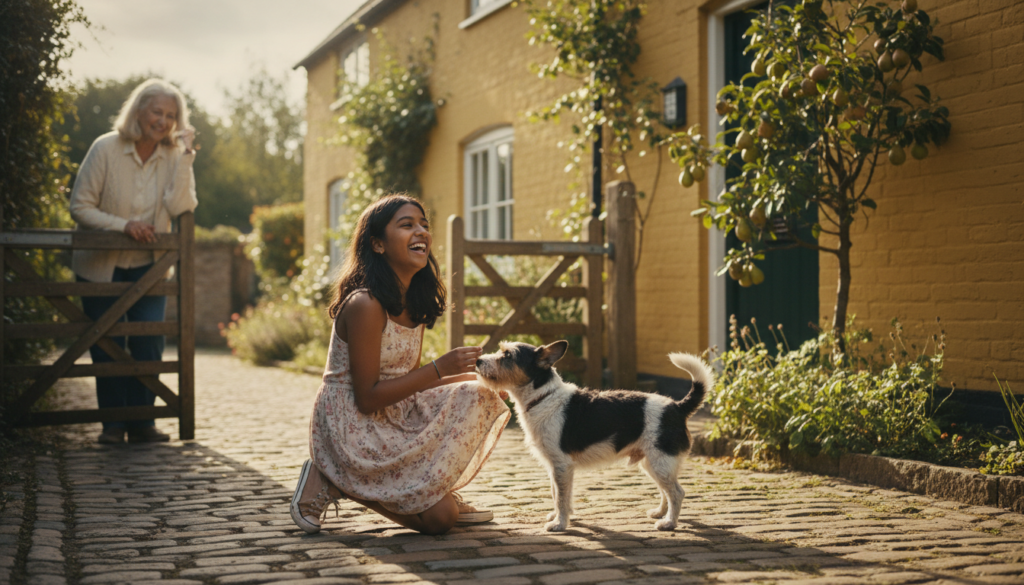
He was a black-and-white terrier of uncertain ancestry, with one upright ear, one folded ear, and a deep conviction that every unattended sandwich existed for his personal improvement.
He was six years old.
He disliked bicycles.
Loved wet leaves.
And had once stolen a complete roast chicken from a kitchen counter without making a sound.
Tavi’s grandmother considered him a genius.
The family considered him a problem.
Both opinions had substantial evidence behind them.
On the morning Appendix disappeared, Tavi was supposed to be finishing a school science assignment.
The assignment was titled:
WHERE IS YOUR APPENDIX?
Her class had been asked to identify the organ’s location, describe its relationship to the large intestine, and explain why a small part of the body could still matter.
Tavi thought it was a poor choice of subject.
Not because anatomy was boring.
Because she had spent three days trying to concentrate on her project while a creature called Appendix repeatedly stole her pencils.
Her grandmother, Ada Noor, was seventy-eight and had spent forty years repairing books.
She lived in a narrow yellow house at the edge of the town of Ashcombe, where the streets climbed toward a wooded hill and the local bus service appeared to operate according to a system known only to its drivers.
Ada had lived there for thirty-one years.
She had raised two children there.
Repaired thousands of books at her kitchen table.
Painted the front door four different colors.
And once planted a pear tree so close to the garden path that everyone eventually had to walk around it.
She was stubborn.
Funny.
Impatient.
And capable of locating misplaced objects by accusing them of deliberately hiding.
She loved Appendix.
Tavi loved him too.
But she loved him in a way that involved frequent complaints.
On the morning he vanished, she was sitting on the kitchen floor with a model of the human digestive system made from felt.
The stomach was pink.
The intestines were orange.
The appendix was a small red piece of fabric attached near the beginning of the large intestine.
Ada had helped sew the model.
It was rather good.
Except that Tavi had attached the appendix to the wrong side.
Ada noticed immediately.
“That’s not right.”
Tavi looked up.
“What?”
“The appendix.”
She stared at the model.
“It’s there.”
“Yes. But you have it on the left side of the body’s lower abdomen.”
Tavi frowned.
“No, I don’t.”
Ada turned the model to face her.
“Look.”
Tavi stared.
Then groaned.
“Oh.”
Her grandmother smiled.
“When a person faces you, their right appears on your left.”
“I know.”
“Then why did you put it there?”
“Because I was tired.”
Ada nodded.
“An explanation with considerable historical precedent.”
Tavi removed the felt appendix.
Placed it on the typical lower-right side of the model’s body.
Then looked toward the real dog.
He was lying beneath the table, chewing something.
Something red.
Something made of felt.
Tavi stared.
“Grandma.”
“Yes?”
“What’s in his mouth?”
Ada looked down.
Appendix stopped chewing.
His eyes widened.
Then he stood.
Tavi reached toward him.
“Give that back!”
Appendix ran.
He darted through the kitchen.
Into the hallway.
Around the umbrella stand.
Tavi followed.
The dog made a sharp turn toward the back door.
Ada shouted, “Don’t chase him!”
Too late.
Appendix shot through the open doorway into the garden.
Tavi ran after him.
He stopped beside the pear tree.
Looked back.
Wagged his tail.
Then squeezed through a gap beneath the side gate.
And vanished.
Tavi reached the gate.
Stopped.
Looked toward the street.
No dog.
No bark.
No movement.
Only a small red piece of felt lying on the path.
She picked it up.
It was damp.
Covered in tooth marks.
And missing one corner.
Tavi looked toward the road.
Then called:
“APPENDIX!”
An elderly man walking past stopped.
Turned.
And looked genuinely alarmed.
“Are you all right, love?”
Tavi closed her eyes.
“It’s the dog.”
The man stared.
“What dog?”
“The dog named Appendix.”
He considered.
Then nodded slowly.
“Unusual name.”
She sighed.
“You’re telling me.”
Ada did not panic.
That made Tavi panic more.
Her grandmother checked the garden.
Then the side gate.
Then the street.
She called the dog’s name.
Waited.
Listened.
Then returned to the kitchen.
Tavi followed.
“We need to look for him.”
“We will.”
“Now.”
“Yes.”
Ada took out her telephone.
Called a neighbor.
Then contacted the local animal shelter and the veterinary clinic where Appendix was registered.
She checked that his microchip details were current and reported him missing through the appropriate channels.
Tavi watched impatiently.
“Why are you making calls?”
“Because if someone finds him, they need to know how to reach us.”
“We should be searching.”
“We can do both.”
Tavi looked toward the garden.
The gate was open.
The gap beneath it had been there for years.
Appendix had never squeezed through it before.
Or perhaps he had.
She’d never thought to check.
Ada looked at her.
“Would you fetch his lead?”
Tavi nodded.
Then stopped.
“Why?”
“In case we find him.”
She ran to the hallway.
Found the red lead.
Then returned.
Her grandmother stood beside the table, looking at a small folded paper.
For a moment, Tavi thought she looked sad.
Not worried.
Sad.
Then Ada put the paper in her pocket.
“Come on.”
They began searching.
First the street.
Then the little park.
Then the path beside the old railway line, where Appendix loved investigating the long grass.
They called his name.
Showed a photograph to people they met.
Asked whether anybody had seen a black-and-white terrier with mismatched ears and an orange collar.
A woman at the bakery thought she’d seen him.
A delivery cyclist said he was almost certain the dog had passed him near the square.
A man outside the hardware shop reported seeing a similar animal twenty minutes earlier but admitted he wasn’t very good at identifying dogs.
“Four legs?” he asked.
Tavi stared.
“Yes.”
“Tail?”
“Yes.”
“Well, that narrows it down.”
Ada laughed.
Tavi did not.
She was frightened.
Appendix was small.
The streets were busy.
He had no understanding of traffic or the consequences of insulting larger dogs.
And she had been the one chasing him when he escaped.
She looked toward her grandmother.
“I’m sorry.”
Ada stopped.
“For what?”
“I shouldn’t have run after him.”
The older woman considered.
“Probably not.”
Tavi looked down.
Ada continued.
“But the gap in the gate should have been secured. And Appendix is an enthusiastic opportunist. We all have a share of the problem.”
Tavi nodded.
Then asked, “Do you think he’ll come home?”
Ada looked toward the road.
“I hope so.”
Her voice was quiet.
Too quiet.
Tavi felt something tighten.
She had heard that tone before.
The previous autumn, when her father told her that her parents were separating.
He’d said they would both keep loving her.
That she would still spend time with each of them.
That some things would change and others would not.
All of it had been true.
But the quietness in his voice had frightened her more than the words.
It meant somebody knew something difficult and had not yet found a way to explain it.
Now her grandmother sounded the same.
Tavi gripped the lead.
Then said, “We’re going to find him.”
Ada looked toward her.
For a moment, she seemed about to say something.
Instead, she nodded.
“Yes.”
Appendix had arrived at Ada’s house two years earlier.
He was not supposed to stay.
That had been the official position.
A woman from the local animal rescue had asked Ada whether she could look after a small terrier for a weekend while a longer-term home was arranged.
Ada agreed.
She had always liked dogs.
But since her last one died, she’d resisted adopting another.
She said she was getting older.
That walking a dog every day was a commitment.
That she liked visiting friends without arranging pet care.
That her house contained too many books and not enough surfaces that a dog could not reach.
The rescue worker assured her it was only for the weekend.
Appendix arrived on Friday.
He slept in the kitchen.
Barked at the refrigerator.
Stole a tea towel.
Then spent Saturday afternoon asleep across Ada’s feet.
By Sunday morning, Ada had decided he was staying.
She named him Appendix because, she said, he had arrived after the main story of her life appeared to be finished.
Tavi thought this explanation was strange.
“An appendix is a bit at the end of a book,” Ada told her.
“It’s also inside your body.”
“Yes.”
“Does that mean he’s like an organ?”
Ada considered.
“Only in his capacity to be troublesome.”
Tavi laughed.
Her grandmother continued.
“An appendix in a book can hold information that doesn’t fit neatly into the main chapters. That doesn’t mean it has no value.”
She looked toward the dog.
“And the organ has functions of its own, even though people can usually live without it.”
Tavi considered.
“Where is your appendix?”
Ada touched the lower-right part of her abdomen.
“Usually here, attached to the cecum, at the beginning of the large intestine.”
Tavi looked at her.
“Does it do anything?”
“It contains immune-system tissue and may help support beneficial bacteria in the gut. Scientists are still learning about its roles.”
Tavi frowned.
“I thought it was useless.”
“So did quite a few people once.”
Ada smiled.
“Which should make us careful about declaring things useless.”
Appendix chose that moment to steal a sock.
Ada chased him through the hallway shouting words that were not particularly philosophical.
Tavi laughed until she couldn’t breathe.
For two years, the dog became part of their routines.
He walked with Ada every morning.
Slept beside her reading chair.
And greeted Tavi during school holidays with such excitement that he frequently forgot where he’d put his feet.
He was not a perfect dog.
He was noisy.
Greedy.
Occasionally disobedient.
And capable of turning a perfectly ordinary afternoon into a search for something he’d taken without permission.
But he made Ada laugh.
And Tavi, who had never quite understood why her grandmother lived alone, began to understand that a house could be full of company even when only one person lived there.
Now Appendix was missing.
And Tavi felt as though she’d broken something that had been holding her grandmother’s world together.
At half past eleven, they reached the small square near the station.
Ada sat on a bench.
Tavi stared.
“Why are we stopping?”
“My legs need a rest.”
“We can’t stop.”
“We can stop for five minutes.”
“What if he’s moving away?”
Ada looked at her.
“Running in circles won’t guarantee we find him.”
Tavi sat beside her.
For a moment, neither spoke.
Then she asked, “Why did you look sad this morning?”
Ada turned.
“What?”
“When he escaped. You looked sad before we started searching.”
The older woman was quiet.
Tavi waited.
Ada looked toward the station.
Then said, “There’s something I should have told you.”
Tavi felt cold.
“What?”
Ada took the folded paper from her pocket.
Unfolded it.
Held it out.
It was a note from a woman named Ruth Calder.
An address.
A telephone number.
And an arrangement for Appendix to visit her home that afternoon.
Tavi read it.
Then looked up.
“What’s this?”
Ada swallowed.
“I’ve been considering finding him another home.”
For a moment, the square became silent.
Tavi stared.
“What?”
Her grandmother looked down.
“I’m having difficulty managing the stairs. And sometimes walking him is more demanding than it used to be.”
“Then I can walk him.”
“Not every day, love. You live with your parents, and you have school.”
“Dad can help.”
“Sometimes. But we can’t assume everybody can rearrange their lives around him.”
Tavi felt anger rise.
“Why didn’t you tell me?”
Ada looked at her.
“I was afraid you’d be upset.”
“I am upset.”
“I know.”
“Did you give him away?”
“No.”
“Did you?”
Ada shook her head.
“No. We were arranging a trial visit to see whether Ruth might be a good fit. I hadn’t made a final decision.”
Tavi looked toward the paper.
Then toward her grandmother.
“Does that mean you don’t want him anymore?”
Ada’s expression changed.
“Oh, Tavi.”
She took a breath.
“I want him very much.”
“Then why would you let him go?”
“Because wanting him isn’t the only thing that matters.”
Tavi stared.
Ada continued.
“He’s a dog. He needs daily exercise, attention, medical care, and a safe home. I have to think about whether I can keep providing those things.”
She looked down.
“Not just whether I love him.”
For a moment, Tavi couldn’t speak.
Then she stood.
“That’s ridiculous.”
Ada looked up.
“Tavi.”
“You love him. He loves you. That’s the important part.”
“It’s an important part.”
“It’s the most important part.”
Her grandmother was quiet.
Then said, “I used to believe that wanting to keep something meant I ought to keep it.”
Tavi stared.
Ada continued.
“Sometimes the better question is what the living thing needs.”
The words made Tavi furious.
Not because she knew they were wrong.
Because she wasn’t sure.
She looked toward the station.
People hurried past carrying bags.
A bus stopped.
The traffic lights changed.
Everything continued as though her grandmother had not just suggested that a dog could be loved and still live somewhere else.
Tavi turned away.
Then said, “I’m going to find him.”
Ada stood carefully.
“We’ll look together.”
Tavi wanted to tell her not to come.
She wanted to run.
Find Appendix.
Bring him home.
Prove that if you held on tightly enough, nothing needed to change.
Instead, she looked at the address on the paper.
Then at her grandmother.
“Where does Ruth live?”
Ada hesitated.
“Near the old water tower.”
Tavi stared.
The old water tower was on the other side of town.
Appendix knew the route.
They had walked past it several times when visiting Ada’s friend.
Tavi looked toward the road.
Then asked:
“Do you think he went there?”
Ada studied the address.
For a moment, she seemed astonished by the possibility.
Then she said, “Let’s find out.”
Ruth Calder opened the door holding a dish towel.
She was sixty-six, broad-shouldered, with short gray hair and a face that suggested she had very little patience for nonsense but considerable patience for animals.
A large brown dog stood beside her.
Behind him, on the sitting-room rug, lay Appendix.
He was asleep.
On his back.
All four legs pointing in different directions.
Looking happier than any creature had a right to look after causing so much distress.
Tavi stared.
“APPENDIX!”
The little dog opened one eye.
Saw her.
Leaped upright.
Then began wagging his tail so violently that his entire body shook.
He hurried toward her.
Skidded across the floor.
And collided with her knees.
Tavi knelt.
Wrapped her arms around him.
Then burst into tears.
“You horrible animal.”
Appendix licked her chin.
“You absolute menace.”
He wagged harder.
“You scared us.”
He showed no remorse.
Ruth looked toward Ada.
“I tried calling.”
Ada took out her telephone.
There were three missed calls.
She closed her eyes.
“Oh.”
Ruth smiled.
“He appeared outside the garden gate about an hour ago. I recognized him from our walks, and he was wearing his identification. I brought him inside, gave him water, and tried to reach you.”
Tavi looked toward the large brown dog.
“Who’s that?”
“Banjo.”
Appendix ran toward Banjo.
The two dogs greeted each other enthusiastically.
Ruth laughed.
“They’ve become friends at the park. Apparently Appendix remembered where the interesting dog lives.”
Tavi watched them.
For a moment, she felt offended.
Appendix had spent the entire morning causing panic.
Now he was behaving as though he’d organized a pleasant visit.
Ada stepped inside.
Looked at him.
Then sat down in the nearest chair.
Her expression changed.
Relief.
Love.
And something more difficult to identify.
Ruth brought water for the visitors.
They talked.
About the escape.
The proposed trial visit.
The garden.
The daily walks.
The difficulty Ada had begun experiencing with the house and stairs.
Ruth did not press.
She explained that she had experience caring for terriers, a secure garden, and the time and resources to meet Appendix’s needs.
She also made it clear that Ada did not have to decide anything that afternoon.
Tavi sat on the rug between the dogs.
Appendix rested one paw on her shoe.
Banjo leaned against her shoulder.
She watched Ada.
The older woman’s face looked tired.
Tavi had never thought much about her grandmother becoming older.
Ada was simply Ada.
Sharp.
Funny.
Always doing things.
She had carried heavy boxes of books, repaired furniture, walked the dog, and spent hours gardening.
But lately, she’d been slower on the stairs.
She sat down more often.
Sometimes she postponed things she used to do without thinking.
Tavi had noticed.
She simply hadn’t understood what the changes might mean.
She looked toward Ruth.
“Would Appendix have to live here forever?”
Ruth considered.
“If Ada decides this is the right arrangement, we would plan a proper transition and make sure he’s settling well. You’d still be welcome to visit, if everyone agrees.”
Tavi looked toward her grandmother.
“Would he?”
Ada smiled sadly.
“I think he might.”
Tavi stared at Appendix.
He was chewing one of Banjo’s toys.
Apparently, the possibility of a new home had not injured his appetite.
She looked toward her grandmother.
“Can I ask you something?”
“Of course.”
“Would you miss him?”
Ada’s eyes filled.
“Very much.”
“Then how would you manage?”
The older woman considered.
“I don’t know exactly.”
Tavi waited.
Ada continued.
“I expect some evenings would feel very quiet. I’d probably keep looking toward his basket.”
Her voice shook.
“And I might cry.”
Tavi felt tears return.
Ada reached for her hand.
“But if I decide to find him another home, it won’t mean I stopped loving him.”
Tavi looked at the little dog.
Then toward the two adults.
For the first time, she understood that there might be no arrangement in which everybody got everything they wanted.
Ada could keep the dog and struggle to meet his needs.
Or he could live somewhere else and Ada could miss him.
Tavi could wish for a different answer.
That did not create one.
She wiped her eyes.
Then asked, “Can we take some time to decide?”
Ada squeezed her hand.
“Yes.”
They brought Appendix home that afternoon.
The side gate was secured properly.
The damaged felt appendix was washed.
Tavi repaired its missing corner.
And for the next several weeks, the family talked.
Not only Tavi and Ada.
Tavi’s parents joined the conversation.
Ruth.
The rescue organization.
The people who could help determine what arrangement would be responsible and sustainable.
There were offers.
Some practical.
Some not.
Tavi’s father could walk Appendix occasionally.
A neighbor could help with certain errands.
But nobody could promise to provide the daily care Ada might need indefinitely.
Ada also began discussing changes to her living arrangements.
The yellow house had become harder to manage.
She was considering a smaller home without so many stairs, closer to public transport and people she enjoyed seeing.
Tavi didn’t like that news either.
The yellow house was part of her childhood.
The pear tree.
The uneven kitchen tiles.
The cupboard that smelled of old paper.
But she listened.
Asked questions.
Learned which decisions had been made and which were still open.
And discovered that her grandmother had plans that didn’t revolve around a dog.
Ada wanted to join a book-restoration group.
Take a short coastal trip.
Visit her oldest friend.
Spend less time worrying about the garden path in winter.
She had a life to live.
Tavi had been so frightened of seeing it change that she’d almost forgotten to ask what Ada wanted from it.
Eventually, the family agreed on a trial stay with Ruth.
Appendix arrived carrying his basket, food, toys, and a written account of his routines and veterinary needs.
He greeted Banjo.
Investigated the house.
Stole a sock.
Then fell asleep.
The trial went well.
So well, in fact, that Tavi found it mildly insulting.
After careful discussion and the appropriate transfer arrangements, Ruth became his new owner.
Tavi cried when the decision was finalized.
So did Ada.
Neither pretended it was easy.
They visited regularly by agreement.
Sometimes they went for walks together.
Sometimes Appendix stayed at Ruth’s home while Tavi and Ada had tea.
And sometimes, when everyone was available, the two dogs came with them to the park.
The arrangement was not perfect.
It was workable.
That mattered.
On the morning of her science presentation, Tavi carried her felt digestive system into school.
The red appendix was attached in the correct position.
The small corner she’d repaired was still visible.
She stood before the class.
Explained that the appendix was a narrow pouch connected to the cecum, normally in the lower-right abdomen.
That it contained immune tissue.
That researchers believed it had roles involving the gut’s microbial community.
And that people could usually live healthy lives after having it removed.
Then a classmate raised his hand.
“Does everybody have one?”
Tavi considered.
“Most people are born with one, but some have had it removed. Also, anatomical positions can vary.”
She smiled.
“My grandmother had hers removed when she was fourteen.”
The boy nodded.
Then asked the question everybody eventually asked.
“Why does she have a dog called Appendix?”
Tavi looked toward her classmates.
For a moment, she thought about giving the complicated answer.
The foster dog.
The unexpected adoption.
The years he lived with Ada.
The strange business of loving something enough to consider what it needed.
Then she smiled.
“Because my grandmother is terrible at naming things.”
The class laughed.
Tavi laughed too.
After school, she went to Ruth’s house.
Appendix greeted her at the door.
Banjo followed more slowly.
Tavi knelt.
Held the little dog.
Then looked toward the hallway.
There were his toys.
His basket.
His food bowl.
Signs of an ordinary, comfortable life.
He was safe.
Cared for.
Entirely uninterested in explaining whether he missed the yellow house.
Tavi rubbed his ear.
“Hello, trouble.”
He licked her hand.
She laughed.
Then sat beside him on the rug.
Later, Ada arrived.
She was carrying a small parcel containing a repaired cloth toy.
They had tea with Ruth.
Talked about the weather.
Complained about the buses.
Laughed when Appendix stole the toy before anyone could give it to him properly.
For a while, Tavi watched her grandmother.
Ada looked relaxed.
Not because she didn’t miss the dog.
She did.
But she was discovering that missing something didn’t mean every part of life had to stop.
Tavi looked toward Appendix.
He was lying between the two older women, chewing the toy with the devoted concentration of a creature who had never worried about tomorrow.
She smiled.
Then opened her schoolbag.
Inside was the little red felt appendix.
She’d brought it to repair one last loose stitch.
Ada noticed.
“How did the presentation go?”
“Good.”
“Did you get the location right?”
“Yes.”
“Excellent.”
Tavi looked toward the dog.
Then toward the model.
She grinned.
“Although I think I’m finally getting confused about where my appendix is.”
Ada raised an eyebrow.
“Why?”
Tavi pointed toward the felt organ.
“That one’s on the right.”
Then toward the terrier.
“But that one keeps moving.”
Ruth laughed.
Ada laughed.
Tavi joined them.
Appendix looked up.
Apparently offended that everyone was making noise while he was trying to chew.
Then he rolled onto his back.
One ear upright.
One ear folded.
Four legs pointing in different directions.
Exactly where, for that afternoon, he wanted to be.
The End.
Editorial Anatomy Note
Where is your appendix? The human appendix is usually in the lower-right abdomen. It is a narrow finger-shaped pouch extending from the cecum, where the small intestine meets the beginning of the large intestine. The appendix contains immune tissue and may help preserve beneficial intestinal bacteria; its biological roles are still being investigated. People can generally live normally after surgical removal. Appendicitis often causes worsening abdominal pain, sometimes moving from the navel toward the lower-right abdomen, but symptoms and anatomy vary. Suspected appendicitis requires urgent medical assessment. Tavi, Ada, Appendix the dog, and all family events are fictional.