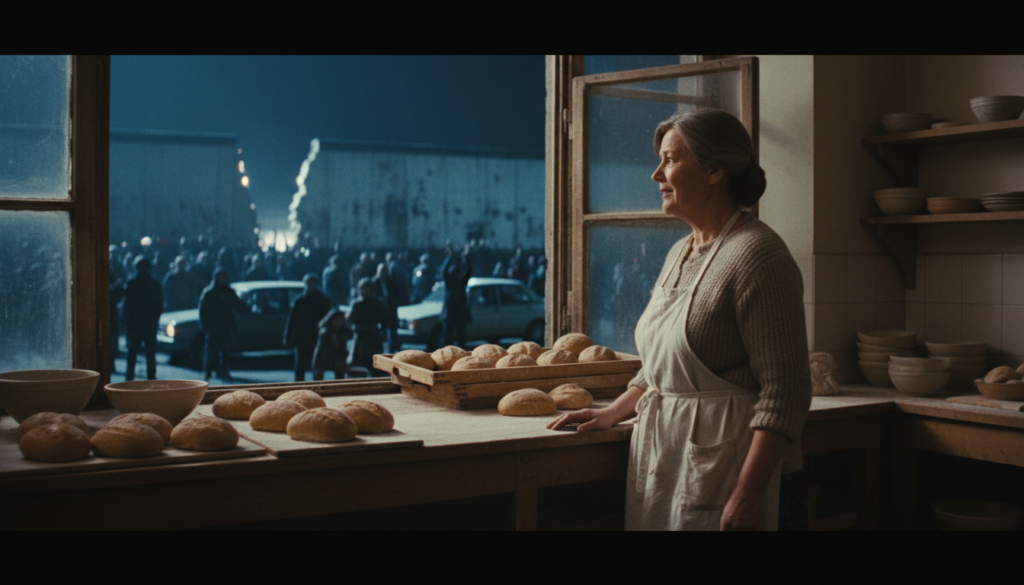
On the night the Berlin Wall opened, Ilse Rademacher had six hundred bread rolls rising and no intention of abandoning them.
The dough was perfect.
It had rested long enough, the temperature was correct, and the little rounds sat beneath clean cloths like sleeping creatures waiting to be woken.
Ilse had worked in the bakery for thirty-one years.
She knew when dough was ready by the way it answered her fingertip.
A slight indentation.
A slow return.
Not too quickly.
Not too slowly.
She had trusted that response through shortages, machinery breakdowns, winter storms, and the peculiar organizational decisions of people who had never worked a night shift.
At 9:14 p.m. on November 9, 1989, her daughter burst through the bakery door and announced that the border was open.
Ilse examined the dough.
“Which border?”
Her daughter stared.
“Mum.”
“Johanna, there are several borders in the world.”
“The Wall.”
Ilse looked up.
Johanna was twenty-three, wore a red coat, and had inherited her mother’s stubbornness without any of her respect for schedules.
She stood beside the flour sacks, breathing hard.
“The Berlin Wall. They’re saying people can cross.”
Ilse considered.
“Who is saying?”
“Everybody.”
“That isn’t a reliable source.”
“Mum!”
Ilse placed another tray on the rack.
“The last time everybody said something, the factory was supposedly closing. We had a meeting about it. Nothing happened.”
“This is different.”
“Why?”
“Because it’s on television.”
Ilse looked toward the small radio above the workbench.
It had been playing music earlier.
Now a presenter was discussing new travel regulations announced during a government press conference.
The report was confusing.
Permissions.
Travel.
New procedures.
Immediate effect.
There was uncertainty about exactly what the announcement meant and how it would be implemented.
Ilse listened for several seconds.
Then turned back to the dough.
“The regulations are changing.”
Johanna stared.
“That’s all you have to say?”
“What would you like me to say?”
“That it’s unbelievable.”
“It is.”
“That it’s wonderful.”
“It might be.”
“That we’re going.”
Ilse stopped.
“Going where?”
“West Berlin.”
Her mother looked at the trays.
“Now?”
“Yes.”
Ilse stared.
“Johanna. The bread.”
The younger woman closed her eyes.
For a moment, she looked as though she might scream.
Then she said, very quietly:
“The Wall has been there my entire life. You’ve waited twenty-eight years to see Aunt Greta. And you’re worried about bread?”
Ilse looked at her daughter.
The bakery became very quiet.
Then she said:
“Yes.”
And she meant it.
Not because she loved bread more than her sister.
Because the news was too large to fit inside an ordinary thought.
Because Ilse had spent almost three decades living with a border that could not simply be crossed whenever she wished.
Because she knew that announcements and permissions were different things.
Because she remembered people who had believed a crossing was possible and suffered terrible consequences.
And because six hundred rolls, rising beneath clean cloths, were something she could understand.
The Wall opening was not.
Not yet.
Ilse’s older sister Greta had moved to West Berlin in 1959.
They had argued about it.
Naturally.
The sisters argued about nearly everything.
Ilse thought Greta was reckless.
Greta thought Ilse was frightened of change.
Ilse liked plans.
Greta liked arriving at a decision and discovering the details afterward.
Greta was the kind of woman who could enter a crowded room, meet twelve people, and leave with invitations to dinner from eight of them.
Ilse preferred knowing in advance who would be there.
They were born in Berlin before the Second World War.
Their father worked as a mechanic.
Their mother sewed clothes for neighbors to help support the household.
They grew up in a city that became a battlefield.
When the war ended in 1945, parts of Berlin lay in ruins.
They had lost relatives.
Neighbors.
Familiar streets.
The family lived with shortages and uncertainty while the occupying powers reorganized Germany.
Ilse was a child.
Greta was old enough to understand more of what the adults were afraid to say.
After the war, Germany was divided into occupation zones.
The western zones eventually became the Federal Republic of Germany.
The Soviet zone became the German Democratic Republic.
Berlin, although situated inside Soviet-controlled territory, was itself divided into sectors.
The city became a focal point of a wider struggle.
The United States and the Soviet Union had fought on the same side against Nazi Germany.
But their alliance fractured.
They disagreed over political systems, security, influence, and the future of Europe.
The United States and its Western allies promoted a largely capitalist, multiparty political model.
The Soviet Union supported communist governments and a security sphere across Eastern Europe.
The rivalry expanded.
Military alliances formed.
Governments competed for influence around the world.
Nuclear weapons made the consequences of direct conflict between the superpowers terrifying.
The struggle became known as the Cold War.
There was no single declaration of war.
No one battlefield where it began.
And no front line that contained all of it.
For Ilse, much of this was first experienced through ordinary changes.
A different government office.
Different travel rules.
Different newspapers.
A border that became harder to cross.
Her father listened to foreign broadcasts when he could.
Her mother told him to keep the volume down.
The family learned that people could disagree about politics without knowing what the consequences of speaking openly might be.
Greta wanted to leave.
Ilse wanted to stay.
By 1959, Greta had established herself in West Berlin, where she worked in a dressmaking workshop.
She wrote frequently.
Sometimes she visited relatives in the eastern part of the city while movement was still possible.
Ilse remained in East Berlin.
She married.
Began work in a bakery.
And imagined her sister would always be close enough to visit.
Then came August 13, 1961.
The East German authorities began sealing the boundary between East and West Berlin.
The barriers developed into the fortified Berlin Wall and its associated border system.
What had once been a journey across a city became a journey controlled by a state.
Family visits were restricted.
Lives divided.
Some people died trying to escape.
Greta remained in the West.
Ilse remained in the East.
They wrote letters.
Sometimes packages arrived.
They exchanged news carefully.
Greta married a man named Rolf, then separated from him.
Ilse had Johanna.
Their father died.
Then their mother.
Greta sent photographs.
Ilse sent photographs.
Years passed.
The sisters remained related by blood, memory, and an increasingly complicated collection of family arguments conducted through envelopes.
Greta complained that Ilse never wrote enough.
Ilse complained that Greta’s letters contained more questions than answers.
Greta sent chocolate.
Ilse thanked her, then told her to stop spending money.
Ilse sent a knitted scarf.
Greta wrote back that it was far too long.
Ilse replied that necks did not come in standardized dimensions.
They loved each other.
They annoyed each other.
They did not meet.
And the years continued.
During the Cold War, the world experienced crises that repeatedly raised the fear of catastrophe.
The Berlin Blockade.
The Korean War.
The construction of the Wall.
The Cuban Missile Crisis.
The Vietnam War.
Nuclear arms competitions.
Conflicts in which larger powers armed, supported, or intervened in struggles far from their own capitals.
The word cold described the absence of a direct, sustained war between the two superpowers.
It did not mean the period was peaceful.
For many people, the consequences were violent and immediate.
For Ilse, the confrontation was present in smaller ways.
Her sister lived a short distance away.
And she could not simply visit her.
That was how she understood the Cold War.
Not as a phrase from a history book.
As a city divided so thoroughly that two women who could once walk to each other’s homes had spent twenty-eight years exchanging letters instead.
At 9:43, Johanna returned with her friend Marek.
Marek was twenty-five, worked as an electrician, and had the anxious expression of someone whose ordinary confidence had been overwhelmed by extraordinary news.
He held a small radio.
“People are going to the checkpoints,” he said.
Ilse looked toward the clock.
“Which ones?”
“Several.”
“Are they letting people through?”
“Not yet everywhere. There’s confusion.”
Ilse nodded.
“Then nothing is certain.”
Johanna stared.
“Mum, thousands of people are going.”
Ilse turned toward her.
“Thousands of people can be mistaken.”
“Thousands of people can also change things.”
The words struck.
Ilse remembered the demonstrations in Leipzig.
The protests demanding reform and greater freedom.
The people who had risked attending them.
The growing pressure on the East German leadership.
Johanna had followed the news closely.
She had attended public gatherings in Berlin and argued passionately about the need for change.
Ilse worried.
That was the polite word.
She was frightened of what might happen to her daughter.
She remembered the state security apparatus.
The consequences people could face for political opposition.
The families who spoke quietly about relatives whose lives had been damaged by surveillance or punishment.
Johanna was young enough to believe change was possible.
Ilse was old enough to know that believing did not guarantee safety.
Now her daughter stood before her asking to go to the border.
Ilse looked at Marek.
“Are you going?”
He nodded.
“Yes.”
“Do you know what’s happening?”
“Not completely.”
“Then be careful.”
Johanna stepped forward.
“Come with us.”
Ilse looked at the bread.
The rolls were ready.
If she waited much longer, the dough would overproof.
She would lose the night’s work.
The bakery had orders to fulfill in the morning.
People would arrive expecting bread.
Her colleague Dieter was due at ten.
He could help.
But he hadn’t prepared this batch.
He didn’t know she’d adjusted the hydration because the flour behaved differently that morning.
He didn’t know which trays needed to go in first.
Ilse knew all these things.
That made the work feel like her responsibility alone.
She looked toward Johanna.
“Go, if you’ve decided. But don’t take unnecessary risks.”
Her daughter stared.
“You’re not coming?”
“Not yet.”
Johanna’s eyes filled.
For a moment, Ilse expected anger.
Instead, her daughter looked almost disappointed.
That was worse.
“Mum,” she said quietly, “what if this is the only night?”
Ilse swallowed.
She didn’t answer.
Because she had asked herself the same question.
Johanna waited.
Then turned toward the door.
Marek followed.
Ilse watched them go.
She almost called them back.
Almost said she would come.
Almost asked whether they could wait until the bread was finished.
But the door closed.
And she was alone with six hundred rising rolls.
At ten, Dieter arrived.
He was fifty-nine, had worked beside Ilse for fourteen years, and possessed the remarkable ability to complain about a problem before discovering whether one existed.
He entered wearing a heavy coat.
Looked toward the radio.
Then at Ilse.
“Have you heard?”
“Yes.”
“They say the border is opening.”
“That’s what they say.”
He set down his bag.
“Are you going?”
“No.”
“Why not?”
She gestured toward the dough.
He stared.
Then began laughing.
“Of course.”
Ilse folded her arms.
“What’s funny?”
“Nothing.”
He laughed harder.
“The world is changing and you’re guarding bread.”
She glared at him.
“Would you prefer we throw it away?”
“No.”
He began washing his hands.
Then said, “I’ll handle the ovens.”
Ilse looked up.
“What?”
“The ovens. Go.”
She stared.
“Dieter, you haven’t checked the dough.”
“Then tell me what needs checking.”
“The flour was different today.”
“Then tell me how.”
“And the second batch needs less time.”
“How much less?”
She hesitated.
He looked at her.
For a moment, they were silent.
Then he said, “Ilse, I’ve been doing this for forty years.”
She stared.
He smiled.
“I might manage a bread roll.”
She looked toward the trays.
He continued.
“Your sister is on the other side of the Wall.”
The words were quiet.
Ilse looked at him.
He had known about Greta for years.
The letters.
The photographs.
The birthday parcels.
He’d listened to Ilse complain that her sister bought clothes in ridiculous colors and had developed a terrible habit of signing letters with an enormous flourish.
He knew.
Dieter stepped closer.
“Go.”
Ilse swallowed.
“What if something goes wrong?”
He looked toward the dough.
“Then I’ll fix what I can and tell you what happened.”
She closed her eyes.
She had spent thirty-one years making herself indispensable.
Not deliberately.
Not as a way of controlling other people.
She simply believed that a job done properly was a form of respect.
But somewhere along the way, she’d begun confusing responsibility with refusing to let anybody else help.
Dieter stood beside the ovens.
Waiting.
Ilse looked toward the door.
Then took off her apron.
Folded it.
Placed it on the workbench.
Dieter smiled.
“Well.”
She pointed at the trays.
“Don’t overbake the first batch.”
“I won’t.”
“And rotate them halfway through.”
“I know.”
“And the third rack…”
“Ilse.”
She stopped.
He looked at her.
“Go and see your sister.”
For a moment, she couldn’t move.
Then she reached for her coat.
By the time Ilse reached Bornholmer Straße, the crowd was enormous.
People moved toward the crossing in waves.
Some carried bags.
Others held children by the hand.
Many appeared to have left home without preparing for anything.
There was laughter.
Shouting.
Confusion.
Anxiety.
Rumors.
People repeated news reports.
Others said the border guards were refusing passage.
Some insisted the gates would open.
Others warned the announcement had been misunderstood.
Ilse stood near the back.
She had not been part of a crowd like this before.
She disliked crowds.
They moved unpredictably.
People pushed.
Conversations overlapped.
A man beside her was crying.
Another was laughing.
Someone shouted that they had waited their whole life for this.
Ilse looked toward the border installation.
The Wall and the fortified crossing had shaped her city for nearly three decades.
She had known where they were.
What they meant.
What they prevented.
Now people were pressing toward them as though the familiar rules had become uncertain.
She felt afraid.
Not of freedom.
Of the possibility that hope might again be punished.
A woman beside her held a little boy.
He looked about five.
The child asked, “Are we going somewhere?”
His mother smiled shakily.
“Maybe.”
“Where?”
“Over there.”
He frowned.
“Why?”
The woman looked toward the crossing.
Then said, “Because we want to see.”
Ilse felt her throat tighten.
She thought of Greta.
The last time they’d seen one another, they had argued about a pair of shoes.
Greta had bought expensive shoes with money she should have saved.
Ilse told her she was foolish.
Greta told Ilse she was a bore.
They parted angrily.
Then the border closed.
Twenty-eight years.
They had never settled the argument.
Ilse looked toward the checkpoint.
And realized she had spent decades imagining what she’d say when she saw her sister again.
She would apologize.
Ask about her life.
Tell her things that didn’t fit easily into letters.
Perhaps complain that Greta still had dreadful taste in clothes.
But she had never seriously imagined the possibility that she would stand in a crowd and be allowed to cross simply because she wished to.
Then movement passed through the people.
A sound.
A change.
Somebody shouted.
The crowd pressed forward.
Ilse felt her heart pounding.
The crossing was opening.
For a moment, she was unable to move.
Then the woman beside her began walking, holding the child close.
Ilse followed.
She didn’t run.
Didn’t shout.
Didn’t wave her arms.
She walked carefully, one step after another, through a border she had been told for decades she could not cross without official permission.
She reached the other side.
And stopped.
West Berlin.
No lightning.
No trumpet.
No great transformation of the air.
A street.
People.
Cars.
Lights.
A crowd cheering.
Strangers embracing.
Some offering flowers or drinks.
Ilse looked around.
She had expected the world to feel different.
It did.
But not in the way she imagined.
She was still Ilse.
Fifty-three years old.
A baker.
A mother.
A woman with flour beneath her fingernails.
And for the first time in decades, she was standing in a part of her own city she had been unable to visit freely.
She began crying.
Not loudly.
Not dramatically.
Tears simply moved down her face.
A stranger touched her shoulder.
“Are you all right?”
Ilse nodded.
“Yes.”
She laughed through the tears.
“Yes.”
Then she remembered something.
Greta’s address.
She had carried it for years in a little card inside her purse.
The street.
The building number.
The apartment.
She took out the card.
Looked at it.
Then looked toward the city.
She knew the route in principle.
But the streets had changed.
The transport was crowded.
And it was already late.
She needed to find out whether Greta still lived there.
Ilse approached a woman near the crossing and asked for directions.
The woman looked at the address.
Smiled.
Then offered to help her find the nearest suitable transport connection.
Ilse thanked her.
For the first time in twenty-eight years, the address was not simply a place where she could send a letter.
It was somewhere she might actually go.
It was almost two in the morning when Ilse found the apartment.
The building was ordinary.
Four storeys.
Pale plaster.
A narrow entrance.
A bicycle chained to the railing.
She stood beneath the streetlight, looking up at the windows.
Then checked the address again.
Correct.
For twenty-eight years, she had imagined Greta living somewhere impossibly distant.
Now she stood outside her door.
Ilse hesitated.
The sister in her memory was twenty-nine.
Bright-eyed.
Impatient.
Always borrowing things and forgetting to return them.
The woman who lived here would be fifty-seven.
Ilse knew that.
She had seen photographs.
Heard about the gray hair.
The separation from Rolf.
The changes in her sister’s work.
But the part of her that remembered Greta most vividly had never updated the image.
She climbed the stairs.
Reached the apartment.
Then stopped.
There was a name beside the bell.
G. BERNER.
Greta’s married surname.
The name she had kept after separating.
Ilse raised her hand.
Stopped.
It was very late.
Perhaps Greta was asleep.
Perhaps she’d gone to the Wall with everybody else.
Perhaps somebody else lived here now.
The last letter had arrived less than a month earlier, but a month was enough time for things to change.
Ilse thought about the bread.
The safe, ordinary bakery.
The familiar workbench.
Dieter telling her to go.
Then she pressed the bell.
Nothing happened.
She waited.
Pressed it again.
Footsteps sounded inside.
A voice called, “Who is it?”
Ilse opened her mouth.
For a moment, no words came.
Then she said:
“Your sister.”
Silence.
A lock turned.
Then another.
The door opened.
Greta stood there wearing an old dressing gown and a pair of slippers shaped like rabbits.
Her hair was almost entirely gray.
She had lines around her eyes.
Her face was fuller than Ilse remembered.
And she looked so much like their mother that Ilse nearly stepped backward.
For a moment, the sisters stared at each other.
Then Greta whispered:
“Ilse?”
Ilse nodded.
Greta looked toward the corridor.
Then back at her.
“How did you get here?”
Ilse began laughing.
It was a foolish question.
A perfectly reasonable question.
A question with twenty-eight years behind it.
“I walked,” she said.
Greta stared.
Then she began crying.
They embraced in the doorway.
Not elegantly.
Greta’s slippers caught on the threshold.
Ilse dropped her handbag.
One of them stepped on the other’s foot.
They laughed and cried at once.
Then Greta pulled her inside.
The apartment smelled of tea, furniture polish, and something sweet baking in the kitchen.
There were books.
Photographs.
A plant beside the window.
A blue armchair with a faded cushion.
So ordinary.
Ilse had imagined the West through photographs, news reports, packages, and stories.
She had imagined abundance.
Bright shops.
Strange goods.
A world where everything was somehow newer than it ought to be.
Now she was standing in a small apartment whose kitchen cupboard needed repairing.
Greta brought tea.
They sat at the table.
For a long time, they looked at each other without speaking.
Finally, Greta said:
“You’re late.”
Ilse stared.
Then began laughing.
“By twenty-eight years.”
Greta smiled through her tears.
“I made tea in 1961. It’s probably cold by now.”
Ilse laughed harder.
They spoke until dawn.
Not everything.
Twenty-eight years could not fit inside one conversation.
They talked about their parents.
Their jobs.
Johanna.
The people they’d loved.
The people they’d lost.
The letters that had gone missing.
The packages that arrived damaged.
The things they’d wanted to say but hadn’t known how to put on paper.
At one point, Greta asked:
“Will you stay?”
Ilse looked toward the window.
Morning was beginning to lighten the sky.
She thought about the bakery.
Her apartment.
Her daughter.
Her friends.
The life she’d built in East Berlin.
“I don’t know what happens next,” she said.
Greta nodded.
“Neither do I.”
Ilse looked at her.
Then smiled.
“But I intend to come back for breakfast another day.”
Greta laughed.
“Good.”
They sat quietly for a moment.
Then Greta said, “Do you remember those shoes?”
Ilse stared.
“What shoes?”
“The red ones. The pair you said were a disgrace.”
Ilse began laughing.
“Of course I remember.”
Greta smiled.
“I was right about them.”
“You were absolutely not.”
“They were beautiful.”
“They were expensive and impractical.”
“I wore them for years.”
“That doesn’t make them practical.”
Greta laughed.
Ilse shook her head.
Then she noticed something beneath the kitchen table.
A shoebox.
Old.
Faded.
Greta reached down.
Lifted the lid.
Inside were the red shoes.
The leather was cracked.
The heels worn.
The color faded almost to brown.
Ilse stared.
“You kept them?”
Greta smiled.
“Of course.”
“Why?”
Her sister considered.
Then said, “Because I remembered how angry you were.”
Ilse laughed.
Greta continued.
“And because every time I looked at them, I remembered that somebody cared enough about me to argue.”
Ilse felt tears rise again.
She looked toward her sister.
Then said:
“They were still terrible shoes.”
Greta grinned.
“I know.”
They laughed until the tea went cold.
Ilse returned to East Berlin later that morning.
The crossings were still crowded.
People continued traveling in both directions.
The city seemed to have forgotten how to behave normally.
Some celebrated.
Others worried.
There were questions about what would happen to jobs, housing, wages, political institutions, and the country’s future.
No single night could answer all of them.
Ilse returned to the bakery.
Dieter was removing the last trays.
The rolls were golden.
Perfectly baked.
He looked up.
“Well?”
Ilse removed her coat.
“Well what?”
“Did you go?”
“Yes.”
“Did you see her?”
“Yes.”
He smiled.
Then asked, “How was it?”
Ilse considered.
She thought of Greta’s gray hair.
The rabbit slippers.
The kitchen.
The red shoes.
The years they could not recover.
Then she looked toward the bread.
“Ordinary,” she said.
Dieter frowned.
“Ordinary?”
Ilse smiled.
“Wonderfully.”
He laughed.
She picked up a roll.
Broke it open.
Steam rose between her hands.
She tasted it.
Perfect.
Then she offered half to Dieter.
He accepted.
They stood beside the ovens, eating warm bread.
Outside, people were still talking about the Wall.
About the border.
About the future.
The Cold War had not ended that night.
The rivalry between the United States and Soviet Union would continue to change, and the Soviet Union itself would dissolve in December 1991.
German reunification would take place on October 3, 1990.
The larger history would require more time, more negotiation, and more difficult decisions.
But Ilse had crossed a border that had separated her from her sister for twenty-eight years.
And somewhere in West Berlin, Greta was probably washing two teacups and wondering whether the red shoes could be repaired.
Ilse smiled.
She looked at Dieter.
“By the way.”
He turned.
“Yes?”
“You were right.”
He stopped chewing.
For a moment, he appeared genuinely alarmed.
“About what?”
“The ovens. You managed perfectly.”
Dieter stared.
Then began laughing.
“Well, I’ll remember this day forever.”
Ilse laughed too.
She looked toward the clock.
Morning.
Another working day.
People would arrive for bread.
The bakery would open.
The rolls would be sold.
And when her shift finished, she intended to write down Greta’s telephone number somewhere she could find it easily.
Not because she could know precisely what the coming months would bring.
Because for the first time in almost three decades, she had reason to believe an ordinary visit might be possible.
Ilse brushed the flour from her hands.
Then went to open the shop.
The End.
Editorial Historical Accuracy Note
What was the Cold War? It was a prolonged rivalry chiefly between the United States and its allies and the Soviet Union and its allies after World War II, commonly dated approximately 1947–1991. It involved political, economic, ideological, technological and military competition, nuclear arms races and proxy conflicts. The term cold refers to the absence of sustained direct fighting between the two superpowers, not an absence of violence elsewhere. Major events included the Berlin Blockade of 1948–49, NATO’s formation in 1949, construction of the Berlin Wall in 1961, and the Cuban Missile Crisis of 1962. On November 9, 1989, East German official Günter Schabowski announced new travel rules and mistakenly suggested immediate effect, leading crowds to checkpoints and the opening of crossings, including Bornholmer Straße. German reunification followed on October 3, 1990; the Soviet Union dissolved in December 1991. Ilse, Greta, Dieter, Johanna and their bakery are fictional.