
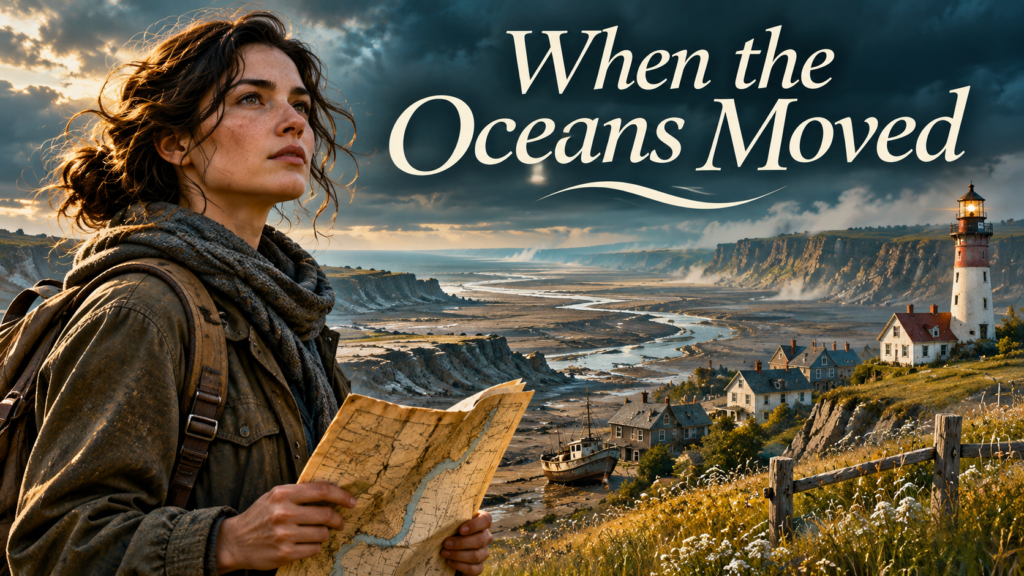
The white line reached the school meadow at seventeen minutes past five.
Mina knew the time because she had begun writing down everything that could still be measured. Her watch had survived the morning. So had the pencil tied to its strap. The hills had not.
From the hospital gate, she watched the line enter the meadow’s western fence. The fence did not fall. Its posts appeared to lean toward one another, although the distance between their shadows increased. A horse tethered beside the school stamped once and went very still.
“Get them away from the fence,” Nera said.
Mina was already running.
The meadow had become a small town assembled from whatever Bellport had managed to carry. Blankets stretched between desks. Hospital beds stood on borrowed doors. Mayor Kade was attempting to reconcile three lists of evacuees, none of which agreed. At the eastern edge, volunteers boiled water in the school’s old kitchen while children drew maps of streets that might no longer exist.
“Everyone to the center,” Mina called. “Leave the tents. Walk, don’t run.”
A man asked where the center was. Mina pointed to the chalk circle the children had drawn around a drain. She could not explain why she trusted that spot more than the fence. It was merely farthest from the advancing line.
Nera moved through the rows with the precision of someone who had learned not to spend fear on words. She helped two nurses roll a bed across the grass, then lifted a sleeping boy whose mother had gone to fetch medicine. The boy woke and asked whether the sea was coming.
“Not yet,” Nera said.
Mina heard the answer and disliked its honesty. Not yet was all any of them possessed.
The white line crossed the fence. The nearest post remained in place, but the next post appeared on the other side of a small pond that had not existed a moment before. Between them hung three wires, impossibly taut, crossing the intervening distance without sagging. A crow landed on the middle wire. It vanished from one end of the span and reappeared near the other, as though the flight between had been omitted.
No one screamed. The sight was too quiet for that.
Then a child began to cry because her drawing had become wrong.
Mina knelt beside the chalk circle and drove a metal tent peg into the earth. She marked its shadow with her pencil, measured the distance to the drain, and waited. The line reached the far edge of the meadow. The peg did not move. The drain remained exactly three paces away.
But the school bell, visible beyond the field, sounded from somewhere behind her.
Kade came to her side. “Tell me what to do.”
“Keep everyone inside this circle until the line passes.”
“Why?”
“Because it hasn’t changed yet.”
He looked at the families crowded together, then at the impossible fence. “That’s a terrible reason.”
“It’s the best one I have.”
Kade did not argue. He began counting people instead.
When the white line reached the circle, Mina expected a shock, a noise, perhaps the sensation of falling. Instead she smelled salt and wet rope. For a fraction of a second she stood on a pier with her mother, watching Adela write numbers in a small blue book. Then she was in the meadow again, her hand still on the tent peg.
The chalk circle had become an ellipse. The people inside it were unharmed. Beyond it, the school stood farther away than before.
Nera touched Mina’s shoulder. “You went somewhere.”
“I remembered something.”
“You looked through me.”
Mina could not decide whether the memory had belonged to her. Adela had died when Mina was young enough that the edges of childhood were already blurred. The pier she had seen was real, but in her memory the water had been green. This water was black.
The line passed beyond the eastern trees and disappeared. The grass settled. Birds resumed calling.
Kade checked his lists. Seventy-nine hospital patients, all accounted for. Fifty-two from the packing house, also accounted for. He said the numbers twice, as though repetition could fasten them to the earth.
Mina walked to the fence. Its first post stood at her feet. The second was across the pond. She followed the wire with her eyes and saw something more troubling than the distance.
The pond reflected the school as it had stood before the line crossed.
She took a photograph. On the camera screen, the pond was empty.
“Don’t tell me the picture is normal,” Nera said.
“It is.”
“Then we have two kinds of evidence.”
Mina turned toward her. “What do you mean?”
“What the instruments say, and what we can bear witness to.”
That was the first useful sentence Mina had heard all day.
They left the meadow under Kade’s care. Nera packed two radios, a coil of rope, and the last of the dry biscuits. Mina took Adela’s notebook and the measuring rod Jonas Rell had given her. She left a copy of the notebook’s first six pages with Kade, along with instructions to read them aloud if the station broadcasts failed. He looked at the papers as though they were a responsibility he had not earned.
“You’re going to the Old Cut,” he said.
“Yes.”
“And if you don’t come back?”
“Then don’t wait for my permission to move people.”
He folded the pages carefully. “Your mother used to say that.”
Mina stopped.
Kade seemed surprised by his own words. “She came to council meetings. Years before you were born. She was always telling us not to confuse a map with a promise.”
“Did you know her?”
“Enough to be irritated by her. Not enough to understand her.”
He glanced at the altered fence. “I wish I’d listened harder.”
The road toward the Old Cut passed between two orchards. Nera drove a battered maintenance truck, keeping the engine slow while Mina watched the landmarks. Every few minutes they stopped to check their bearings. The compass needle behaved normally. The distance between the orchards did not.
At the first station marker, Mina found a strip of blue cloth tied around the metal post. At the second, someone had scratched a triangle into the paint. The symbols matched marks in Adela’s notebook, but not the sequence of station numbers printed on the Commission map.
“Someone is making a second route,” Nera said.
“Or preserving the first one.”
They reached a junction where three roads met. The official sign pointed toward the Old Cut, six kilometers west. Adela’s notebook showed a narrow service lane running north between the trees. There was no lane now, only a ditch filled with white stones.
Mina climbed out and placed the measuring rod across the ditch. Its pale filaments brightened.
A voice came from behind the orchard wall. “You shouldn’t put that in the ground.”
Jonas Rell stepped into view.
He wore the same gray coat as before. Mud marked his boots, and a fresh cut crossed one knuckle. He looked like a tired man who had walked too far, not like a person who had supposedly been dead for eleven years.
Nera moved in front of Mina. “Your name.”
“Jonas Rell.”
“Your real name.”
He looked at her for a long moment. “It is my real name. The Commission declared me dead because it was cheaper than explaining where I’d gone.”
Mina held up the notebook. “Who sent the warning?”
“Which warning?”
“The woman on the radio.”
His expression changed. “What did she say?”
“That my mother left the wrong map.”
Rell closed his eyes briefly. “Then she’s still there.”
“Who?”
“Dr. Leora Venn. She was Adela’s partner on the first survey. She stayed at the Old Cut when the Commission sealed it.”
“Twenty-six years ago?”
“Yes.”
Nera gave a short, incredulous laugh. “You expect us to believe someone has been living inside a sealed research station for twenty-six years?”
“No. I expect you to believe that the Old Cut is not always twenty-six years away from itself.”
Mina thought of the pier, the black water, the moment that had passed without time. “Explain.”
Rell looked at the measuring rod. “Adela called it relative translation. The Commission called it a navigational anomaly because that sounded less frightening. We were measuring places that did not agree about where they were. Sometimes they did not agree about when.”
“Is that what happened to you?”
“It is part of what happened.”
He did not offer more. Mina recognized the shape of the omission. Every Commission survivor seemed to have learned how to hide the important part inside a truthful sentence.
“Why did my mother leave the notebook for me?” she asked.
“She didn’t.”
The answer struck harder than she expected.
“She left it for whoever could read it without trying to make the world obey it. I kept it because I thought that person might be you.”
“You could have brought it to me years ago.”
“Years ago the stations were silent.”
“And now?”
Rell looked toward the western hills. “Now someone has turned the listening network back on.”
He led them along the ditch. After fifty paces the stones became flat slabs, and after another fifty they found themselves on a narrow paved lane that Mina was certain had not been visible from the junction. The truck stood behind them, framed between two trees. Its windshield reflected a road they had not taken.
“Don’t look back for too long,” Rell said.
Nera did anyway. “Why?”
“Because the lane is not a shortcut. It’s an agreement. It holds while we keep moving.”
Mina wanted to demand a better explanation, but the ground beneath the slabs began to hum. They walked.
At the end of the lane stood a low concrete building, its windows sealed with metal shutters. A weathered sign identified it as a drainage inspection station. Beyond the building, the land fell toward a wide trench filled with mist. The Old Cut had once been a channel blasted through the coastal ridge to divert floodwater. Now the trench seemed deeper than the valley that contained it.
A narrow bridge crossed the mist. It had no visible supports.
Rell stopped at the inspection building and unlocked a rusted door. Inside were three desks, a battery cabinet, and a wall covered with paper maps. Every map showed a different coastline. Some displayed islands that did not exist. One placed Bellport on the inland side of a long lake.
Nera walked from map to map. “Are these predictions?”
“No,” Rell said. “Records.”
Mina found a photograph pinned beside the window. Four researchers stood in front of the Old Cut bridge. Adela was among them, younger than Mina had ever known her. Beside her stood a woman with dark hair pulled into a severe knot. The other two were men, one unmistakably Rell.
On the back, written in Adela’s hand, were four names and a date.
The date was tomorrow.
Mina checked it twice. “This picture hasn’t happened.”
Rell looked at the photograph without touching it. “It happened to us.”
“Then why is my mother in it?”
“Because the first survey was never one event.”
A metallic knocking came from beneath the floor. Three blows, a pause, then two.
Rell’s face drained of color.
“That’s the access signal,” he said. “Leora used it when the radio couldn’t reach us.”
Nera moved toward the door. “Then we answer.”
“No.” Rell caught her arm, then released it at once. “We listen first.”
The knocking repeated. Three blows. Two. Then a third sequence, different: three, two, one.
Mina looked down at Adela’s notebook. Along the bottom of its last page, almost erased, was a row of dots grouped in the same pattern.
“That’s not a signal to open,” she said. “It’s a warning.”
Rell stared at her.
“Three positions,” Mina continued, following the dots. “Two witnesses. One decision.”
A voice rose from the floor grille. It was the woman from the radio, faint but unmistakable.
“If you have brought Adela’s book, do not cross the bridge.”
Nera crouched beside the grille. “Leora Venn?”
“Yes.”
“We need to know what is happening.”
“You know enough to be afraid,” Leora replied. “That is a beginning.”
Mina knelt. “My name is Mina Vale.”
The voice stopped. When it returned, its careful calm had broken.
“Adela’s daughter.”
“She is dead.”
“I know.”
“Then tell me what she died trying to prevent.”
From below came the sound of a door opening and a long rush of water.
“She was trying to prevent us from choosing which coast would be sacrificed,” Leora said.
Mina looked at the maps. Each coastline had been drawn with the precision of an instrument, but across every one a thick red line separated two regions. In the margin of the nearest map, someone had written the word BALANCE.
“Are the movements natural?” Mina asked.
“They began naturally. What followed did not.”
Rell backed away from the grille. “Leora, don’t.”
But the woman continued. “The Commission built a correction system. It cannot restore a place without displacing another. Every successful correction was recorded as a storm, a landslide, a failed survey. We told ourselves we were containing a disaster.”
“And now?”
“Now the corrections are running without our consent.”
Mina thought of the meadow, of a fence stretched across a pond, of children learning that their drawings could be made false in an instant. “Can you turn it off?”
“Possibly. But you must understand what turning it off means.”
The floor trembled. On the wall, a pin fell from one of the maps and rolled toward the door, then abruptly reversed direction.
Rell seized the edge of a desk. “The bridge is waking.”
Leora spoke quickly. “There is a ledger in the cabinet marked TIDES. It contains the places we moved and the people who paid for them. Take it out of the station. Give copies to every settlement you can reach. The Commission will ask you to destroy it.”
Mina crossed to the cabinet. Its lock had been broken long ago. Inside lay a thick binder wrapped in waterproof cloth. She opened it to the first page.
There were columns for location, displacement, estimated loss, and authorized correction. Beside some entries were handwritten names. One entry recorded a fishing village erased from the official charts. Another described a hospital that had moved nine kilometers without its patients. The numbers were too orderly for the suffering they represented.
At the bottom of the page was Adela’s signature.
Mina felt the old, childish urge to close the book before it could tell her anything else about her mother.
Nera came to stand beside her. She did not look away.
“She signed it,” Mina said.
“She might have signed to record what happened.”
“Or to approve it.”
“Then we’ll find out.”
Outside, the bridge began to ring. Not like metal struck by a hammer, but like a glass filled to its edge. Through the doorway Mina saw the mist withdraw from the trench. Far below, water flowed along a channel that should have been dry. It carried a fishing boat, upright and empty, moving against the current.
Rell moved toward the bridge.
“Where are you going?” Mina asked.
“Someone has to keep the return path open.”
“You said it holds while we keep moving.”
“It holds while someone witnesses it.”
He looked at the photograph dated tomorrow. For the first time Mina saw that the fourth researcher in the picture was not a stranger. It was a younger version of the man before her, with the same scar near his eyebrow. The photograph had been taken in a place that could contain several different histories without agreeing which was true.
“You were supposed to be here tomorrow,” she said.
“Perhaps I still am.”
He stepped outside.
Leora’s voice came through the grille one last time. “Mina, the notebook is not the wrong map because Adela made a mistake. It is wrong because she refused to mark one place as expendable. She wanted the person who found it to ask a different question.”
“What question?”
“Who gets to decide?”
The connection went silent.
Nera lifted the binder. It was heavier than she expected. “We have to go.”
Mina looked once more at Adela’s signature. The handwriting was steady. Whatever her mother had done, she had not done it accidentally. Mina slipped the ledger into her bag and followed Nera outside.
The bridge had begun to lengthen. Rell stood at its near end, one hand on the rail, watching the far side recede into the mist. He raised his other hand, not in farewell but in warning.
Behind Mina, the inspection station door slammed shut.
The lane they had walked was gone.
Where it had been, the orchard now ended at a cliff. Far below, waves broke against rocks that had never belonged to Bellport’s coast.
Nera stared at the drop. “How do we get back?”
Mina opened Adela’s notebook to the page with the grouped dots. Three positions. Two witnesses. One decision. She understood at last why her mother had insisted on two people taking every measurement. A single observer could be moved with the place being measured. Two people, separated, could detect the change between them.
She gave Nera the measuring rod.
“Stay here. Keep your eyes on me.”
“And you?”
“I’m going to find the place where the road still agrees with us.”
Mina stepped toward the cliff edge, carrying the ledger of everything the Commission had hidden. The wind smelled of salt and hot stone. Somewhere beneath it she heard a bell from the school meadow, though the school was now impossibly far away.
For the first time that day, she did not ask where the road had gone.
She asked what it would cost to bring everyone home.


