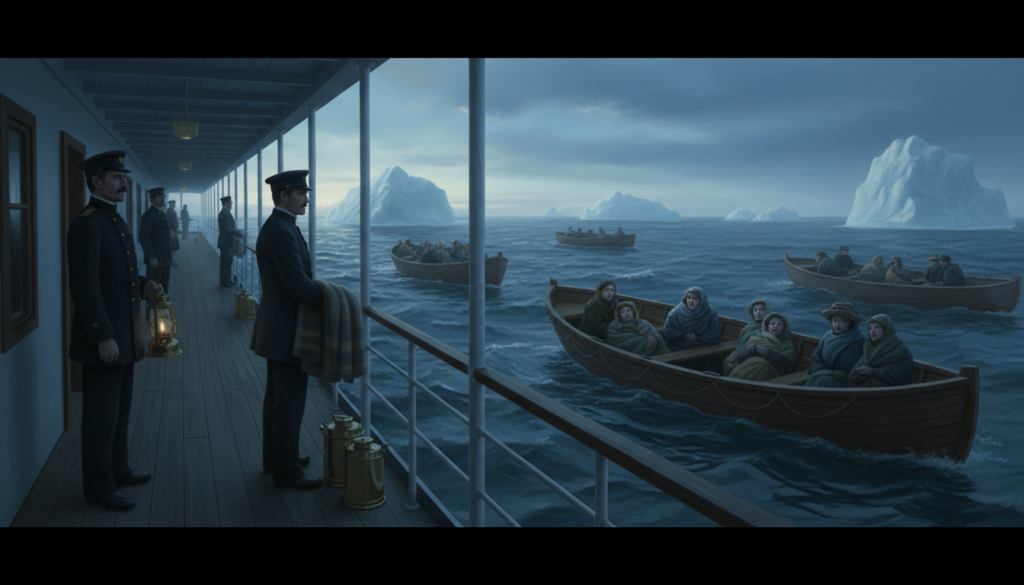
At twenty minutes past two in the morning, Mara Fenwick was counting blankets.
She had forty-six.
She needed more.
The linen cupboard aboard the Carpathia was nearly empty, the passageways were crowded with crew members carrying hot water and supplies, and the ordinary arrangements of a passenger ship had been overturned in less than an hour.
Mara was a stewardess.
She had worked aboard Cunard vessels for seven years.
She understood how to keep cabins orderly, assist passengers, and maintain a civilized appearance while a ship rolled enough to make the furniture seem personally offended.
She could identify a seasick passenger from thirty paces.
She knew which blankets were warmest.
She could carry three cups of tea without spilling them.
And she had learned that the most useful words aboard a ship were often this way, sit here, and I will find out.
But nothing in her seven years at sea had prepared her for the message received during the night of April 14–15, 1912.
Another ship was in distress.
A very large passenger liner.
The Titanic.
She had struck an iceberg.
Her wireless operators were calling for help.
The Carpathia, under Captain Arthur Rostron, had turned toward her.
Now the crew was making preparations.
Public rooms were being readied.
Blankets gathered.
Hot drinks prepared.
Space arranged for people who might arrive wet, cold, frightened, or injured.
Mara had been told to assist with receiving survivors.
She had not been told how many to expect.
Nobody knew.
At 2:20 a.m., the Titanic sank beneath the North Atlantic.
Mara did not know that at the time.
She was below deck, carrying blankets through a passageway, unaware that hundreds of people far away were entering the freezing sea or struggling to remain alive in lifeboats.
She would learn the approximate time later.
It would appear in reports.
In newspapers.
In inquiries.
In books.
2:20 a.m., April 15, 1912.
A precise answer to a terrible question.
But at that moment, Mara possessed only a rough blanket, a narrow corridor, and a growing fear that the ship toward which they were racing might no longer be afloat when they reached her.
A young crewman appeared.
“More blankets?”
She nodded.
“Can you find any?”
“We’ve collected what we can from the spare stores.”
“Ask which passengers are willing to contribute extras.”
“Already underway.”
He hurried past.
Mara watched him go.
Then looked toward the clock.
The hands moved calmly.
Indifferently.
She felt a sudden irritation with clocks.
They continued measuring time whether or not anyone was prepared for what happened inside it.
She carried the blankets toward the receiving area.
And waited for the first boat.
Mara grew up in a house where the clocks were always wrong.
Not badly wrong.
Just enough to cause arguments.
Her father was a watch repairer in Liverpool.
He spent his days taking apart timepieces, cleaning mechanisms, replacing springs, and explaining to customers why a cheap clock would not behave like an expensive one simply because they spoke sternly to it.
He owned seven clocks.
None agreed with the others.
Mara believed this was a disgrace.
Her father said it was educational.
“Time is time,” she told him when she was twelve. “Surely one of them ought to know it.”
He smiled.
“Several know it reasonably well.”
“Then why don’t they agree?”
“Because an instrument can be carefully made and still need adjustment.”
Mara frowned.
“That sounds like an excuse.”
He laughed.
Then handed her a small pocket watch.
Its case was brass.
Its face scratched.
It gained three minutes every week.
“This one’s yours.”
She stared.
“It’s wrong.”
“Then you’ll learn to check it.”
She carried that watch for twenty years.
By 1912, it no longer gained three minutes a week.
It lost time unpredictably, especially when exposed to damp air.
Mara kept it anyway.
Not because she believed it was accurate.
Because it had belonged to the person who taught her that an exact-looking number was not always an exact measurement.
Her father had died five years earlier.
She had no husband.
No children.
A sister in Manchester who wrote to her about the price of coal, an unreasonable landlord, and the difficulty of persuading her youngest son to wash his neck.
Mara liked her life.
She traveled.
Met people.
Earned her own wages.
Returned home with stories nobody in her family entirely believed.
But she also knew that working aboard a ship meant living with a particular kind of uncertainty.
The sea could change.
Machinery could fail.
A passenger could become ill.
A schedule could be overturned.
You prepared carefully.
Then adapted.
She had been taught that seamanship was not the absence of danger.
It was the practice of taking danger seriously enough to plan for it.
Now the Carpathia was racing through the North Atlantic toward an unknown number of people in need of rescue.
Mara held her father’s unreliable watch.
Then put it away.
Tonight, she thought, there were better things to measure than minutes.
At about four o’clock, the Carpathia reached the vicinity of the reported position.
The sea was dark.
Cold.
Ice lay in the surrounding waters.
The crew searched for signs of survivors.
Then came word of a lifeboat.
The first boat was taken aboard at approximately 4:10 a.m.
Mara stood near the receiving area as people began coming up from the boat.
They were not what she expected.
She did not know what she had expected.
Perhaps an orderly group.
People relieved to be safe.
Ready to answer questions.
Instead, she saw faces pale with cold and exhaustion.
People wrapped in insufficient clothing.
Some bewildered.
Some crying.
Some silent.
A woman asked where the Titanic had gone.
A crewman gently explained that the great ship had sunk.
The woman stared.
Then asked whether it might still be visible beyond the ice.
Nobody knew how to answer.
Mara helped a passenger to a seat.
Brought a blanket.
Asked whether she needed medical assistance.
The woman shook her head.
Then gripped Mara’s sleeve.
“My husband was on another boat.”
Mara looked at her.
“Do you know which one?”
“No.”
The woman swallowed.
“They told us he would be taken off later.”
Mara felt something tighten.
She had not been aboard the Titanic.
She could not know what had been said or what had happened to this woman’s husband.
More lifeboats might arrive.
Other rescue possibilities had not yet been fully accounted for.
The woman watched her with enormous expectation.
Mara took a breath.
“I can help you ask the people coordinating the survivor information. I don’t want to tell you something I can’t confirm.”
The woman’s expression changed.
Hope.
Fear.
Anger.
All at once.
Then she released Mara’s sleeve.
“Very well.”
Mara brought her tea.
The woman held it in both hands without drinking.
Another boat arrived.
Then another.
The work continued.
People needed assistance boarding.
Warm clothing.
Food.
Medical attention.
Places to rest.
Sometimes they wanted to talk.
Sometimes they couldn’t.
Sometimes they asked questions that no one aboard could yet answer.
Mara moved from person to person.
A man whose hands shook so badly he couldn’t hold his cup.
An elderly woman who insisted she was quite well while leaning heavily against the wall.
A child who wanted to know whether his suitcase had been saved.
The boy could not have been more than seven.
He wore an oversized coat.
His hair was damp.
He looked at Mara with complete seriousness.
“My suitcase was blue.”
She knelt.
“All right.”
“It had a train on it.”
She nodded.
“Do you know where it is?”
Mara looked toward the deck.
More people were arriving.
The boats carried survivors, not ordinary luggage.
She looked back at the child.
“I don’t know where your suitcase is.”
His face fell.
She continued.
“Do you have what you need to be warm right now?”
He looked down at the coat.
Then nodded.
“Are you here with your mother?”
“Yes.”
“Good. Let’s find her a place to sit with you.”
He considered.
Then asked, “Can I have a pencil?”
The question surprised her.
“A pencil?”
“To draw the train.”
Mara smiled faintly.
“I’ll see what I can find.”
She did.
An old pencil from a service desk.
A small piece of paper.
Nothing impressive.
The boy sat beside his mother and began drawing a train.
Mara watched for a moment.
His hand was trembling.
The lines came out unevenly.
But he kept drawing.
She had seen children lose toys, coats, and bags before.
Ordinary disappointments.
Small disasters.
Now a child had survived a maritime catastrophe and wanted to reproduce the little train on his missing suitcase.
She didn’t know whether this was courage, shock, or simply the way a seven-year-old mind tried to make the world familiar again.
She did not need to decide.
She gave him another sheet of paper.
Then returned to work.
By sunrise, the decks and public rooms had become places of exhaustion and uncertainty.
The Carpathia had not arrived in time to save the people who remained in the water when the Titanic sank.
The lifeboats held those the rescuers could reach.
As the morning progressed, more survivors were brought aboard.
Mara did not attempt to calculate the total.
She knew the officers and designated personnel were coordinating the rescue and accounting for the people received.
Her work was elsewhere.
She helped passengers find rest.
Assisted with spare clothing.
Directed those needing medical attention toward the appropriate care.
And tried not to mistake the absence of tears for the absence of grief.
One woman sat beside a window for nearly an hour.
She wore a borrowed shawl.
Her hair was pinned neatly.
Her hands lay folded in her lap.
She stared toward the water.
Mara approached.
“Would you like something warm?”
The woman shook her head.
“Have you eaten?”
“No.”
“May I bring you a little food?”
A pause.
“Perhaps.”
Mara brought broth.
The woman thanked her.
Then set it aside.
For several minutes, they sat quietly.
Finally, the woman asked:
“What time did it sink?”
Mara looked toward her.
The question was simple.
Too simple.
She had heard different accounts from exhausted survivors.
Some remembered the collision.
Others the boats being lowered.
The last moments of the ship.
Their own watches.
Someone else’s watch.
The order of events.
The night had been chaotic.
And Mara had not witnessed the sinking.
“I don’t have a confirmed time yet,” she said.
The woman nodded.
Then whispered:
“I keep thinking that if I know the time, I’ll know where he was.”
Mara felt a sharp ache.
“Who?”
“My brother.”
The woman looked toward the window.
“He stayed aboard when I left.”
Mara said nothing.
The woman continued.
“If it happened at two, perhaps he was still on the deck. If it happened later, perhaps he found another boat.”
She stopped.
Her hands tightened.
“I don’t know.”
Mara sat beside her.
For a moment, she wanted to give the woman an answer.
A precise time.
A reassuring possibility.
Something that might make the uncertainty less terrible.
But she knew what the woman was really asking.
Not when the ship sank.
Where her brother had been.
Whether he had suffered.
Whether he’d lived long enough to know that she was safe.
The time alone could not answer those questions.
Mara looked toward her.
Then said:
“I’m sorry. I don’t know what happened to him.”
The woman stared.
Tears began moving down her face.
Mara remained beside her.
She did not say that everything would be all right.
She did not ask her to be brave.
She did not tell her that the ship’s passengers had behaved heroically, or that history would remember them, or that one day the world would speak of the disaster with great solemnity.
None of those statements could replace her brother.
Instead, Mara asked whether she would like someone to sit with her.
The woman nodded.
So Mara stayed.
For a little while.
Until duty called her elsewhere.
And when she stood, the woman touched her hand.
“Thank you for not guessing.”
Mara looked at her.
Then nodded.
The words remained with her.
She would remember them long after the voyage ended.
By late morning, the rescue was ending.
The Carpathia had taken hundreds of people aboard. Some had lost spouses, children, siblings, friends, and colleagues. Some did not yet know whom they had lost.
There were names being recorded and checked.
Messages to be sent.
Medical needs to meet.
Passengers to accommodate.
The ship that had set out on an ordinary voyage now carried the survivors of a disaster that would be discussed around the world.
Mara began making her own small list.
Not a passenger manifest.
Not an official record.
Just a practical sheet of names and requests that people had given her permission to write down.
A woman needing another shawl.
A child whose mother was resting in a particular cabin.
Someone asking whether a family member had been received aboard.
The names mattered.
So did how they were written.
One woman corrected Mara twice.
“The surname has two n’s.”
Mara changed it.
The woman watched.
“People always leave out the second one.”
“I won’t.”
The woman looked toward the pencil.
Then nodded.
Mara understood.
People who had lost nearly everything had reason to hold tightly to the things that remained.
A name.
A memory.
A photograph.
A spelling.
A small piece of paper containing the correct information.
She wrote carefully.
Left spaces when she didn’t know something.
Asked again rather than guessing.
It was work she knew how to do.
Not heroic.
Not spectacular.
But useful.
That afternoon, a young stewardess named Elsie approached her.
Elsie was nineteen.
She had been working aboard the ship for only a few months.
Her eyes were red.
“I don’t know what to say to them.”
Mara looked up.
“Who?”
“The people asking about their families.”
She swallowed.
“They keep asking whether someone might be on another ship.”
Mara was quiet.
Elsie continued.
“I don’t want to be cruel.”
“Of course not.”
“But I don’t want to give them false hope.”
Mara looked toward the corridor.
A woman passed carrying a child.
An exhausted man followed, holding a borrowed coat.
The ship was full of people trying to understand what had happened.
She turned back to Elsie.
“Tell them what we know. Help them find the people responsible for checking the information. And don’t make up the part we don’t know.”
Elsie nodded.
“That sounds simple.”
“It isn’t.”
The younger woman gave a small, unhappy laugh.
Mara continued.
“People may be angry. They may ask the same question again and again. They may hear an answer and still hope something else is true.”
Elsie looked down.
“Then how do we help?”
Mara considered.
“By not leaving them alone with a question merely because we can’t answer it.”
Elsie nodded slowly.
Then went back to work.
Mara remained beside the little list.
For a moment, she thought of her father.
The clocks.
The watch.
The way he’d told her that instruments needed checking.
She had spent years believing his lesson concerned precision.
Now she wondered whether it concerned humility as well.
A watch could give a time.
It could not tell you everything that happened at that moment.
A passenger list could contain a name.
It could not contain the whole person.
A number could describe how many people had been saved.
It could not make the number of those lost any easier to bear.
The ship moved steadily through the sea.
Mara placed her pencil beside the list.
Then returned to her work.
On the evening of April 18, 1912, the Carpathia arrived at New York.
Rain fell over the harbor.
Crowds waited along the waterfront.
News had traveled ahead of the ship, but information remained confused and incomplete for many families.
Some knew that relatives had survived.
Others had heard nothing reliable.
Reporters wanted details.
Photographers wanted faces.
Families wanted names.
Answers.
Proof.
The Carpathia had aboard people for whom the sight of land meant safety.
It also carried people who dreaded stepping ashore because they would have to explain why someone had not returned with them.
Mara stood near the passageway as disembarkation preparations continued.
She watched survivors gather their few belongings.
Borrowed coats.
Small parcels.
Notes.
Clothing provided by others.
The boy who’d asked for a pencil passed her.
He held the drawing of his train.
It had become crumpled.
One corner was torn.
But he carried it carefully.
Mara smiled.
“Is that your train?”
He nodded.
“Yes.”
“Very fine.”
He looked pleased.
Then took his mother’s hand and walked toward the exit.
Mara watched them go.
She was glad.
She would have liked to know what became of the boy.
Where he lived.
Whether he kept the drawing.
Whether, years later, he remembered the woman who found him a pencil.
She would probably never know.
That was all right.
A small kindness did not require a lifetime of recognition to count.
Then the woman with the borrowed shawl approached.
The one who had asked what time the Titanic sank.
She looked exhausted.
Her face was pale.
But her shawl was folded neatly over one arm.
Mara recognized her.
“Are you ready?”
The woman nodded.
Then hesitated.
“I still don’t know about my brother.”
Mara looked at her.
“I’m sorry.”
The woman held a small piece of paper.
It contained the names she had given to the people assisting with inquiries.
She had written her brother’s name in large letters.
The pencil had pressed so hard that it nearly tore the paper.
She looked toward the harbor.
“Do you think I’ll ever know?”
Mara wanted to answer.
She could imagine saying that the inquiries would establish everything.
That somebody would eventually identify every person and explain every circumstance.
But that was not a promise she could make.
Some families would receive confirmation.
Others would live with incomplete accounts.
The sea had taken more than lives.
It had taken the last moments of those lives beyond the reach of the people who loved them.
Mara looked toward the paper.
“I hope you learn what you need to know.”
The woman nodded.
Then asked:
“And if I don’t?”
Mara felt her throat tighten.
For a moment, she could not think of anything useful to say.
Then she answered:
“I hope you have people who will listen when you speak about him.”
The woman looked at her.
A long silence followed.
Then she smiled sadly.
“Thank you.”
She moved toward the gangway.
Mara watched until she was gone.
Outside, the harbor was full of lights.
People shouted names.
Some embraced.
Others waited.
Some stared toward the ship, searching every face.
Mara had worked aboard passenger vessels for seven years.
She was accustomed to arrivals.
The relief of reaching port.
The movement of baggage.
The sound of people calling for friends.
But this was unlike any arrival she’d known.
There was no single story.
Only hundreds.
Some ending in reunion.
Others in loss.
Others still unfinished.
The same ship carried them all.
Later, when her duties were completed, Mara went to her small cabin.
She sat on the edge of the bed.
Took out her father’s pocket watch.
Opened the case.
Its hands pointed to a time that was almost certainly wrong.
She smiled faintly.
Then wound it.
The little mechanism began ticking.
A quiet sound.
Ordinary.
She held it close.
For years, she’d imagined the great moments in history as things people recognized while they were happening.
A speech.
A battle.
A declaration.
A ship crossing an ocean.
But she had spent the moment when the Titanic sank counting blankets.
She had not seen the liner disappear.
Had not heard its final sounds.
She had been preparing to help people she had never met.
Only afterward did the night acquire a date and an hour that the world would remember.
April 15, 1912. Approximately 2:20 a.m.
The number mattered.
The chronology mattered.
The facts mattered.
Yet the most important thing Mara learned that week could not be expressed as a time.
A person asking when something happened might be asking something else entirely.
Where was someone I loved?
Did they know I was thinking of them?
Could anything have been different?
Will I ever stop wondering?
Mara closed the watch.
Placed it beside the bed.
Then turned out the light.
Beyond the ship’s windows, New York continued moving.
Carriages and automobiles traveled along wet streets.
Crowds dispersed.
Newspapers went to press.
Families gathered around tables and tried to understand who had come home and who had not.
The Carpathia rested at the pier.
Its rescue voyage was over.
Its passengers would continue into lives changed by what had happened.
And Mara, who had begun the night counting forty-six blankets, lay awake listening to the quiet of the ship.
She remembered a little boy drawing a train.
A woman correcting the spelling of her name.
An exhausted passenger thanking her for not guessing.
She would carry those things longer than she carried the blankets.
They had no place on an official timetable.
But they were part of the night.
And they mattered.
The End.
Editorial Historical Accuracy Note
When did the Titanic sink? RMS Titanic struck an iceberg in the North Atlantic at approximately 11:40 p.m. on Sunday, April 14, 1912, and sank at approximately 2:20 a.m. on Monday, April 15, 1912, according to the commonly accepted shipboard chronology. The sinking occurred during its maiden voyage from Southampton to New York. More than 1,500 passengers and crew died; the exact historical count varies because of record inconsistencies. The Cunard ship RMS Carpathia reached the area after Titanic had sunk; its first lifeboat was taken aboard at about 4:10 a.m., and the rescue continued through the morning. Carpathia arrived at New York on April 18. Mara Fenwick, Elsie, and the individual passenger encounters are fictional, while the dates, rescue ship, captain, and broader events are historical.