
The room in which Mira was finally allowed to see her lawyer contained two chairs, a table and a window painted white.
From the other side of the glass came the sound of somebody dragging a metal bin along the pavement.
Liora Dane set a folder on the table.
“Before we discuss anything else,” she said, “your father’s all right.”
Mira pressed her hands against her knees.
“Have you heard about Ivo?”
“Not enough. The inspector has acknowledged to me that he received information about an injured detainee matching Ivo’s particulars. He will not provide the location.”
“He told me Ivo was alive.”
“Then we’ll put that in the record.”
Mira nodded.
The lawyer explained that the authorities had not yet decided whether to charge her. She could ask to leave, and the officers would have to state their reason for keeping her. They had already been instructed to register her presence at the directorate.
Mira looked toward the painted window.
“Does that mean they’ll let me go?”
“It means there is now a record that you are here.”
It had taken human beings so much work to achieve that modest fact.
The lawyer asked about the photographs. Mira described the material she had given to Jana and what the officers had removed from her father’s shop. She was not asked to identify the location of any originals.
When they had finished, Liora offered to go downstairs and speak to the officer responsible for detention.
“Wait,” Mira said.
The lawyer sat down again.
“If they let me go, can you ask them to let me see my brother before I leave?”
“I can ask.”
“Even if they won’t let him out?”
“Yes.”
Mira looked at the painted window.
“Thank you.”
At five in the morning, she was given back her handbag and told that she was free to leave while the investigation continued.
Nobody mentioned Ivo.
Her aunt was waiting in a taxi outside. When Mira climbed into the back seat, Ema gave her a piece of bread and a bottle of water.
“Your father’s asleep,” she said.
Mira began to eat.
It was the first thing she had managed to eat since the officers arrived the night before. She remembered the strange kindness of that meal, and the telephone message confirming that the copies had reached the regional bureau.
She asked whether there had been any news since the broadcast.
Ema looked at her.
“People are asking questions everywhere.”
They passed the Exchange building shortly after dawn.
The square had been washed. Freshly painted barriers marked the eastern road. The great cloth banner was gone. A man in municipal overalls was replacing a broken pane at the tram shelter.
Mira could see the place where Ivo’s bus had stood.
Ema reached across the seat and closed her hand over Mira’s wrist.
The taxi continued toward Silver Street.
That afternoon, a second newspaper published an account of the massacre. The third one carried an interview with a doctor who had treated injured civilians. Separate reports appeared during the following week. Several foreign correspondents requested entry to the city. Some were refused.
The government announced that an internal review had begun.
Families continued to gather outside the prosecutor’s office, demanding notification of the people being held.
The hospital’s laundry receipt, Lina’s account and the record obtained from the eastern depot had given Liora several places to inquire about Ivo. Lev Anik’s statement had been taken with independent legal assistance. He described the orders he had received and the people he had seen being brought into the temporary holding room. He could not say what happened to them after he was relieved.
It was enough to establish that such a room had existed.
After days of refusals, a judicial inspection was authorized. The holding room was empty when the inspectors arrived, but a register of transfers remained in an adjoining office. Its entries included a wounded municipal employee, transferred to a military treatment ward late on Thursday.
An identifying number had been recorded beside the entry.
Liora carried that number through three different offices.
On the following Tuesday, Mira received a telephone call at her aunt’s apartment.
“He’s in the western hospital,” Tessa said.
Mira gripped the receiver.
“Have you seen him?”
“Yes.”
“Have you actually seen him?”
“Yes.”
Tessa laughed, then began to cry.
“I know what he looks like, Mira.”
Mira turned around.
Her father had risen from his chair. He stood without moving while she listened.
“He’s hurt,” Tessa continued. “His shoulder. He’s very tired. Come here.”
Mira put down the receiver.
Her father was looking at her mouth as though he could not understand words until he saw them being formed.
“They’ve found him.”
He sat down again.
Then he reached for his shoes.
They found Ivo in a small room near the surgical ward. His right arm was supported in a sling. A purple bruise spread from beneath the collar of his shirt. His hair looked as if somebody had attempted to cut it without a comb.
He looked at Mira.
“You look terrible,” he said.
She began to laugh.
Then she leaned carefully against his uninjured side, and he put his good arm around her.
Their father stood beside the bed.
Ivo looked up.
“Sorry about the bus.”
His father shook his head.
The old man sat beside him and took his hand.
For a long time nobody asked about Thursday.
Tessa brought four cups of tea. Ivo could not hold his cup comfortably, so she helped him. He protested once, then gave in.
Later, after a doctor had examined him, he told Mira a little of what had happened in the square.
He had opened the bus doors when people began running. Several climbed inside. A woman carrying a child fell near the front wheel. He remembered getting down to help her, and something striking him in the shoulder.
He could not remember being put in the truck.
When he woke, he was on the floor of a room with other men.
He asked repeatedly whether they would tell his family.
Nobody did.
“Did you see Emil Ves?” Mira asked.
Ivo thought for a moment.
“I don’t know the name.”
She described the brown jacket.
He shook his head.
“I’m sorry.”
She told him there was nothing to apologize for.
He asked how she had known where to look. She described Lina’s statement and the photographs they had examined on the light box, then told him about the cap Tessa had found.
At the mention of his cap, he looked around the room.
“Did they bring it?”
“Not yet.”
“Good. I thought I’d lost it.”
He closed his eyes.
Mira sat beside him until he fell asleep.
That evening, she went to Oda’s apartment.
Oda listened to the news without speaking. Then she pulled out a chair and asked Mira to sit down.
“I am glad,” she said.
Mira nodded.
“I know.”
“I really am glad.”
She twisted the edge of a tea towel between her fingers.
“It’s difficult to hear when somebody has come home.”
Mira looked at the photograph on the windowsill. The girls were standing on either side of their mother, with the bridge behind them.
She thought of all the words she could use to make the moment less painful.
None would do anything for Emil.
“I wish he had come home too,” she said.
Oda sat beside her.
They remained at the table until the children returned from school.
The older girl asked whether Ivo was going to drive buses again.
“Not for a while,” Mira answered.
“Can we visit?”
“Perhaps when he’s better.”
The girl put her schoolbag down and went to find her sister.
Oda looked after her.
“The little one thought he was coming home yesterday. We went past his coat in the hallway, and she asked where he’d gone.”
She stood up.
“I think I’ll put the coat away.”
Mira offered to help.
Together they folded it and placed it in the cupboard. Oda kept the wedding ring in a little ceramic bowl beside her bed.
There was no photograph in the newspaper that could tell anyone how to do these things.
By the end of summer, the emergency authorities were under increasing pressure from the city’s municipal officials, the families and independent observers. The original internal review had produced no public findings. After a dispute within the cabinet, a new judicial investigation was authorized, with powers to obtain military records and hear civilian witnesses.
Its work was slow.
The public account of Exchange Square had already changed several times. The investigators obtained a record of the units present, the movement instructions for the vehicles and an incomplete collection of communications from that afternoon.
Mira agreed to testify.
Before the hearing, Jana returned to Varda and visited her at the reopened photography shop.
She brought an envelope containing prints from the first report.
“The originals are still being kept separately,” she said. “We’ve recorded every occasion they’ve been examined.”
Mira checked the captions.
For months she had seen the images reproduced beneath headlines in newspapers she could not read. Now she was looking at them in the same room where her father had taught her how to develop film.
She approached the twenty-sixth frame with a magnifying glass.
The officer stood beside the armored vehicle. The white band around his wrist was visible.
There had been considerable speculation about his identity, especially after the names of commanding officers were released. Lev had identified one of the men present, but he had not been able to establish that the figure in the photograph was that man.
Mira had been asked several times to name him.
She had refused.
The judicial investigators would have other evidence to compare with the pictures. She was willing to explain where she had been standing and what she had heard, but she could not allow somebody else’s identification to become her own.
Jana watched her examine the frame.
“Would you like another print?”
Mira shook her head.
“I don’t need to see it every day.”
Jana put the photographs away.
They went outside for coffee.
The city was busy. A child was selling little paper flags from a box beside the bakery. A tram bell sounded as the driver approached the corner. People continued to discuss what had happened in the square in voices that were still noticeably lower than their ordinary voices.
Jana asked what Mira intended to do when the hearing ended.
“Work,” she said.
“What kind?”
Mira looked toward the shop.
“I don’t know yet.”
She told Jana that Oda and several other families were interested in establishing a collection of testimony and photographs, independent of the newspaper and the government. The legal assistance group had offered to advise them on protecting personal records.
They wanted somewhere to leave accounts that would not disappear when an official account was revised.
It would contain photographs of the missing before they became missing, letters from relatives and copies of public reports. Some families wanted their names published. Others wanted their records available only to specified investigators.
They had not agreed on every detail.
That was partly why they wanted a place of their own.
“Do they have a name for it?” Jana asked.
“Not yet.”
She smiled.
“Then let them choose one.”
At the hearing in October, Mira was asked whether her photographs established the reason the soldiers began shooting.
“No,” she said.
“Did you see a weapon in the hands of any of the civilians you photographed?”
“No.”
“Can you say that nobody in the square had a weapon?”
“No, I couldn’t see every part of it.”
She listened to the next question.
“Then what can you tell us?”
She described the gathering she had watched from Dena’s balcony. She described the blocked roads, the man raising his hands, the officer pointing toward the southern exit, the sound of the shooting and the people who fell.
She was asked why she had continued pressing the shutter.
She did not have a satisfactory answer.
“I thought somebody ought to be able to see it afterward.”
The clerk wrote the words down.
The hearing took several months to conclude.
The findings established that security personnel under the command of a named operational group had fired repeatedly into a crowd that included large numbers of unarmed civilians. The gathering had been prevented from dispersing through several of its expected exits. Some people had been denied prompt notification of their detention and adequate access to medical assistance.
Several individual cases were referred for prosecution. Inspector Sorel’s conduct during the subsequent detentions and inquiries was examined separately. Not every person who had given an order was identified, and the families of several missing people were still waiting for answers.
Oda’s husband’s death was formally acknowledged.
His missing brother remained among those whose whereabouts could not be established.
The findings did not make the city whole.
They did make some of its lies much more difficult to repeat.
The families chose an upstairs room for their archive, above an independent bookshop whose owner had offered them a long lease. They painted the walls pale green. Dena contributed curtains. Ivo, who could move his shoulder almost normally by then, helped carry the tables up the stairs.
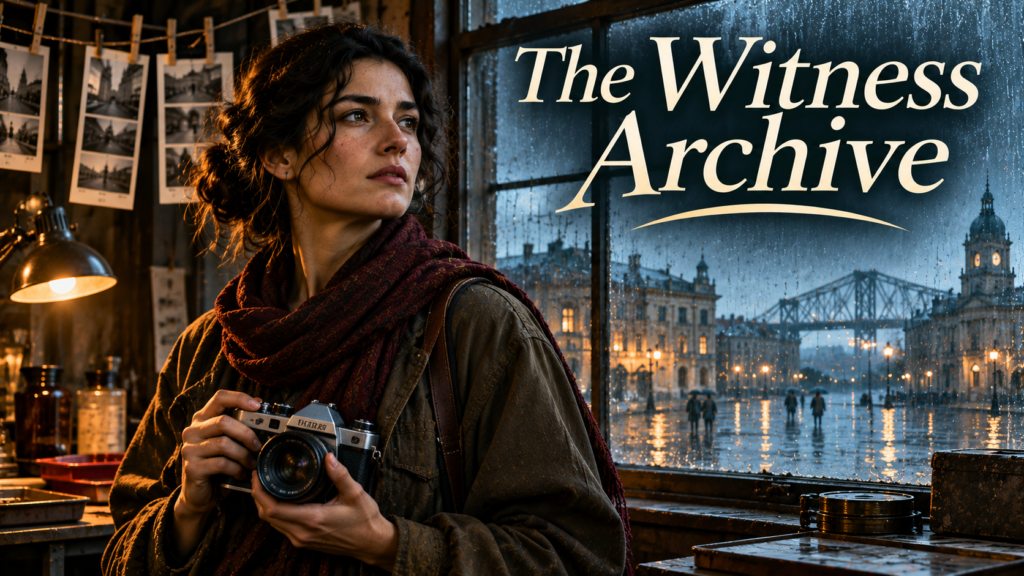
At the entrance, a plain wooden sign bore the name THE WITNESS ARCHIVE.
The first day it opened, a woman brought a photograph of her son standing on a bicycle beside the river. A man brought a letter that had arrived from a prison four years earlier. Two sisters brought a wedding album.
Each was asked what they wished to leave and what they wished to happen to it.
Mira spent the morning photographing the donated material with the owners’ permission.
At noon, Oda arrived with the smaller of the two portraits Mira had made by the bridge.
She set it on a table.
“Is this all right?”
“Of course.”
“I want this to be part of Emil’s record.”
Mira looked at the picture.
It did not show Emil.
Oda noticed her expression.
“He wasn’t there that morning. He was going to take us to the river on Sunday.”
She sat beside the table.
“I want there to be something in his record that isn’t about the way he died.”
Mira nodded.
They made a copy. Oda took the original home.
Later, they placed the photograph beside a short account of Emil’s life that Oda had written with her daughters. It described his work at a repair shop, the terrible songs he sang while washing dishes, and his fondness for taking the girls across the bridge.
There was a separate reference to the judicial findings.
Mira stood looking at the record.
She thought of the night Emil’s name had been read on the radio. She was still glad that it had been heard. But a name in a list of the dead could not be the whole of the person.
At the end of the day, her father came upstairs carrying a wooden frame.
Inside was a photograph of Mira at the age of twelve, holding an old camera in both hands.
“Absolutely not,” she said.
“It’s a good picture.”
“My hair looks like a broken umbrella.”
“That was your mother’s opinion too.”
He set it on her desk.
Ivo arrived shortly afterward, accompanied by Tessa. They were getting married the following July. He had recovered his old cap and had brought it with him because he wanted Mira to photograph him wearing it one last time.
“Why one last time?”
“I’m getting a new job. Same depot. Dispatch office.”
“Do you want to do that?”
“Yes, I think I’ve had enough of steering buses.”
Tessa looked at him.
“And?”
He sighed.
“And I bought a ring.”
Their father laughed.
They went downstairs and stood together in front of the bookshop. The late sun lit the pavement. Behind them, Dena was trying to persuade the bookseller to purchase new geranium pots.
Mira lifted her camera.
Ivo stood beside Tessa wearing his worn blue cap. His shoulder was still slightly lower than the other one. Her father moved closer to them.
For a moment they all looked too serious.
Mira lowered the camera.
“Come on. You look like you’re waiting for a government announcement.”
Ivo laughed first.
Tessa followed.
Mira raised the camera and took the photograph.
Then she took another, because the first might not have been quite right.
When she finished, she put the camera away.
The second photograph had no immediate evidentiary value. It would not establish a date of detention, the position of a vehicle or the identity of a commanding officer. No investigator would request the negative. No family would search it for the last glimpse of a missing person.
It was simply a photograph of her family.
Mira was very glad to have taken it.


