
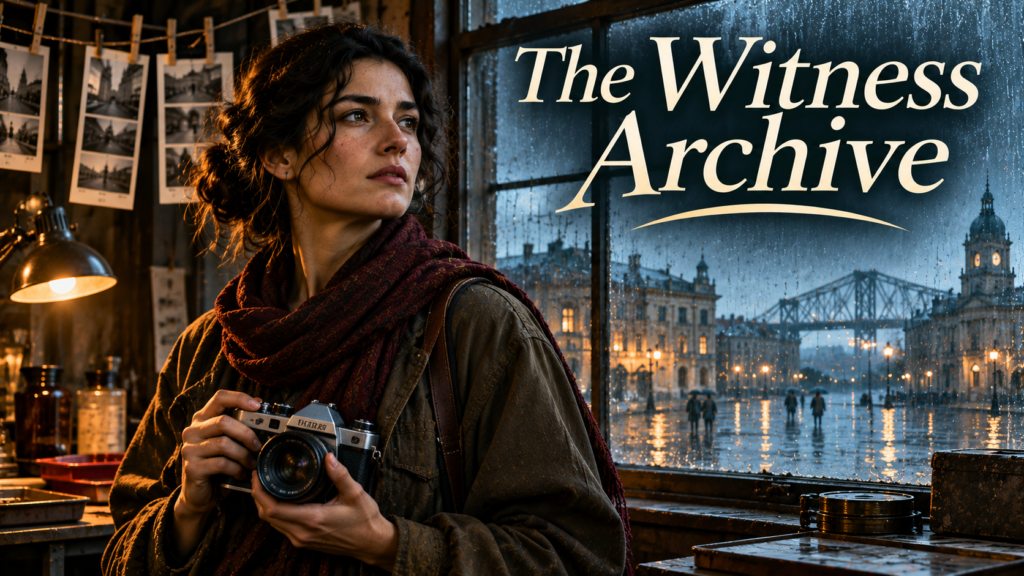
Dena’s grandson arrived at the shop on Friday evening with a suitcase, two shirts and the news that she had been invited to answer questions at the district security office.
“She hasn’t been arrested,” he said.
He repeated this twice.
Mira’s father set the suitcase beside the counter.
“Where is she now?”
“At home. My mother’s with her.”
The young man looked toward the darkroom.
“My grandmother says you’ve got something that needs to be looked after.”
Mira asked what else Dena had told him.
“Nothing.”
“Then don’t ask her.”
He nodded. There were small patches of white dust on his shoes. He worked at a bakery near the northern station and had planned to take the evening train to visit his aunt. Dena had asked him to bring the suitcase to the shop first.
Mira thanked him and told him to go ahead with his visit.
After he left, her father sat behind the counter and examined his own hands.
“We could close for a few days,” he said.
“We should.”
He looked around the room. The painted wooden horses used in children’s photographs stood against a wall. The shelves contained dozens of packets waiting for collection.
“We’ll have to find somewhere to put all these.”
Mira took down a large box of envelopes. She began separating the work that customers had already paid for from work still in progress.
It was an absurd task. Men had been killed in the square, her brother was missing, and she was arranging photographs of weddings.
She was grateful for it.
Shortly before closing, Tessa arrived with a woman called Lina Rusk, the conductor who had been working on route nine the previous day.
Lina wore a knitted hat pulled down almost to her eyebrows. She did not take it off when she entered.
She had seen the driver of route sixteen helping people into the bus shortly before the soldiers began firing. Later, she saw uniformed men bringing several people toward a truck. One of the men being taken away wore a municipal driver’s shirt.
“I thought it was Ivo,” Lina said.
“Did you see his face?”
“From the side.”
Mira fetched a photograph of her brother from the shelf.
Lina studied it.
“Yes, I think that’s him.”
“Would you say you were certain?”
The woman looked at her helplessly.
“No.”
Mira put the picture away.
“Thank you.”
Tessa asked Lina whether she was willing to leave a secure record of what she had seen. They explained what the record might be used for and that they could not promise a risk-free arrangement. Lina decided she would first speak to her husband.
Nobody tried to persuade her otherwise.
After she left, Tessa took Mira by the shoulders.
“He’s alive.”
“He may have been at that moment.”
“Mira.”
She closed her eyes.
“I’m sorry.”
Tessa lowered her hands.
“I know.”
For a while they stood together among the undelivered photographs. Then Tessa took off her scarf and went to help Mira’s father with the envelopes.
At eight that evening, the shop bell rang once.
A woman stood outside in a dark raincoat. She introduced herself as Jana Orrel, a former picture editor who now worked for a regional press cooperative. Narek had reached her through a colleague in another city. She handed Mira a note bearing his signature.
Mira invited her inside.
Jana placed her bag on the counter.
“I leave tomorrow. Narek says you have photographs of Exchange Square.”
“Yes.”
“Has anybody else seen the original material?”
“My father. Narek. Myself.”
“What about the woman whose balcony you used?”
“She’s seen the contact sheet.”
Jana listened to Mira describe what was on the film. She asked how the time had been established, whether anything had happened before Mira arrived, and where the photographer had been standing.
She did not ask Mira to describe the worst thing she had photographed.
When her father brought out the selected prints, Jana examined them beside Mira.
“These contradict part of the official story,” she said.
“Part?”
“The authorities say soldiers were responding to an organized attack. In these frames we can see their positions and civilians moving away. We can see people down. There are separate witness accounts. That’s significant. It doesn’t establish what happened everywhere in the square.”
Mira nodded.
Jana pointed to the figure beside the armored vehicle.
“Can you identify this officer?”
“No.”
“Then we shouldn’t identify him in the caption.”
“He’s wearing a white band.”
“I can see that.”
“The same officer stood beside the vehicle before the shooting.”
“That is something we can report.”
For the first time since the film emerged from the developer, Mira felt that she could hand the pictures to someone without having to defend their significance or exaggerate it.
Jana offered to take a copy of the evidentiary material to the cooperative. She described the people responsible for holding it and agreed that no images identifying vulnerable civilians should be released without considering their safety. She would not take Oda’s family portraits for publication.
Mira asked about the original negatives.
“Keep them somewhere safe if you can. If you decide I should take them too, we’ll record that separately.”
Her father looked at her.
She thought of the pictures drying in his darkroom, and the inspector standing only a short distance away.
“I want the originals to survive,” she said.
“Then they shouldn’t depend on one person surviving.”
Jana stayed until almost midnight.
They prepared an unaltered copy of the relevant sequence and a set of prints intended for independent review, along with Mira’s account of the exposure dates and location. Dena’s statement remained separate. Jana signed a receipt for the material she accepted.
At the end, Mira gave her the envelope.
She had expected to feel lighter.
Instead she felt a very particular fear: the helplessness of knowing that something important was no longer in her possession.
Jana put the envelope into her bag.
“I’ll let you know when it arrives.”
“If it doesn’t?”
“I have arranged for my colleague to contact Narek if there is a problem.”
They shook hands.
At the door, Jana turned.
“Don’t let the fact that the pictures are evidence make you forget that you’re also the person who took them. Find somewhere safe to sleep.”
Mira watched her walk down Silver Street.
It began to rain.
Before closing the shop for the night, Mira and her father placed the original negatives in the custody of an independent lawyer, who gave them a dated acknowledgment for the complete film. Jana had the copy; the lawyer had the original. Neither collection depended on the other remaining safe.
By the following morning, the authorities had changed their account again.
The newspaper published a short official statement describing an armed provocation at Exchange Square. It reported the deaths of nine civilians. It did not name them. No information was provided about the people taken away after the shooting.
Narek telephoned the shop at seven.
“We’re being told not to publish the names of the dead without approval.”
“Do you know any?”
“Four. From the families.”
“Will you print them?”
“I’m trying to.”
His voice sounded far away. Mira wondered whether he was still in his office.
“Jana has left,” she said.
“Good.”
“Have you heard from her?”
“Not yet.”
He paused.
“Listen to me. Sorel has been asking for you. He came here last night.”
“Did he take anything?”
“The photographs from our old files. He said they needed to establish which pictures were made before the emergency regulations.”
Mira looked at the shop’s windows.
“Why didn’t you call?”
“Because he was sitting at my desk.”
She put the receiver down after arranging to meet Narek later.
At ten, Inspector Sorel returned.
This time he brought two uniformed officers and a written search authorization. Mira’s father read it with difficulty, holding it close to his face.
Sorel asked Mira whether she had made copies of the photographs.
She asked whether she could have a lawyer present.
“You’re not under arrest,” he said.
“Then I would like independent advice before answering questions.”
He looked around the shop.
“That’s your choice.”
The officers searched the darkroom, the studio and the shelves behind the counter. They removed packets of photographs, examined the negatives stored in labeled envelopes and opened several boxes containing old family portraits.
Mira did not attempt to prevent them.
Her father stood beside the desk, watching one officer handle a photograph of a child who had been dead for eleven years.
“Be careful with those,” he said.
The officer put the envelope down.
Eventually Sorel found the public prints that Mira and Narek had selected.
He laid them on the counter.
“Where are the negatives?”
Mira repeated her request for a lawyer.
Sorel took out the card he had given her the previous evening.
“I did make an inquiry about your brother.”
She looked up.
“There are some people being held for examination. I’m told a person with his surname may be among them.”
“Where?”
“I can’t tell you at present.”
“Is he hurt?”
“I don’t know.”
The inspector tapped one of the prints.
“These photographs could be misleading, depending on how they’re used. You understand that?”
“I understand photographs.”
“Then you must understand that we need the original material.”
Mira felt her father move beside her.
She wanted to tell Sorel everything he asked. She wanted to hand him the envelope, the camera, the appointments book, the names of everyone who had seen the pictures.
She wanted to take her brother home.
The inspector waited.
“Please tell me where he’s being held,” she said.
Sorel gathered the prints.
“I’ll contact you if I receive any further information.”
He instructed one officer to list the items they were taking. The list included six prints from Exchange Square, several packets of negatives from the shop’s earlier work and Mira’s camera.
She asked for a copy.
He gave her one.
When the men left, her father sat in the chair behind the counter. His hands were trembling.
“They know,” he said.
“They’ve known since Thursday.”
“But now they have the pictures.”
“Some of them.”
He looked at her.
She had never seen him look so frightened.
“Mira, if you give them what they want, they might let him go.”
She sat beside him.
“They didn’t promise that.”
“He is my son.”
“I know.”
He turned away.
She waited until he could look at her again.
“I want him home too.”
The shop stood silent around them.
Then her father began to cry.
It was the first time she had seen him cry since her mother’s funeral. She moved closer, but he would not let her touch him immediately.
After a while, he took her hand.
At midday, Tessa returned from the hospital with a message from Lina. The conductor had decided to give a statement through the legal assistance group that was helping relatives make inquiries about detainees. She had also remembered that the truck which collected people near the fountain had carried a painted blue rectangle on its rear panel.
Tessa looked at Mira.
“Can you see a truck in the photographs?”
“Not clearly. There might be part of one beyond the bus.”
“Could we look?”
Mira nodded.
The public prints were gone. But her father had retained his working contact sheet.
They examined it at the light box.
In one of the last frames, beyond the front of route sixteen, there was the rear corner of a vehicle.
The shape might have been a rectangle.
It was not possible to establish its color from the black-and-white negative.
“Not enough,” Mira said.
Tessa stared at the tiny shape.
“But she remembers blue.”
“That’s her evidence. We should give it to the lawyer separately.”
Tessa nodded slowly.
The distinction hurt. Mira knew that because it hurt her too.
That afternoon, she and her father left the shop together. They put a notice on the door explaining that appointments would be rearranged and asking customers to retain their receipts.
Her father went to stay with his sister on the western bank. Mira accompanied him to the bridge checkpoint. For a terrible moment she thought the soldiers would stop him. They examined his papers and waved him through.
He turned back.
“Will you come tonight?”
“If I can.”
“Don’t stay by yourself.”
She promised not to.
At the newspaper office, the front door was locked. A reporter told her that Narek had been taken away for questioning shortly before lunch.
She asked whether he had been allowed to collect his coat.
“No.”
Mira stood on the pavement.
It was the smallest detail the reporter could have given her.
It was the one that convinced her.
At the hospital, Tessa had been asked to attend to a young conscript who had been brought in from a military barracks with a badly injured ankle. He had requested to speak to somebody who knew about the missing people.
“I don’t know what he wants,” Tessa said.
“Who is he?”
“His name is Lev Anik.”
They found him sitting on a bed in a small ward.
He was nineteen. A photograph of a woman and a dog lay on the bedside table. When Mira introduced herself, he looked at her for a long moment.
“You’re the woman who took pictures from the balcony.”
She did not answer.
He pulled the blanket over his injured leg.
“They asked us who was up there. I said I didn’t know.”
Tessa drew the curtain.
“Do you have something to tell us?”
Lev looked at the door.
“There’s a room behind the eastern bus depot,” he said. “They brought some people there after the square.”
Mira moved toward him.
“Drivers?”
“I don’t know.”
“Was there a municipal bus driver?”
He swallowed.
“There was a man who kept asking for his cap.”
Mira sat down.
Lev’s hands were shaking.
“They told us everybody at the square was armed. But when we took the people out of the truck, they had shopping bags.”
He looked at the photograph beside his bed.
“I didn’t know where else to tell anybody.”
Mira wanted to ask twenty questions at once.
Tessa put a hand on her shoulder.
They asked Lev whether he would speak to the legal assistance group instead.
He nodded.
“If you can get them here.”
Mira stood.
The young man caught her sleeve.
“Don’t tell my mother,” he said.
She looked at him.
“Not until I can tell her myself.”
They left the ward.
Outside, the hospital corridor stretched toward the doors to the courtyard. The evening sun shone through the glass, filling the floor with long amber rectangles.
Mira had stood on a balcony two days earlier and seen a group of soldiers advance toward civilians. She had believed that the most important thing she could do was keep the film from being taken.
She still believed that.
But a photograph could not open the door behind the bus depot.
And if Ivo really was inside it, she had to find a way to reach him before the next truck left.


