Past to the Future | Volume 4 | Part 2
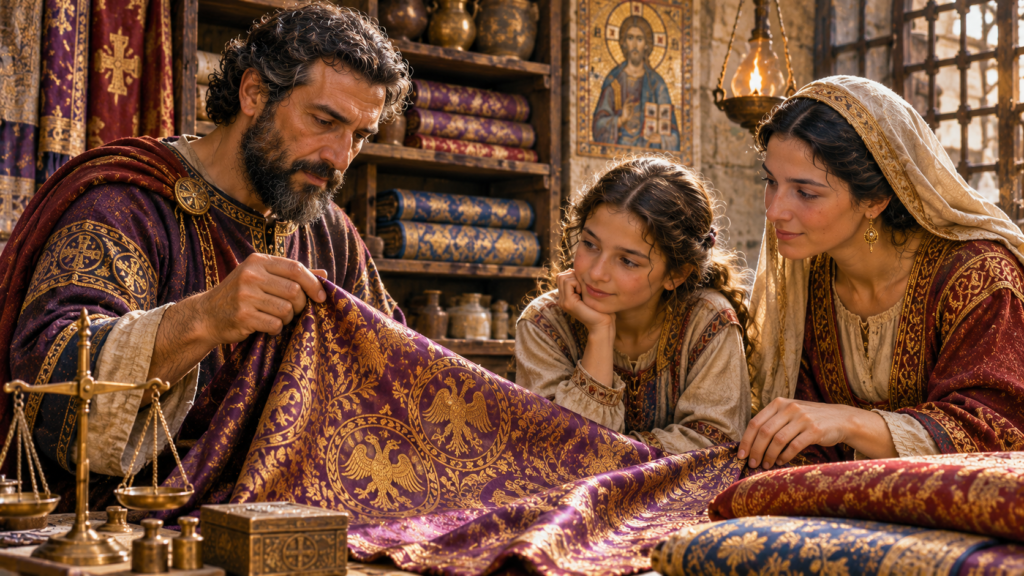
Historical scope: The Eastern Roman Empire, conventionally called the Byzantine Empire, from the foundation of Constantinople as an imperial capital in 330 CE to its Ottoman conquest in 1453. Our principal fictional narrative takes place in Constantinople around 950 CE, during the reign of Constantine VII. The silk merchant Stephanos, his wife Anna, their daughter Eirene and their acquaintances are invented. Surviving monuments, historical events and documentary evidence are distinguished from the imagined experiences of this household.
The cloth that arrived before the sunrise
Eirene had never seen the place where the silk in her father’s storeroom had begun its journey.
She knew the cloth by its appearance, by the way its surface changed beneath the light and by the care with which her parents handled it. Anna had once told her that careless storage could destroy the value of work performed by people their family would never meet.
On a morning when the water beyond the harbor seemed almost silver, her father arrived home later than expected.
“The delivery came,” he said.
“Then why are you worried?” Anna asked.
“The price.”
Eirene had expected the arrival of the merchandise to be the end of the difficulty. Instead, it became the beginning of a discussion about what could be sold, to whom, and whether the household could meet its obligations before another delivery was needed.
Her family lived in Constantinople, the capital of the Eastern Roman Empire, around the middle of the tenth century.
Ships and travelers arrived from a world far larger than the streets she knew. The city contained churches, palaces, marketplaces, workshops and immense defensive walls. Somewhere among these places, people were making decisions that might change her father’s livelihood without ever meeting him.
To Eirene, this was not the capital of a vanished civilization.
It was home.
The Romans who lived after Rome
The inhabitants whom historians now commonly call Byzantines generally understood themselves as Romans. Their empire was the continuation of the Roman imperial state in the East, even as its language, institutions, territorial reach and religious life changed over the centuries.
In 330 CE, Constantine I inaugurated Constantinople on the site of the earlier city of Byzantium. Its strategic position near the meeting of the Bosporus and the Sea of Marmara offered access to maritime routes between the Mediterranean and the Black Sea.
The eastern imperial government survived the political transformations that brought an end to the western imperial throne during the fifth century.
Our previous chapter, When the Roman World Became Something New, examined those changes through the experiences of an imagined household in Ravenna.
For the people of Constantinople, Roman political identity did not become irrelevant when imperial rule in the West fragmented. Their emperors continued to claim Roman authority, and the legal and administrative traditions of the earlier empire remained important.
Greek increasingly became the principal language of government and intellectual life, although Latin retained significance in parts of the empire’s earlier history and other languages were used by its diverse populations.
The term Byzantine is useful to modern historians because it distinguishes this long historical period from other phases of Roman history. It should not be mistaken for the ordinary political identity of the people being described.
Eirene’s father may have heard accounts of emperors who had ruled before his ancestors were born. But nothing in his own experience would have suggested that his family lived among the ruins of a civilization that had ceased to exist in 476.
The empire was changing, not absent.
The city built between worlds
A visitor approaching Constantinople by water might recognize its geographical advantages before understanding its institutions.
The nearby straits connected different maritime regions. The city’s position allowed goods and people to move through routes extending northward, westward and eastward. Yet the surrounding waters did not offer unlimited protection or make the movement of supplies effortless.
Constantinople’s land walls became one of its defining features. The defensive system developed under Theodosius II and was later repaired and strengthened as circumstances demanded. Its towers, layered barriers and defensive spaces offered protection against armies approaching from the west.
The UNESCO account of the Historic Areas of Istanbul identifies these massive fortifications alongside the monuments and urban infrastructure surviving from the Byzantine and Ottoman periods.
A defensive wall could change the fate of a city. But a community enclosed within one still needed regular supplies, working infrastructure and institutions capable of responding to danger.
Imagine Eirene walking past a damaged section of masonry with her father. She might regard its repair as a temporary interruption to their journey, while an official responsible for the city’s defenses would regard the same work as a matter of public security.
The city was not defended through architecture alone. Maintenance, military preparations, diplomacy, maritime operations and the mobilization of resources all played roles in its survival.
Its geography was an advantage only insofar as people could act upon the possibilities and risks presented by it.
The enormous roof above a small person
One day Anna took her daughter into the great church of Hagia Sophia.
Eirene had seen the building from a distance. She was familiar with its imposing roof and the scale of its walls. Yet the experience of standing beneath its dome was unlike the experience of seeing it from a street.
She looked upward until she became conscious of her own smallness.
The present structure originated in the reign of Justinian I. Following the destruction of an earlier church in the Nika uprising of 532, construction brought together remarkable architectural and technical knowledge. The building was consecrated in 537, although its dome suffered a partial collapse in 558 and was subsequently rebuilt.
The Metropolitan Museum’s introduction to Hagia Sophia describes the architectural solution associated with Anthemius of Tralles and Isidore of Miletus, including the use of pendentives to support the vast dome.
The scale of the building expressed the ambitions of imperial patronage. Materials and craftsmanship brought together from different locations gave those ambitions a physical form.
Yet the church’s significance was not limited to imperial self-presentation. It became a setting for religious experiences, ceremonies and traditions that could hold importance for people whose circumstances differed profoundly from those of the emperor.
We cannot know what sensations a particular tenth-century visitor experienced. Eirene’s wonder is imagined.
What we can recognize is the relationship between the immense physical space and the forms of expertise and organization necessary to create and maintain it.
A monument capable of making an ordinary person feel small was itself the result of innumerable activities performed by individual human beings.
An empire that learned to become smaller
In Justinian’s reign, the eastern imperial government established control over substantial territories in North Africa, Italy and elsewhere in the western Mediterranean.
Those achievements did not create a permanently stable imperial geography.
During the sixth and seventh centuries, prolonged conflict with the Sasanian Empire, epidemics and other disruptions placed great pressures on the state. The expansion of Muslim political communities during the seventh century transformed the political landscape of western Asia and the Mediterranean.
The Eastern Roman Empire lost Syria, Egypt and eventually its remaining territories in North Africa. At the same time, its relationships with powers in the Balkans continued to change.
These territorial losses affected the resources available to the imperial government. They also required adjustments in the defense and administration of the regions that remained under its authority.
Military and administrative structures conventionally associated with the themes emerged over a prolonged period. Their formation cannot be attributed with certainty to a single reform enacted in one year.
The political world of Eirene’s family was the product of those transformations, not simply the reduced version of Justinian’s Roman Empire that might appear on a historical map.
An institution can preserve its identity while losing some of the capacities it once possessed. It may survive by changing the relationships on which it depends.
By the tenth century the empire was again expanding in various directions, though its security was never permanent. The recovery of Crete in 961, after the main setting of our story, was one example of renewed military strength.
Such developments help explain why historians must resist imagining Byzantine history as a thousand years of uninterrupted decline.
The empire experienced contraction, recovery, political crises and substantial changes in regional influence. Its history consisted of different periods with their own possibilities and limitations.
The price that belonged to more than one person
When Stephanos inspected the newly arrived silk, Anna asked how much of it he could safely sell.
The question was not simply whether someone would be willing to pay the price he hoped to receive.
Constantinople’s commercial activities were subject to rules administered under the authority of the eparch, an official responsible for important aspects of government within the capital.
The collection conventionally known as the Book of the Eparch, associated with the early tenth century, provides unusually significant evidence for the organization of the city’s trades.
It describes rules concerning several occupations, including silk merchants, money changers, perfumers, food sellers and other specialists.
James Howard-Johnston’s study of Byzantine trade and commercial regulation situates the document within a wider historical economy in which commercial activity continued to generate substantial wealth despite the emphasis of many surviving elite sources on other pursuits.
Regulations varied according to the activities being addressed. They could affect access to particular occupations, the conduct of business and the movement of goods whose value or availability mattered to the authorities.
An official document cannot establish how consistently every rule was enforced. Its existence nevertheless makes visible the concerns of the people attempting to organize commercial life.
The historical study of the private silk industry in tenth-century Byzantium by George C. Maniatis examines the distinct activities and institutional arrangements involved in this specialized sector.
A silk merchant might benefit from operating within a recognized commercial arrangement while also encountering restrictions on choices that could otherwise improve the household’s position.
To a buyer, the finished cloth represented a desirable object. To the seller, it represented money already committed, time invested and obligations whose consequences extended beyond the immediate transaction.
These were not the same experiences, although both belonged to the same market.
A city that had to drink
Eirene knew the places where people might obtain water. She did not know the full routes through which it reached them.
The problem of supplying Constantinople with adequate water had occupied imperial authorities since the city’s development as a major capital.
Aqueducts carried water from sources outside the urban area. Open reservoirs and covered cisterns helped retain supplies, including reserves that might become especially valuable when normal delivery was interrupted.
The research guide on Constantinople’s water supply maintained by Koç University introduces the immense system of storage works built across the earlier centuries of the city’s imperial history.
The surviving Basilica Cistern is an impressive reminder of the scale of those undertakings. Its rows of columns supported an underground space designed to hold water rather than to serve as a grand room for public gatherings.
The demands placed upon the network changed with the city’s population and political circumstances. Not every installation remained in use throughout the entire history of the empire, and the precise distribution of water at particular dates requires careful historical investigation.
The chapter on Ancient Rome: From Republic to Empire explored the relationship between urban infrastructure and the everyday labor required to maintain it.
Constantinople inherited and transformed aspects of that engineering tradition.
A reservoir’s existence did not by itself establish equitable access to water. The arrangement of distribution, competing demands and the physical condition of the system helped determine whose needs could be met.
For the residents of a vast city, water was never merely an engineering problem. It was a recurring social and administrative responsibility.
When an image became a question
Anna possessed a small religious image whose presence in the household carried personal meaning.
She had grown up in a world where the veneration of icons occupied an established position in Orthodox Christian practice. But the place of such images within the empire had been fiercely contested in earlier centuries.
The Byzantine controversy known as Iconoclasm involved periods of opposition to the religious use and veneration of images, conventionally associated with major phases in the eighth and ninth centuries.
The debates concerned theological arguments about the relationship between images and the sacred. They also involved imperial policy and the authority of religious institutions.
In 843, the restoration of image veneration marked a decisive conclusion to the second phase of official Iconoclasm.
The Metropolitan Museum’s overview of Byzantine history and art examines the controversy and its significance for the visual culture of the empire.
Surviving works represent only a portion of what was originally produced. Images were destroyed, altered, replaced or created in response to changing conditions.
It is important not to imagine that every inhabitant participated in the controversy in the same way, or that their understanding of an image can be reduced to support for or opposition to a particular ruler.
A religious object might belong to the memory of a family, the practices of a monastery or the visual program of a church commissioned by an emperor.
These contexts could overlap, but their meanings were not identical.
The girl in our story grew up after a major historical controversy about the legitimacy of images. She encountered its consequences through the ordinary religious world around her, without knowing every argument that had been made in earlier generations.
The gold that left the palace
A piece of cloth from Stephanos’s business might eventually be worn by someone whom he would never see.
Silk possessed significance extending beyond its practical use as a material. Fine textiles could communicate rank, participate in religious ceremony and function as gifts in diplomatic relationships.
Imperial ceremonies made extensive use of visual and material distinctions. Clothing, architecture and the ordered movements of participants contributed to the representation of authority.
Constantine VII, the emperor in the principal setting of our narrative, is associated with the compilation of the Book of Ceremonies, an important source for understanding the protocols of the Byzantine court.
Those ceremonies appeared within a political system in which relationships with neighboring rulers could involve negotiation, gifts, military pressure and carefully managed displays of prestige.
The image of a splendid palace does not explain all the resources required to sustain it.
People produced textiles, acquired raw materials, transported supplies and carried out specialized tasks. Households depended upon the arrangements through which their work was rewarded or compelled.
The modern article An Open Letter to the People Who Keep Things Running offers a contemporary reflection on the tendency to notice the visible results of an institution while overlooking the people sustaining them.
The Byzantine court provides a distinct historical setting in which to consider that question.
The splendor of a ceremony could communicate the emperor’s position. It could also conceal the immense diversity of the relationships through which its material elements had become available.
The travelers who did not share a language
The capital attracted people connected with several political and cultural worlds.
Merchants arrived with goods from different places. Envoys entered the city to conduct negotiations. Travelers associated with pilgrimage, employment and other purposes encountered institutions whose expectations might be unfamiliar to them.
The histories of Byzantium and neighboring Muslim states included warfare and competition, but their relationships were not limited to military confrontation.
Exchange continued across political boundaries. Knowledge, artistic forms and material resources could move through people whose motives were not identical to those of governments.
To the north, commercial and diplomatic relationships developed with the peoples and political communities of eastern Europe and the Black Sea region.
The Christianization of various neighboring societies was associated with missionary activity, political decisions and the adaptation of religious practices within new linguistic and cultural environments.
The missions of Cyril and Methodius in the ninth century belong to this wider history, although the development of Christian traditions and written cultures among Slavic-speaking peoples cannot be understood as the achievement of two individuals alone.
A few generations before Eirene’s birth, people had already established relationships whose consequences would extend far beyond the territories directly governed from Constantinople.
The empire’s historical influence cannot therefore be measured solely by the extent of its territory at a particular moment.
A political boundary could change while religious practices, forms of artistic expression and commercial relationships continued to develop elsewhere. The earlier chapter Ancient Persia: The Empire That Connected Worlds considers a different imperial network and helps frame this distinction between political territory and cultural influence.
The city that was captured before its final conquest
Many generations after our imagined household disappeared from the historical world, Constantinople experienced a catastrophe.
In 1204, forces participating in the Fourth Crusade captured and sacked the city. The event profoundly transformed the political geography of the Byzantine world.
Latin imperial rule was established in Constantinople, while several competing states continued traditions of eastern Roman political authority in other regions.
In 1261, forces associated with the Empire of Nicaea recovered Constantinople under Michael VIII Palaiologos.
The restored empire confronted substantially altered conditions. Its territorial and financial resources were more restricted than those possessed by earlier rulers at periods of greater strength.
The history of the city after 1261 nevertheless included significant intellectual and artistic accomplishments. The political weakness of an institution does not mean that every aspect of the society surrounding it has ceased to develop.
Events in 1204 are also a reminder that shared religious affiliations did not prevent political violence among Christian powers.
The conflicts that developed between the Byzantine Empire and western European states cannot be explained entirely by a single theological division or by an inevitable hostility maintained without interruption for centuries.
Political ambitions, commercial interests, military decisions and institutional relationships shaped the course of events.
The city survived its capture in a physical sense, but survival did not restore the circumstances of the people who lost property, livelihood or security during the crisis.
The day the gates could no longer hold
On 29 May 1453, Ottoman forces led by Sultan Mehmed II captured Constantinople. Constantine XI, the last eastern Roman emperor, died during the final defense.
The siege brought together historical developments in military organization, artillery, political alliances and the shifting relationships between the shrinking Byzantine state and the expanding Ottoman Empire.
The defensive walls that had helped protect the city across many centuries could not prevent its conquest.
Yet the city itself did not cease to exist. It became the capital of the Ottoman Empire and developed through new political, demographic, religious and architectural transformations.
For the inhabitants confronting the conquest, these changes were not abstract historical milestones. The capture brought violence, displacement and enslavement to many people, while the subsequent years involved efforts to repopulate, reorganize and rebuild the city under Ottoman authority.
The architectural landscape of modern Istanbul preserves evidence of different phases of that long history.
Hagia Sophia, for example, has served different religious and institutional purposes across the centuries since its construction.
The historical distinction between the end of the Byzantine Empire and the continuation of the city is fundamental.
A place may retain recognizable buildings and geographical relationships while undergoing profound changes in the political institutions and communities that shape its life.
The past survives neither completely nor on its own terms. It becomes part of the world made by later generations.
The cloth that outlived its owner
Return to the tenth-century household.
Eirene watched her mother finish examining a small piece of silk that had become unsuitable for the purpose originally intended.
It still possessed value.
Anna folded it carefully and put it away.
Years later, the girl might have remembered the movements of her mother’s hands more clearly than the exact terms of the transaction that had occupied the family that morning.
Our narrative cannot establish what happened to the object. No documented textile can be assigned to this invented household.
But surviving Byzantine textiles, coins, manuscripts, buildings and religious objects allow us to investigate aspects of the world in which households like theirs existed.
The empire’s remarkable longevity cannot be explained by military defense alone. Its history involved people maintaining institutions, adapting religious and intellectual traditions, engaging in commerce and finding ways to live through extraordinary changes.
It was not an unchanged survival of ancient Rome. Nor was it a mere interval between antiquity and the emergence of the modern world.
Its inhabitants created a society of their own, adapting what they inherited to problems and possibilities that earlier generations could not have anticipated.
The city that refused to disappear eventually ceased to be the capital of the Roman Empire.
What did not disappear with it were all the histories made within its walls.
In the next chapter, we turn toward Arabia and the seventh-century emergence of Islam, examining the religious, social and political transformations that reshaped the medieval world.
Series navigation: Volume 4 index | Volume 2 — Ancient Civilizations | Past to the Future.