Past to the Future | Volume 4 | Part 11
Historical scope: The Mongol Empire from the rise of Temüjin in the late twelfth century through the expansion and division of the empire in the thirteenth and fourteenth centuries. Our central narrative follows an invented horse-keeping household in the Orkhon Valley near Karakorum around 1254 CE. The herder Baatar, his wife Altan, their daughter Naran and the travelers they encounter are fictional. Documented events, historical figures and archaeological evidence are distinguished from invented scenes.
The horse that belonged to another journey
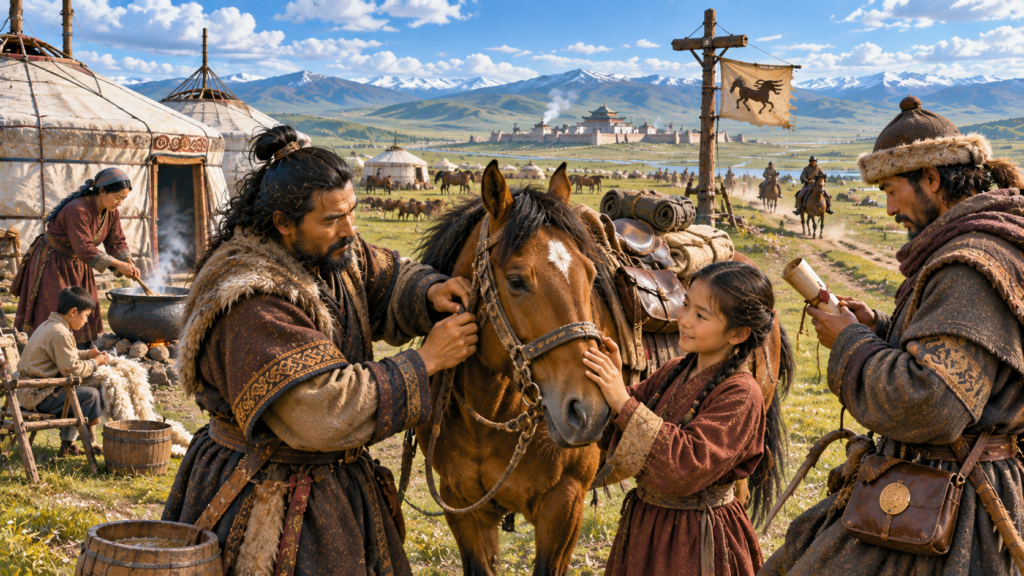
Naran knew the sound of approaching horses well enough to recognize when a rider was urging an animal harder than usual.
She had been helping her mother prepare food when a man appeared beyond the grazing animals. His horse was tired, and his clothes carried the dust of a journey whose beginning the girl could only imagine.
Her father went to speak with him.
The visitor was traveling on official business. He needed a fresh mount and intended to continue without a long rest. Baatar examined the horses kept for such requirements, paying particular attention to their condition.
Naran watched him choose one.
“Will that horse come back?” she asked.
Her father could not promise that it would return in the manner she expected. He needed to fulfill an obligation, and the arrangements governing the journey extended beyond his own household.
The girl had been born into a world in which mounted travelers could carry messages across enormous distances. She was accustomed to seeing people move with their animals, but the visitor’s urgency belonged to something different from the seasonal journeys familiar to her family.
It was approximately 1254 CE, during the reign of the Great Khan Möngke. Karakorum, the imperial center in Mongolia, stood not far away in the Orkhon Valley.
Within a few decades, the political order established by Temüjin, better known as Chinggis Khan or Genghis Khan, had extended across much of Eurasia.
Naran’s family could not see the territory of that empire. What they could see was the animal they had raised leaving with another person.
Somewhere beyond the horizon, a decision had been made. Whether it could be carried out might depend on a horse that had enough strength to reach the next station.
The landscape that taught people to move
The grasslands of the Mongolian plateau were not empty spaces waiting for a political order to arrive.
They had long sustained communities whose livelihoods depended on detailed knowledge of animals, water, pasture and seasonal changes. Mobile pastoralism developed through practical responses to conditions in which remaining permanently in one location was not always advantageous.
Sheep, goats, cattle, camels and horses provided different resources and possibilities. A household needed to consider the changing requirements of its animals, the availability of grazing and the preparation of food and materials for periods of difficult weather.
Portable dwellings known as gers could be dismantled, moved and assembled elsewhere. Their value lay in their suitability to a way of life requiring movement, not in their similarity to permanent buildings.
The UNESCO documentation of the Orkhon Valley situates these traditions within a landscape that also preserves the remains of successive administrative and religious centers.
The relationship between movement and settlement was more complicated than a simple opposition between nomadic people and urban societies.
Pastoral communities could participate in trade with agricultural settlements. Urban centers could depend on resources obtained from mobile populations. Political institutions could develop through arrangements involving both.
The opening chapters of Volume 1 explored these issues, including When Movement Became Strategy, which considered the significance of knowledge adapted to changing environments.
Naran’s mother did not need to regard the seasonal movement of animals as a primitive alternative to city life. It was a sophisticated response to conditions she understood through years of experience.
The mobile character of the household shaped the resources it could provide to the imperial world.
It also shaped the responsibilities that world could impose upon it.
Before the name Chinggis Khan
Temüjin was born during the twelfth century into a political landscape containing numerous competing communities, alliances and leaders.
Accounts of his early life, particularly the work conventionally known as The Secret History of the Mongols, preserve narratives about family loss, hardship, conflict and the establishment of relationships that later became politically consequential.
The text is an indispensable historical source. It is also a literary work transmitted through particular historical circumstances, and its speeches and episodes cannot automatically be treated as verbatim records.
Temüjin developed alliances and overcame rivals through a combination of political negotiation, military activity and the establishment of personal commitments. His conflicts involved other powerful leaders, including Jamukha and the ruler of the Kereyit, Toghrul, also known as Ong Khan.
In 1206 an assembly of Mongol elites recognized Temüjin as Chinggis Khan.
The historian Ruth W. Dunnell’s account of the rise of Chinggis Khan and the united empire emphasizes the development of a new political order drawing upon existing traditions of steppe government and incorporating resources and institutions from territories acquired through expansion.
It would be misleading to imagine the decision of 1206 as the creation of unity among people who had previously possessed no forms of organization.
Temüjin had transformed relationships that already existed, establishing new loyalties and incorporating defeated groups into arrangements that served his authority.
For a household whose members became part of those arrangements, the political transformation could affect the people with whom they traveled, the responsibilities they owed and the leaders whose instructions mattered to them.
The emergence of a powerful ruler was also the emergence of obligations that reached into places far from his personal presence.
An army that could not live on courage alone
A mounted army may appear to depend chiefly on the bravery of its warriors.
The Mongol armies depended upon much more: disciplined organization, experienced leadership, reconnaissance, communication, suitable animals and the capacity to adapt their methods to different environments.
The connections between military mobility and pastoral life were particularly important. Bringing replacement mounts could allow military forces to sustain movement over distances that would otherwise exhaust their horses.
Yet mobility was neither effortless nor unlimited. Animals needed water, forage and suitable conditions. Different landscapes presented different constraints, and military commanders had to adjust their plans accordingly.
Mongol organization included units structured around decimal groupings. Such arrangements helped coordinate large forces and reduced the exclusive importance of some older affiliations, although kinship and elite relationships remained important within the empire.
As the conquests expanded, the armies incorporated people and expertise from many regions.
The capacity to take fortified cities, for instance, depended on more than mounted archers. Engineers, specialists and troops familiar with siege operations contributed to campaigns in environments profoundly different from the open steppe.
Columbia University’s Mongols in World History educational resource examines both the organization of the conquests and the broader contributions and characteristics of the societies from which they emerged.
An empire sustained by a variety of capabilities cannot be understood entirely through the weapon most strongly associated with its warriors.
Our fictional Baatar knew that an animal could become unfit for a journey even when its rider possessed considerable skill.
From that observation we can approach the wider history of Mongol military success through its practical foundations, without transforming successful conquest into a judgment about the moral worth of its consequences.
The city whose inhabitants paid for a ruler’s decision
The Mongol advance into Central Asia and the Iranian world during the early thirteenth century brought destruction on an immense scale.
In 1218 a caravan associated with the Mongol ruler was seized at Otrar, within the domains of the Khwarazmian Empire. The killings associated with the incident, and subsequent failures of diplomacy, preceded the invasion launched in 1219.
Cities including Bukhara and Samarkand fell to Mongol forces in 1220. Campaigns continued across Central Asia, Khurasan and other regions.
The consequences differed according to the circumstances of particular settlements, the decisions made by commanders and the behavior of local authorities.
Some urban populations suffered mass killing. People were displaced, enslaved or compelled to relocate, including specialists whose skills were considered useful by the conquering power.
The historical overview of the period in Encyclopaedia Iranica notes the extraordinary devastation recorded in Persian accounts while cautioning that some reported death tolls exceed plausible estimates of the populations involved.
This distinction matters. The inability to establish an exact number does not justify denying the violence, nor does recognition of the violence justify repeating every figure in a medieval chronicle as established fact.
Imagine a family within one of the affected towns. Its members might have possessed skills valuable to the people who captured their community. That fact would not necessarily give them control over where they were expected to live afterward.
The preceding chapter, The Crusades: Between Faith, Power and the Cost of War, examined the experience of conflict through people whose interests were different from those of the rulers directing it.
The Mongol conquests demand the same attention to individual circumstances.
Military victory could determine which authority controlled a town. It could also destroy the ordinary relationships through which its inhabitants had made their lives possible.
The empire that grew beyond one lifetime
Chinggis Khan died in 1227 while campaigning against the Western Xia.
The expansion of Mongol power nevertheless continued. His son Ögedei became great khan in 1229, overseeing further conquests and the development of imperial administration.
The Jin dynasty in northern China was defeated in 1234. During the later 1230s and early 1240s, forces led by Batu and other Mongol commanders established control over much of the Rus world and invaded parts of central Europe.
The campaigns brought profound suffering to affected communities. The capture of Kyiv in 1240 marked a major episode within a broader transformation of eastern European political relationships.
In 1241 Mongol forces defeated armies at Legnica in present-day Poland and at Mohi in Hungary. Their withdrawal from much of central Europe in the following year has been explained through various combinations of political circumstances, military considerations and environmental conditions. No single explanation accounts conclusively for every aspect of the decision.
The Columbia University overview of expansion under Ögedei traces the remarkable geographical extent of conquest in the years following Chinggis Khan’s death.
Controlling new territories required more than defeating their armies.
Rulers needed ways to mobilize resources, obtain information and determine how different communities would be governed. Existing institutions and administrative specialists could be adapted rather than replaced entirely.
The resulting empire combined traditions and arrangements that were not uniform across its extensive territories.
A local official in northern China, a prince in the Rus lands and a pastoral household in Mongolia might all encounter Mongol authority through substantially different obligations.
It is those variations, as much as the geographical extent of conquest, that explain why imperial government cannot be described as a simple enlargement of the political arrangements established in 1206.
The city within the grasslands
Naran had accompanied her father to the edge of Karakorum before.
She found the buildings, workshops and concentration of people striking. The settlement contained activities that were unfamiliar to her household, although its people depended in various ways upon resources obtained from the surrounding pastoral countryside.
Karakorum developed as an imperial center in the thirteenth century. Under Ögedei, important construction included an imperial palace. Its inhabitants and visitors came from diverse geographical, linguistic and religious backgrounds.
The Franciscan traveler William of Rubruck visited the city in 1254, the approximate setting of our story. His account describes the capital, religious buildings, merchants, artisans and individuals who had been transported to the area from other parts of the empire.
The 2021 archaeological study mapping Karakorum examines the physical organization and development of the settlement through surveys of the site. It offers opportunities to test and extend interpretations once based principally on written accounts.
The existence of the city does not establish that the imperial elite abandoned mobile traditions. The movement of royal courts, animals and households continued to be an important feature of Mongol society.
Instead, Karakorum illustrates the ability of institutions associated with mobile populations to establish relationships with concentrated administrative and commercial centers.
The people entering its markets might arrive by very different means.
A merchant who hoped to sell goods could possess a considerable degree of choice about the journey. A captive artisan brought there because of specialist skills might possess very little.
The presence of cultural diversity within a city is not itself evidence that everyone had arrived voluntarily or held equivalent status.
Naran regarded the settlement as a place in which unfamiliar materials became available. Its larger history reminds us that the origins of those materials and the circumstances of the people working with them require separate investigation.
The woman who could not abandon the herd
After the messenger’s departure, Altan returned to the work through which her household obtained food and maintained its animals.
Some of the responsibilities she carried would become more demanding when her husband was absent. Decisions about the condition of the animals and the supplies available to the family could have consequences extending over several seasons.
Women performed significant economic and social roles within pastoral communities. Their responsibilities could include household management, animal husbandry, the preparation of materials and the organization of practical activities during periods of movement.
Their experiences were shaped by differences in wealth, status, household relationships and historical circumstances.
Elite Mongol women could also exercise substantial political authority.
Following Ögedei’s death in 1241, his widow Töregene governed as regent until the accession of her son Güyük in 1246. Oghul Qaimish subsequently exercised regency following Güyük’s death. Sorqoqtani Beki, the widow of Tolui and mother of Möngke and Kublai, played a significant part in the political relationships surrounding imperial succession.
Anne F. Broadbridge’s study of women in steppe society identifies forms of political influence and authority that would remain inadequately understood if the history were organized exclusively around male rulers.
The extraordinary authority acquired by particular elite women should not be interpreted as evidence that every woman in the Mongol Empire possessed equal rights or similar opportunities.
The position of a regent and that of a woman caring for animals near an imperial route belonged to different social circumstances.
Both, however, direct attention to the responsibilities and decisions that disappear when the history of the empire is reduced to its armies.
The reflection An Open Letter to the People Who Keep Things Running addresses the importance of work underlying the visible achievements of institutions.
In the case of a mobile society, that work could include sustaining the very material foundations of the mobility for which its warriors became famous.
The object that opened the next door
Naran remembered that the traveler who had needed a replacement horse was recognized as someone conducting official business.
She wondered how a stranger arriving in a settlement could establish that he possessed the authority he claimed.
Among the material objects associated with Mongol government are tablets of authority commonly known as paizas or gereges. Their forms, inscriptions and uses varied according to their date and the responsibilities of the person carrying them.
Some authorized individuals to use the imperial communications network. Others served as indications of official rank and the authority to requisition resources.
The historian Christopher Atwood’s study of a Mongol messenger’s badge explains how such objects were connected with the imperial relay system and with earlier practices that the Mongol government adapted.
A system of stations, often known as the jam or yam, supported the movement of official messengers and authorized travelers. Under Ögedei, the network became especially important to communication across expanding imperial domains.
Fresh horses, provisions and suitable places to rest provided the material means of extending the distance that a message could travel.
The existence of a system of privileges, however, did not mean that every traveler could freely use its resources. Nor did it prevent abuses by individuals able to claim official authority.
A household responsible for providing horses could face serious burdens if animals and supplies were demanded beyond the intended arrangements.
The earlier chapter on Ancient Persia: The Empire That Connected Worlds examined an earlier and historically distinct imperial system in which administrative documents and transport routes helped coordinate the movement of people and supplies.
The comparison illustrates a recurring challenge of government over extensive territory. An order becomes effective at a distance only when people and institutions can recognize it and obtain the resources required to act upon it.
For Naran, the messenger’s authority had become visible in the departure of a horse.
For a ruler far away, that departure might be one small event within an immense system of communication.
When Baghdad became part of another empire
Four years after the imagined events in the Orkhon Valley, Mongol forces under Hülegü reached Baghdad.
In February 1258, they captured the city. The Abbasid caliph al-Musta’sim was killed, ending the Abbasid caliphate based in Baghdad.
The conquest brought widespread killing, destruction and upheaval to a city whose history of learning, commerce and political authority had extended across centuries.
Our chapter on the Islamic Golden Age considered Baghdad through an earlier fictional bookseller’s household. The Baghdad encountered by Hülegü’s forces belonged to a later historical environment, and the city had experienced political and economic changes long before the conquest.
The loss of lives, institutions and manuscripts in 1258 must not be minimized.
But the event should not be interpreted as the simultaneous end of intellectual activity throughout the Islamic world. Communities in many other regions continued their scholarly traditions. Baghdad itself experienced subsequent periods of activity and reconstruction under new authorities.
In 1260 Mongol forces suffered a significant defeat at Ayn Jalut at the hands of the Mamluks, whose political center lay in Egypt. The encounter demonstrated the existence of limits to Mongol expansion in the region.
The Ilkhanate established by Hülegü and his successors developed its own political history across Iran and neighboring territories.
From the perspective of the Mongol elite, those territories offered resources and opportunities for the creation of new institutions. From the perspective of people harmed during conquest, their incorporation could represent the destruction of an earlier world.
These experiences cannot be made morally equivalent by describing their common participation in an empire.
The history of Baghdad reminds readers that the networks later celebrated for connecting Eurasia were established partly through violence whose consequences were not erased by later cultural achievements.
Four political worlds within an imperial inheritance
Möngke died during a military campaign in 1259. Disputes over succession produced conflict among rival members of the ruling family, including Kublai and Ariq Böke.
The once relatively unified imperial order became increasingly divided among major regional powers, commonly identified as the Yuan domains centered on China and Mongolia, the Chagatai Khanate in Central Asia, the Golden Horde in the western steppe and the Ilkhanate in Iran.
These descriptions are useful for identifying the broad political landscape. They should not suggest that the boundaries and internal relationships of the khanates became permanently fixed during a single year.
Rival rulers competed over territory, resources and the legitimacy of their claims. Their disputes could affect commercial routes and disrupt the movement of people who had no involvement in imperial succession.
The OpenStax historical overview of the empire’s fragmentation examines these separate political histories, including changes in religious affiliations and the development of Yuan government.
Kublai proclaimed the Yuan dynasty in 1271. The defeat of the remaining Southern Song forces in 1279 completed the Mongol conquest of China.
His court adapted numerous institutions and practices associated with Chinese imperial government, alongside administrative approaches and arrangements developed in other parts of the Mongol world.
These changes created different opportunities and restrictions for various populations. They did not produce one administrative model consistently applied in all Mongol-ruled territories.
In 1368, the Ming dynasty displaced Yuan authority from its capital in China. Mongol political and cultural life continued in Mongolia and elsewhere, and the other successor states followed distinct historical paths.
The end of a unified empire did not erase the relationships formed during its expansion.
The fabric whose makers came from different worlds
A person examining a finely woven textile might be able to identify its materials without knowing the origins of every technique used in its production.
Under Mongol rule, artistic traditions developed through encounters among craftspeople, patrons and materials from many regions.
The Metropolitan Museum’s exhibition The World of Khubilai Khan documents the development of textiles, ceramics, metalwork and other decorative arts during the Yuan period. It also describes the forced relocation of weavers from western regions to the eastern parts of the expanding empire.
Their movements brought different kinds of expertise together. Such circumstances could produce innovations, but the beauty of the resulting objects does not establish that the people making them possessed freedom to determine their own circumstances.
In the Ilkhanid world, manuscript painting and other arts likewise developed through the interaction of established Persian traditions with influences from eastern Asia. New patrons supported work whose forms expressed the changing political and cultural landscape.
The growth of movement and exchange across Mongol-ruled territories is often described using the expression Pax Mongolica.
In certain periods and regions, increased security and imperial support made long journeys easier for some merchants and envoys. But warfare among successor states, insecurity and restrictions continued.
No single phrase describes the experiences of all people living across Eurasia during those centuries.
The very routes that carried manuscripts, textiles and diplomatic messages could also carry captives, armies and disease.
Their history is not simply a story of connections becoming beneficial.
It is a history of how unequal political arrangements could create new possibilities for movement while determining who had the freedom to use them.
The horse beyond the horizon
Return to the valley where our fictional story began.
Naran watched another rider approach. This time she knew to look at the condition of the horse before asking how far the visitor had traveled.
Her father had explained how the animals needed food and rest, and why a network designed to carry messages quickly still depended upon people who could recognize when a horse was exhausted.
She understood that the strength of the empire was connected to work performed in places its most powerful rulers might never visit.
The Mongol Empire grew from political traditions developed among the peoples of the Eurasian steppe. Its conquests transformed the histories of cities, kingdoms, commercial networks and societies across immense distances.
Those transformations included great achievements of communication, administration and cultural exchange. They also included devastating warfare, mass killing, forced movement and the loss of freedom experienced by many communities.
Neither side of that history can substitute for the other.
The empire’s legacy extended far beyond the period of its political unity. Its successor states developed institutions and cultural traditions of their own, while the peoples connected through earlier conquests continued to negotiate the circumstances of their lives.
Modern Mongolia possesses a distinctive living culture and history that cannot be reduced to the medieval campaigns of its most famous ruler.
Our narrative ends where the human requirements of the empire became visible to one child.
The rider could continue because somebody somewhere had raised the horse.
The message might reach the distant people for whom it was intended.
Naran might never learn what it said.
In the next chapter, we follow the routes that connected the medieval world: the many land and maritime networks collectively associated with the Silk Roads.
Series navigation: Volume 4 index | Volume 2 — Ancient Civilizations | Past to the Future.