Past to the Future | Volume 4 | Part 10
Historical scope: The Crusades in the eastern Mediterranean, principally from 1095 to 1291, with a fictional narrative set in Acre during the siege of 1189–1191 and its aftermath. The potter Hasan, his wife Layla, their daughter Mariam and their acquaintances are invented. Their words and experiences are not presented as historical testimony. The chapter examines Christian, Muslim and Jewish experiences without assigning collective responsibility to present-day religious communities.
The jar that would not be filled
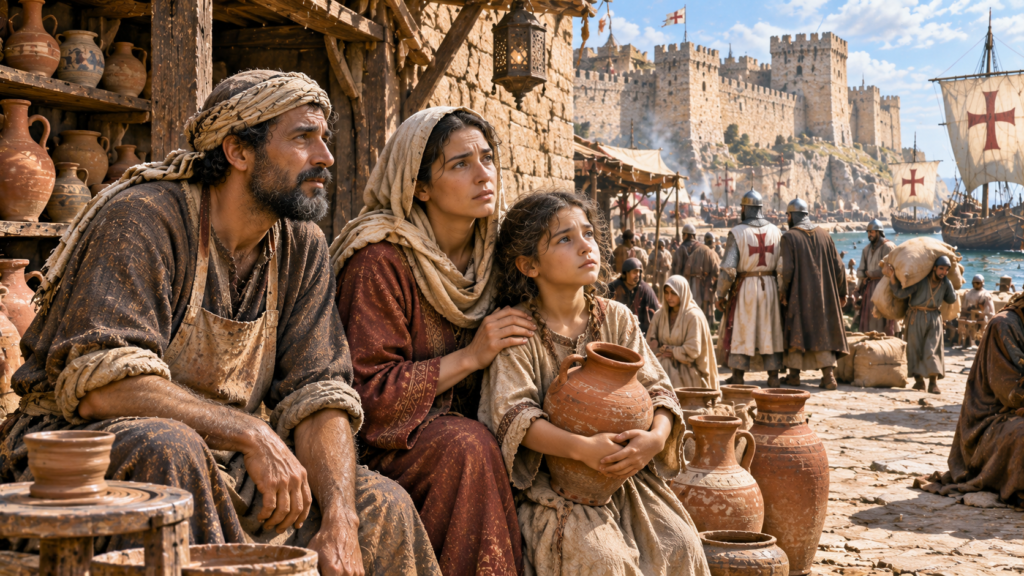
Mariam had carried the empty jar farther than her mother expected.
There had been a time when she could obtain water without wondering how long she might have to wait or whether the adults standing nearby would begin arguing. Now an ordinary task could occupy much of the morning.
When she returned, her father looked toward the doorway.
“Anything?”
She shook her head.
Hasan had once earned his living making vessels like the one she carried. He knew which clay could withstand firing and how to recognize a crack before a finished pot became useless. In better times, the failure of a single vessel would have been a small professional disappointment.
Now he was considering the things his household might have to leave behind if they could find a way out of the city.
Layla brought the jar inside. Its usefulness had not changed, but the circumstances in which her family needed it had.
The city was Acre, on the eastern Mediterranean coast, during the long siege that ended in July 1191. Beyond its walls, armies were attempting to take a fortified port whose possession could affect political and commercial relationships across the region.
Within those walls were people whose immediate concerns could not be expressed through the language of strategic victory.
The armies surrounding Acre included forces arriving from western Europe. Inside, a garrison loyal to Salah al-Din, known in much European historical writing as Saladin, defended the city. The siege also brought hardship to the besieging armies and the people accompanying them.
Mariam knew very little about the ambitions of the rulers involved. She knew the sound of adults lowering their voices when discussing the future.
Our chapter begins with her empty jar because the history of a war is incomplete if it tells us only who won.
The appeal from the other side of the sea
The events that brought armies to Acre had origins extending almost a century into the past.
In 1095, the Byzantine emperor Alexios I Komnenos sought military assistance from the West as his empire confronted the consequences of Seljuk expansion in Anatolia. Pope Urban II’s call for an expedition at Clermont in November of that year helped initiate a movement whose aims and scale went well beyond the immediate problem faced by the emperor.
The Metropolitan Museum’s historical overview of the Crusades describes the central place of Jerusalem and its Christian sacred sites in the undertaking, together with the religious incentives and material ambitions associated with participation.
For Latin Christians who undertook the expedition as an act of devotion, the journey could possess a significance that cannot be reduced to an attempt to obtain wealth. The prospect of spiritual remission, the fulfillment of vows and the recovery of sacred places all mattered.
Other participants had interests involving land, status, family obligations or military employment. Motives could overlap within the same person and could change during the course of a journey.
The movement also included people who were not experienced fighters. They confronted difficulties of transportation, provisioning and protection far beyond those suggested by a description of knights marching east.
Our earlier chapter, The Byzantine Empire: The City That Refused to Disappear, examined the eastern Roman state’s continuing history. Its relationship with the Crusades was neither a straightforward alliance nor an inevitable hostility.
Byzantine authorities had particular territorial objectives. The people arriving from the West did not necessarily share them.
An appeal for assistance could set events in motion that the person making it would no longer be able to control.
The violence that began before Jerusalem
Imagine a household in a Rhineland town in 1096.
Its members had heard of the expedition being organized to travel toward Jerusalem. They did not belong to the army. They had made no decision about the military affairs of the eastern Mediterranean.
Yet some of the armed groups traveling through the region turned against Jewish communities in Europe.
Massacres occurred in Speyer, Worms, Mainz and elsewhere. Jewish residents were killed, and others confronted coercion and demands for conversion. Some ecclesiastical authorities attempted to protect them, with differing results.
The historian Judith Bronstein examines the sources and historical debates surrounding these attacks in The Crusades and the Jews: Some Reflections on the 1096 Massacre.
The violence reveals a fundamental problem with reducing the Crusades to a conflict between two religious communities. People who were neither participants in the eastern campaigns nor responsible for the political arrangements being contested became targets.
Jewish accounts preserve evidence of suffering, resistance, religious commitment and communal memory. Their importance is not diminished by recognizing that medieval historians must examine the circumstances under which particular texts were produced and transmitted.
The history of these massacres must not be used to attribute guilt to all Christians of the period or to their modern descendants. Responsibility belongs to the perpetrators and the circumstances in which the attacks occurred.
Nor should the recognition that some people sought to protect their Jewish neighbors diminish the gravity of the crimes committed.
A family living far from the territory an army claimed to be seeking could nevertheless experience the violence generated by its movement.
The distance between a declared objective and the actual consequences of an expedition is one of the central questions of this chapter.
The city that became the goal of a journey
Jerusalem held immense significance for several religious traditions long before the First Crusade.
For Christians, it was associated with the life, crucifixion and resurrection of Jesus. For Muslims, the sacred precinct containing al-Aqsa Mosque and the Dome of the Rock held profound religious importance. Jewish traditions maintained an enduring relationship with Jerusalem through worship, history and memory.
A place could therefore possess meanings for people whose experiences and beliefs were not identical.
After a difficult series of campaigns across Anatolia and Syria, including the capture of Antioch in 1098, the armies participating in the First Crusade approached Jerusalem. The city was then governed by the Fatimids of Egypt.
On 15 July 1099, the crusading forces took Jerusalem. The capture was accompanied by the killing of many Muslim and Jewish inhabitants and others caught in the violence. Estimates of the number killed vary substantially, and some medieval descriptions were shaped by rhetorical conventions.
Uncertainty about the exact number does not cast doubt on the occurrence of the massacre.
The Metropolitan Museum’s chronology of the medieval eastern Mediterranean situates the conquest within the region’s changing political and religious landscape.
A new Latin Christian political order emerged in Jerusalem. Over the following years, other cities along the coast came under crusader control.
The event could be understood by participants as the fulfillment of a religious vow. For the people who lost their lives, homes or relatives, the same event was a catastrophe.
A historical account must preserve the distinction between the beliefs through which people justified their actions and the consequences experienced by the people affected by them.
No claim to sacred geography can by itself explain the entire history of a city inhabited by human beings.
The kingdoms whose walls depended on the fields
The political arrangements conventionally known as the crusader states included the Kingdom of Jerusalem, the County of Edessa, the Principality of Antioch and the County of Tripoli.
Their development took place through separate campaigns, negotiations and relationships. They were not entirely dependent upon one center, and their rulers did not always pursue identical interests.
The settlers associated with western European conquest entered a region already inhabited by diverse communities, including Arabic-speaking Christians and Muslims, Jews, Armenians, Syriac Christians and others.
Their legal positions and relationships with the new authorities varied. Some communities continued working agricultural land and participating in commercial activity under transformed political arrangements.
A fortress could help establish control over a strategic route or territory. But its occupants required supplies from the surrounding countryside. The ability to maintain military forces depended upon access to resources and the labor of people who did not necessarily participate in political decisions.
The modern reflection An Open Letter to the People Who Keep Things Running examines the tendency to overlook the work underlying apparent institutional strength.
The medieval Levant offers a distinct historical setting in which to consider this question. The existence of a fortified castle tells us something about the intentions and capacities of its patrons. It tells us less directly about the people who milled grain, cared for animals or repaired the buildings that supported its occupants.
The establishment of a new kingdom did not release it from the requirements faced by earlier societies occupying the land.
It needed food, water, labor, information and relationships extending beyond its walls.
An enemy who could also become a customer
Before the siege, Hasan had sometimes sold pottery to people whose language or religious practices differed from those of his household.
An unfamiliar customer did not necessarily require an unfamiliar business arrangement. The parties needed to understand the price, the quality of the object and the conditions under which it would pass into different hands.
The movements of merchants across political boundaries are documented in the writings of Ibn Jubayr, an Andalusi Muslim traveler who visited the eastern Mediterranean in the 1180s.
His observations, discussed in the Metropolitan Museum’s overview of the crusading period, suggest that some commercial journeys continued even when military hostilities occurred nearby.
The existence of such trade should not be mistaken for universal tolerance or security.
A merchant might be able to cross an area under another ruler through negotiated arrangements while a captive possessed no freedom of movement. Customs payments, political restrictions, armed conflict and personal circumstances affected the possibilities available to different people.
Nor did trade automatically bring warfare to an end. The parties benefiting from commercial activity were not always the people able to determine military policy.
Our preceding chapter, Medieval African Kingdoms: Gold, Knowledge and the Roads Across Continents, explored exchange as a relationship extending across numerous political and cultural environments.
The eastern Mediterranean illustrates why such connections must be understood without assuming that the people taking part in them agreed on every question of religion or government.
The circumstances of a particular transaction could create a practical reason for cooperation.
Those circumstances could disappear with extraordinary speed when war came to the place where the transaction ordinarily occurred.
The changing balance of power
The political response to the establishment of the crusader states developed within a region containing rival Muslim rulers and institutions.
The capture of Edessa by Zengi in 1144 helped prompt the Second Crusade, which failed to achieve its principal objectives. The expedition’s unsuccessful attempt to take Damascus in 1148 demonstrated that military cooperation among its participants could be difficult to sustain.
Zengi’s son Nur al-Din extended his authority across important parts of Syria. His activities, and the changing relationship between Syria and Egypt, helped shape the circumstances in which Saladin rose to power.
Saladin, of Kurdish origin, became vizier in Fatimid Egypt in 1169. In 1171, the Fatimid caliphate ended. Over the ensuing years he consolidated substantial authority in Egypt and Syria, establishing the political foundations of the Ayyubid dynasty.
The creation of this wider political relationship was not the result of every Muslim ruler immediately adopting a common policy. Saladin confronted rivals, negotiated alliances and used military force in struggles that involved other Muslim powers.
Religious appeals associated with jihad formed an important part of the resistance to crusader authority. Political consolidation and competition also shaped the environments in which those appeals operated.
As with the motivations of crusading forces, religious conviction cannot responsibly be treated as either irrelevant or sufficient to explain every decision.
The relationships established between different territories gave Saladin resources and strategic opportunities that a more fragmented political landscape had restricted.
For inhabitants of the region whose primary concern was sustaining a household, these transformations could become visible through changes in taxation, military obligations, security or the availability of essential goods.
The history of political consolidation was also a history of changing local circumstances.
The battle that changed the course of a kingdom
On 4 July 1187, Saladin’s forces defeated the army of the Kingdom of Jerusalem at Hattin, near the Sea of Galilee.
The battle resulted in the capture of King Guy of Lusignan and the loss of a relic of the True Cross. The destruction of much of the kingdom’s field army made the defense of its remaining territories extraordinarily difficult.
The historical context and consequences of the defeat are examined by Linda Paterson in a study of the Third Crusade and its cultural responses.
Jerusalem surrendered to Saladin on 2 October 1187 following negotiations.
The surrender differed substantially from the city’s capture in 1099. Many Christian inhabitants were permitted to depart under ransom arrangements. Some unable to secure release were enslaved, while others were freed through interventions or negotiated provisions.
Jewish residents were permitted to resettle in the city, and Christian religious life continued under changed conditions.
Saladin’s decision to negotiate the surrender became an important part of his historical reputation. It deserves to be understood without converting his entire career into a legend of uniform mercy.
The capacity to choose between demanding ransom, accepting surrender or authorizing release was itself a consequence of unequal power.
For a wealthy household, the payment required for departure might be achievable. For a poor household, the same condition might threaten the freedom of its members.
The difference between a mass killing and a negotiated surrender was profound. The difference between the experiences of individual people within the latter arrangement was also consequential.
A ruler’s reputation, however favorable or unfavorable, cannot substitute for an examination of the options available to those whose future depended upon his decisions.
The siege in which neither shore felt safe
The capture of Jerusalem generated a renewed call for crusading in western Europe.
The expedition conventionally called the Third Crusade involved major rulers including Frederick I Barbarossa, Philip II of France and Richard I of England.
Their participation did not produce a single army under an unchanging command. Frederick drowned in 1190 while traveling through Anatolia. Other forces reached the eastern Mediterranean through different routes.
Acre, which Saladin’s forces had taken in 1187, became the focus of a lengthy siege beginning in 1189. The besiegers faced pressure from Saladin’s army outside their positions, creating an unusual and demanding military situation.
Within the city, resistance depended upon provisions, defenses and the ability to withstand prolonged isolation. Outside, the besieging forces faced their own difficulties, including disease, shortages and exposure to fighting.
Our invented Mariam carried her empty jar in this setting.
She could not see the full geographical extent of the conflict, but she understood the difference between a household that expected tomorrow to resemble today and one that could not make such an assumption.
A soldier or camp follower outside the walls might likewise experience uncertainty about food and the survival of companions.
These parallel needs do not erase the different responsibilities and positions of participants. They direct attention toward the conditions under which war was endured.
The city surrendered in July 1191. The weeks that followed included the killing of a large number of Muslim prisoners on Richard’s orders, after negotiations concerning the surrender terms failed to produce the required settlement.
The deaths became part of the human cost of a campaign otherwise frequently remembered through the military reputations of Richard and Saladin.
A battle can be decided while the suffering associated with it continues.
The agreement that did not give either side everything
The Third Crusade eventually ended without the recovery of Jerusalem by the crusading armies.
In 1192, an agreement between Richard and Saladin recognized arrangements through which the remaining Latin coastal territories could continue to exist, while Christian pilgrims could visit Jerusalem under agreed conditions.
Jessalynn Bird’s study of the Third Crusade’s aftermath considers the treaty in relation to continuing diplomacy, trade and the different objectives pursued by the parties.
Agreements ending a particular military campaign do not necessarily resolve every source of conflict. They can, nevertheless, create circumstances in which activities interrupted by war become possible again.
For a household whose livelihood depended upon the ability to move objects between settlements, the existence of a workable route could matter more immediately than the formal title of the person controlling an entire region.
The archaeological remains of Acre reveal a later medieval urban environment containing fortifications, streets, commercial spaces and buildings associated with different institutions. The UNESCO documentation of the Old City of Acre distinguishes these remains from much of the Ottoman-era architecture visible today.
Acre became the principal center of the diminished Kingdom of Jerusalem after its recovery by crusading forces.
What happened to our imagined potter’s family after the surrender is intentionally left uncertain. Historical evidence does not identify them, and we should not invent a secure return to normal life merely because an agreement was eventually reached.
The restoration of a trade route and the restoration of a lost household are not the same achievement.
When a crusade turned against Constantinople
A different expedition, the Fourth Crusade, departed in 1202 with plans directed initially toward Egypt.
Financial difficulties, obligations to Venice and intervention in Byzantine political disputes contributed to a change of course. The crusaders attacked Zara, a Christian city on the Adriatic, and subsequently turned toward Constantinople.
In April 1204, they captured and sacked the Byzantine capital.
Religious buildings and private property suffered plunder. Works of art and sacred objects were carried away, some reaching western European collections. A Latin imperial government was established in the city, while eastern Roman successor states developed elsewhere.
The events undermined the idea that the crusading movement can be adequately described as a confrontation between Christianity and Islam.
Christians could become the victims of forces claiming a Christian religious mission. Political and financial pressures could reshape a campaign far from its originally declared purpose.
The Byzantine recovery of Constantinople in 1261 did not reverse all the consequences of the sack. The restored empire faced altered circumstances and more restricted resources.
For many inhabitants, the events represented losses that could not be repaired merely through the return of a familiar political authority.
When studying the Crusades, the object of an original vow must be distinguished from the decisions taken in the course of undertaking it.
An expedition may begin with one purpose and produce consequences that the people financing, participating in or affected by it did not anticipate.
The last port of a changing world
Later crusades continued to target different parts of the eastern Mediterranean and North Africa.
The Fifth Crusade sought to establish leverage in Egypt. The expedition associated with Frederick II achieved a negotiated transfer of Jerusalem in 1229, without the kind of major siege that had characterized earlier struggles over the city. The settlement was temporary, and Jerusalem changed hands again in 1244.
Louis IX of France undertook further expeditions involving Egypt and Tunis. His Egyptian campaign ended in defeat and captivity in 1250.
Meanwhile, the Mamluk Sultanate emerged in Egypt and extended its authority into Syria. Under rulers including Baybars, the remaining Latin territories in the Levant came under increasing military pressure.
Antioch fell in 1268. Tripoli fell in 1289. In May 1291, Mamluk forces captured Acre, ending the principal remaining mainland center of Latin rule in the region.
The date serves as a useful boundary in the conventional history of the eastern Mediterranean Crusades. Crusading as a broader movement continued elsewhere, in different political and religious settings, beyond that year.
The collapse of the Latin political institutions along the coast did not end the histories of the populations living throughout the eastern Mediterranean.
Some people fled. Others remained or rebuilt their lives under changed arrangements. Trade and pilgrimage continued through new and sometimes restrictive conditions.
The final chapter of the ancient volume, The Ancient World Never Really Ended, distinguished the end of a political order from the much longer histories of the people affected by it.
The fall of Acre makes that distinction especially important.
The disappearance of a kingdom from a map cannot tell us the fate of every person who once lived in its territory.
What remained inside the empty jar
Imagine, for a final moment, the potter’s daughter seated beside her mother.
The jar was still there. Its clay, shaped by practiced hands and hardened in fire, had not become less capable of holding water.
What the family lacked was the ability to use it as they once had.
A society’s institutions and relationships can make an ordinary object immensely useful. War can destroy those relationships without destroying the object itself.
The Crusades involved deep religious convictions, competing political projects, commercial interests, diplomatic arrangements and repeated violence. They cannot be explained responsibly through a single intention shared by everyone involved.
Their history includes the people who undertook dangerous journeys in the belief that they were fulfilling sacred obligations. It includes Muslim communities defending lands, cities and religious institutions. It includes Jewish victims of persecution, eastern Christians affected by conquest, captives, merchants, laborers and families whose interests were not identical to the ambitions of rulers.
Recognizing those different experiences does not require pretending that all actions were morally equivalent. It requires examining particular decisions, identifying their consequences and refusing to turn entire religious communities into permanent enemies.
The medieval world was connected even when some of the relationships within it became violent. Its histories of coexistence and exchange are no excuse to minimize that violence. Its histories of conflict are no reason to deny that coexistence and exchange occurred.
Mariam’s family is fictional. The circumstances in which a household might lose access to the resources on which it depends are not.
The empty jar reminds us to ask a question that can disappear beneath accounts of military achievement: what happened to the people who needed to fill it?
In the next chapter, we turn toward the Mongol Empire, the expansion across Eurasia that transformed cities, trade routes, political boundaries and the lives of entire populations.
Series navigation: Volume 4 index | Volume 2 — Ancient Civilizations | Past to the Future.