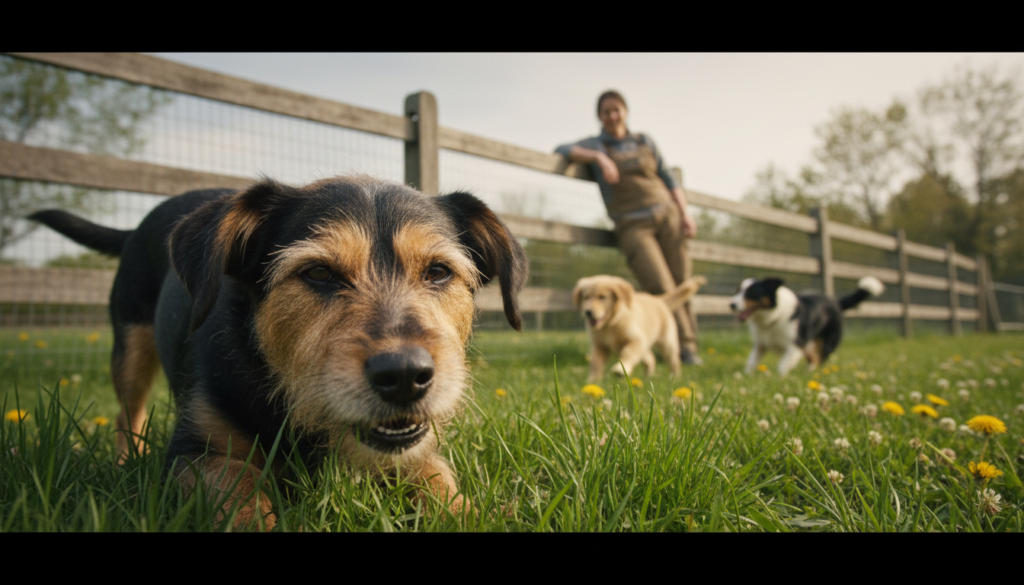
The accusation was that I had eaten the evidence.
This was unfair for three reasons.
First, nobody told me it was evidence.
Second, it was grass.
And third, I am a dog.
My name is Scone. I am a mixed-breed animal of medium height, magnificent eyebrows, and uncertain parentage. According to my veterinarian, I have the legs of a terrier, the shoulders of a spaniel, and the digestion of an individual who should be less confident around unattended rubbish bins.
I live with a woman named Reva Finch.
Reva is thirty-seven, runs a small dog-daycare business, and possesses a deeply confusing attitude toward food.
She keeps a tin of biscuits on a high shelf.
She tells me I am a good boy when I sit.
I sit.
She gives me one biscuit.
I sit again.
She tells me I’ve already had one.
I don’t understand how she expects consistency in a world governed by such unpredictable rules.
Nevertheless, I love her.
Reva has a laugh that starts quietly and then takes over her entire body. She smells of peppermint soap, coffee, and approximately twelve other dogs. In the mornings, she scratches the space behind my left ear. On difficult days, she scratches both ears.
I know when she’s having a difficult day.
Humans believe dogs don’t notice things unless they are moving or edible. This is an unfortunate misconception.
I notice when Reva comes home without singing.
I notice when she checks the bank account while standing at the kitchen counter.
I notice when she sits beside me after a long day and says, “Well, Scone, that could have gone better.”
I cannot explain to her that I notice.
My conversational abilities are largely restricted to barking, whining, and the production of a dramatic sigh.
But I can place my head on her knee.
This usually helps.
Our trouble began on a Wednesday in April.
The grass was particularly good that morning.
I do not know whether humans understand that grass changes with the seasons. In winter, much of it is tough and uninteresting. In spring, the new growth can be soft and pleasantly cool against the tongue.
There are many grasses.
I have preferences.
I do not disclose them because Reva already interferes with enough of my personal decisions.
We were at the enclosed exercise field used by her daycare business. The field had a shaded corner, a shallow drinking station, and a peculiar wooden bench that several dogs believed belonged to them.
I was examining a patch of young grass beside the fence when I noticed an unusually appealing blade.
I ate it.
Then another.
Then several more.
The experience was pleasant.
There was a little dew.
The weather was mild.
A spaniel named Pickle was attempting to persuade a tennis ball to come out from beneath the bench.
A Labrador named Queenie had found a stick that was both too large to carry and too important to abandon.
Everything was satisfactory.
Then a child pointed a telephone toward me.
“Look! Scone’s eating grass!”
The child was named Ari. She was thirteen and the daughter of one of Reva’s customers.
She came to the field sometimes with her mother and liked making short videos of dogs doing ordinary things.
I had no objection.
I am remarkably photogenic.
Ari filmed me eating grass.
I looked directly at the camera.
This was interpreted later as a sign of distress.
In fact, I was wondering whether Ari had brought the cheese crackers she sometimes carried in her coat pocket.
She had not.
I returned to the grass.
The video lasted twelve seconds.
It would eventually be viewed by more than four hundred thousand people, most of whom seemed to believe I was either dying, healing myself, protesting against a chemical company, or attempting to communicate with the supernatural world.
I was doing none of these things.
I was having breakfast after breakfast.
You may imagine my surprise.
Reva’s business was called Second Walk.
It was not a particularly good name.
Dogs do not care whether a walk is first, second, or eighth. We care whether it happens.
But humans like names.
They like to place them on buildings, clothing, and little pieces of paper.
Reva had named the business after the dog-walking service she began years earlier, when she was working two jobs and trying to earn enough money to open a proper daytime care facility.
Now she looked after a small number of dogs whose owners needed help during working hours.
She had a licensed premises, insurance, trained assistants, written care arrangements, and rules governing which animals could safely spend time together.
She also had a notice beside the entrance.
ALL DOGS ARE INDIVIDUALS.
Beneath it, in smaller letters:
YES, EVEN YOURS.
I liked that notice.
It made a strong argument for additional biscuits.
Reva knew her customers.
She knew which dogs became nervous when separated from their families.
Which needed quiet spaces.
Which disliked other dogs rushing toward them.
Which had dietary restrictions or health conditions requiring particular care.
She did not pretend that every dog needed the same exercise, food, or attention.
She had built the business carefully, one client at a time.
It was small.
The rent was high.
The margins narrow.
And every time somebody canceled a regular booking, Reva spent an evening studying her accounts as though the numbers might change if she stared hard enough.
But it was hers.
She loved the work.
So when Ari’s video appeared online that evening with the caption WHY IS THIS DOG EATING GRASS???, Reva initially laughed.
“Apparently you’re famous, Scone.”
I wagged my tail.
Fame sounded edible.
Then the comments arrived.
Some people explained that dogs sometimes eat grass because they enjoy the taste or texture.
Others suggested boredom.
Instinct.
Dietary fiber.
Digestive discomfort.
Several stated confidently that all dogs eat grass to make themselves vomit.
Others insisted grass eating was proof of a nutrient deficiency.
A man who identified himself as an expert in animal communication announced that I was expressing dissatisfaction with the emotional atmosphere of my home.
I took this personally.
Our sofa is excellent.
By midnight, the video had reached thousands of viewers.
By morning, a second clip appeared.
This one showed Pickle vomiting beside a pathway at the daycare field.
Pickle had been unwell later in the day. Reva had separated him from the play group, contacted his owner, and arranged veterinary advice according to his care plan. He was examined and recovered, although the precise cause of his brief stomach upset was not established.
Ari had filmed part of the incident without realizing that the footage would be sensitive.
She combined the two clips into a video.
First me eating grass.
Then Pickle being sick.
Then the caption:
THEY ATE THE GRASS AND THIS HAPPENED.
There were two problems.
Pickle was not me.
And nobody had established that the grass caused his illness.
These were important distinctions.
The internet did not appear impressed by them.
By lunchtime, the video was circulating in local groups.
One viewer claimed the grass must have been sprayed with chemicals.
Another said all the dogs at Second Walk were becoming ill.
A third announced that the business was poisoning animals.
There was no evidence for those claims.
But they were repeated with increasing confidence.
Reva spent the afternoon answering calls.
One customer wanted to know whether the field had been treated with pesticides.
Another asked whether all the dogs were safe.
A third canceled a booking.
Then two more.
By evening, Reva sat at the kitchen table with her face in her hands.
I approached.
Placed my head on her knee.
She did not scratch my ear.
This was serious.
“Scone,” she whispered, “what on earth have you done?”
I looked at her.
I was tempted to explain the grass.
The tender blades.
The pleasant texture.
The fact that I sometimes graze when I’m relaxed and sometimes when I’m simply curious.
But I had a limited vocabulary.
So I sighed.
Reva looked toward her telephone.
Then began crying.
I placed one paw on her foot.
I didn’t know how to stop four hundred thousand strangers from talking.
I could barely persuade Reva to share her toast.
But I stayed beside her.
It was the only useful thing I could think to do.
The next morning, Reva called her veterinarian, Dr. Minnow Vale.
Dr. Vale was a sensible woman.
She had cold hands, an alarming collection of instruments, and a habit of calling me “young man” even though I was nearly nine.
I disliked her examination table.
I liked the treats she kept in the cupboard.
Our relationship was complicated.
Reva asked whether eating grass was a sign of illness.
Dr. Vale explained that it was common in dogs and could have several possible explanations, including taste, texture, instinctive foraging, or sometimes digestive discomfort.
Most grass-eating dogs did not vomit afterward.
The behavior alone could not establish the cause.
Reva asked about poison.
The veterinarian explained that treated lawns, toxic plants, and areas contaminated with animal waste could present risks, so preventing dogs from grazing in unsafe areas was sensible.
But a video of an animal eating grass was not proof that the grass contained a harmful substance.
Nor did the footage establish that the two dogs had the same condition.
Reva listened.
She confirmed that the daycare used written grounds-maintenance records and restricted access to any area where treatment or other hazards might be present.
She reviewed those records again.
Checked the field.
Discussed appropriate precautions.
And contacted the relevant professionals about whether any additional environmental assessment was warranted.
She did not find evidence supporting the viral allegation.
But she also refused to announce that no dog could ever be harmed by grass.
That was not something anyone could guarantee.
By Friday, Reva had written a clear statement for customers.
She explained what had actually happened.
That I had been filmed grazing.
That Pickle had become ill later and received veterinary care.
That the two clips had been combined in a misleading way.
That the daycare’s grounds and care records had been reviewed and that veterinary advice had been sought.
She did not disclose Pickle’s private medical information without his owner’s permission.
She invited customers to ask questions directly.
Then she posted the statement.
It received thirty-seven likes.
The original video had received sixty thousand.
Reva stared at the screen.
“Wonderful.”
I wagged my tail.
I approve of thirty-seven things.
She looked at me.
“The truth is less exciting than the rumor.”
I considered.
The truth was that I had found tasty grass.
I thought that was exciting enough.
Humans have peculiar standards.
On Saturday, Ari arrived at the daycare with her mother.
The girl looked miserable.
She stood in the office wearing an oversized sweatshirt and holding her telephone in both hands.
“I’m sorry,” she whispered.
Reva looked at her.
For a moment, she said nothing.
Then she asked, “What did you think you were showing?”
Ari swallowed.
“That Scone ate grass and Pickle got sick.”
“Did you know the videos were of different dogs?”
“Yes.”
“Did you know they were taken at different times?”
“Yes.”
“Then why did you edit them together?”
Ari stared at the floor.
“I thought they were connected.”
“Did you ask?”
“No.”
The room became quiet.
Ari began crying.
“I didn’t mean for people to say those things.”
Reva sighed.
I watched her.
She was angry.
I could smell it in the way her body held itself, in her tightened hands, in the pause before she spoke.
But she wasn’t shouting.
“Intent matters,” Reva said. “But it doesn’t change what viewers were led to believe.”
Ari nodded.
“I know.”
“You’re not responsible for every stranger’s behavior. You are responsible for what you chose to publish.”
Ari wiped her face.
“I deleted it.”
“Thank you.”
“But people have copied it.”
“I know.”
She looked toward the floor.
“Can I do anything?”
Reva considered.
Then said, “You can explain clearly that the two clips show different animals, that the cause of Pickle’s illness wasn’t established, and that the video didn’t justify the accusations people made.”
Ari nodded.
“And please ask before filming or posting animals at my business again. Their owners have a right to know how images of their pets are being used.”
“I will.”
For a moment, neither spoke.
Then Ari looked toward me.
“Is Scone okay?”
Reva sighed.
“Scone is fine.”
I wagged my tail.
This was an excellent moment to request food.
Ari crouched.
Scratched behind my ear.
“Sorry, Scone.”
I licked her hand.
The situation improved considerably.
Then she whispered, “Why do you eat grass?”
I looked at her.
It was a reasonable question.
I thought about answering.
Instead, I walked toward the water bowl.
Drank.
Returned.
And sat on her foot.
Humans place far too much importance on explanations.
Sometimes what matters is simply that you’re still there.
On Monday, Reva opened the daycare to customers who wanted to visit.
Not a spectacle.
Not a press conference.
No dramatic banner announcing that the grass had been declared innocent.
Just an opportunity for people to see the premises, meet the staff, ask about the daily routines, and understand how animal health concerns were handled.
Reva checked that the visits could take place without disrupting or distressing the dogs.
Most customers were interested in practical things.
Where did the animals rest?
How were groups supervised?
What happened if a dog became unwell?
How were changes in appetite or behavior recorded?
What was done when a dog needed veterinary care?
Reva answered.
When she didn’t know something, she said so.
She showed the procedures she was authorized to share.
Explained the grounds-maintenance arrangements.
Discussed how staff assessed the dogs individually.
Some visitors seemed relieved.
Others remained skeptical.
One man announced that he’d watched a video proving dogs only ate grass when they were poisoned.
Dr. Vale, who had agreed to attend for a short educational discussion, asked which evidence the man was referring to.
He opened his telephone.
Searched.
Scrolled.
Looked irritated.
Then announced that he couldn’t find it just then.
Dr. Vale nodded.
“That’s all right. We can still discuss what veterinary evidence does and doesn’t tell us.”
I liked her enormously at that moment.
I would have liked her more if she had brought treats.
A woman near the fence asked whether grass eating could ever be a medical warning.
Dr. Vale explained that it could sometimes occur alongside gastrointestinal problems or other concerning changes, and that a dog showing repeated vomiting, loss of appetite, unusual lethargy, or abrupt excessive grazing should be assessed by a veterinarian.
But ordinary, occasional grass eating in an otherwise healthy dog was common.
A boy raised his hand.
“Does it mean they need vegetables?”
“Not necessarily.”
“Does it mean they’re hungry?”
“Sometimes a dog may forage because food or texture appeals to them, but it isn’t a reliable sign of hunger.”
“Does it mean the dog is sad?”
The veterinarian considered.
“Behavior depends on the individual and the circumstances. We shouldn’t diagnose a dog’s emotional or physical condition from one action in a short video.”
I watched the crowd.
They seemed disappointed.
It occurred to me that humans ask questions because they want answers, but often prefer answers that are shorter than the truth.
They want one cause.
One explanation.
One rule that works every time.
But dogs are different from one another.
Queenie loved carrying sticks.
Pickle ate his meals at a speed suggesting a personal quarrel with the bowl.
I sometimes chewed grass.
We all possessed different preferences, habits, and limitations.
This seemed obvious to me.
It was apparently a revelation to several people standing beside the fence.
Then a man near the front asked whether I could demonstrate.
Reva looked at him.
“Demonstrate what?”
“Eating grass.”
She stared.
He pointed toward me.
“Just so we can see.”
The people around him turned.
A few lifted their phones.
Reva looked down at me.
I looked up at her.
I was sitting.
A perfect sit.
A biscuit-worthy sit.
Then I noticed a leaf drifting across the yard.
I stood.
Walked toward it.
Sniffed it.
Decided it wasn’t interesting.
Returned to Reva.
Sat again.
The man looked disappointed.
“Doesn’t he usually do it?”
“Sometimes,” Reva said.
“Then why not now?”
She smiled faintly.
“Because he doesn’t do it on command.”
I wagged my tail.
At last.
A human who understood me.
The man lowered his phone.
For a moment, the entire gathering seemed unsure what to do.
They had arrived expecting a dramatic revelation.
A poisoned lawn.
A miraculous animal instinct.
An expert uncovering a secret.
Instead, there was a small dog refusing to perform a behavior that people had mistaken for a message.
Reva looked around.
“That’s really the point.”
The group quieted.
She continued.
“I know each of these dogs as an individual. But I still can’t read their minds. If I notice something unusual, I look at the whole situation, check for other symptoms, review possible hazards, and get professional advice when it’s needed.”
She glanced toward me.
“Scone sometimes eats grass.”
I wagged.
“He’s done it for years.”
I wagged harder.
“Most of the time, he appears to enjoy himself.”
I approved.
“But if his behavior suddenly changed, or he seemed unwell, I’d take that seriously.”
She looked toward the visitors.
“I can’t promise that every dog here will always be healthy. I can promise that we won’t ignore a concern or pretend to know something we haven’t established.”
Nobody applauded.
That would have been strange.
They asked more questions.
Some inspected the resting spaces.
Others spoke to the staff.
One customer renewed her booking.
Another said she needed time to think.
A third thanked Reva for being open about the incident.
The business did not suddenly become more successful than before.
The lost bookings did not all return.
Reva still had to manage the finances.
But people began talking to her rather than only about her.
That made a difference.
When the visitors left, Reva closed the office door.
Sat on the floor.
And laughed.
I approached.
She looked at me.
“Scone, you are the least helpful celebrity in the world.”
I sat.
She reached into her pocket.
Produced a biscuit.
I accepted it with professional dignity.
Then rested my head on her shoulder.
She scratched behind my left ear.
The situation, I felt, had been resolved.
A month later, the grass returned.
I mean, of course, that it had been present all along.
But spring made it greener.
Softer.
More interesting.
The shaded corner of the exercise field grew a particularly fine patch.
I noticed it one Tuesday morning.
It was a beautiful day.
There was sunlight on the fence.
A breeze moving through the trees.
Queenie had located a stick.
Pickle was conducting an intense investigation into a patch of soil that contained absolutely nothing of interest to anyone else.
Reva stood nearby, speaking to her assistant about the following week’s schedule.
Her voice sounded lighter.
She was still tired sometimes.
Still worried about money.
Still frustrated when somebody repeated the old video without its correction.
But she had stopped apologizing for the fact that she could not explain every behavior with certainty.
She had also stopped asking me to solve her financial difficulties.
A wise decision.
I have very little understanding of banking.
I noticed the grass.
Walked toward it.
Sniffed.
Selected a blade.
Chewed.
It was excellent.
Ari was visiting that afternoon, helping her mother collect their own dog after daycare.
She saw me.
Stopped.
Then lifted her telephone halfway out of her pocket.
I looked at her.
She looked at me.
For a moment, we stood in perfect silence.
Then she put the telephone away.
“Enjoy your salad, Scone.”
I did.
Nobody shouted.
Nobody ran for a camera.
Nobody announced that I had discovered something terrible beneath the earth.
The grass was ordinary.
The day was ordinary.
And my behavior, which had once been considered evidence of a neighborhood catastrophe, was ordinary too.
This pleased me.
I have always believed that ordinary things deserve more appreciation than humans give them.
An open window.
A comfortable rug.
A person who returns when they say they will.
A bowl of water after a walk.
The sound of a biscuit tin opening.
A particularly good smell beneath a hedge.
And grass.
Especially the young kind.
I cannot tell you why every dog eats it.
I am not every dog.
Some may enjoy the taste or texture.
Some may forage out of habit or curiosity.
Some may have digestive discomfort.
Some may do it because it produces a reaction from the humans around them.
And sometimes the reason may remain unclear.
I can tell you only why I ate that particular blade on that particular Tuesday.
It was there.
It was fresh.
I wanted it.
I ate it.
Then Reva called my name.
I looked up.
She was smiling.
“Scone. Come on.”
I considered the remaining grass.
Then the woman standing beside the gate.
She held a lead.
And perhaps a biscuit.
The grass would still be there tomorrow.
I ran to her.
Not because of an ancient instinct.
Not because I was communicating a warning.
Not because she had solved every problem in her life.
Because she was Reva.
And I was her dog.
She clipped on my lead.
We walked home together.
The End.
Editorial Veterinary Note
Why do dogs eat grass? Grass eating is common in dogs, and there is no one confirmed explanation. Possible reasons include enjoying taste or texture, ordinary foraging, curiosity, boredom, and sometimes digestive discomfort. It does not automatically mean illness or nutritional deficiency. Most dogs eating grass do not vomit afterward, contrary to the belief that they invariably do it to cause vomiting. Seek veterinary advice for sudden or excessive grazing, repeated vomiting or diarrhea, loss of appetite, lethargy or other changes. Avoid exposure to treated lawns, toxic plants and contaminated areas. Scone, Reva, and the daycare are fictional; his first-person voice is an imaginative device, not a claim that we know exactly what dogs think.