By the time the doctor said urate crystals, Vera Sen had already blamed the anchovies, her second husband, and the price of butter.
The anchovies were innocent.
Her second husband had been dead for six years.
Butter had been expensive for longer than anyone cared to remember.
None of this improved her mood.
The doctor, a woman with patient eyes and an alarming lack of interest in excuses, examined the swollen joint at the base of Vera’s right big toe and asked when the pain had begun.
“Tuesday.”
“What time?”
“Early.”
“Did it come on suddenly?”
“Like somebody putting a heated nail through my foot.”
The doctor nodded and reviewed the details of Vera’s previous evaluations.
This was not Vera’s first episode.
The earlier attack had been investigated, and joint-fluid analysis had identified monosodium urate crystals. The present flare resembled that episode, though the clinician still assessed for signs suggesting another cause or complication.
Vera had ignored the first diagnosis as much as possible.
She disliked being ill.
More precisely, she disliked the way illness reduced her authority.
She could instruct twelve cooks while standing in a kitchen so hot that visitors began sweating in the doorway. She could correct a sauce by smelling it. She could determine whether meat had rested long enough by pressing it with two fingers.
But she could not instruct a swollen joint to become reasonable.
“Why does this keep happening?” she asked.
The doctor explained that gout resulted from the buildup of urate over time, which could form crystals in and around joints and provoke intense inflammation. Genetics, kidney handling of uric acid, certain medicines, other health conditions, alcohol, and diet could all contribute.
Vera frowned.
“So it isn’t because I ate shellfish?”
“One meal doesn’t explain the whole condition. Food can influence urate levels or trigger flares in some people, but we need to look at your overall risk factors and long-term management.”
The doctor reviewed Vera’s medicines, including a diuretic prescribed for her blood pressure, and discussed coordinating any changes with the clinician managing that condition. She also recommended follow-up for serum urate and kidney function, along with treatment for the acute flare and a plan to reduce the risk of further attacks.
Vera listened.
Then said, “My father had it.”
The doctor nodded. “Family history can matter.”
“He used to blame the sausages.”
“People often look for a single culprit.”
Vera almost laughed.
She had spent forty years doing exactly that.
A bad sauce meant the junior cook had used too much vinegar.
A late service meant the suppliers were unreliable.
A failed marriage meant her husband had been too weak to tolerate the hours.
A staff resignation meant somebody lacked ambition.
There was comfort in one cause.
One person.
One thing that could be identified, corrected, and blamed.
She looked at her foot.
The toe was red, swollen, and so tender that the bedsheet brushing against it during the night had made her gasp.
“How soon can I go back to work?”
The doctor looked at her. “What do you do?”
“I’m a chef.”
“What kind of work would you be returning to?”
“Twelve hours standing.”
The doctor considered.
“That’s unlikely to be comfortable or sensible while the flare is this severe. Let’s discuss treatment, recovery, and how you can modify your activity.”
Vera looked at the clock.
It was eleven thirty.
At six that evening, her restaurant would open for its twenty-fifth-anniversary dinner.
At ten, after service, she was expected to sign the final documents selling the business to a hospitality group.
There would be photographs. Speeches. Wine. People claiming they had loved the restaurant since its first day, although several had refused to eat there until a newspaper told them it was fashionable.
It was supposed to be the most important night of Vera’s career.
Now she could barely tolerate the pressure of a shoe.
She looked at the doctor.
“Tonight isn’t possible to postpone.”
The doctor met her gaze.
“Then the things you do tonight need to take your condition into account.”
Vera stared.
She had come hoping for permission to behave exactly as she always had.
Instead, she was being told the body possessed terms of its own.
She found this profoundly irritating.
The restaurant was called Anvil.
It stood on the corner of Mercer and Ninth, in a brick building that had once housed a cobbler’s workshop.
The dining room held forty-eight guests.
The kitchen was narrow.
The stairs to the storage cellar were too steep.
The rear entrance opened onto an alley where delivery drivers sometimes argued about who had arrived first.
The walls were painted a deep green.
The tables were walnut.
And the lighting was low enough to conceal the fact that one corner of the ceiling had been repaired with a material that didn’t quite match the original plaster.
Vera opened Anvil when she was thirty-one.
She had almost no money.
A difficult reputation.
And the conviction that a restaurant should serve food with enough character that people argued about it afterward.
Her first menu was six dishes long.
Roasted onion broth.
A small plate of smoked trout.
Braised lamb.
A bitter-leaf salad.
A pear dessert.
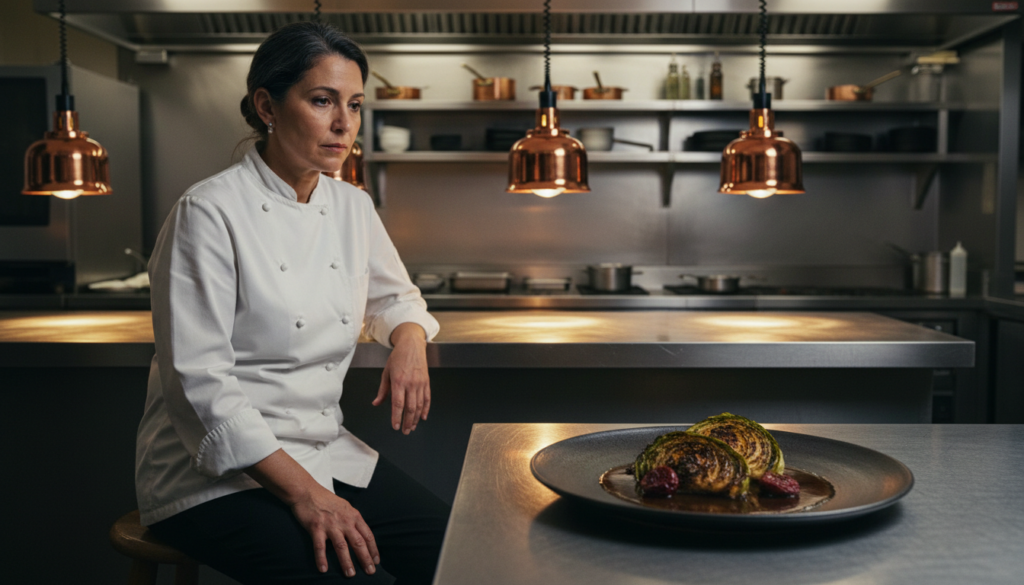
And a dish made with charred cabbage, fermented plum, and a dark broth that smelled faintly of smoke.
Critics disliked the cabbage.
Customers ordered it repeatedly.
Over time, the restaurant changed.
The menu became more elaborate.
The prices rose.
The dining room filled with people who could afford to complain about things that cost more than Vera had once earned in a week.
The newspaper reviews improved.
A prestigious guide listed Anvil among the city’s best restaurants.
Vera became famous enough that strangers occasionally approached her in supermarkets and asked whether she had opinions about their potatoes.
She usually did.
There were television appearances.
Cookbook offers.
Interviews.
A documentary in which the director insisted she stare thoughtfully out of a window for several minutes while pretending to remember something.
She remembered thinking the window needed cleaning.
But the restaurant succeeded.
Not consistently.
Not without debt.
Not without long periods when the staff worked harder than was healthy or reasonable.
Still, it survived.
Anvil became the center of Vera’s life.
Her marriages had happened around it.
Her friendships.
The birth of her daughter, Lena.
The death of her parents.
The slow disappearance of the woman Vera had been before the kitchen required all her attention.
She loved the restaurant.
She also resented it.
On some evenings, she stared at the stove and imagined simply walking out.
Taking a train.
Renting a room somewhere by the sea.
Eating food somebody else had cooked.
Then the first order arrived.
And she forgot the fantasy.
For twenty-five years, the kitchen had given her a way to understand the world.
Heat.
Timing.
Salt.
Acid.
Fat.
Texture.
A set of transformations that could be controlled through skill and attention.
The body was different.
A restaurant could be cleaned.
Reorganized.
Rebuilt.
A person could work every day and still become ill.
Vera disliked that fact.
She disliked it even more because the business was being sold.
The buyer, a hospitality group called Westhaven Dining, intended to preserve the Anvil name and use selected dishes across a new chain of premium restaurants.
The offer was substantial.
Not enough to make Vera rich.
Enough to repay the business’s debts, fund contractual and other obligations associated with the sale, and leave her with some money after decades of work.
The terms were complicated.
The building was leased.
The staff would not all be retained.
Some employees would be offered positions elsewhere in the group.
Others would lose their jobs when the current operation closed.
Vera had spent months negotiating.
She had insisted on payment of outstanding wages and accrued entitlements.
The buyer had agreed to certain transition arrangements.
But there were limits to what she’d secured.
The building’s owner wanted a new tenant.
The restaurant needed major repairs.
The business couldn’t continue indefinitely without new capital.
Vera told herself selling was the responsible choice.
Then, some nights, she lay awake wondering whether she’d simply become too tired to fight.
She hadn’t told anyone that.
Not even her daughter.
Especially not her daughter.
Lena was thirty-two, worked in commercial law, and possessed the particular precision of someone who had inherited her mother’s intelligence but refused to inherit her belief that shouting made an argument stronger.
She had spent years asking Vera to reduce her workload.
Vera had spent years explaining why that was impossible.
Their conversations had become predictable.
“You’re exhausted.”
“I’m busy.”
“You need help.”
“I have staff.”
“Then let them do their jobs.”
“They do.”
“Then why do you insist on doing everything yourself?”
“Because somebody has to make sure it’s right.”
Lena would sigh.
Vera would change the subject.
Eventually, they spoke mostly about practical things.
Invoices.
Appointments.
The sale.
Whether Lena wanted to attend dinner.
Their affection remained.
But it traveled through increasingly narrow passages.
Vera had begun to suspect that some relationships ended not through arguments but through the gradual disappearance of subjects people could discuss safely.
She didn’t know how to repair that.
She knew how to repair a sauce.
Tonight, she would have preferred to deal with the sauce.
At four, Vera entered Anvil wearing an orthopedic shoe approved for her comfort and a face that suggested everyone in the building had personally offended her.
The kitchen stopped.
Not completely.
A pot continued simmering.
Water ran.
Somebody sliced fennel.
But conversation quieted.
Vera looked around.
“Why is everybody staring?”
Her sous-chef, Rosa Mendez, approached.
Rosa was forty-nine.
She had worked at Anvil for twenty-three years.
She was compact, serious, and possessed hands that moved with a quiet economy Vera had never mastered.
Rosa never shouted in the kitchen.
She had no need.
People listened because she knew what she was doing.
She looked at Vera’s foot.
“How bad?”
“Manageable.”
“That’s not what you said yesterday.”
“Yesterday was worse.”
Rosa examined her.
Then said, “Sit.”
Vera stared.
“Excuse me?”
“Sit.”
“I’m the chef.”
“Yes.”
“And you’re giving me orders?”
“Correct.”
A young cook near the ovens looked down very quickly.
Vera glared.
Then, with considerable irritation, she sat on a stool beside the pass.
Rosa handed her the evening menu.
The dishes were drawn from twenty-five years of Anvil’s history.
The onion broth.
The lamb.
The trout.
A modern version of the old pear dessert.
And the dish that had made the restaurant famous.
SMOKE-BRAISED CABBAGE, FERMENTED PLUM, BLACK GARLIC BROTH.
It had appeared in magazines.
Cookbooks.
Television programmes.
It was the restaurant’s signature.
The dish Vera had been asked to explain more often than anything else she’d ever cooked.
Critics called it an expression of her genius.
Westhaven wanted the recipe included in the sale.
Vera looked at the menu.
Then at Rosa.
“Did the plums arrive?”
“Yes.”
“Properly fermented?”
“Yes.”
“The cabbage?”
“Excellent.”
“Broth?”
“Ready.”
Vera nodded.
Then she noticed Rosa was still standing beside her.
“What?”
Rosa folded her arms.
“I need to talk to you.”
“Later.”
“No.”
Vera stared.
The younger cooks continued working, pretending not to listen.
Rosa leaned closer.
“After tonight, what happens to the signature dish?”
Vera looked toward the menu.
“The buyer gets the agreed commercial rights.”
“And the recipe?”
“It’s included.”
Rosa was quiet.
Then she asked, “Whose recipe?”
Vera felt a sudden coldness.
She looked up.
Rosa’s expression hadn’t changed.
But the question was not a casual one.
Vera looked toward the other cooks.
“Can we discuss this privately?”
Rosa nodded.
They went into the tiny office behind the kitchen.
The room contained a desk, a filing cabinet, and a printer that had not worked reliably since 2019.
On the wall hung a photograph of Anvil’s opening-night staff.
Vera, thirty-one.
Rosa, twenty-six.
Four other people.
All wearing white jackets and looking simultaneously delighted and terrified.
Vera stared at the photograph.
Rosa shut the door.
Then placed a notebook on the desk.
Its cover was stained with oil.
The pages were yellowing.
Vera recognized it immediately.
The first recipe book.
The one they used before everything was entered into computers.
Rosa opened it.
Turned to a page near the middle.
The handwriting was hers.
Not Vera’s.
A recipe titled:
CABBAGE — THIRD VERSION.
Beneath it were ingredients.
Measurements.
Tasting notes.
Changes.
The fermented plum had been Rosa’s idea.
The black garlic broth, a joint experiment.
The final seasoning balance had been adjusted after a disastrous first service when Vera complained that the dish tasted like a wet fireplace.
The notebook recorded all of it.
Rosa looked toward Vera.
“Did you tell the buyer I developed this dish with you?”
Vera stared at the page.
For years, she had answered interview questions about the recipe.
She often said we in conversation.
We tried several versions.
We changed the broth.
We discovered the plum balanced the smoke.
But the book carried her name.
The television programmes credited her.
The branding materials called it VERA SEN’S SIGNATURE CABBAGE.
She had not corrected them.
At first, it seemed like an abbreviation.
A chef’s name standing for the work of the kitchen.
That was how restaurants operated.
Then the attribution became useful.
Then valuable.
Then something she no longer wanted to question.
She looked at Rosa.
“Of course the kitchen developed it together.”
“That’s not what I asked.”
Vera felt anger rise.
“What do you want me to say?”
“The truth.”
“The truth is complicated.”
Rosa nodded.
“Yes.”
Vera stared.
Her toe throbbed.
The kitchen noise came faintly through the door.
Rosa continued.
“I don’t need you to say I invented the entire dish. I didn’t. You worked on it. So did I. So did other people.”
She pointed toward the notebook.
“But the buyer wants the right to use it for years, and I’ve never been part of that conversation.”
Vera looked down.
Rosa’s voice remained steady.
“I gave twenty-three years to this place. I don’t expect you to give me ownership of everything we cooked together.”
A pause.
“But I expect you to stop selling the story that it came out of your head fully formed.”
Vera felt an old, familiar defensiveness.
The restaurant had been hers.
She had borrowed the money.
Taken the risks.
Stayed awake worrying about payroll.
Worked weekends while other people went home.
If something failed, reporters blamed her.
If the restaurant closed, the debts were hers to settle.
Why shouldn’t the name on the book be hers?
She opened her mouth.
Then stopped.
Because Rosa hadn’t asked for all the credit.
She’d asked not to be erased.
Vera looked at the notebook.
Then asked, “Why now?”
Rosa gave a small, sad laugh.
“Because after tonight, the story belongs to a company that wasn’t here.”
The sentence stayed between them.
Vera looked toward the photograph.
Six people on opening night.
Two women who had spent twenty-three years cooking beside each other.
And an old notebook recording decisions neither had bothered to claim until those decisions were about to be sold.
She looked at Rosa.
“What do you want?”
The sous-chef took a breath.
“A truthful attribution and an agreement that recognizes my contribution to the recipe they’re acquiring.”
Vera nodded slowly.
“Have you spoken to a lawyer?”
“Yes.”
“Good.”
Rosa looked surprised.
Vera continued.
“I don’t know what rights the notebook establishes. I won’t pretend I do. But we need to put the issue in front of the people drafting the agreement before I sign.”
Rosa stared.
Then said, “You’re not going to argue?”
Vera looked toward the door.
A pan struck the stove.
Someone called for more stock.
She sighed.
“I’ll probably argue.”
Rosa almost smiled.
“But I won’t tell you that you have no reason to ask.”
For the first time in days, Vera felt something inside her become less painful.
Not the toe.
The toe remained furious.
Something else.
The recognition that the dispute did not need to be won before it could be understood.
Rosa closed the notebook.
Then reached for the door.
“Service in forty minutes.”
Vera looked at her.
“Are you ready?”
Rosa smiled.
“Have been for twenty-three years.”
At six, the first guests arrived.
At six fifteen, a man sent back the onion broth because it was too warm.
Vera stared at the waiter.
“Too warm?”
“Yes.”
“It’s soup.”
“I know.”
“Was it boiling?”
“No.”
“Was it cold?”
“No.”
“Then what does he want?”
The waiter looked miserable.
Rosa stepped forward.
“I’ll speak to him.”
Vera opened her mouth.
Then shut it.
Rosa went to the dining room.
Returned four minutes later.
The guest had meant that the room itself was too warm.
He loved the soup.
Vera looked at the ceiling.
“Wonderful.”
The kitchen continued.
Orders arrived.
Pans hissed.
Knives moved across boards.
A young cook spilled a tray of roasted onions and immediately looked as though he wanted to leave the country.
Rosa told him to clean the spill safely and fetch the prepared backup.
He did.
No catastrophe.
No public execution.
Vera watched.
For years, she’d believed that a good kitchen required somebody sufficiently frightening to prevent mistakes.
Rosa had built a kitchen in which mistakes were noticed, corrected, and discussed without becoming entertainment.
The difference was visible.
People moved quickly.
But not desperately.
They called out when they needed help.
They checked one another’s work.
They laughed occasionally.
The food went out.
Vera sat at the pass, inspecting plates, making small corrections, and discovering that her restaurant could function without her standing over everybody.
She disliked the discovery.
Then, unexpectedly, she found herself enjoying the food.
Not cooking it.
Not controlling it.
Watching it become something complete in other hands.
At seven forty, the first cabbage dishes went out.
Rosa placed one before Vera.
A small portion.
Charred leaves.
Dark broth.
Fermented plum.
A final drop of oil that caught the light.
Vera took a spoon.
Tasted.
Smoke first.
Then the deep savoriness of the broth.
Then the bright, sharp plum.
She closed her eyes.
For twenty-three years, she’d spoken about three principal tastes in the dish.
The char.
The sweetness.
The acidity.
But she remembered the first time Rosa brought her the plum experiment.
It was 2003.
The restaurant was losing money.
The roof had leaked into the storage room.
A critic had called the menu “ambitious but insecure.”
Vera was furious.
Rosa entered carrying a jar of fermented plums her aunt had helped her prepare.
Vera tasted one.
Made a face.
Then tasted another.
They spent four hours adjusting the broth.
At two in the morning, they ate cabbage from the same pan and agreed the dish was finally worth serving.
Vera had forgotten the laughter.
She remembered the reviews.
The photographs.
The praise.
The moment her name became attached to the recipe.
But not the two women sitting on overturned crates, eating from a pan because they couldn’t afford another wasted ingredient.
She looked at Rosa.
“Do you remember the first night?”
Rosa raised an eyebrow.
“Of course.”
“You said the plum tasted like somebody had hidden fruit inside a cellar for revenge.”
Rosa laughed.
“I did.”
“You were right.”
“Usually.”
Vera smiled.
Then the next order arrived.
Rosa went back to work.
The room filled with the smells of roasting, smoke, butter, and hot steel.
Vera watched the staff.
She had spent twenty-five years thinking the restaurant was the thing she’d built.
The name.
The menu.
The reputation.
Now she watched people doing work that would remain theirs even after the sign above the door changed.
At eight thirty, Lena arrived.
She wore a dark blue suit and carried a folder containing the final sale documents.
Vera looked at her.
“You’re late.”
Lena examined her mother’s foot.
“And you’re seated. Apparently both of us have surprised the other.”
Vera smiled faintly.
Her daughter didn’t.
“How bad is it?”
“Bad.”
“Did you see the doctor?”
“Yes.”
“Are you following the plan?”
“Yes.”
Lena looked skeptical.
“Mother.”
Vera sighed.
“I came here in a car. I’m sitting. I’m not lifting pans. Rosa is running service.”
Her daughter studied the kitchen.
Then nodded.
“Good.”
She placed the folder on the desk.
“Everything is prepared for the signing.”
Vera looked toward it.
“I need you to read something.”
Lena frowned.
“What?”
Vera handed her the old recipe notebook.
Opened to the cabbage.
Explained Rosa’s contribution.
The advertising.
The proposed commercial use.
The fact that the agreement treated the signature dish as something the company could acquire from Vera without any unresolved attribution questions.
Lena listened.
Then said, “That needs proper review.”
“I know.”
“Rosa has counsel?”
“Yes.”
“Good.”
Lena examined the notebook.
Then looked toward her mother.
“Why didn’t you tell anybody about this before?”
Vera felt anger rise.
“I didn’t know it would become an issue.”
Lena looked at her.
“That’s not what I asked.”
For a moment, Vera saw herself in the younger woman’s face.
The same stubbornness.
The same refusal to accept an answer that addressed everything except the question.
She looked away.
Then said, “Because I liked being the person people said had invented it.”
Lena was silent.
Vera continued.
“I knew Rosa had done important work. I said so privately. Sometimes publicly, in general terms.”
She swallowed.
“But when the books and programmes began calling it mine, I let them.”
Lena closed the notebook.
“That’s a different kind of problem from the contract.”
“I know.”
Her daughter sat opposite her.
Then said, quietly, “You do this.”
Vera looked up.
“What?”
“You tell yourself you’re protecting the business. Sometimes you are. But you also use the business to explain why other people’s concerns have to wait.”
Vera felt the words like a slap.
“That’s unfair.”
“Is it?”
“I’ve spent my life here.”
“I know.”
“I kept this place open when nobody thought it would survive.”
“I know.”
“People had jobs because of this restaurant.”
“Yes.”
Lena leaned forward.
“And you missed my graduation dinner because you wouldn’t let someone else handle the kitchen.”
Vera went still.
The room seemed to narrow.
That old argument.
The one Lena had never quite forgiven.
Vera remembered the night.
A large booking.
A problem with the ovens.
A last-minute absence.
She’d called to say she would be late.
Then not come at all.
She had sent flowers the following morning.
Expensive ones.
Lena had returned them.
Vera had considered that cruel.
Now, after years of treating the incident as an example of how difficult restaurant work could be, she remembered something else.
Rosa had offered to cover the final service.
Vera had refused.
She had not trusted anyone else with a particular menu.
She looked at her daughter.
Then down at the notebook.
“I could have left,” she said.
Lena didn’t answer.
Vera continued.
“Rosa offered.”
Her daughter stared.
“I remember.”
Vera closed her eyes.
The admission didn’t repair the evening.
It didn’t return the hours she’d missed.
But it made her old explanation impossible to keep repeating.
“I was wrong,” she said.
Lena looked down.
For a moment, her face seemed younger.
Then she nodded.
“Yes.”
Neither spoke.
Finally, Vera asked, “Will you help me postpone the signing so the recipe rights can be reviewed?”
Lena considered.
“Yes. But we have to be prepared for the buyer to change its offer.”
“I know.”
“The closing may be delayed. There may be costs.”
“I know.”
“And I’m advising you as your daughter here, not acting as your lawyer. Your transaction counsel needs to handle the negotiations.”
Vera smiled faintly.
“Always precise.”
Lena looked at her.
“Somebody has to be.”
This time, Vera laughed.
The buyer’s representative arrived at nine fifty-five.
He was a polished man named Martin Vale who treated every conversation as a negotiation, including his request for sparkling water.
He had expected signatures.
Champagne.
A photograph of Vera handing over the restaurant’s name.
Instead, he found her seated beside the pass with a swollen foot and a lawyer’s note requesting changes to the transaction documents.
He read the note twice.
Then looked up.
“You’re raising this now?”
Vera nodded.
“Yes.”
“After months of negotiation?”
“Yes.”
He sighed.
“The brand has been valued on the basis of its existing intellectual property and culinary assets.”
“Then we need to be clear which of those assets I have the authority to convey.”
He stared.
“Your signature dish is one of the principal reasons we’re making this acquisition.”
“I know.”
“We can’t simply exclude it.”
“Then we shouldn’t pretend the question has been settled.”
Martin looked toward the dining room.
Guests were leaving.
Some were embracing Vera’s staff.
Others were taking photographs.
Anvil’s final service was ending.
He turned back.
“What are you asking for?”
Vera considered.
The old version of herself would have demanded an immediate solution.
A number.
A deal.
Something signed before midnight.
Now she looked toward Rosa, standing near the sink with a towel over one shoulder.
The sous-chef was exhausted.
She had run the best service of the restaurant’s final year.
And she deserved a conversation conducted without being treated as an obstacle.
“I’m asking for time to establish the contributions, clarify the rights, and discuss appropriate terms with everyone involved.”
Martin looked irritated.
“That could take weeks.”
“Perhaps.”
“The price could change.”
“I understand.”
The buyer representative stared.
Then stood.
“I’ll have our counsel review the request.”
Vera nodded.
“Thank you.”
He looked toward the door.
Then stopped.
“Can I ask you something?”
“Of course.”
“Why would you risk the sale for a recipe?”
Vera looked toward the kitchen.
Rosa was helping a young cook clean the stove.
She was demonstrating how to remove a stubborn stain without damaging the surface.
Twenty-three years.
Thousands of services.
A dish the world thought belonged to one person.
Vera looked back at Martin.
“Because I know what happened in that kitchen.”
He waited.
She continued.
“And the agreement needs to be based on what I can honestly say.”
He regarded her for a moment.
Then nodded.
Not approvingly.
Not warmly.
Simply acknowledging that she wasn’t going to sign.
He left.
Vera sat alone for several minutes.
The restaurant grew quieter.
The last customers departed.
The staff began cleaning.
The contract remained unsigned.
For a moment, she wanted to scream.
She had jeopardized the sale.
Her recovery.
Her future.
Everything she had spent months trying to arrange.
Then Rosa approached.
“Well?”
Vera looked at her.
“No signatures tonight.”
Rosa nodded.
“All right.”
Vera frowned.
“That’s all?”
“What would you like me to say?”
“I don’t know.”
Rosa took off her apron.
Folded it.
Placed it on the counter.
For twenty-three years, Vera had watched her do that at the end of service.
The same movement.
Careful.
Neat.
Final.
Then Rosa said, “I’m leaving, whatever happens with the sale.”
Vera stared.
“What?”
“I’ve taken another job.”
“Where?”
“A small restaurant near the harbor.”
Vera felt betrayed.
“Since when?”
“Two weeks ago.”
“Why didn’t you tell me?”
Rosa looked at her.
For a moment, she seemed almost amused.
“Would you have listened?”
Vera stared.
The answer hurt because she couldn’t be sure it was yes.
Rosa continued.
“I don’t want another twenty-three years in somebody else’s kitchen.”
Vera looked down.
The toe throbbed.
The room smelled of cooling stock and detergent.
She wanted to ask Rosa to stay.
Offer more money.
Promise things.
Explain that the restaurant needed her.
Then she remembered that Anvil was closing.
That Rosa had already made a decision.
That the person standing before her was not a piece of restaurant equipment being transferred with the sale.
She swallowed.
“Will you be happy there?”
Rosa considered.
“I don’t know.”
Vera looked up.
The sous-chef smiled.
“But I’d like to find out.”
For a moment, Vera couldn’t speak.
Then she nodded.
“I hope it’s good.”
Rosa looked surprised.
“Thank you.”
She picked up the old notebook.
Held it out.
Vera shook her head.
“Keep it for now. We both have copies of the relevant records. The lawyers can work with those.”
Rosa nodded.
Then, unexpectedly, she leaned forward and kissed Vera on the cheek.
Not forgiveness.
Not farewell exactly.
Something more complicated.
A recognition that the work had mattered, even when the relationship had become painful.
Then Rosa collected her bag.
And left.
Vera watched her walk through the kitchen door for the last time.
She wanted to call her back.
Instead, she let the door close.
The sale closed five weeks later.
Not on the original terms.
The buyer agreed to acquire the Anvil name and certain assets while leaving the cabbage dish outside the licensed menu package. Vera and Rosa reached a separate agreement concerning the use and attribution of the recipe in Vera’s future publications. It was not the sweeping financial arrangement either had first imagined.
The final price was lower.
After debts, staff obligations, professional fees, and the cost of closing the restaurant, Vera had less money than she’d hoped.
Enough to live more quietly.
Not enough to pretend twenty-five years had made her wealthy.
The building’s next tenant would operate a different restaurant.
The kitchen would be renovated.
Some of the equipment would be sold.
The deep green walls might disappear.
Vera found that unexpectedly painful.
She’d imagined the restaurant surviving with her name still above the door.
Instead, the name would continue elsewhere, in forms she could influence only through the agreed licensing terms.
The original dining room would become somebody else’s.
She had created something she could no longer preserve unchanged.
She was still trying to accept that.
Her gout required ongoing management.
The flare settled with treatment.
Further reviews helped her clinician address factors contributing to her urate levels and establish a longer-term plan.
Vera became less interested in identifying a single food as guilty.
She had a medical condition.
It needed attention.
It was not a verdict on her character.
Nor was treatment a guarantee that she could ignore every factor affecting her health.
She had to learn the difference between taking responsibility and assigning blame.
That distinction proved useful outside medicine.
In January, Lena visited her mother’s new apartment.
It was small.
Bright.
Almost entirely free of restaurant equipment.
Vera had bought a comfortable chair and placed it beside a window overlooking a courtyard.
She still hadn’t decided what to do with her evenings.
For twenty-five years, six o’clock had meant the beginning of service.
Now it meant whatever she wanted.
At first, the freedom felt empty.
Then, gradually, she began finding uses for it.
Reading.
Walking when comfortable.
Watching terrible television.
Cooking meals that required no particular skill and did not need to impress anyone.
Sometimes she missed the kitchen so violently that she opened the spice cupboard merely to smell something familiar.
On the afternoon Lena arrived, Vera was making soup.
Not a restaurant soup.
A pot of lentils, onions, carrots, and herbs.
The vegetables were unevenly cut.
The stock came from a carton.
Nothing was plated.
Lena looked at the saucepan.
“Is that dinner?”
Vera nodded.
“Yes.”
“Should I be frightened?”
“Probably.”
Her daughter laughed.
They sat at the small table.
Ate.
Talked about work.
The weather.
A book Lena had read.
A disagreement with a neighbor over the courtyard bins.
For nearly an hour, neither mentioned the restaurant.
Then Lena looked toward her mother.
“Do you miss it?”
Vera considered.
“Every day.”
“Do you regret selling?”
“Sometimes.”
Her daughter nodded.
Vera continued.
“I also regret some of the things I did to keep it open.”
Lena looked at her.
For a moment, Vera considered offering a grand apology.
Listing every mistake.
Explaining every sacrifice.
Asking whether they could begin again.
But she had spent too many years using speeches to substitute for change.
Instead, she asked, “Would you come for dinner next Sunday?”
Lena looked surprised.
“Here?”
“Yes.”
“Are you cooking?”
“If you like.”
Her daughter smiled faintly.
“I’d rather we cook together.”
Vera considered.
Then nodded.
“All right.”
A pause.
“And I promise not to supervise everything.”
Lena laughed.
“That’s not a promise you can keep.”
Vera smiled.
“Probably not.”
They finished the soup.
Later, after Lena left, Vera washed the dishes.
She did it slowly.
The kitchen was quiet.
No orders.
No shouting.
No applause.
She thought of Rosa.
Of the old notebook.
Of the dish they’d invented together in a kitchen neither could afford to leave.
Then she thought of the three tastes she’d spent years describing.
The smoke.
The sharp plum.
The dark, savory broth.
She’d always explained that the recipe succeeded because each ingredient changed the others.
Neither had been enough alone.
The dish was not the product of one idea.
Or one person.
Or one evening.
Its history was more complicated than the story she’d sold.
Vera dried a bowl.
Placed it on the shelf.
Then looked at the saucepan.
A little soup remained.
She tasted it.
It needed salt.
She added a pinch.
Stirred.
Tasted again.
Better.
Not extraordinary.
Not worth a review.
Simply good enough for a woman cooking dinner in her own apartment.
For once, Vera was content to leave it there.
The End.
Editorial Medical Accuracy Note
What causes gout?
Gout is an inflammatory arthritis caused by monosodium urate crystals in and around joints. They can form when urate levels remain elevated over time, provoking painful flares with redness, swelling, and tenderness. The big toe is a common site, but other joints may be affected. Uric acid is produced when the body breaks down purines, found naturally in tissues and some foods. Contributing factors can include genetics, kidney function, certain medicines including diuretics, some medical conditions, alcohol, sugary drinks, and purine-rich foods. Gout is not simply a punishment for eating rich food. Treatment may include medicine for acute inflammation, long-term urate-lowering treatment when indicated, and management of associated conditions. Sudden severe swelling or redness of a joint requires medical assessment, because joint infection can resemble gout. Vera Sen, Anvil, and the business sale are fictional.