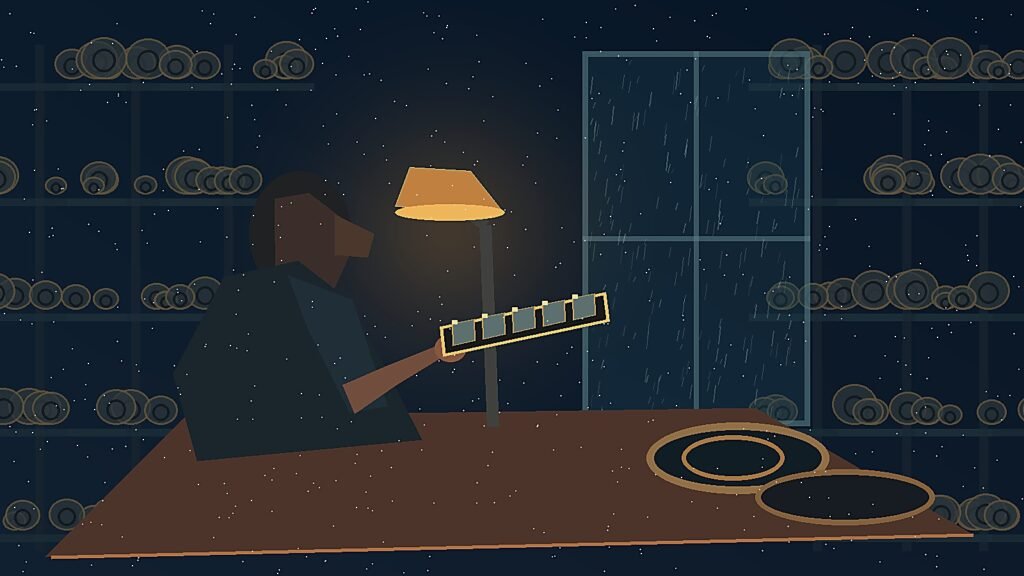
The first time somebody asked Nadra Vey what holiday was tomorrow, she was standing on a chair she had been specifically forbidden to stand on, trying to remove a dead moth from the dining-room chandelier.
“Returning Day,” she answered, without looking down. “Unless the council has found a way to cancel that too.”
The boy in the doorway considered this. He was nine, had lived in Verin for six weeks, and regarded the town as an assembly of baffling adult rules. “My teacher said it was the day everyone comes home.”
“That is the theory.”
“Then why did she say my family couldn’t be in the parade?”
Nadra took hold of the dead moth, climbed down, and searched for a way to explain civic hypocrisy to a child whose homework still had stars drawn in the margins.
“Because,” she said eventually, “your teacher is very good at remembering the rules and not always as good at remembering why we invented them.”
The boy was called Sami. He lived above the mechanic’s workshop at the end of Orchard Lane with his mother, who worked nights repairing the refrigerated trucks that brought fish to the market. He had come to return a saucepan. Nadra had lent it to them because the stove in their rented flat was too small for the pan they owned, and because lending things was still an acceptable way to begin a friendship without embarrassing either party.
Sami placed the saucepan beside her sink. “If you have to be born here to come home, how can anybody new ever come home?”
Nadra regarded the boy with the weary respect one reserves for a person who has discovered a problem that three committees have spent forty years refusing to solve.
“I will need to sit down to answer that,” she said.
I. A celebration with a guest list
Verin was built on two hills joined by a long stone bridge. Every spring, on the anniversary of the bridge’s reopening after a disastrous winter, the town celebrated Returning Day. Families tied ribbons around balcony rails. Bakers made orange-scented buns. People who had moved away came back and told exaggerated stories about how narrow the streets had become. A brass band marched from the north hill to the south, playing one march with such spectacular wrong notes that the children sang them on purpose.
Forty years earlier, the day had meant something simpler. During the long winter when the bridge was closed, some residents had been trapped on the far hill, others had taken shelter with strangers, and a few families had spent months sleeping in one room with whichever relatives could offer space. When the passage reopened, people carried benches outside so everyone could eat together. A chair had been a chair. It had not yet become an indicator of whether you belonged.
But ceremonies have a way of discovering sponsors. The simple shared meal became a parade, the parade became a heritage festival, the festival acquired a brochure, and the brochure developed a page titled Authorized Founding Families. To dine in the central square, a household now needed a ticket, a family registration number, and the patience to survive a form that required the maiden names of grandmothers who had been dead since the previous century.
Nadra’s late husband, Yusuf, had called the ticketed dinner “a picnic that has put on a necktie.” He was a carpenter, a generally mild man except when confronting a badly built cupboard or an unnecessarily complicated rule. On the first Returning Day after their marriage, he had carried every chair they owned into the street.
“What if somebody breaks one?” Nadra had asked.
“Then they’ll have a place to sit while I mend it.”
That was Yusuf’s entire philosophy of public life. He had never developed a more sophisticated one, and Nadra, who had once considered this a failing, now suspected it had been his great achievement.
Yusuf had been dead for four years. Their chairs remained: fourteen mismatched objects occupying the dining room as if the house had been preparing for a gathering that no one had remembered to attend. Nadra dusted them in a particular order. Six was the wobbly green chair where her daughter Rana used to do her schoolwork. Eleven had a burn mark from the year Yusuf made the disastrous mistake of demonstrating that varnish was not flammable. Four was the chair he used at breakfast until he could no longer climb the stairs.
This year the official parade would pass beneath her windows. For the first time, the committee had installed a ticket checkpoint at the southern end of Orchard Lane. Nadra had discovered this by watching two men carry an enormous sign past her house: WELCOME HOME — ADMISSION BY RESERVATION.
She had laughed so hard she frightened her cat, who was not easily frightened and had once challenged a passing delivery van.
Then Sami asked his question, and the laugh no longer seemed adequate.
II. The borrowed chairs
Nadra began with the green chair. She took it into the lane, rubbed the dust from its back, and placed a folded paper on the seat.
RETURNING DAY. SUPPER AT SUNSET. COME AS YOU ARE. BRING NOTHING IF YOU HAVE NOTHING. BRING A CHAIR IF YOU HAVE ONE.
She wrote fourteen copies in the careful handwriting of a woman who had once taught children to form letters properly, then immediately added a fifteenth for the cat, whose capacity to invite conflict ought not, she decided, to exempt him from community responsibility.
Her first guest was Sami’s mother, Amara, who studied the invitation in the half-light of the workshop while a refrigerator unit rattled on the bench behind her.
“What are you celebrating?” Amara asked.
“A town having forgotten its manners.”
“Is that a holiday?”
“It will be if I can get the bakery to cooperate.”
Amara looked at her hands, blackened with engine oil. “I don’t know anybody here.”
“Then, by a startling coincidence, you have the exact qualifications necessary to meet people.”
Amara smiled, reluctantly. “I can bring a broken folding chair. I keep meaning to repair it.”
“Leave it by the gate. It is the only sort Yusuf ever understood.”
The invitations traveled along Orchard Lane in ways Nadra had not planned. The delivery cyclist took one for his grandfather, who had not been outside since his wife died. The baker took three and sent back a tray of buns she had not ordered. A young nurse from the night clinic put a note under Nadra’s door: I finish at seven. May I come late? Nadra wrote back: There is no such thing.
By midday, thirty-one people had said they might attend. That was twenty-eight more than she had expected and sixteen more than her table could hold. She went to the carpenter’s yard, where Yusuf’s former apprentice, Bash, listened to the problem while scraping paint from a window frame.
“You need a longer table,” he said.
“I need people to stop owning so many elbows.”
“That’s harder to arrange.”
Bash lent her four trestles and two broad doors salvaged from a demolished hotel. Their brass handles hung over the ends like accidental decoration. Three teenagers carried them home on their shoulders. A delivery woman donated plates from a restaurant that had closed. Someone produced a box of forks, half of them too small for polite dining and the other half better suited to gardening.
The festival committee discovered the preparations shortly before lunch. Its chairwoman, Mrs. Salvi, arrived in a gray linen suit, carrying the expression of a person who had identified an unauthorized source of happiness.
“Nadra,” she said, “I understand you’re organizing an event.”
“Only supper.”
“During the official festival.”
“What an unfortunate coincidence.”
“You’ll need to submit a request for temporary outdoor seating.”
“How temporary?”
“That depends on the approval.”
“I mean the seating. The chairs have been in my family since my wedding.”
Mrs. Salvi did not smile. She had been a friend of Nadra’s once, before the committee began to consume all her evenings and most of her sense of proportion. “The central square is reserved.”
“I have no intention of using the central square.”
“The lane may obstruct the parade.”
“Then I will put the food inside my courtyard.”
“And if people gather outside?”
“I will ask them not to stand in front of the fire exit.”
It was not a victory, exactly. Nadra knew enough of regulations to know that a private gathering could become a public event with one complaint and a poor-tempered inspector. She decided to keep the main table within her courtyard, leave the lane passable, and borrow the adjoining courtyards with their owners’ permission if needed. If she was going to make a point about belonging, she would not begin by making the neighbors unsafe.
Mrs. Salvi looked past her at the chairs. “Yusuf would have enjoyed this.”
Nadra felt the quick sting of hearing his name used in the present, as though he might still be in the kitchen looking for his spectacles.
“He would have made you carry the tables,” she said.
Mrs. Salvi gave a small sound that might have been the beginning of a laugh. Then she left, taking her clipboard and her certainty with her.
III. An empty chair is not an accusation
The most difficult invitation was the one Nadra had not written.
Her daughter Rana lived three towns away. At thirty-six she managed a hotel, spoke rapidly, and had learned to keep her mother at a careful conversational distance. They telephoned on Sundays. They discussed the price of vegetables, the health of the cat, and whether Nadra ought to have the roof inspected. They did not discuss the year Rana came home after a painful divorce and Yusuf told her, in anger, that she was not to bring her troubles into the house.
He apologized eventually, though never with the directness she deserved. Rana moved out again. There were birthday calls, awkward holidays, parcels delivered by courier. By the time Yusuf fell ill, there was a narrow peace between them, but no way to recover the years spent protecting their pride.
Nadra sometimes wondered if she had made the greater mistake. She had understood that Yusuf was wrong, yet had let him do the speaking. Silence could appear in a family as good manners and harden into an entire history.
At four o’clock, while polishing the green chair, Nadra called her daughter.
“Hello, Ma,” Rana answered. A hotel lobby murmured behind her. “Everything all right?”
“I’m having supper tomorrow.”
“You do that most days.”
“With some people.”
“How many?”
“At the moment, thirty-one. It may become fifty if the baker is counting generously.”
Rana was silent. Then she laughed, a sound Nadra had missed more fiercely than she allowed herself to know. “What have you started?”
“Possibly an international incident.”
“Are you inviting me?”
There were a dozen ways to answer indirectly. Nadra could mention the food, the festival, the nice weather expected after sunset. She could make the invitation sound as though it cost nothing.
“Yes,” she said. “I am asking you to come home. I know it hasn’t always been a comfortable place for you. I should have said that years ago.”
The lobby sounds grew clearer during the pause. A suitcase rolled across tiles. Somebody called for a taxi.
“I have a shift tomorrow,” Rana said.
“I understand.”
“I don’t know if I can change it.”
“I understand that too.”
After they hung up, Nadra sat for a while with the green chair before her. She had not been refused; she had not been promised. An honest invitation, she discovered, did not remove uncertainty. It merely made uncertainty possible to bear without making the other person responsible for it.
IV. Supper at sunset
On Returning Day the official band crossed the bridge at noon, its horn section arguing cheerfully with the trumpets as usual. There were ribbons on the balconies and a minister’s speech about continuity. The reserved dining tables gleamed beneath white canopies. The ticket scanner worked for exactly forty-three minutes before failing, at which point the guests were asked to wait beside a sign reminding them to be patient while their heritage was verified.
In Nadra’s courtyard, lunch had become a logistical emergency. Two children were peeling oranges for the buns, although their work appeared to involve eating every fourth orange. Amara had borrowed a large stockpot from the workshop canteen and was supervising a stew with the concentration of a mechanic listening for a faulty bearing. Bash had assembled the hotel doors into a table wide enough to seat an entire municipal subcommittee, though nobody said this aloud for fear the subcommittee might arrive.
Sami had appointed himself head of seating. He drew a map identifying the adults as circles, the children as stars, and the cat as a small black storm cloud. He tried to put people beside others they did not know. Nadra noticed that he had seated a shy elderly man beside a woman who talked without pause. It was a social experiment she decided not to interrupt.
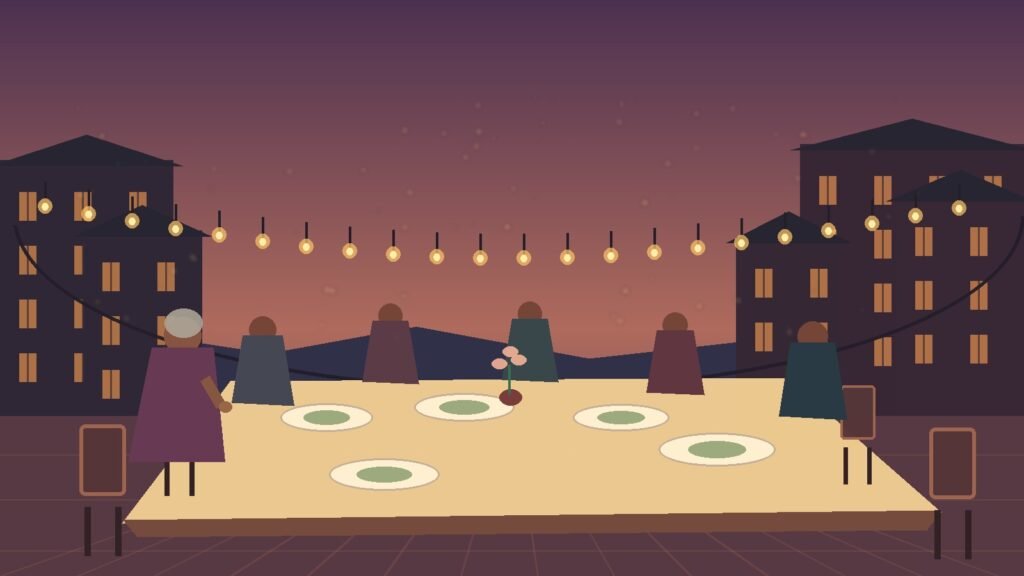
At six, the first guests arrived. A bus driver still in uniform brought pickles. A retired seamstress arrived with a basket of napkins she had embroidered from leftover fabric. Two cousins who had not spoken since a dispute over a fence found themselves holding opposite ends of the same tablecloth and were forced to negotiate, briefly, like diplomats. The night nurse came early after all, her clinic having managed to rearrange the shift.
Nobody asked anyone to produce a family registration number. Nobody announced who had been born in Verin and who had come later. The first toast was interrupted by the cat stealing a fish from a plate and fleeing beneath a bench. The second toast was not attempted.
Nadra moved among the guests carrying a bowl of olives. She noticed all the things Yusuf would have noticed: a chair leg beginning to wobble; an elderly neighbor moving gingerly because his knees hurt; a child stretching across the table for bread. She found a folded cloth for the chair leg, brought a cushion for the neighbor, and passed the bread. Practical care, she thought, was a language with surprisingly few grammatical exceptions.
Then Mrs. Salvi appeared at the gate.
She stood for a moment watching the long table, the borrowed dishes, the unmistakable absence of a seating chart. The formal festival had ended with a speech from the mayor, who congratulated the town for its extraordinary welcome. Mrs. Salvi had spent the afternoon processing complaints from people who had been turned away because their names did not match the records.
“I came to make sure the lane is clear,” she said.
“It is.” Nadra moved aside so she could see. “Would you like to inspect a chair?”
Mrs. Salvi’s lips moved in spite of her. “I don’t have a reservation.”
“We have been careful not to develop that technology.”
Nadra placed a clean plate before the oldest empty chair. The committee chairwoman hesitated, then sat. A few people looked surprised. Nobody made a speech about it. Amara handed her stew; Sami asked whether she wanted bread; within five minutes she was arguing with Bash about the correct way to restore the bridge’s wooden handrails.
The sound of the meal spread into the next courtyard, where two neighbors had opened their gates. People who had only intended to pass through stopped to talk. Some stayed for supper, others simply took tea and left. There was food enough, with a little improvisation. No one claimed the gathering had repaired the town’s divisions. By the end of the evening, several old disagreements were still intact, merely better fed.
At half past seven, Nadra heard a taxi stop outside.
She did not turn at once. She was helping Sami balance a stack of plates, and part of her feared that if she looked too quickly, the figure at the gate would turn out to be someone else. Then a familiar voice said, “I was told there would be only thirty-one guests.”
Rana stood beneath the string lights with her travel bag against one ankle. Her hair was damp from the evening mist. She looked tired and amused and frightened of being made into a spectacle.
“The baker was conservative,” Nadra said.
They looked at each other for a moment. Nadra wanted to rush forward, to ask how long she would stay, to pour every apology she had stored for a decade into one impossible sentence. Instead she moved the green chair away from the wall.
“Would you like to sit?” she asked.
Rana touched the worn edge of its back. “You still have this.”
“I tried throwing it away once. It came back in a very judgmental dream.”
Rana laughed. Then her eyes filled, and she did not hide it. Nadra held out a hand. Her daughter took it. Neither said anything wise. People at the table kept talking, respectfully allowing them not to become the evening’s entertainment.
V. The holiday after the holiday
The next morning Nadra woke to the noise of chairs being carried back through the courtyard. Her guests had returned to help, some still wearing clothes from the night before. Bash inspected a loose joint. The nurse washed plates. Sami had created an official inventory, including the cat, who had apparently counted as a guest and eaten the equivalent of three portions.
Rana was sitting on the green chair beneath the fig tree, drinking tea. She was not transformed. She had a shift to return to, bills to pay, and reasons for having kept her distance that would not vanish because one supper had gone well. But she had slept in her old room. In the morning she had walked downstairs without asking permission.
“I could visit again next month,” she said.
Nadra set a second cup beside her. “I’d like that.”
“You don’t have to prepare a festival.”
“I would struggle to stop myself.”
Across the courtyard, Sami was explaining his homework to Mrs. Salvi. He had been asked to write three sentences about tomorrow’s holiday. He had written seven. The teacher would have to manage.
“Returning Day,” Sami read aloud, “is when people come home or find a place they can come to. We borrowed chairs because we had more people than chairs. Next year I think we should borrow tables too.”
Mrs. Salvi read the page, then looked toward Nadra. “The committee could consider an open supper next year,” she said cautiously.
“You may,” Nadra replied. “But if you print tickets, I will personally feed them to the cat.”
The boy folded his homework. Over the roofs of Verin, the bells began to ring the ordinary hour. Returning Day was over. Shops would open, buses would run, invoices would arrive. Nothing in the calendar could promise that people would remain kind to one another when the lanterns came down.
Nadra carried the chairs inside one by one. At number six she stopped, looking at the worn green paint where Rana’s fingers had rested.
For years she had kept the chair empty as if emptiness were a form of loyalty. Now she understood that the chair had never been waiting for one perfect return. It had been waiting to be used.
She set it near the window, where the morning light fell. From the workshop came the noise of Amara coaxing a stubborn engine back to life; from the lane came Sami’s voice asking the next important question. Nadra could not hear all the words. She was certain that whatever he asked, it would be difficult.
She opened the door anyway.
Editorial note: Returning Day, Verin, and the characters are fictional. This is an original story about hospitality and homecoming, not a live calendar of national or religious holidays. Actual holidays depend on your location and the date.