
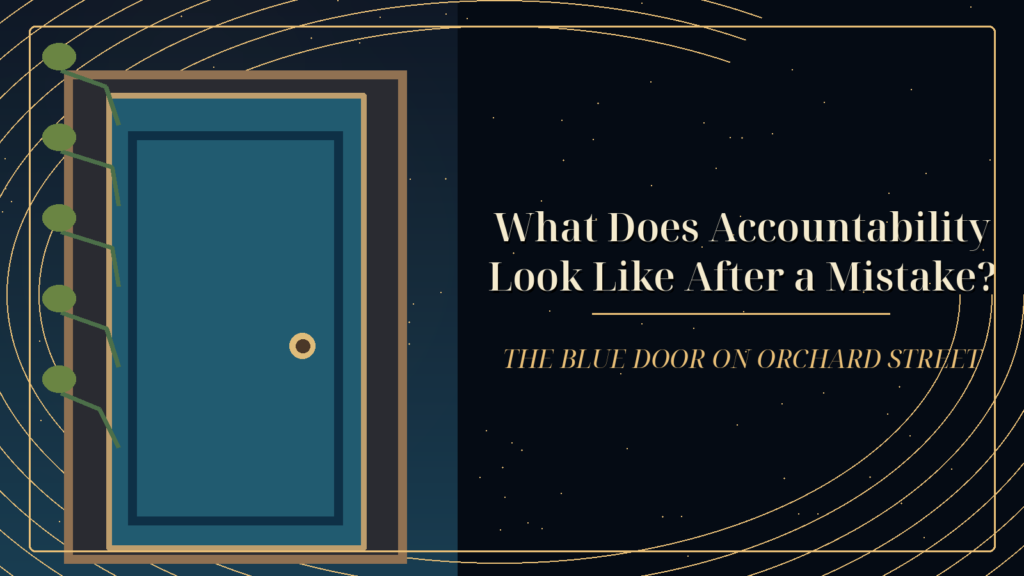
What does accountability look like after a mistake? It is more than confessing, feeling guilty or making a persuasive apology. It means identifying the harm, listening to those affected, correcting what can be corrected and changing the decision-making process that allowed the mistake. Research on guilt and moral behavior, including Tangney, Stuewig and Mashek’s review, provides useful context for why remorse may support repair but cannot replace it. This original story follows a neighborhood project director whose cheerful publicity campaign turned several people’s front doors into signs they had never agreed to display.
The first person to complain about the blue door was not the woman who lived behind it.
It was a boy with a red schoolbag.
He stood on the pavement outside number fourteen Orchard Street, watching two strangers photograph the door from across the road. One held a camera. The other was explaining that the blue paint identified homes restored through the Helping Hands project.
“That’s our house,” the boy said.
Neither stranger appeared to hear him.
“Excuse me,” he tried again. “That’s where we live.”
The photographer lowered her camera.
“We’re doing a community article,” she said.
“Did my mum say you could?”
The woman with the notepad smiled in the way adults sometimes smile when a child asks a question they have no intention of answering.
“We’re celebrating the work that was done here.”
The boy looked at the blue door, then at the camera.
“My mum only wanted the stairs fixed,” he said.
I heard that sentence because I was coming down the street carrying a box of pamphlets announcing our next volunteer weekend.
My name is Leena Qureshi. I directed the Orchard Street Home Repair Project, a small neighborhood organization that matched donors and skilled volunteers with residents needing minor work on older houses. We painted exterior woodwork, repaired loose steps and helped people apply for more substantial repairs through appropriate professional services.
We did not build new homes. We did not promise to solve the housing crisis. We tried to make existing homes a little safer and more comfortable.
For three years I had worked there with a belief that small practical kindnesses were undervalued. I hated photographs of smiling people standing beside enormous charity checks. I wanted a project that looked like work: ladders, paint on old shoes, weather-sealed frames, steps that no longer moved when a person stood on them.
Then I helped turn the work into a picture of itself.
The blue doors began as a donation. A paint supplier offered fifty cans of weather-resistant blue finish after a contractor cancelled an order. The color was rich and deep, somewhere between a night sky and a wet slate roof. We had a limited budget for supplies. Free paint meant we could complete more repairs.
I showed residents a sample card and asked whether they wanted their doors repainted. Most who agreed liked the color. Others chose a different finish from the small amount of stock we already had. Nobody was required to take blue paint as a condition of assistance.
That was the part I repeated whenever I needed to feel that nothing had gone wrong.
What I had not explained was the decision I made later.
Our fundraising committee wanted a way to show donors what their contributions had accomplished. I suggested a walking map of the street, with photographs of the newly painted doors and a line about the repairs completed at each address. I called the campaign THE BLUE DOORS OF ORCHARD STREET.
The map appeared online. It did not list people’s incomes or describe why they had requested help. But it showed their homes and used the words homes supported by our hardship repair fund.
Anyone who knew the street could identify the houses.
We had asked for permission to paint.
We had not asked permission to turn those houses into public examples of receiving assistance.
The first emails were positive. A local paper wanted photographs. A company offered funding. A donor called to say she had walked past three blue doors and felt she could finally see where her money went.
I felt proud.
Then the boy with the red schoolbag asked why strangers were photographing his home.
I put down the box of pamphlets.
“I’m sorry,” I told him. “They should have asked.”
His mother opened the door before he could answer. Her name was Farah. She worked long hours at a bakery and had applied for help after the front steps shifted badly in wet weather. She was not in financial trouble because she had done something wrong. The house was old, the landlord’s response to the repair request had been slow, and the project had arranged a permitted minor repair with written approval.
Farah looked at the camera, then at me.
“Did you send them?”
I wanted to say no. I had not invited those two particular people. I had not known they would arrive that morning.
Instead I said, “I put the map online. That’s how they found the door.”
“Take the map down.”
“I will.”
“And ask them to leave.”
I turned to the photographer.
“This is a private home,” I said. “The resident does not consent to photographs. Please stop and leave.”
They protested that the image was already on our website.
“That doesn’t give you permission to take more,” I answered.
They walked away without apologizing.
Farah kept her hand on the doorframe.
“You told me this was about fixing the steps,” she said.
“It was.”
“Then why are people treating my house like a museum?”
I had no useful answer.
She closed the door, not loudly, but with a finality I felt in my stomach.
I went back to the office and removed the walking map from the website. I sent a request to the local paper asking it not to use the photographs or identify the houses. I could take down our material. I could not promise that copies already shared would disappear.
The fundraising chair, Owen, arrived carrying a stack of printed flyers.
“What’s happened?” he asked.
I told him.
He looked at the title across the top of the flyer.
“But the residents chose the color.”
“They didn’t choose the campaign.”
“They were happy when the work was done.”
“That isn’t permission to publicize where they live.”
He sat down.
“I thought we were trying to normalize asking for help.”
“So did I.”
“Then perhaps we’ve done the opposite.”
That was the moment I understood that good intentions were going to make this conversation harder, not easier. We had genuinely wanted to reduce embarrassment around seeking help. We had tried to accomplish it by drawing attention to the people who had accepted it.
My own childhood made the mistake feel especially inexplicable.
My mother once lived in a rented flat with a broken heater. She kept asking the property owner to repair it and, for one winter, warmed our rooms with borrowed electric blankets and thick curtains. A neighbor eventually helped her find the right service to inspect the system and resolve the issue.
The help mattered.
So did the neighbor’s discretion. My mother told the story freely years afterward, but only when she chose to. Nobody posted a photograph of our flat with a sign describing our circumstances.
I knew what dignity felt like when it was protected.
I had forgotten to protect it when I became responsible for the project.
That evening I called my mother and told her what had happened. She listened carefully, then asked whether anyone had been offered the choice not to appear on the map.
“No.”
“Then where was the choice?”
“They could say no to the paint.”
“That isn’t the same thing.”
“I know.”
“Do you?”
She wasn’t trying to be cruel. She wanted me to stop using a partial truth to hold a larger truth at arm’s length.
For several days I felt the heavy, useless kind of remorse that makes every moment of a person’s life seem to refer back to one error. I understood why guilt can become an effort to prove we are suffering enough instead of a guide toward better decisions.
The suffering did not change a single door.
On Monday I asked the project trustees to hold an emergency review. I submitted the original publicity proposal, the paint consent forms, the online map and a list of places where the photographs had been shared. I did not edit the documents to make the omission look smaller.
I recommended we stop publishing identifiable repair sites without separate, informed permission. I also proposed that residents be offered a choice to repaint or retain their doors at the project’s expense, regardless of whether they complained.
One trustee said that was too generous.
“People chose the blue,” she said.
“They did,” I replied. “But the color acquired a meaning we imposed afterward.”
Owen supported the proposal.
“Can the campaign budget pay for it?” he asked.
“Most of it. We will need to postpone the autumn publicity event.”
Nobody seemed devastated by the cancellation of a publicity event. It was a useful reminder of where the project’s priorities should have been.
We approved the remediation plan, documented the incident and arranged for someone independent of the publicity team to contact residents privately. The message explained what had happened, what material had been removed and what help was available. It did not ask people to recount embarrassment or prove that the campaign had upset them.
We could not promise full deletion of materials already saved elsewhere. We could promise to stop creating new exposure and to make reasonable requests for removal when copies were found.
Farah was the first resident I visited personally, at her request.
She had taken down a small blue ribbon we had tied to the rail during the repair-day celebration. The repaired steps were clean and even. Her son’s red schoolbag rested in the hall.
“I don’t want a different color,” she said.
I was surprised.
“You don’t?”
“I like blue. My son chose that shade.”
I looked at the door.
“Then what would you like us to do?”
“I want your organization to stop telling people that this door means something about our money.”
“Yes.”
“And I want the photos removed.”
“We’ve taken ours down and contacted the paper. We can’t guarantee every copy is gone.”
“I know.”
She sighed.
“People at work found the campaign. They asked whether I was in trouble. Someone said the project only helps families who can’t manage their lives.”
“I’m sorry.”
“Don’t make me reassure you,” she said.
I went quiet.
That had become my habit: using a sincere apology as a question that asked the injured person to provide a soothing answer.
Farah sat on the second step.
“My son asked whether we were poor,” she said. “Not because we have less money than some people. Because strangers were looking at our house like it told them something they were entitled to know.”
I stood beside her.
“What did you tell him?”
“That our house needed fixing and some people helped. That’s all they needed to know.”
There was a pause.
“Please tell your volunteers that accepting help doesn’t make a home public property.”
“I will.”
I wrote down her exact words after she said I could.
At number twenty-two, a retired bus driver named Gordon wanted his blue door repainted. He told the coordinator that people had begun making comments about the house he had worked to maintain for decades. We offered the color he chose and arranged the work without asking him to repeat his story for a photograph.
At number six, a family wanted the blue to stay and asked whether it was safe to paint the garden gate the same shade. We told them it was their choice and that the project had no claim over the color.
At number thirty-one, a resident wanted no contact beyond confirmation that their address had been removed from our publicity. We honored that.
The responses were different. They did not form a single heartwarming lesson.
I remembered how shame can make a person withdraw from ordinary connections and understood that our public campaign had created risks we had no right to dismiss simply because several residents had enjoyed the attention.
The review took six weeks. We counted every photograph we had published and documented which platforms had confirmed removal. We updated our consent procedures so that accepting repairs, consenting to optional publicity, and accepting a particular paint color were separate decisions. We revised our donor reporting to use aggregate numbers and non-identifying photographs of materials, with clear explanation of what each measure actually represented.
Some donors complained that the new reports were less exciting.
Owen answered them himself.
“Residents are not a demonstration product,” he wrote. “We can show our work without making people give up their privacy.”
I read his email three times. It was shorter than my proposed statement and better.
The project continued. It moved more slowly for a while. Volunteers were trained not to assume a camera was welcome because someone had smiled on repair day. Contractors received clearer instructions about site information. We asked residents which completed improvements they wanted described publicly, if any, and made declining publicity a simple, consequence-free option.
One Saturday a new volunteer named Kit arrived with a camera around her neck.
“Where should I take the before-and-after photos?” she asked.
“First, let’s talk about what we’re recording and why.”
She lowered the camera.
“Has something happened?”
“Yes,” I told her. “We made a mistake by publishing homes without separate permission. We’re changing the way we document work.”
She listened, then asked whether we still needed pictures for technical records.
“Sometimes,” I said. “But that doesn’t mean they belong on a website. The purpose matters, and so do the permissions.”
Kit nodded.
“Could we photograph a sample door frame in the workshop instead?”
“That would help.”
We set up a demonstration with donated timber and showed the repair technique without identifying a residence. The photographs were less sentimental and more useful to volunteers who wanted to learn.
In early autumn the neighborhood held a street gathering unrelated to our project. Someone hung lanterns between the houses. Children ran between tables carrying pastries. Farah arrived with her son, who had traded his red schoolbag for a paper crown.
I was stacking chairs when she approached.
“The steps are holding,” she said.
“I’m glad.”
“And we’ve put a little plant beside the door.”
“I saw it.”
She looked at me.
“I still think you should have asked before publishing anything.”
“You’re right.”
“I also don’t want that to be the only thing anyone remembers about the project.”
I had been preparing to say that I deserved the criticism. It was true, but it wasn’t what she had asked.
“What would you want them to remember?” I said.
“That the steps were fixed properly. That the volunteers did their jobs. That we got to choose what happened next.”
I nodded.
“And that some of us like blue,” she added.
Her son waved his paper crown at us.
The door at number fourteen stood behind them, its paint dark in the evening light. No marker identified it as a recipient of charity. No sign invited strangers to take a photograph. It was simply the color of a home whose occupants had chosen to keep it.
That evening I visited my mother again. She had kept a copy of the project’s old pamphlet, with its cheerful headline and a photograph of three doors in a row. I asked why she hadn’t thrown it away.
“So I can remember the mistake,” she said.
“I don’t need help remembering.”
“Perhaps not. But a record can teach us how much other people rely on our words. Keep the facts accurate and you won’t need to keep repeating the shame.”
She took the pamphlet to the recycling bin.
The following week I presented the revised policy at our annual community meeting. It included a simple public account of the error, the remedial work completed, the limits of what we could remove, and the steps we had introduced to prevent recurrence.
I did not display a montage of residents’ grateful faces.
I spoke for seven minutes and then asked for questions.
One person asked whether we were wasting money repainting doors. I explained that residents had chosen colors before our later campaign assigned the blue a public meaning, and that the choice to change or retain it was part of our responsibility for the mistake.
Another asked whether we should stop taking photographs altogether. I said documentation could serve legitimate technical or reporting purposes, but that those purposes needed to be distinguished from public promotion and handled with proper permission.
A third asked whether the program was still worth supporting.
“Yes,” I answered. “The need for repairs hasn’t disappeared because we mishandled publicity. But continuing the work means changing how we do it.”
I thought about the stories in which shame seems to demand either public punishment or instant redemption. Real accountability seldom provides such a clean ending. It consists of forms, conversations, corrected choices, and other people retaining the right to decide how much of our work they want near their lives.
The trustees voted to continue the repair project with the new rules and an annual review of consent and privacy practice. A few donors withdrew. New donors joined. The finances remained tight, and we stopped pretending a growing list of supported houses was an adequate measure of whether we had treated residents well.
Months later, I passed Orchard Street on my way to the bus. The blue door at number fourteen was open. Farah’s son was holding it while his mother carried a plant inside.
He saw me and called, “The stairs still work!”
“I’m glad,” I answered.
He closed the door.
I did not stop to take a photograph.
In the project report that year, we included the number of repairs completed, the number of follow-up visits and the independent issues raised by residents. We reported the publicity error and what we had done in response. We did not add a photograph of the blue door.
The story of that house no longer belonged to our fundraising materials.
It belonged to the people who lived behind it.
I kept walking.
There were still houses on the street whose steps needed fixing. We had work to do, and for once I knew that doing it well would not require everyone to see us doing it.
After the story: Orchard Street, its repair project, publicity incident and all named characters are fictional. Privacy and consent obligations vary by jurisdiction. The story’s focus is the difference between agreeing to a repair and separately authorizing public identification, not a specific legal ruling.


