Past to the Future | Volume 6 | Part 7
Historical Scope: This chapter follows the expansion of British East India Company power in South Asia, the uprising of 1857 to 1858 and the establishment of Crown rule. A fictional household associated with a Lucknow bookshop provides the narrative thread. Its members, their dialogue and their private documents are invented and must not be mistaken for surviving testimony. The documented history draws on the research of the UK Parliament, the National Army Museum and Columbia University Asia for Educators.
The Bookshop That Kept Two Ledgers
Near Lucknow, in a fictional street that stands for no single historical address, a young copyist named Zainab watched her uncle write the same transaction in two ledgers. The first recorded the price of paper and the money owed by customers. The second recorded what those customers had been talking about: an official removed, a tax demanded, a soldier’s allowance altered, a court order no one in the neighborhood entirely understood. Her uncle was not collecting revolutionary slogans. He was trying to keep a shop open while the rules surrounding it changed.
“Which of these books tells the truth?” Zainab asked. “Both,” he replied, “but neither tells the whole story.” The exchange is fictional. Its central difficulty is not. The history of nineteenth-century South Asia cannot be reduced to an account of European rulers and Indian subjects, or to one decisive military uprising. It is also a history of merchants, soldiers, peasants, landlords, artisans, religious institutions, and regional political authorities whose choices shaped what empire could accomplish.
Across oceans, industrial and military transformation connected production to conquest. The earlier chapter on Coal, Cotton And The New Factory explored how demand for materials and markets traveled along uneven lines of power. In South Asia those relationships rested upon much older commercial networks, sophisticated states and communities already capable of regulating trade and defending political interests. The empire entered an inhabited world, not an empty map.
Before An Empire There Were Many Polities
By the eighteenth century the Mughal Empire, powerful in earlier periods, had become politically fragmented. Regional states and rulers, including the Nawabs of Bengal and Awadh, the Marathas, Mysore and Sikh authorities, pursued their own projects. They sometimes cooperated, competed, hired European military specialists or contested territory. No single South Asian political identity explains their decisions. Treating them merely as obstacles to a British advance erases the history of diplomacy and administration that preceded it.
The English East India Company began as a commercial enterprise under a royal charter in 1600. It negotiated access, traded goods and became increasingly entangled in local politics. Its transformation into a territorial power took place through military victories, alliances, revenue arrangements and continuing parliamentary intervention. Commercial privilege could finance armies, and armies could secure privileges. That circular process would become one of the defining mechanisms of Company expansion.
Historians debate how to balance European military power, divisions among regional polities and active South Asian collaboration in explaining the Company’s gains. It is important to resist two opposite simplifications: that all Indian rulers welcomed Company power, and that every advance reflected an inevitable foreign superiority. People acted under constraints, calculated advantage and changed sides. The eventual outcome should not be mistaken for something everyone could have predicted.
From Bengal To The Revenue Office
The Company’s victory at Plassey in 1757, following alliances and political maneuvering, helped establish its influence in Bengal. The Battle of Buxar in 1764 further strengthened its position. In 1765 the Company received the diwani, or right to collect revenue in Bengal, Bihar and Orissa, from the Mughal emperor. Revenue rights mattered as much as military occupation. When a trading company could direct the flow of taxation, it could pay soldiers and administer an expanding political system.
An official might describe a revenue assessment as a rational rule. A cultivator might experience it as a demand made under threat of seizure. The details varied widely by region and period, and no single land settlement represented all of colonial India. Revenue extraction, commercial pressure, changing property rights and climatic stress could interact dangerously. Claims that one policy alone explains every famine or agricultural change often go beyond what the evidence establishes.
Consider the fictional ledger in the Lucknow shop. Before an order was issued, an entry might record a family’s debt after a bad harvest. After the order, it might also record expenses for a petition, a translator and a journey to a court. Administration did not arrive merely as a flag. It appeared as paperwork, taxes, property disputes and the cost of obtaining a hearing.
An Army Built With Indian Labor
The British East India Company’s armies were never simply British armies stationed abroad. Large numbers of Indian sepoys served within them, alongside European officers and troops. Recruits entered for pay, status, family networks and other reasons; their expectations included allowances, customary practices and respectful treatment. Recruitment patterns also differed between regional armies. A system that relied heavily on Indian soldiers could become highly vulnerable when those soldiers no longer trusted its commanders.
The Company depended on Indian intermediaries throughout its administration. Clerks, revenue agents, translators, merchants and local magnates gave the apparatus practical reach. Some acquired influence through these positions; others found their room to maneuver narrowed by changing rules. In the earlier The State, The Tax And The Cost Of War, we considered how states finance authority. Here we encounter a company exercising many functions of a state, even though its original legal identity was commercial.
The word collaboration is sometimes used as though everyone involved consented freely. The reality could range from enthusiastic partnership to fearful accommodation. Likewise, resistance could mean armed conflict, legal petitions, desertion, evasion of taxes or preserving practices officials wished to change. An account focused only on battles misses the struggle over ordinary governance.
Promises Of Reform And Their Uneven Consequences
Colonial authorities justified aspects of their rule through the language of law, efficiency, education and reform. Measures could alter courts, communications, schooling and selected social practices. Local reformers also pursued their own agendas, sometimes using new institutions and sometimes condemning colonial interference. The existence of reform did not settle the question of legitimacy. Who defined the problem, who possessed the power to act, and who bore the cost remained essential questions.
Policies concerning inheritance, property, religious institutions and princely states caused deep anxiety. The annexation of Awadh in 1856 was especially consequential, affecting not only its former ruler but officers, retainers, landholders and households connected to older systems of patronage. The National Army Museum’s account identifies annexation among the grievances feeding the uprising. It is a concrete reminder that high politics changes livelihoods in streets far from a governor’s chamber.
In Zainab’s imagined neighborhood, one family hopes that a modern court will settle an old dispute; another fears losing a claim that relied on custom; a third wants its children to learn languages useful for employment. These reactions are invented, but their diversity reflects the need to avoid treating society as one voice. Institutions may create new opportunities while also enforcing unequal sovereignty.
Religion, Rumor And Trust
The immediate military crisis of 1857 is closely associated with cartridges for the new Enfield rifle. Soldiers were expected to bite open cartridges, and rumors that they were greased with cow or pig fat prompted fear of violating Hindu or Muslim religious commitments. Historians describe the cartridge issue as an immediate trigger rather than a complete explanation. Anxiety about religious interference had already accumulated within an environment of military and political grievance.
To an officer who considered the cartridges a technical supply matter, a protest might appear irrational. To a soldier whose trust had already deteriorated, assurances could sound like another demand to ignore conscience. Rumor can be historically consequential without every rumor being true. The larger issue was whether people believed the institution making the demand had earned the right to be believed.
Missionary activity, reform legislation and public controversy intensified fears that colonial rulers might seek to transform religious and social life. At the same time, communities were not neatly divided into religious blocs. Hindus, Muslims and others occupied different positions as soldiers, landholders, officials and civilians, often forming shifting coalitions. The patterns of participation in 1857 cannot be summarized as one religious war.
Meerut And The Road To Delhi
On 10 May 1857, a military uprising began at Meerut, following the punishment of sepoys who had refused orders associated with the cartridges. Rebel soldiers moved to Delhi, where the aging Mughal emperor Bahadur Shah Zafar became a symbolic figurehead for the revolt. The choice of Delhi drew upon the continuing political prestige of the Mughal name, even though imperial authority had long been diminished.
News did not travel through a perfectly reliable network. Stories of victories, atrocities and defections circulated along roads and in marketplaces. In some districts the rebellion expanded beyond the Bengal Army to include landholders, dispossessed elites, artisans and other groups. In other areas Company authority endured and substantial Indian forces supported it. The uprising was geographically extensive but not uniformly subcontinental.
The National Army Museum dates the outbreak at Meerut and describes the variety of motivations, while Columbia University’s historical overview places the rebellion in the longer history of Company rule. The distinction matters because a sudden outbreak can have long roots. A single date begins the fighting, but it does not begin the grievances.
Awadh: A Conflict Larger Than A Barracks
In Awadh, including Lucknow and the countryside around it, the rebellion drew upon political resentments generated by annexation and the disruption of relationships among landholders, peasants and the former court. This helps explain why military mutiny became connected to broader civil conflict in particular regions. The mixture of loyalties was unstable and could change as local circumstances shifted.
Women appear in the history not only as victims or observers. Begum Hazrat Mahal, associated with resistance in Awadh, emerged as a leading political figure during the struggle. Lakshmibai, the Rani of Jhansi, became another prominent figure in the war. Their situations were not identical, and neither should be transformed into a flawless modern symbol detached from her own political setting. Their historical significance includes concrete leadership and the ways subsequent generations have remembered them.
The imaginary copyist Zainab hears two versions of the same confrontation, both told with perfect confidence. Her uncle asks her to write the place and the speaker before the story itself. That act is a narrative device, but it suggests sound historical practice. Testimony produced amid fear, partisan newspapers and imperial propaganda demands careful comparison, not automatic dismissal or credulous repetition.
Delhi, Cawnpore And Lucknow In The Imperial Imagination
Major episodes of the fighting, including the struggles over Delhi, Cawnpore (Kanpur) and Lucknow, became central to British popular narratives of 1857. Accounts of attacks on British civilians provoked intense outrage, and public discussion frequently portrayed British military retaliation as a moral necessity. Yet retaliatory violence, including executions and collective punishment, caused grave suffering among Indians as well. The conflict cannot be narrated responsibly by treating one population’s dead as historically meaningful and another’s as background.
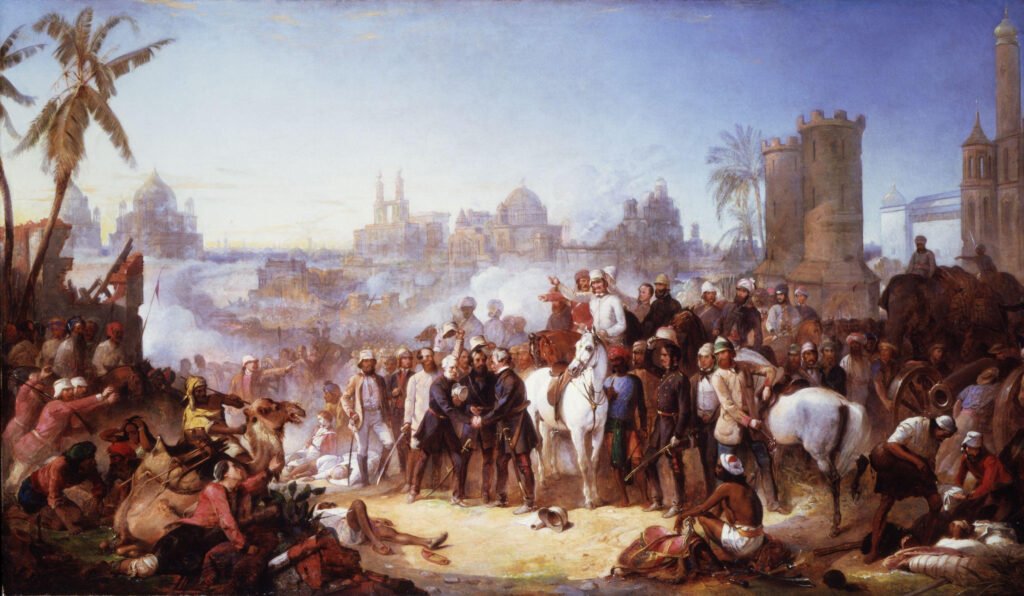
The painting used as this chapter’s featured image, The Relief Of Lucknow, 1857 by Thomas Jones Barker, offers a useful lesson about sources. It is a historical representation of British military action, not a photograph from which every surrounding event or individual perspective can be recovered. It records a particular way of seeing empire and heroism. Its public domain status makes it reusable; that does not make its perspective neutral.
The desire for a clean story is understandable. Violence shocks readers into looking for villains, heroes and an ending that restores the moral order. History is less accommodating. People suffered through siege, displacement, hunger and reprisals; many details remain contested or unevenly documented. A journal about humanity owes their experiences care without sensationalism.
Why The Uprising Was Not One National Program
Later writers have sometimes described 1857 as India’s first war of independence, while colonial accounts long favored the phrase Indian Mutiny. Both labels carry interpretive commitments. The term rebellion or uprising can help avoid deciding the argument before examining it, but it does not settle the question of who participated and what they sought. Some insurgents supported restoration of former rulers; others resisted annexation, military discipline or economic grievances. Their political imaginations did not necessarily match a later national movement.
People across the region did not act as a single collective. Numerous princely states and groups did not join the rebellion, and some Indian troops fought alongside Company and British forces. Sikh and Gurkha forces, among others, played important roles in suppression, though individual motives and experiences varied. The rebellion’s limitation was not merely a failure to coordinate. It was also the result of different interests, histories and calculations.
This unevenness should not be used to deny the importance of the uprising. It demonstrates that an event may be transformative without possessing one shared manifesto. The Cambridge history of the uprising stresses the conflict’s wider imperial consequences and the need to read local materials alongside military and administrative sources.
The Cost Of Retaking Control
British and Company forces eventually suppressed the revolt after prolonged fighting. Delhi was recaptured in September 1857; resistance continued elsewhere through 1858 and beyond in some areas. The reoccupation of cities did not instantly restore civilian life. Buildings were damaged, families displaced and economic relationships disrupted. Military success for one side offered no simple measure of what had been lost by the population as a whole.
Official reports, memoirs, illustrated newspapers and later histories differed in what they chose to highlight. Colonial accounts could glorify loyal officers while depicting rebels as faceless threats. Nationalist retellings might emphasize courage and sacrifice but compress disagreements among insurgent leaders. The task of historical interpretation is not to choose the most emotionally satisfying archive. It is to recognize the interests and limitations of each one.
In the fictional shop, some pages are torn out during the conflict, while others have their dates smudged beyond recovery. No historical document attests to Zainab’s shop; the scene simply reminds us that broken archives and silent witnesses affect the histories that can be written. We should not invent certainty where the record is thin.
The Government Of India Act Of 1858
The rebellion led to a decisive institutional transformation. The Government of India Act of 1858, documented by the UK Parliament, transferred the Company’s administrative powers to the British Crown. A secretary of state and new arrangements of imperial governance changed the chain of authority. It is more precise to say that Company government ended in 1858 than to claim that colonial rule began that year. A vast colonial system already existed.
Queen Victoria’s proclamation in 1858 promised certain forms of religious noninterference and protection under the new political order, but promises did not remove the hierarchy at its center. Indians remained subjects of a foreign imperial government, and representation was deeply limited. Reorganized military recruitment and new approaches to princes and landholders aimed to stabilize British power and prevent another revolt of comparable scale.
The shift from Company to Crown changed responsibility for decisions, but it did not turn conquest into consent. Political structures developed over subsequent decades, including councils, courts, educational institutions and infrastructure, inside an unequal distribution of sovereignty. To examine those developments is not to assume they were either wholly beneficial or wholly useless.
Railways, Telegraphs And The Power To Move
Railway lines, postal changes and telegraph networks expanded across nineteenth-century India, transforming travel, administration and commerce. These systems had multiple uses. They could connect markets, facilitate migration and circulate news, while also allowing officials to move troops, coordinate orders and manage resources across enormous distances. Infrastructure is not politically innocent merely because ordinary people find ways to benefit from it.
The previous chapter on Canals, Railways And Telegraphs described the worldwide acceleration of movement and communication. In South Asia, the question of who selected routes, paid for construction and controlled the resulting networks was especially important. Financial guarantees, land policies and military priorities shaped imperial transport as well as passenger demand.
These changes also created spaces of social encounter. Travelers could meet across linguistic and regional boundaries, printers could distribute political discussion and commercial communities could adapt their business. Not every effect was intended by colonial administrators. Technologies designed partly for control could also help produce networks of opposition.
The Economy Was Neither Frozen Nor Freely Chosen
Colonial economic history is a field of continuing debate. Indian textile production had long been internationally significant, and the nineteenth century brought profound changes in competition, tariffs, technology and patterns of trade. British industrial output affected many producers, while parts of the Indian economy developed new enterprises, export industries and financial networks. Broad slogans about total destruction or effortless modernization obscure regional and sectoral differences.
A useful analytical question is not simply whether trade increased, but who captured the returns, who shouldered risks and who controlled policy. Land taxation, military spending, debt, commodity markets and the balance between imported manufactures and exports affected different groups differently. The older The Human Cost Of Atlantic Empire examined how commercial expansion could coexist with coercion. That tension also belongs to the Indian Ocean and to South Asian imperial rule, though its legal and labor systems differed.
Zainab’s uncle might welcome cheaper paper yet fear losing customers when households can no longer afford books. Such a fictional contrast should not be read as an economic statistic. It illustrates the danger of judging an empire’s record through one aggregate measure instead of examining the distribution of benefits, opportunities and harms.
Education, Print And The Seeds Of New Politics
European and Indian languages, new schools, universities and printing networks contributed to changing public debates in the nineteenth century. Indian reformers, journalists, scholars and associations did not merely absorb Western ideas. They criticized practices within their communities, defended intellectual traditions, translated political concepts and argued over the purpose of modern education. Their agendas could conflict with colonial priorities and with one another.
The circulation of print enabled new discussion of law, caste, religion, women’s education, government and economic policy. It also allowed colonial institutions to classify populations and promote certain images of civilization. Knowledge was both a resource for negotiation and a site of power. The Renaissance Humanism And The Circulation Of Learning theme returns here in a different form: ideas move through institutions, but not along roads free of hierarchy.
An educated elite’s emergence did not by itself transform the lives of all farmers or laborers. Access remained unequal by class, gender, location and social position. Nor did political opposition spring fully formed from one school examination. Later nationalism developed through many organizations, crises and arguments, shaped by conditions that extended well beyond 1857.
South Asia Beyond The Raj’s Administrative Borders
The story of British India should not swallow the history of the entire subcontinent. Nepal maintained its own political trajectory; Afghanistan, the Himalayan regions, princely states and neighboring territories had distinctive relationships with imperial powers. Ceylon, later Sri Lanka, followed a different colonial administrative history. Burma’s incorporation unfolded through wars and subsequent annexation. Borders changed and should not be projected backward as though modern states already existed in their present forms.
This matters especially in a global journal. Political spaces contain people with languages, memories and loyalties that do not fit later national maps. The Company’s expansion and the Crown’s rule reshaped the region, but the choices of communities and neighboring polities also constrained imperial ambition. Some regions became sites of strategic contest; others retained varied forms of autonomy under pressure.
A narrative confined to Calcutta, Delhi and London would miss much of this history. The continent was connected by pilgrimage routes, seasonal labor, markets, military service and scholarly exchange long before telegraph poles reached its roads.
A New Name On The Door
When Zainab returns to the fictional shop after the worst fighting, her uncle has repaired one ledger and started another. A new authority now signs the orders. He tells her to write the date carefully, because later generations will be tempted to mistake a change of signature for a change in the nature of power.
The scene is imagined, but the historical boundary is real. In 1858 Company administration yielded to Crown government after a devastating uprising. That shift altered the machinery of empire without resolving the questions that produced resistance: whose property could be taken, whose convictions would be respected, whose labor financed development, and who had a right to govern.
The chapter began with two ledgers and ends with a third, blank one. In the decades that followed, South Asians would fill its pages with negotiations, reforms, new associations, resistance and eventually organized anti-colonial politics. The next turn in this journal takes us east, where Qing China faced a different but related crisis of forced trade, war, unequal treaties and contested reform.
Historical Reading And Narrative Method
The narrative family and all dialogue are fictional. The Company-to-Crown transition and the rebellion’s chronology are anchored in UK Parliament’s account of the Company and Raj, the National Army Museum’s exploration of causes, Columbia University’s regional guide and the Cambridge introduction to the uprising’s imperial context. Terms such as uprising, rebellion and mutiny are discussed as historical framings rather than treated as interchangeable facts.