
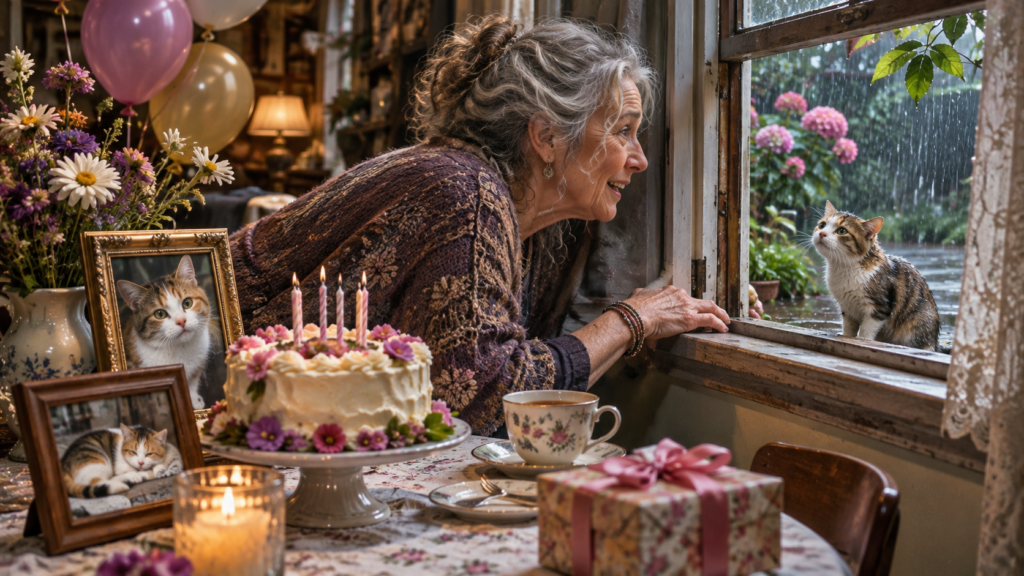
Clementine was twenty years old, had three teeth, and had never apologized for anything.
She had survived two house moves, a broken washing machine, a divorce, an extraordinarily unpleasant summer, and one disastrous Christmas when somebody brought a terrier into her living room.
She had bitten a veterinarian.
Stolen an entire chicken breast.
Ruined an expensive Persian rug.
And once spent forty minutes sitting inside a birthday cake box, causing twelve guests to accuse one another of eating the cake.
Her owner, Della Quist, loved her beyond reason.
Which was why, at eight o’clock on a Saturday morning, Della had arranged a funeral for a cat who wasn’t dead.
Technically, she called it a living celebration.
The invitations were printed on cream-colored cards.
CLEMENTINE IS TWENTY.
SHE HAS OUTLIVED OUR EXPECTATIONS, SEVERAL PIECES OF FURNITURE, AND EVERYONE’S PATIENCE.
PLEASE JOIN US TO CELEBRATE HER LIFE WHILE SHE CAN STILL INSULT YOU IN PERSON.
The gathering was scheduled for four o’clock.
There would be tea, cake, photographs, and a short speech.
Della had ordered a special cake for the human guests, bought Clementine a new heated bed, and invited twenty-three people who had known the cat at various stages of her life.
At 8:12 a.m., she opened the kitchen cupboard to retrieve Clementine’s breakfast.
At 8:13, she called the cat.
At 8:14, she called again.
At 8:16, she checked beneath the bed.
At 8:19, she found the kitchen window open.
And at 8:21, Della Quist, who had spent six weeks preparing to say goodbye to a cat who might someday die, discovered that she had absolutely no idea where the animal had gone.
On the windowsill lay one white whisker.
Outside, the rain was starting.
Della stared at the empty window.
Then she whispered a sentence she had not spoken aloud in twenty years.
“Please don’t leave me like this.”
Della was sixty-four and had spent thirty-one years managing inventory for a company that manufactured hospital furniture.
She knew how to count.
She knew how to organize.
She knew that if a warehouse contained four hundred and twelve wheelchairs, the computer had better say four hundred and twelve wheelchairs, or somebody would spend the afternoon discovering why.
She believed in records.
In dates.
In clearly labeled boxes.
Clementine had opposed this philosophy since kittenhood.
She slept in drawers that had been emptied for cleaning, knocked labels off storage containers, and once spent three hours hiding behind a stack of folded towels while Della searched the entire house.
But this was different.
Clementine was old.
Very old.
At her most recent veterinary appointment, Dr. Hester Salvi had called her a super senior.
Della had been offended.
Clementine had been indifferent.
The cat had some arthritis, a history of kidney disease that required ongoing management, and a tendency to shout at the refrigerator whenever anyone walked past it.
She still ate.
Still groomed herself, though not quite as meticulously.
Still enjoyed the warm patch of sunlight beside the kitchen door.
Still possessed enough strength to express her dissatisfaction with a veterinarian’s thermometer.
But lately, she had been sleeping more.
She no longer jumped onto the kitchen counter.
She used a little carpeted step to reach the sofa.
Sometimes she paused before entering a room, as though considering whether the journey was worth the effort.
Della had begun noticing every small change.
And once she started noticing, she couldn’t stop.
At ten years old, Clementine had seemed indestructible.
At fifteen, she’d become elderly in a way Della found almost charming.
At eighteen, Della began worrying.
At nineteen, the worrying became a habit.
Now, at twenty, Della could barely look at her without calculating how long they might have left.
Three years earlier, she’d searched the internet for the first time.
How long do cats live?
She found answers that varied by source and population.
Around twelve years.
Around fourteen.
Some into their late teens.
A smaller number into their twenties.
The figures were averages, not promises, and they depended on health, environment, and many other factors.
But Della had treated every number like a deadline.
She would look at Clementine sleeping in the sun and think:
Fourteen. You’ve already passed fourteen.
Then:
Eighteen. You’ve passed eighteen too.
And now:
Twenty.
She felt as though they had been living on borrowed time without being told who had lent it to them.
That’s why she’d arranged the party.
She wanted to celebrate Clementine while the cat was still there to hear the laughter and smell the food and look at everybody with her customary expression of contempt.
It was supposed to be joyful.
Now the kitchen window was open, the cat was missing, and rain was soaking the herb pots beneath the sill.
Della ran outside.
“Clementine!”
The garden was empty.
A blackbird leaped away from the birdbath.
Water dripped from the washing line.
The little wooden gate at the end of the path stood slightly ajar.
Della stared.
She had left it unlatched after bringing home groceries the previous evening.
She could have sworn she’d closed it.
But lately she was certain of so many things that turned out not to be true.
She went through the gate.
The lane behind her house ran between two rows of old brick buildings.
There were garages, wheelie bins, a patch of overgrown grass, and a disused drinking fountain that had not worked since Della moved in.
She looked beneath every parked car.
Behind every bin.
Inside an empty cardboard box.
Nothing.
She returned home at 8:47 with wet shoes and a trembling hand.
She picked up the telephone.
Called her veterinarian’s practice.
Explained what had happened.
The receptionist took the details and advised her to continue searching nearby, notify local animal services and neighbors, and make sure the microchip contact information was current.
If Clementine was found unwell or injured, she should be examined promptly.
Della already knew the microchip details were correct.
She checked them anyway.
Then she printed a photograph.
It showed Clementine sitting on the kitchen table beside a bowl of oranges.
The cat looked deeply unimpressed by the entire existence of fruit.
Della wrote underneath:
MISSING CAT
CLEMENTINE — 20 YEARS OLD SMALL TORTOISESHELL, WHITE CHEST, CLOUDY LEFT EYE PLEASE CALL DELLA QUIST She printed twelve copies.
Then stared at the paper.
Twenty years old.
The words looked enormous.
She had never put Clementine’s age on a missing-pet notice before.
She wondered whether people would think the cat was too old to bother searching for.
Then she was ashamed of herself for wondering.
She put on her raincoat.
Picked up the notices.
And went outside.
Her first stop was the house next door.
Mr. Farouk Dane answered wearing an enormous dressing gown decorated with sailing ships.
He was seventy-one, had never owned a boat, and had once told Della that the print made him feel adventurous without requiring him to leave the house.
“Morning,” he said.
“Have you seen Clementine?”
His expression brightened.
“Her Majesty?”
Della frowned.
“Who?”
“The little tortoiseshell. We call her Her Majesty.”
“We?”
“My granddaughter and I.”
Della stared at him.
“You know Clementine?”
“Of course.”
“How?”
Farouk looked confused.
“She comes to visit.”
Della felt as though he’d said her kitchen furniture had been secretly attending meetings.
“Visit?”
“On occasion.”
“Inside your house?”
“Sometimes. Mostly the garden.”
Della gripped the doorframe.
“How long has this been happening?”
He considered.
“Five or six years.”
“Five or six years?”
“Possibly longer.”
Della stared.
Farouk scratched his chin.
“Is something wrong?”
“She’s missing.”
His expression changed immediately.
“Oh, dear.”
“Have you seen her today?”
He shook his head.
“Not today.”
Della handed him a notice.
Farouk read it.
“Twenty?”
“Yes.”
He looked surprised.
“I thought she was about twelve.”
Della nearly laughed.
Instead, she said, “She’s been getting old for quite some time.”
Farouk studied the photograph.
“She’s a good companion.”
Della looked at him.
“Clementine?”
“Oh yes.”
He smiled faintly.
“After my wife died, I used to sit in the garden every evening. I didn’t want to go inside. The house felt too quiet.”
Della said nothing.
“One day, your cat turned up. Sat beside my chair. Didn’t want anything.”
He looked toward the rain.
“She came back the next day. And the day after.”
Della stared at him.
She had known that Farouk’s wife died six years earlier.
She had sent a card.
A casserole.
Offered to help with errands.
He had thanked her politely.
Then they’d returned to exchanging greetings over the garden wall.
She hadn’t known about his evenings outside.
Or that Clementine had spent part of them with him.
“She never let me pick her up,” Farouk said.
“She doesn’t like being picked up.”
“I gathered that.”
He smiled.
“One night I tried. She bit me.”
“She does that.”
“Excellent cat.”
Della laughed despite herself.
Then she stopped.
“Please call if you see her.”
“Of course.”
He reached for his coat.
“I’ll look in my garden now.”
Della thanked him and walked away.
She had owned Clementine for twenty years.
Apparently, she had known only part of her.
The next house belonged to a woman named Brigid Saye, who ran a bicycle repair shop.
Brigid answered the door holding a spanner.
“Morning, Della.”
“Have you seen my cat?”
Brigid frowned.
“The little one-eyed pirate?”
“She isn’t one-eyed. She’s got some cloudiness in her left eye.”
“Right, Pirate with a cloudy eye.”
“Have you seen her?”
“Not today.”
Della showed her the notice.
Brigid studied it.
“Twenty years old?”
“Yes.”
“Good grief.”
Della stiffened.
Brigid looked up.
“I don’t mean that badly.”
“What do you mean?”
“She’s older than my nephew.”
Della almost smiled.
Then Brigid said, “She usually comes through the workshop when I’m repairing bikes.”
Della stared.
“Usually?”
“Well, not as often now. She’s slowed down.”
Della looked down the street.
Clementine had an entire social calendar she had never bothered to disclose.
“Why didn’t anybody tell me?”
Brigid looked surprised.
“Tell you what?”
“That my cat has been visiting everybody.”
Brigid laughed.
“We assumed you knew.”
Della thought of the open kitchen window.
The unlatched garden gate.
Clementine’s habit of appearing beside her food bowl every evening.
She had never suspected the old animal was spending her afternoons elsewhere.
Or perhaps she hadn’t wanted to.
She had imagined herself as the center of Clementine’s universe.
The person who fed her.
Took her to appointments.
Cleaned her bedding.
Brushed the places she could no longer reach.
But Clementine, apparently, had other plans.
Brigid picked up her jacket.
“I’ll help you look.”
Della shook her head.
“You don’t have to.”
“I know.”
She put down the spanner.
“That’s why it’s called helping.”
By ten o’clock, five neighbors were searching.
Della worked along the garden walls.
Farouk checked the sheds.
Brigid searched the bicycle workshop and garages.
Two students from the house across the lane walked through the nearby streets calling Clementine’s name.
At eleven, a message arrived.
I saw your cat near the old bakery yesterday.
Della hurried there.
The bakery had been closed for eight months.
Its windows were covered in brown paper.
The sign above the door had lost three letters.
An empty display case stood behind the glass.
Della knelt beside the entrance and called softly.
“Clementine?”
Nothing.
She looked through the narrow gap beneath the door.
Only dust.
And the shadows of furniture.
The rain had grown heavier.
Her knees hurt.
Her shoes were soaked.
She felt foolish.
Then her telephone rang.
It was Dr. Salvi.
The veterinarian had heard about Clementine and wanted to check whether she’d been found.
“Not yet,” Della said.
“Any sightings?”
“Some neighbors knew she visited them. One thinks she was near the bakery yesterday.”
“Keep searching locally and ask people to check enclosed spaces like sheds and garages before closing them. Older cats may move less quickly, especially if they have arthritis.”
Della wiped rain from her cheek.
“How long do cats live, Hester?”
There was a brief silence.
“We’ve talked about that before.”
“I know.”
“Clementine is twenty, which is an exceptional age for many cats.”
“But how long?”
“Della.”
The gentle firmness in her voice nearly broke something.
“There isn’t a number I can give you that tells you how much time Clementine has left.”
Della pressed the phone against her ear.
“Some cats live into their twenties,” Dr. Salvi continued. “Others develop serious health problems much younger. What’s important is how she’s doing now—her comfort, appetite, activity, and the conditions we’re monitoring.”
Della looked toward the rain.
“She’s been slowing down.”
“Yes, and we’ve been managing her arthritis and kidney condition. But age alone doesn’t tell us that she’s dying today.”
Della closed her eyes.
She had spent months acting as though a twenty-year-old cat was a candle in its last seconds of burning.
She had stopped letting herself enjoy ordinary moments.
Every nap might be the final nap.
Every meal might be the final meal.
Every time Clementine walked into another room, Della watched to make sure she came back.
Her love had become something frightened and watchful.
“Find her,” Dr. Salvi said gently. “Then we can examine her and decide what she needs.”
Della thanked her.
Ended the call.
And remained beneath the bakery awning for several minutes.
At twelve fifteen, Farouk called.
“Come to the lane.”
Della’s heart lurched.
“Have you found her?”
“No, but somebody’s here who might know where she’s gone.”
She ran.
The lane was crowded.
Farouk stood beside Brigid.
The two students were nearby.
And sitting on the garden wall was a boy Della recognized vaguely from the neighborhood.
He was perhaps thirteen.
Thin, with a mop of dark hair and a jacket that was much too large for him.
He held a small notebook.
Farouk pointed.
“This is Ellis.”
The boy looked at Della.
“You’re Clementine’s person?”
“Yes.”
He nodded thoughtfully.
“We call her Captain Biscuit.”
Della closed her eyes.
“Of course you do.”
The boy seemed offended.
“She looks like a Captain Biscuit.”
“Why?”
“Because she has authority.”
Brigid snorted.
Della looked at the notebook.
“Have you seen her?”
Ellis opened it.
There were drawings.
Cats.
Dozens of cats.
Some stretched out asleep.
Some crouched beside flowerpots.
Some sitting on windowsills.
One drawing showed Clementine with an enormous crown.
Another showed her beside a bicycle wheel.
A third depicted her on Farouk’s garden bench.
Della stared.
“Did you draw these?”
Ellis nodded.
“She’s my favorite.”
“How long have you known her?”
“Since we moved here three years ago.”
Della examined another drawing.
It showed Clementine lying on a low brick wall beside a cluster of flowering plants.
“Where is this?”
Ellis pointed toward the far end of the lane.
“Behind the old bakery.”
Della looked up.
“There’s a garden behind it?”
“A little one.”
“How do you get there?”
“Through the side passage. It’s usually locked, but you can see in from the street behind.”
He hesitated.
“She goes there when it rains sometimes.”
Della stared at him.
“Why?”
Ellis shrugged.
“There’s a greenhouse.”
The word struck her.
A greenhouse.
Warm.
Sheltered.
Full of places to hide.
“Are you sure?”
He nodded.
“I used to see her through the broken window before they boarded it up.”
Della looked toward Brigid.
“Let’s go.”
They reached the bakery garden at 12:31.
The side passage was narrow and overgrown.
The entrance was secured by a locked gate.
Beyond it stood a small glasshouse attached to the rear of the bakery.
Several panes were broken.
Others had been covered with plastic.
The roof sagged slightly near one corner.
Della looked through the gate.
“Clementine?”
Nothing moved.
She called again.
Farouk approached from behind.
“Careful. That place isn’t safe to enter without permission.”
Della nodded.
She knew.
She also knew that Clementine might be hiding somewhere inside.
Brigid called the property agent whose number was displayed on the bakery’s front window.
After several attempts, someone answered.
The agent explained that the site was vacant and that the rear structures had not been inspected for public access.
He agreed to contact the person responsible for the premises and arrange access by someone authorized to check for the animal.
Della waited.
The rain fell.
Water gathered in the cracks of the pavement.
Somewhere inside the greenhouse, a loose sheet of plastic rattled.
She pressed her face toward the gate.
“Clementine, sweetheart.”
For a moment, she thought she heard something.
A very small sound.
Then the plastic rattled again.
Farouk leaned beside her.
“Did you hear that?”
“I don’t know.”
They listened.
Nothing.
Ellis stood nearby, clutching his notebook.
“She’s probably asleep,” he said.
Della turned toward him.
“Maybe.”
He considered.
“She’s very good at sleeping.”
Della almost laughed.
“Yes.”
“Sometimes she sleeps for hours.”
“I know.”
The boy looked at her.
“Is she really twenty?”
“Yes.”
He thought about it.
“That’s older than me.”
“Quite a bit older.”
“How long do cats live?”
Della looked toward the greenhouse.
She had been asked that question so many times.
By friends.
By neighbors.
By veterinarians.
By herself.
She used to answer with numbers.
Averages.
Ranges.
Percentages.
As though a statistic could tell her which morning would be the last.
Now she looked at Ellis and said, “It depends on the cat. Many live into their teens.
Some reach twenty or more. Clementine has been very lucky, and we’ve tried to take good care of her.”
Ellis nodded.
Then asked, “Will she die soon?”
The question was so direct that the adults went quiet.
Della looked at the boy.
She could see the worry on his face.
He knew Clementine too.
Not as completely as she did.
Not in the same way.
But he loved her.
And he was asking something that frightened him.
“I don’t know,” Della said.
Ellis looked down.
She continued.
“But if we find her, we can make sure she’s safe and comfortable today. That’s something we can do.”
He considered.
Then nodded.
“Okay.”
Della looked back toward the greenhouse.
For the first time all morning, she felt a little less alone.
At one forty-eight, the property manager arrived with a key.
His name was Lorcan Meade.
He was a broad man with muddy boots, an enormous set of keys, and a face that suggested he had been inconvenienced by most of the world.
He examined the gate.
Then the greenhouse.
“Can’t let everyone wander in there,” he said.
“We understand,” Brigid replied. “Can you check?”
He nodded.
“Stay back.”
He unlocked the gate, approached the greenhouse carefully, and looked inside from the doorway.
Then he stopped.
“Well,” he said.
Della felt her heart leap.
“What?”
He leaned closer.
Something moved inside.
A shape beneath an old wooden bench.
Small.
Tortoiseshell.
White chest.
Della gripped the gate.
“Clementine?”
The cat lifted her head.
Looked toward the doorway.
Then gave a thin, outraged meow.
Della began crying.
She couldn’t help it.
The sound came out of her like something breaking.
“She’s there,” Farouk said.
“I can see.”
“She’s alive.”
“I can see.”
Lorcan moved slowly, keeping clear of the damaged glass.
He crouched and spoke softly to the cat.
Clementine looked at him with deep suspicion.
He reached toward her.
She hissed.
Della laughed and cried at the same time.
“That’s her.”
Lorcan withdrew his hand.
“Feisty little thing.”
“Very.”
He looked toward Della.
“Has she got a carrier?”
“At home.”
“Get it.”
Brigid volunteered.
She ran back along the lane.
Della waited beside the gate.
She wanted to rush inside.
Take Clementine in her arms.
Tell her never to frighten her again.
But the structure wasn’t safe, and the cat was frightened enough already.
So she remained outside.
Calling softly.
Talking about things the cat recognized.
Breakfast.
Her blanket.
The warm patch on the sofa.
The soft brush she liked along her cheeks.
Clementine listened.
Or perhaps she didn’t.
She lay beneath the bench, looking thoroughly unimpressed by the spectacle she’d created.
When Brigid returned with the carrier, Lorcan placed it near the doorway and withdrew to allow the cat a clear, quiet route.
Della knelt outside the entrance.
“Clem?”
The cat turned her head.
“Come on, old girl.”
Clementine looked at the carrier.
Then at Della.
Then at the rain.
She considered her options with the seriousness of a monarch deciding whether to accept a peace treaty.
Finally, she stood.
Her movements were stiff.
She took a few careful steps.
Paused.
Then continued.
Della felt her breath catch.
Clementine entered the carrier.
Lorcan closed the door securely.
And the entire lane seemed to exhale.
Farouk sat down on a low wall.
Brigid wiped her forehead.
Ellis began smiling.
Della lifted the carrier carefully.
Inside, Clementine turned in a small circle.
Settled onto the blanket.
And immediately began complaining.
Loudly.
Without restraint.
Della laughed until she cried again.
“Yes,” she whispered. “I know.”
The cat continued.
“You’ve had a terrible day.”
Another meow.
“You’ve been deeply inconvenienced.”
A third.
Della pressed her forehead gently against the carrier.
“I’m sorry.”
Clementine looked at her through the mesh.
Then blinked.
Della carried her home.
Dr. Salvi examined Clementine that afternoon.
The cat was wet, tired, and somewhat dehydrated, but she was conscious, responsive, and showing no obvious traumatic injuries.
The veterinarian assessed her carefully, considering her existing conditions and the possibility that the outing had put additional strain on her.
She discussed hydration, monitoring, and the signs that would require prompt reassessment.
Clementine objected to the proceedings.
She bit no one.
Della considered that a small miracle.
When the examination was complete, Dr. Salvi looked at her.
“She’s had quite an adventure.”
Della nodded.
“Yes.”
“Keep her comfortable and watch her closely. We’ll review her ongoing treatment as planned, and call if anything changes.”
Della nodded again.
Then she asked the question she’d been carrying for months.
“Should I cancel the party?”
Dr. Salvi looked surprised.
“Why?”
Della stared.
“Because she’s twenty.”
“Yes.”
“And old.”
“Yes.”
“And…”
She stopped.
Dr. Salvi waited.
Della looked toward the examination table.
Clementine had found a corner of her carrier that she apparently considered acceptable and was sitting there with her eyes half closed.
“I keep feeling like I’m preparing for something terrible,” Della said.
Dr. Salvi nodded.
“It’s understandable to worry about an older animal. But if she’s comfortable enough for a quiet celebration, and she can rest away from the guests when she wants, there’s no medical reason to treat her birthday like a funeral.”
Della felt her face grow hot.
“I wasn’t calling it a funeral.”
Dr. Salvi smiled.
“Then perhaps don’t give everybody a speech about her last days.”
Della stared.
Then, unexpectedly, she laughed.
“Did Brigid tell you?”
“Brigid told half the neighborhood.”
Della covered her face.
“Oh, heavens.”
Clementine sneezed.
The veterinarian laughed.
Della looked at the cat.
Then said, “I think I’ve been acting as though she’s already gone.”
Dr. Salvi’s expression softened.
“She’s here now.”
Della nodded.
The words were simple.
Almost embarrassingly simple.
Yet she had spent months forgetting them.
Clementine was here.
Old.
Stiff.
Sometimes irritable.
Occasionally magnificent.
Still hungry at breakfast.
Still capable of making a room feel properly occupied simply by lying in the middle of it.
Della looked down at the carrier.
Clementine looked back.
Neither offered an apology.
It was a relationship of equals.
At four o’clock, the party began.
The invitation had promised a living celebration.
Della had planned a solemn afternoon.
A speech.
A slideshow.
A carefully arranged table of photographs.
She’d even prepared a short reading about the fragility of life.
Instead, the guests arrived to find twenty-year-old Clementine resting comfortably in her heated bed beside the window, looking furious about the number of people in her house.
The atmosphere was immediately ridiculous.
Farouk brought flowers.
Brigid brought a framed photograph of Clementine asleep beside a bicycle wheel.
The students brought a small painting.
Ellis arrived with his notebook and presented Della with a portrait of Clementine wearing a crown.
Beneath the drawing, he had written:
CAPTAIN BISCUIT, AGE 20.
Della stared at it.
Then smiled.
“Beautiful.”
Ellis looked relieved.
“She’s not going to die today?”
Della glanced toward Clementine.
The cat was sniffing the corner of her blanket.
“I certainly hope not.”
He considered.
“Good.”
Then went to examine the cake.
By five o’clock, the living room was full of laughter.
People were telling stories about Clementine.
Not grand stories.
Not stories about heroism.
Little ones.
Farouk described how the cat had sat beside him in the garden during the first winter after his wife’s death.
Brigid told everyone about the day Clementine climbed into a customer’s bicycle basket and refused to get out.
One of the students admitted that Clementine had appeared in every online class she attended during a difficult period of studying from home, invariably walking across the keyboard at the worst possible moment.
Ellis displayed a drawing he’d made when he first moved to the neighborhood.
It showed Clementine sitting outside his bedroom window.
He explained that she’d been the first creature in the street whose name he knew.
His family had moved so often that he was nervous about approaching other children.
It had been easier to talk to a cat.
Della listened.
For twenty years, she had believed she knew Clementine’s entire life.
She knew the habits.
The illnesses.
The favorite places.
The disasters.
The exact sound of the hungry meow and the annoyed meow and the meow that meant somebody had closed a door the cat believed should remain open.
But she had not known about the bicycle basket.
Or the online classes.
Or the garden evenings with Farouk.
Or the boy who had drawn her as a captain because she made him feel as though the street contained something familiar.
She had thought of Clementine’s life as a line stretching between the day she brought her home and the day she would eventually have to say goodbye.
Now she understood it was more like a web.
A hundred little connections.
Most invisible.
Many ordinary.
None less real because she hadn’t been present.
At five thirty, Farouk asked whether Della was going to make her speech.
She looked toward the pile of papers on the table.
Six pages.
Carefully written.
Edited twelve times.
She had spent more than a week preparing the words.
They described how Clementine had come into her life.
How she’d changed her routines.
How she’d provided companionship.
How the house would one day feel empty without her.
Della picked up the pages.
Looked at them.
Then looked toward the cat.
Clementine was asleep.
One paw extended beyond her heated bed.
Her ears twitched occasionally as people spoke.
She had eaten a little of her usual food, accepted a brief brushing, and decided that the party was somebody else’s problem.
Della looked around the room.
Twenty-three people.
Some friends.
Some neighbors.
Some she barely knew.
All connected, in some way, to an elderly cat who had spent her life doing exactly what she pleased.
She folded the speech.
Put it down.
Then raised her glass.
“I’d like to say something.”
The room quieted.
Della looked at Clementine.
“When I brought her home, she was a kitten small enough to fit inside one of my shoes.”
Someone laughed.
“She was found by a rescue volunteer with her littermates. I chose her because she was sitting apart from the others, looking as though she disapproved of the entire adoption process.”
Brigid laughed.
“Sounds right.”
Della smiled.
“I didn’t know how long we’d have together. I thought perhaps twelve years.
Maybe fifteen. I didn’t expect twenty.”
She looked around.
“I think I’ve spent the past few years being so frightened of losing her that I forgot how much of her life was still happening.”
The room was quiet.
She continued.
“Today, I learned that Clementine has apparently been running a second household next door, supervising bicycle repairs, attending university lectures, and serving as an unpaid emotional adviser to half the street.”
Laughter moved through the room.
Della looked at Ellis.
“She’s a very busy woman.”
He grinned.
Della glanced toward the sleeping cat.
“I was going to make a long speech about everything I’ll miss when she isn’t here.”
She paused.
“But I think that can wait.”
Her throat tightened.
For a moment, she couldn’t continue.
Then she said, “Today, I’d rather thank you all for loving her while she’s still here.”
Farouk raised his glass.
Brigid did the same.
Someone began clapping.
The applause was quiet at first.
Then louder.
Clementine opened one eye.
Looked at the room.
And gave a long, deeply offended meow.
Everyone burst out laughing.
It was the best moment of the afternoon.
At six fifteen, Della cut the cake.
At six forty, somebody found Clementine asleep inside an empty gift bag.
At seven, Farouk helped carry the chairs back into the dining room.
At seven thirty, the last guests left.
Ellis lingered near the door.
He looked toward the cat.
“Can I come and visit her again?”
Della smiled.
“Of course.”
“Even if she’s very old?”
“Especially then.”
He considered.
Then looked at her.
“Do you think she’ll reach twenty-one?”
Della looked toward Clementine.
The cat was asleep beneath the window.
Warm.
Dry.
Safe.
She thought about averages.
Percentages.
The strange arithmetic of living things.
She thought about the frantic morning.
The rain.
The missing-pet notices.
The old greenhouse.
How frightened she’d been.
Then she looked back at Ellis.
“I don’t know.”
He nodded.
She smiled.
“But if she does, we’ll have another party.”
His face lit up.
“Can I make another drawing?”
“I’d be disappointed if you didn’t.”
He left.
Della closed the door.
The house was quiet again.
The decorations remained.
Balloons drooped near the ceiling.
Empty cups stood on the kitchen counter.
A photograph of Clementine wearing a paper crown rested beside the cake stand.
Della began cleaning.
She washed plates.
Folded the tablecloth.
Put leftovers in the refrigerator.
Then she found the six-page speech she’d decided not to give.
She sat at the kitchen table.
Read it once.
Then carefully tore it into strips.
Not because the words were wrong.
Some were lovely.
Some were true.
But they belonged to a goodbye that hadn’t happened.
And Della was tired of rehearsing it.
She carried the scraps to the recycling bin.
When she returned, Clementine was standing beside the kitchen doorway.
The cat looked at her.
Meowed.
Then began walking toward the bedroom.
Slowly.
With the careful, stiff-legged dignity of an elderly monarch whose subjects were refusing to cooperate.
Della followed.
Clementine stopped beside the bed.
Looked up.
Then looked at the little carpeted step.
Della waited.
The cat climbed the first step.
Paused.
Climbed the second.
Then reached the blanket at the foot of the mattress.
She circled twice.
Settled.
And began washing one paw with the concentration of an artist restoring a masterpiece.
Della sat beside her.
For a while, she simply watched.
Then she reached out and stroked Clementine gently between the ears.
The cat stopped washing.
Pressed her head against Della’s hand.
And began to purr.
It was a quieter sound than it used to be.
Not the enormous rumble of her younger years.
Something smaller.
A little uneven.
But unmistakable.
Della felt tears gather in her eyes.
She did not stop them.
She had loved Clementine through twenty years of ordinary life.
Through mornings when the cat screamed for breakfast.
Through nights when she slept at the foot of the bed.
Through illnesses, vaccinations, unexpected expenses, ruined curtains, and the gradual discovery that a house could belong to an animal without the animal ever signing a mortgage.
Someday, she would have to say goodbye.
That was still true.
She would have to make difficult decisions.
Listen to the veterinarian.
Consider comfort and quality of life.
Notice changes that needed care instead of dismissing them as inevitable.
And eventually, perhaps, she would have to make the kindest choice available even when it broke her heart.
But not tonight.
Tonight, Clementine was warm.
She was comfortable.
She had eaten.
She had shouted at her guests.
She had survived a journey into a greenhouse and returned home with absolutely no intention of explaining herself.
Della sat beside her.
The cat purred.
And the room grew quiet.
After a while, Della whispered, “You know, I never did understand why you went into that greenhouse.”
Clementine continued purring.
“Perhaps you had a reason.”
The cat closed her eyes.
“Perhaps you just felt like it.”
Della smiled.
She had spent so much time wondering how long cats lived.
Now she was beginning to understand how little the answer could tell her about a particular cat on a particular day.
Twenty years was an age.
Not an explanation.
A birthday was a date.
Not a prediction.
And love was not improved by counting the hours before it might end.
She left her hand resting lightly against Clementine’s back.
Then the cat stopped purring.
Della’s heart lurched.
She leaned forward.
“Clem?”
One amber eye opened.
Clementine looked at her.
Then sneezed directly into her face.
Della recoiled.
For one terrible second, she was too startled to move.
Then she began laughing.
Loudly.
Helplessly.
The kind of laughter that makes it impossible to speak.
Clementine looked disgusted.
Then returned to washing her paw.
Della laughed until her ribs hurt.
Until tears rolled down her face.
Until the awful tension she’d carried for months finally loosened enough for her to breathe.
When she could speak again, she leaned close to the cat.
“Happy birthday, you dreadful creature.”
Clementine yawned.
Showed the three teeth she still possessed.
And went to sleep.
Outside, the rain had stopped.
The garden was dark.
Somewhere beyond the wall, Farouk was closing his windows.
A bicycle bell rang in the lane.
The ordinary world continued.
Della switched off the bedroom light.
Then climbed into bed beside her cat.
She did not calculate the remaining years.
She did not search the internet.
She did not check Clementine’s breathing every thirty seconds.
She knew the cat’s health would still need attention tomorrow.
She knew love couldn’t make age disappear.
But she also knew that Clementine was beside her now.
Warm.
Stubborn.
Alive.
And, for tonight, that was enough.
At 5:42 the following morning, Clementine woke Della by placing one cold paw directly on her mouth.
Della opened her eyes.
The cat stared down at her.
Then screamed for breakfast.
Della groaned.
“Clementine.”
Another scream.
“It’s not even six.”
The cat did not care.
Della lay still for a moment.
Then began smiling.
She got out of bed.
Put on her slippers.
And followed the twenty-year-old tyrant into the kitchen.
The End.
Editorial note — factual background and original fiction
How long do cats live? Lifespan varies considerably by cat and by the population studied. A 2024 UK study reported an life expectancy at birth of approximately 11.7 years for UK pet cats, while other guidance commonly describes averages around 12–14 years. Many cats live into their late teens, and some reach their twenties.
Genetics, health, weight, nutrition, environmental risks, and veterinary care can all influence how long a cat lives. Living indoors can reduce exposure to hazards such as traffic, although indoor cats also need exercise, enrichment, and appropriate health care.
Older cats may experience reduced mobility, changes in appetite, kidney disease, dental problems, or other health concerns. Old age itself is not a disease, and new changes should not automatically be dismissed as normal aging. Veterinary assessment helps determine appropriate treatment and quality-of-life support.
Clementine, her neighbors, and the events of this story are fictional.


