Past to the Future | Volume 3 | Classical Antiquity | Part 11
Historical scope: Mesoamerican and Andean societies of the first millennium CE, compared by region without imposing Mediterranean periodization; fictional story disclosed and historical image accurately dated.
A City Without A Roman Name
In a fictional first-millennium CE town near the basin of Teotihuacan, a craft worker named Itzel examines a painted vessel while relatives discuss the next market day. Her name, actions and speech are imaginary. The monumental city and its regional networks, however, are well established through archaeology.
The UNESCO listing for Teotihuacan dates the great city’s development to the first through seventh centuries CE. The earlier journal chapter Han China And The Worlds Beyond The Court considered Asian states; here the subject is the independent history of societies in the Americas during some of the same centuries.
Classical Is A Comparative Label, Not A Universal Calendar
The term Classical Period has specific meanings in different scholarly traditions. In Mesoamerica it is commonly associated with parts of the first millennium CE, while Andean chronology uses other regional classifications.
This chapter uses classical-era as a comparative convenience. It does not mean that all American societies developed simultaneously or shared institutions with Rome. Archaeological dates and local traditions provide the foundation rather than a Mediterranean timeline imposed on another continent.
The Americas Had Long Histories Before This Period
Human communities occupied different American environments for thousands of years before the first millennium CE. Farming, settlements and social institutions developed through diverse local histories.
The Olmec tradition in parts of Mesoamerica belongs principally to earlier centuries and should not be merged into the later histories of Teotihuacan or Classic Maya polities. Chronological care prevents an account of complex regions from becoming a list of famous monuments without context.
Mesoamerica Contained Multiple Political Worlds
Mesoamerica included regions with different languages, cities, political institutions and religious traditions. Exchange connected some communities, but no one polity governed the entire region throughout the first millennium.
Archaeologists study architecture, inscriptions, objects and environmental evidence to understand these differences. Surviving material is uneven, and the boundaries of cultural interaction do not always match the territorial maps drawn for modern readers.
Teotihuacan Became A Major City
Teotihuacan grew in the Basin of Mexico into one of the largest urban centers of ancient America during the first centuries CE. Its monuments and planned areas show major investment in construction and collective organization.
The UNESCO heritage description places the city’s growth between the first and seventh centuries. The site is not identical to the later Aztec political order, whose historical relationship with the ruins included memory and ritual.
The Avenue Of The Dead Organized A Landscape
The great ceremonial axis at Teotihuacan helped structure a monumental urban landscape. Temples, plazas and residential areas formed part of a city whose spatial organization still attracts archaeological study.
A ceremonial avenue is evidence of planning and social organization, but its surviving form cannot identify every worker or reveal all the decisions made during construction. Historians should not infer one simple political system solely from a straight road.
The Pyramids Are Not Egyptian Copies
Teotihuacan’s Pyramid of the Sun and Pyramid of the Moon are distinctive Mesoamerican monuments developed in a separate cultural and architectural tradition.
Superficial resemblance to Old World pyramids is not evidence of direct contact. Explaining their design through local geography, ritual and political institutions respects the archaeological record rather than imposing a fantasy of a single worldwide builder.
Apartment Compounds Reveal Urban Households
Teotihuacan is notable for residential complexes often described as apartment compounds. They suggest forms of urban living that cannot be understood through pyramids alone.
Excavated domestic spaces provide evidence of craft production, household organization and varied social status. They do not necessarily support one universal family model or reveal the names of everyone who lived within them.
Craft Workers Contributed To The City’s Life
Pottery, obsidian tools and other materials testify to specialized production and exchange. The city’s economic life required skilled people able to make, distribute and repair objects.
The fictional Itzel cannot be used as a historical witness, but craft evidence establishes that artisans mattered. An account centered only on rulers or monuments would conceal much of the daily labor supporting urban institutions.
Obsidian Connected Distant Markets
Obsidian was an important material for tools and other objects, and its geological origins can sometimes be investigated through scientific analysis.
Distribution patterns help archaeologists study regional contact, but an object far from its source does not reveal every person who transported it. Exchange could pass through multiple intermediaries and political relationships.
Teotihuacan Had Influence Beyond Its Basin
Architecture and material culture associated with Teotihuacan appear in evidence from other Mesoamerican regions, including contacts with Maya cities.
Influence did not necessarily mean that every distant community was ruled directly from Teotihuacan. Historical interpretations of political relations require examination of local inscriptions, objects and chronology. The Met’s Ancient Americas exhibition discusses the complexity of these connections.
The Maya Developed Distinct Cities
Maya societies formed diverse political centers across Mesoamerica, including areas of present-day Guatemala, Mexico, Belize and neighboring regions. They did not constitute one permanent unified empire.
The Metropolitan Museum’s Classic Maya overview places the Classic Period broadly between about 250 and 900 CE. Different cities reached prominence at different times, and their local histories must be studied separately.
Maya Writing Preserves Historical Names
Hieroglyphic inscriptions provide evidence of rulers, ceremonies, political relationships and dates in parts of the Maya world. Research on their decipherment transformed understanding of the region.
Some texts preserve elite narratives, while the lives of many farmers, artisans and women remain less directly documented. Historians distinguish what an inscription states from the broader social conclusions inferred from it.
Maya Calendrical Knowledge Was Sophisticated
Maya systems of counting and recording time supported historical inscriptions and ceremonial practice. Their complexity reflects accumulated mathematical and astronomical knowledge.
Popular claims that a Maya calendar predicted the destruction of the world in a modern year are not reliable historical interpretations. Calendar systems should be explained through their ancient uses and evidence rather than sensational contemporary myths.
City-States Had Political Rivalries
Classic Maya polities formed alliances, fought wars and engaged in diplomacy. Individual kings and dynasties appear in inscriptions associated with particular cities.
These political histories show complexity without implying one constant pattern across every center. The effects of conflict extended beyond elite monuments to households and communities whose experiences are less completely recorded.
Agriculture Sustained Urban Centers
Farming practices and environmental management enabled people to live in different Mesoamerican landscapes. Communities adapted to local soils, water conditions and the demands of settlement.
Changes in land use and climate may have interacted with political pressures, but no single environmental explanation accounts for the fate of every Maya city. The evidence needs regional comparisons rather than a universal collapse story.
The Americas Were Not Isolated Internally
Regional trading networks connected communities across Mesoamerica and within the Andes. Goods, technologies and ideas moved through different environments and political relationships.
These connections should not be confused with confirmed routine contact across the Atlantic during the classical centuries. The histories discussed here developed through American networks without requiring an imagined Mediterranean source for their achievements.
The Andean World Had Different Chronologies
South America’s Central Andes contained societies whose political and artistic development followed distinct regional paths. Coastal deserts, highlands and river valleys shaped settlement and production.
The Met’s Central And Southern Andes chronology for 1 to 500 CE and its 500 to 1000 CE continuation show overlapping Moche, Nazca and later traditions. They cannot be compressed into one Andean empire.
Moche Art Reveals Skilled Production
Moche societies flourished on Peru’s northern coast during the first millennium CE. Their ceramic vessels, architecture and other objects provide evidence of craft expertise and political and ritual life.
The Met’s Moche portrait vessel record illustrates how detailed ceramic representation became part of cultural production. A portrait-like vessel should not automatically be assigned the identity of a historical individual without supporting evidence.
Moche Political Authority Was Regionally Varied
Archaeological scholarship examines centers and changing political structures associated with Moche traditions. Evidence does not establish a single centralized Moche state governing every coastal valley for the same period.
Different communities managed agriculture and ritual institutions under local conditions. A historical narrative should distinguish archaeological cultural labels from the existence of one uniform dynasty.
The Nazca Region Developed Distinct Practices
Nazca cultural traditions in southern Peru are associated with ceramics, ceremonial centers and the geoglyphs of the desert region. Their chronology overlaps with parts of Moche history but follows a different environmental and political setting.
The Met Andean chronology describes Cahuachi and regional artistic developments. Similarity in period does not imply that Nazca and Moche societies shared one government or language.
Geoglyphs Require Evidence Rather Than Fantasy
The Nazca geoglyphs have inspired many speculative claims. Their archaeological investigation considers chronology, landscape and possible ceremonial or social functions.
Assigning their creation to extraterrestrials or a mysterious outside civilization is not supported by the historical evidence. The expertise of local communities should be acknowledged without pretending that every aspect of the geoglyphs’ meaning is completely established.
Tiwanaku Became Important In The Southern Andes
The Tiwanaku cultural and political center developed near Lake Titicaca and became influential during later parts of the first millennium CE.
The UNESCO Tiwanaku listing identifies its flourishing between roughly 400 and 900 CE, with a peak during approximately 500 to 900. This chronology differs from early Teotihuacan and cannot be treated as part of one identical classic era.
Highland Agriculture Required Adaptation
Communities living near Lake Titicaca and in other highland landscapes developed methods suited to altitude, climate and water availability.
Agricultural technology included knowledge passed through local communities. Political centers depended upon the work of people maintaining land and food systems, not simply upon ceremonial architecture. The specific methods require archaeological and environmental evidence rather than assumptions borrowed from coastal societies.
Wari Traditions Developed Through Another Network
Wari political and artistic developments became influential in portions of the central Andes during the middle horizon, overlapping chronologically with Tiwanaku in some centuries.
The Met’s later Andean chronology distinguishes these traditions. Their relationship remains a subject of investigation, and they should not be described as one state merely because their influence expanded during similar periods.
Political Change Was Not Cultural Disappearance
Major centers could lose political power while local populations continued to produce food, maintain traditions and form new communities. Archaeological patterns of change differ across regions.
The decline of Teotihuacan’s central institutions should not be equated with the disappearance of all people who had lived there, nor should transformations in Maya polities be reduced to one instantaneous collapse. The historical record points to changing political and environmental circumstances.
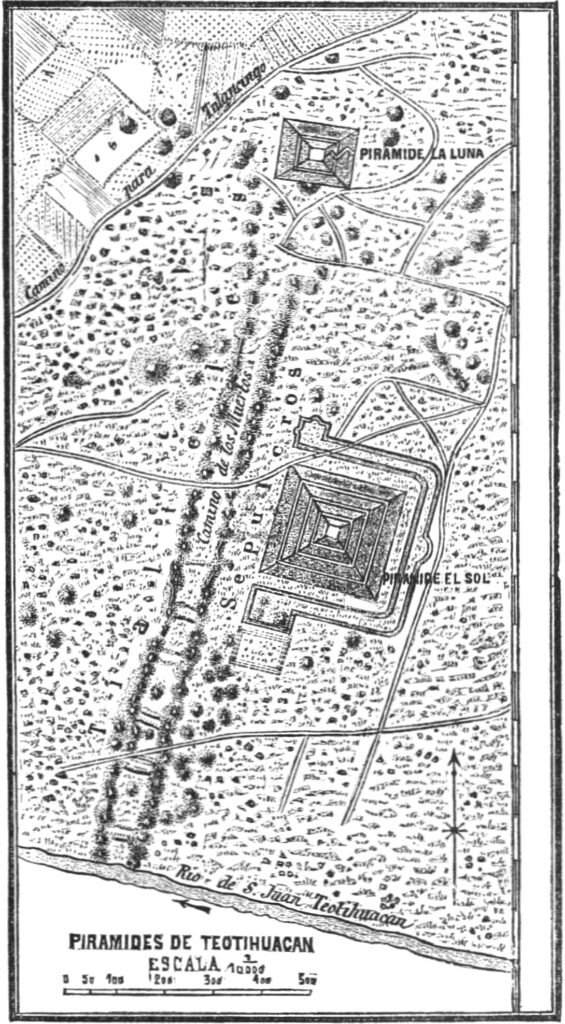
The Featured Print Is A Nineteenth-Century Interpretation
The featured 1884 illustration of Teotihuacan’s pyramids is public-domain historical artwork portraying ancient remains as seen or interpreted by a later artist.
It is neither a photograph from antiquity nor a reliable reconstruction of the original painted monuments. Its role is visual orientation and a reminder that historical sites have been described through later cultural perspectives.
Colonial Records Are Much Later Sources
Spanish colonial-era writings contain descriptions of American traditions, but their authors wrote after conquest and under very different political and religious conditions.
Such records may preserve valuable information while reflecting later perspectives. They cannot be used without caution as direct testimony about first-millennium societies. Archaeological and earlier Indigenous evidence are essential for reconstructing classical-era history.
Indigenous Peoples Are Not Confined To The Past
Modern Indigenous communities have living cultural, linguistic and historical relationships with the regions discussed in this chapter. Archaeological sites are not merely relics belonging to distant outsiders.
Research and conservation should involve appropriate local institutions and respect community interests. Historical writing that acknowledges this continuity avoids treating ancient America as a vanished world without living descendants or cultural memory.
Comparisons Should Clarify Difference
Roman, Han, Maya, Teotihuacan and Andean societies all developed institutions and forms of specialized work, but their political structures and sources differed. Comparing them can reveal shared questions about authority, agriculture and trade.
Comparison becomes misleading when one region’s sequence is imposed on another. The journal’s global approach respects the independence of American histories while placing them alongside contemporaneous developments elsewhere.
One methodological challenge is that the word civilization is sometimes used as if it has one universal measurement. Monumental architecture, writing and urban size offer important evidence, but communities with different political or settlement patterns may possess sophisticated knowledge that does not leave the same kind of archaeological record. A hierarchy based solely on surviving stone buildings would distort the diversity of American societies. Historians should specify the institutions or achievements being discussed rather than rely on an undefined ranking that makes one region a standard for every other.
Teotihuacan’s urban history illustrates the need to distinguish a city’s extent from the nature of its government. Residential compounds, ceremonial areas and material evidence demonstrate complex planning and production. The exact distribution of political authority remains a subject of scholarship. It would be misleading to invent the name or private motives of a ruler where evidence does not support them. Similarly, the loss of a city’s central authority does not mean that all residents disappeared. Later communities could continue living in parts of the region and remembering its monuments in new ways.
Classic Maya writing allows historians to study some political events through named rulers and dated monuments. Yet inscriptions are often elite statements designed to communicate legitimacy, status and victory. They do not record every household’s experience or the full economic consequences of warfare. Archaeological work on settlement and agriculture can widen the picture, but those sources also have limitations. A comparative narrative should combine different kinds of evidence without assuming that the survival of a dated inscription makes all other aspects of a society transparent.
The Americas’ ancient trade networks also require careful geographical interpretation. Goods and artistic styles can circulate through intermediate markets, gifts and movement across neighboring communities. Their presence at a distant site does not prove a single merchant completed the entire route or that one powerful state controlled every exchange. The journal’s published chapter The Atlantic Was Not Empty addresses a different historical era while making a related point: people and systems already existed in the Americas before later outside narratives attempted to define them.
Environmental explanations need particular caution when discussing changes in ancient urban centers. Drought, shifting rainfall or agricultural stress may have influenced events in particular regions, but their relationship to politics and warfare requires detailed evidence. A model showing a climatic pattern cannot automatically explain every dynastic transition. Different communities may have adapted, migrated or reorganized their institutions in distinct ways. Historians should test competing explanations rather than select a single dramatic cause because it seems to provide a satisfying story.
Andean societies developed production systems in environments that differed markedly from those of central Mexico and the Maya lowlands. Coastal deserts, river valleys and highlands required distinctive knowledge about crops, water, transport and materials. Ceramic vessels or monumental centers reveal only portions of that work. The later published chapter The Columbian Exchange: A World Remade explores the consequences of a much later era of connection. Reading it after this chapter helps preserve the difference between preexisting American traditions and changes imposed through overseas conquest and exchange.
The archaeological record has also been shaped by the history of collecting and excavation. Objects removed without adequate documentation may lose much of the context needed to establish their date and use. Museums and researchers increasingly face questions about provenance, conservation and the participation of communities connected to ancient sites. Such concerns are not separate from historical accuracy. Without context, an impressive object may be attributed to the wrong period or society. Careful scholarship and respectful cooperation help preserve evidence for later study.
Stories about unknown builders or mysterious outside visitors often arise when popular accounts refuse to recognize the achievements of Indigenous American societies. Archaeological evidence provides human explanations for monuments, production and settlement, even where particular details remain debated. The appropriate response to an open question is research, not an unsupported claim that another civilization or extraterrestrial group must have supplied the necessary knowledge. The earlier chapter Scientific Inquiry And The Authority Of Evidence offers the broader principle: explanations must be open to testing and correction.
A history organized around rulers and warfare also overlooks the work of farmers, household members, builders and traders. Their individual names often do not survive, but tools, buildings, food remains and production areas provide partial evidence. The challenge is to describe that evidence without inventing biographies and giving the resulting fictional characters the authority of real witnesses. The brief imagined craft worker in this chapter should help readers consider the scale of ordinary life, not substitute for the archaeological record that supports historical claims.
Finally, ancient American societies remain relevant to the present without being reduced to modern national identities. Archaeological sites lie within present-day countries, but political boundaries and social categories changed across centuries. Indigenous communities maintain living languages and traditions while also participating in contemporary societies. Historical research can recognize these continuities without assuming that every present practice has existed unchanged since antiquity. Respect for the past means explaining documented change and preserving the right of living communities to represent their own experiences.
The Craft Worker Leaves No Written Diary
In the fictional conclusion, Itzel sends the vessel to a market and returns to work. Her imagined actions are not evidence about a particular person.
The history of classical-era Americas is documented through monuments, inscriptions, objects and environmental evidence interpreted with care. The next and final Classical Antiquity chapter examines late antiquity and the different regional transitions that preceded medieval worlds.
Sources And Fictional Disclosure
Itzel and all dialogue are fictional. Evidence comes from the UNESCO Teotihuacan inscription, the Met’s Ancient Americas exhibition, the Met’s Andean 1 to 500 CE chronology, its 500 to 1000 CE chronology, and the UNESCO Tiwanaku listing. The featured public-domain print is dated 1884.