Past to the Future | Volume 3 | Part 1
Historical scope: This chapter introduces a comparative classical-era frame, approximately 500 BCE to 650 CE, while recognizing that societies had distinct regional chronologies. Nadiya, a fictional modern-day museum researcher, and her conversations are invented; no historical personal testimony is presented. The Romans, Han Chinese, Parthians, Kushans, Aksumites, South Asian societies and cities of the Indigenous Americas were not parts of one uniform civilization. Trade links across Afro-Eurasia are documented, but no regular ancient transoceanic network linking the Americas to Afro-Eurasia is assumed.
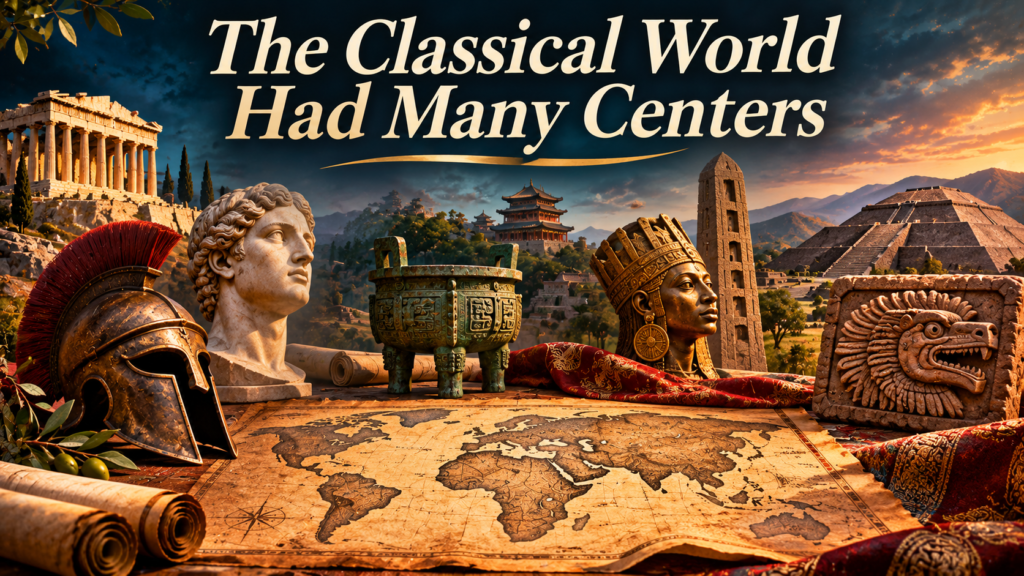
The Map That Misplaced Most Of The World
Nadiya could not understand what was wrong with the exhibition map until she turned off the desk lamp. In the sudden dimness, she saw the design instead of the words. The Mediterranean was enormous; almost every other region had been squeezed toward an edge.
The fictional researcher had been asked to prepare an introduction to Classical Antiquity. Her first draft contained Greece, Rome and a little of Persia. It was a reasonable beginning for a Mediterranean gallery, but the museum was presenting a history of the world’s civilizations.
“Do you want to take Rome off the map?” a colleague asked.
“No. I want to know why Rome takes up the whole world.”
The scene is invented. The historical issue is not. Ancient Mediterranean cultures profoundly influenced later societies, but between roughly 500 BCE and 650 CE other complex political and cultural worlds were developing across Africa, Asia and the Americas.
The Han dynasty shaped China, South Asian rulers and intellectual traditions changed across many centuries, Aksum linked highland Africa to Red Sea commerce, and Teotihuacan developed a remarkable urban landscape in central Mexico.
These places did not all occupy exactly the same centuries. They did not exchange the same ideas, or use the same institutions. Their presence on a single map must communicate comparison rather than a claim that the world had been one political community.
Nadiya began again with a larger question: how could people in different regions build powerful institutions and flourishing cultures without being reduced to a story whose central character was a Mediterranean empire?
Classical Is A Historian’s Label
The word classical is often used to describe a cultural tradition treated by later generations as exemplary. It is also a conventional label for parts of Mediterranean history. That makes it useful within limits and misleading when treated as a universal ranking.
People in Han China did not describe their centuries by the rise and fall of Roman emperors. Communities in the Andes and Mesoamerica did not wait for events around the Mediterranean to enter an age of urbanism, political organization or artistic sophistication.
Time frames are scholarly tools. They allow comparison but cannot erase the local timelines with which the evidence must be read.
Our preceding chapter, The Ancient World Never Really Ended, closed Volume 2 by examining how institutions survived and changed. Volume 3 follows those transformations rather than restarting earlier introductions.
In particular, Ancient Greece: Democracy, Philosophy and the Cost of Citizenship has already introduced Greek political and intellectual traditions. This volume will move beyond that starting point to explore the Hellenistic cities that developed after Alexander’s conquests.
The danger of a title is that readers may mistake a way of arranging history for a judgment about peoples. The word classical should not suggest that one civilization was more human, rational or creative than another.
Nadiya wrote the dates on the map’s label, then added a note explaining that they were approximate and regionally uneven. The extra sentence made the introduction less elegant. It made it more accurate.
Alexandria In A World With Older Histories
After Alexander’s campaigns, Egypt became the center of a Ptolemaic kingdom whose rulers supported projects of administration, diplomacy and cultural patronage. Alexandria developed into a major city with scholarly institutions associated with a library and research.
The Metropolitan Museum’s history of Ptolemaic Egypt describes the interactions between a Macedonian ruling dynasty and the longstanding cultural traditions of Egypt. The court was part of regional warfare and dynastic politics as well as intellectual life.
An influential library does not mean all the knowledge of the age had been collected in one room. Nor does admiration for scholars explain the daily lives of farmers, builders or market workers whose resources helped maintain a royal city.
The OpenStax survey of the Hellenistic era places Alexandria in a larger geography of successor kingdoms and their cities.
Nadiya imagined visitors spending the whole exhibition looking at one shining model of Alexandria. The city deserved attention; it did not deserve to replace every other place.
An old Egyptian temple and a Hellenistic scholarly institution could exist within the same political world without representing identical cultural choices. Different communities experienced royal power through different forms of authority.
The next chapter will examine those negotiations in greater depth, including the unequal relations through which rulers promoted language, art and ideas.
The Empires Beyond Rome’s Horizon
The Roman empire was not the only extensive political power in Afro-Eurasia. The Metropolitan Museum’s study of Rome and Asian trade describes large connected political worlds in the late first century BCE: Rome, Parthian Iran, Kushan territories, the Xiongnu confederation and Han China.
Their institutions were not subdivisions of Rome. Each had its own political traditions, contests for authority and relationships with surrounding peoples.
Commercial routes moved goods through many intermediaries. Silk, spices and other high-value products could travel astonishing distances without requiring one traveler to cross the entire network.
Modern maps often draw an arrow between Rome and China as though the road were direct and uncomplicated. That arrow can help orient a reader, but it must not erase the merchants, oases, ports, kingdoms and changing alliances along the way.
Our earlier article Ancient Persia: The Empire That Connected Worlds introduced the Achaemenid era. The Parthians and later Sasanians belonged to new phases of Iranian history, not to an unchanged ancient empire.
A connection does not always imply equality. Rival states might tax caravans or contest access to resources. Traders could benefit from new buyers while remaining vulnerable to political changes.
Nadiya added several lines across Asia, each thinner than the broad central arrows on the first draft. She realized that a web made of many segments told a more convincing story than one imperial road extending toward the edge of a page.
What An Empire Demanded From A Household
Political authority becomes real through practical obligations. A ruler may appear on coins or public monuments. An ordinary household may encounter the same power through taxes, roads, military service, officials or restrictions on movement.
Roman provincial administration relied on different arrangements in different regions, combining central interests with local elites and institutions. Those arrangements changed over centuries.
The Cambridge Ancient History on provincial administration and taxation explores how revenue, security and governance connected Rome to people beyond the capital.
Similar questions can be asked of other empires without pretending their answers were identical. How did officials communicate with distant communities? Who maintained roads? What happened when a local harvest failed but the state still expected payments?
A large territory on a map can suggest uniform control. Actual government worked through local institutions, negotiations and sometimes coercion.
The same road might benefit a farmer reaching a market and a soldier sent to impose an order. The same coin might facilitate exchange and symbolize demands backed by state force.
Nadiya wrote a new exhibition label: An empire is also a set of obligations felt far from its capital.
She knew a sentence could not explain every place. It could at least remind the reader that the significance of political power was not measured only by the number of provinces added to a map.
The people living under imperial institutions were participants in history, not merely the background against which rulers acted.
The Sea Linked Several Histories
The ancient Indian Ocean was an arena of long-distance connections supported by ports in Arabia, East Africa, the Red Sea, the Persian Gulf and South Asia. Maritime travel depended on knowledge of seasons, winds, routes and local markets.
The Annual Review of Anthropology’s survey of ancient Indian Ocean research examines material evidence for interactions from approximately 500 BCE through the first millennium CE.
These networks did not begin when a Mediterranean ruler took an interest in imported goods. Sailors, brokers, merchants and producers had built practical knowledge across generations.
Some maritime exchanges were conducted through negotiation; others occurred amid political inequalities, warfare or coercion. The presence of valuable objects at a port cannot alone explain the bargaining conditions under which they arrived.
A small artifact found far from its point of manufacture may demonstrate a relationship between regions. It may not tell the entire chain of hands through which it traveled.
Nadiya drew a maritime line linking the Red Sea and the western Indian Ocean. Then she hesitated over another line reaching from East Asia to the Americas.
There was no adequate evidence for regular transoceanic exchange between those regions in the period she was depicting. She left the gap visible.
The absence of a trade line was not an accusation that the Americas had no sophisticated societies. It was recognition that independent histories matter, even when a connected global narrative would be easier to illustrate.
Aksum Had Its Own Political Center
The kingdom of Aksum developed in the highlands of what are now Ethiopia and Eritrea, maintaining important trade relationships through the Red Sea port of Adulis. It developed monumental architecture, coinage and changing religious institutions.
The Metropolitan Museum’s account of Aksumite civilization connects commercial activity, royal authority and the growth of Christianity in the kingdom.
It would be a serious distortion to describe Aksum only as a place from which Mediterranean consumers acquired luxury goods. Its rulers, artisans, religious communities and households made decisions within local political circumstances.
The Nile valley also sustained the histories of Kush and Meroë, whose earlier political traditions and artistic forms were not interchangeable with those of Aksum.
The objects that survive can show wealth, technical skill and connections. They do not automatically reveal how prosperity or labor was shared among a state’s population.
Nadiya moved the Aksum label toward the geographic center of its own region. On the first draft, the African highlands had appeared as an appendage of a Mediterranean shipping route.
This was not merely an aesthetic correction. It changed the implied direction of attention.
African societies made political and intellectual choices that deserve explanation for their own sake, whether or not an outside observer happened to record them.
The Han Court Was Not All Of China
The Han dynasty ruled much of China from 206 BCE to 220 CE, with an interruption and changes in political center. It helped shape influential forms of administration, elite culture and relations with neighboring peoples.
The Metropolitan Museum’s Han dynasty history describes the period’s institutions, material culture, trade and technological developments.
Yet a dynasty’s name is not a complete description of all the people within its territory. Agricultural communities, artisans, merchants and local officials sustained life across landscapes with different conditions.
Connections toward Central Asia depended on political and military relationships, not on a single permanently open corridor.
The Smithsonian’s Chinese history timeline situates Han institutions within a much longer sequence that included earlier states and later periods of division.
A later dynasty might inherit practices without reproducing the earlier government exactly. A political breakup could allow cultural and technical change rather than simply ending civilization.
Nadiya put a second marker on her map for a Han political center. Then she added an ordinary regional marketplace.
She could not represent every such place. The small act prevented a common mistake: treating the capital as the only location where history occurred.
To study China’s classical-era history seriously is to ask questions appropriate to its own evidence and institutions rather than measuring every development by distance from Rome.
Teotihuacan And The Unconnected Centers
In central Mexico, Teotihuacan became one of the great cities of the Indigenous Americas. Its architecture, planned landscape, residential compounds and art reveal a history of urban organization that developed independently of Mediterranean or East Asian states.
The Metropolitan Museum’s essay on Teotihuacan examines its urban growth and interactions with other Mesoamerican centers, including Maya communities.
The Maya region contained numerous political entities whose alliances, rivalries and artistic traditions changed over time. No one city governed the entire region as a permanent centralized empire.
These societies did not become historically significant because they resembled Rome. Their achievements belonged to their own institutional and environmental settings.
Our earlier article Ancient Mesoamerica: The Civilizations Beyond the Ocean introduced their broad history. A later chapter will examine specific classical-era dynamics without merely repeating that overview.
It would be careless to connect Teotihuacan to Rome on the map with a line of imagined trade. Its political and cultural sophistication is not dependent on that connection.
The word classic is also used by specialists for portions of Mesoamerican chronology, but its meaning should be defined regionally rather than borrowed without explanation from European history.
Nadiya kept the American societies in the exhibition and left the oceans between them and Afro-Eurasia unmarked by speculative arrows.
A comparison can respect separate histories. It need not manufacture contact to prove that two places both mattered.
What The Surviving Evidence Allows
A Roman inscription, a Han tomb object, an Aksumite coin and a Mesoamerican painted vessel can each tell historians something important. They cannot be interrogated as though they were the same kind of document.
Some places have extensive surviving texts produced by governments and learned elites. Others are understood primarily through archaeology, inscriptions, material analysis and forms of historical knowledge preserved within communities.
The quantity of surviving writing does not provide a fair scale of historical importance. It reflects preservation, technology, institutional choices and the uneven history of collecting and research.
Nor does an impressive monument describe the full lives of the people who constructed or maintained it.
Nadiya realized that her exhibition needed a legend explaining different levels of evidence. Solid lines would represent well-documented relationships. Dotted lines would indicate an interpretation needing further study. Some areas would remain deliberately unconnected.
The map became visually less simple. It also became more responsible.
A museum should invite visitors to ask why historians hold a particular conclusion, what sources support it and what remains uncertain.
Confidence should be proportionate to evidence. Imagination can help readers enter the past, but it must not disguise gaps in that evidence.
The fictional exhibition itself was an example: its curator and conversations were invented, while the historical subjects were not.
Comparing classical societies requires careful attention to the kinds of evidence each region preserves. A written court chronicle can identify rulers and political events, while archaeological remains may reveal households and labor without supplying personal names. Neither source is complete, and one should not be treated as inherently superior for every question. A responsible global narrative uses each kind of evidence for the claims it can support and leaves uncertain matters openly unresolved.
The idea of a classical age can help readers compare political institutions, trade and cultural production across centuries, but it cannot define the worth of a society. Some communities built extensive cities and permanent monuments, while others organized social life through practices that leave different material traces. The absence of a stone palace is not evidence of an absence of historical knowledge, leadership or human achievement. Historians must explain why particular records survive and what their loss prevents us from knowing.
An empire also had boundaries that were never simply a line on a modern map. Merchants, languages, religious ideas and military practices could move through regions controlled by different authorities. Local rulers might negotiate with powerful neighbors while pursuing their own priorities. Comparing the Han court, Roman provincial life, Kushite royal centers and American cities reveals overlapping human questions without implying that each society followed one universal ladder of development.
Finally, period labels should not hide transitions that occurred at different times. The Roman office in the west changed dramatically in the fifth century CE, while Chinese, South Asian and American communities followed independent chronologies. This series will therefore move among regions to show both connections and differences, making chronology a tool for understanding rather than a standard of cultural superiority.
The Beginning Of A Larger Comparison
At last Nadiya spread the revised map across the table. Rome remained prominent. Alexandria and Iranian political centers had their places. The Han world, Aksum, South Asia and the Indigenous Americas were no longer faded afterthoughts.
The map did not claim that all these societies were equivalent or connected. It asked readers to consider several kinds of political and cultural achievement on their own terms.
The next chapters will narrow the view to specific histories: the Hellenistic successors of Alexander, the transformation of Roman government, lives along Roman frontiers, Iranian kingdoms, Mauryan and Gupta South Asia, the Han and post-Han worlds, the African Red Sea, religious communities, Arabia and the Americas.
We will end with late antiquity and the multiple transformations that lead into the Medieval World.
Such a sequence cannot eliminate the gaps in surviving evidence. It can resist the temptation to fill those gaps with false certainty.
Nadiya put away the old draft. Its mistake had been a familiar one: it treated the civilization most prominent in a later tradition of teaching as the natural center of the entire ancient world.
The revised map had no single middle. It made room for evidence from regions whose histories had previously been placed at the margins of the narrative. Its purpose was not to declare every society identical, but to compare their distinctive developments with equal seriousness and explain why the surviving sources allow different levels of certainty.
It was not a weaker story. It was a larger and more accurate beginning.
Next chapter: After Alexander : Hellenistic Cities and Cultural Exchange.
Series navigation: Volume 2 conclusion | Volume 3 : Classical Antiquity | Past to the Future.