Past to the Future | Volume 2 | Part 8
Historical scope: The Achaemenid Persian Empire, approximately 550–330 BCE, with the main narrative set near Persepolis around 500 BCE during the reign of Darius I. The ration clerk, his sister, her daughter and the travelers in this story are fictional. Their experiences illustrate circumstances suggested by ancient administrative records without claiming to reconstruct specific historical individuals.
The traveler with the seal
The girl was sitting beside the doorway when a tired stranger arrived carrying a document.
His clothes were covered in dust. He had been traveling for several days, and one of his companions had begun to walk with difficulty. Their animals needed water. The men needed something to eat.
Her uncle did not immediately open the storehouse. Instead, he examined the document and called for a colleague who could help establish what supplies the travelers were entitled to receive.
The girl had seen this happen before. She knew that a seal could mean the difference between a request that was accepted and one that required further explanation.
“Where have they come from?” she asked.
“From farther away than you have ever been.”
“Do they know the king?”
Her uncle smiled. “They know who sent them.”
She watched people bring grain out of storage. What interested her most was not the quantity but the fact that these strangers could arrive in a place they did not know and be provided for under arrangements established elsewhere.
Our imagined storehouse lies in the region of Persepolis, in what is now southwestern Iran. The year is approximately 500 BCE. Darius I rules an empire that has grown to encompass territories separated by great distances, different languages and distinct traditions.
The girl cannot see the empire’s boundaries. She knows nothing of its appearance on a modern map.
But she can see that a decision made beyond her horizon has brought these travelers to her uncle’s doorway.
Before there was an empire
The history of ancient Iran reaches much farther back than the rise of the Achaemenid kings. Communities across the Iranian plateau and its neighboring lowlands developed agricultural settlements, craft traditions, trade networks and political institutions over many centuries.
Elam, associated particularly with southwestern Iran and centers such as Susa, possessed a long history before the emergence of Persian imperial rule. To the west lay Mesopotamian states whose institutions likewise had developed through centuries of change.
The first Achaemenid rulers did not enter an unorganized landscape. They acquired territories already inhabited by people with sophisticated methods of government, religious institutions, commercial practices and traditions of written administration.
In the middle of the sixth century BCE, Cyrus II of Persia defeated the Median king Astyages. His subsequent conquests brought Lydia and Babylon under his authority. His son Cambyses II conquered Egypt in 525 BCE.
These events transformed the political geography of western Asia and neighboring regions with extraordinary speed.
The Metropolitan Museum’s historical overview of the Achaemenid Empire traces the sequence of these conquests and the consolidation of imperial rule under Darius.
Military victory could transfer authority over an existing territory, but it could not automatically produce a functioning administration. Local officials, specialists and communities still possessed the knowledge required to operate many of the institutions of everyday life.
The challenge facing the new rulers was how to make those institutions serve a larger political order.
The king who entered Babylon
In the imagined family, an older relative sometimes described foreign cities using stories he had heard from travelers. Babylon was among the places that seemed almost too distant to be real.
Yet the city’s conquest in 539 BCE had been a decisive moment in the history of the expanding empire.
Cyrus presented himself in Babylon through forms of royal language familiar to its people. Rather than requiring every subject to adopt an identical cultural identity, the new ruler could express his authority within existing traditions.
One especially important surviving artifact is the Cyrus Cylinder, an inscribed clay object produced following the conquest. Its text describes the king’s accession in terms associated with the Babylonian god Marduk and records actions concerning sanctuaries and their communities.
The cylinder was intended for deposition in a building foundation. It belongs to a long Mesopotamian tradition of commemorating royal achievements through written objects.
Its modern reputation often extends far beyond that original context. It has become associated with religious tolerance and human rights, and in the twentieth century a replica was presented to the United Nations.
The Metropolitan Museum exhibition on the Cyrus Cylinder carefully distinguishes this modern symbolic importance from the purposes of the original inscription.
The ancient text is not a universal charter guaranteeing equal rights in the modern legal sense. Nor does its survival establish that every community within the new empire was governed without coercion.
Its importance lies in what it reveals about a particular ruler’s presentation of legitimacy in a conquered city.
For the girl near Persepolis, Babylon was not merely a name associated with the victories of a previous king. It formed part of the vast network within which the decisions of the ruling household could have consequences for people living far apart.
The story carved into a mountain
Her uncle was accustomed to handling records small enough to hold in his hand. The king whose authority underlay those records had commissioned another kind of statement entirely.
At Bisotun, along an important route across western Iran, a monumental relief and inscription preserve Darius I’s account of his accession and the rebellions he confronted.
Darius became king in 522 BCE after a crisis in the ruling house. His account presents the overthrow of a man he identified as an impostor and his victories against those who subsequently challenged his claim.
The monument is a source of exceptional historical value, but it is also a deliberate presentation of events from the perspective of the victorious ruler. The competing accounts of the people depicted as his enemies have not survived in equally accessible forms.
The UNESCO documentation of Bisotun describes the relationship between the sculpted figures and inscriptions written in Old Persian, Elamite and Babylonian.
The combination of languages later became crucial to the decipherment of ancient cuneiform writing. It illustrates an unexpected consequence of an imperial monument: a statement intended to proclaim royal power eventually helped scholars recover knowledge of societies extending far beyond the lifetime of its author.
Even its physical position is significant. A traveler passing below could recognize the monument as an assertion of authority without necessarily being able to read its extensive text.
The stone declared that the king had prevailed. It did not reveal everything about the experiences of the people through whose territories his armies had moved.
How a decision traveled across mountains
The stranger had arrived at the storehouse because someone knew the route, someone had authorized the journey and someone at the destination understood the arrangements for supporting it.
Each of those conditions mattered.
An empire extending over thousands of kilometers could not depend on a ruler personally delivering instructions to every official. Communication had to operate through networks of people, routes, written records and delegated authority.
The route generally known as the Royal Road between Sardis in western Anatolia and Susa is the most famous example. The Greek historian Herodotus described its stations and distances, but this particular route belonged to a much wider system of connections.
Some routes inherited patterns of travel established long before the Persian conquests. Others were developed or adapted in response to the requirements of imperial administration.
The study of Achaemenid royal communication in Encyclopaedia Iranica emphasizes the importance of both personal representatives and written correspondence in maintaining connections across the empire.
A road might carry traders, officials, soldiers and messengers. The provisions available to a particular traveler, however, depended upon circumstances and authorization. The existence of an imperial route should not be confused with unrestricted access to government resources.
Imagine the girl’s uncle discovering that the number of companions arriving at the storehouse did not correspond to the arrangements described in a document.
He would have to reconcile the immediate needs of those standing in front of him with the responsibilities assigned to him by people who were absent. The original historical evidence does not describe this invented incident, but it does establish the existence of records governing official travel and provisions.
A great network functioned through many smaller encounters of this kind. Its effectiveness depended on whether people separated by immense distances could act upon information they recognized as valid.
The provinces behind the royal title
As the girl became older, she began to understand that her uncle had supervisors who answered to people farther away.
She found it difficult to imagine responsibility extending beyond the circle of people she had actually met.
The Achaemenid rulers governed extensive territories through arrangements often discussed under the term satrapies. Satraps exercised authority in major territorial units, while many other officials and institutions operated within overlapping administrative hierarchies.
These structures helped mobilize resources, maintain order, organize military obligations and connect provincial authorities with the royal household. Their precise organization was not necessarily identical in every region or throughout the entire period.
Bruno Jacobs’s study of Achaemenid satrapies examines the administrative terminology and its relationship to earlier political structures.
An important feature of imperial government was the use of institutions already present in conquered regions. Local knowledge, established practices and existing administrative relationships could make government possible across territories whose inhabitants did not share a common language or identical political traditions.
But delegated authority also introduced difficulties. A provincial governor could command resources indispensable to the king while acquiring interests and connections of his own.
A system built to overcome distance could therefore create new concentrations of power.
The earlier chapter When Influence Quietly Replaced Equality considered how control over resources and relationships can establish lasting differences in influence. The Achaemenid administration provides a historically distinct example of why the distribution of authority is as important as its formal source.
The words that survived in clay
The girl’s uncle worked with people who knew how to record quantities in ways recognized by the administration.
When supplies were issued, the record could matter long after the actual food had been consumed. It enabled another person to establish what had been provided, to whom and under what arrangements.
In the twentieth century, excavations at Persepolis uncovered a remarkable collection of ancient administrative documents. Many belong to the period of Darius I. Together with related material, they provide unusually detailed evidence of activities associated with the imperial economy.
The University of Chicago’s publication of the Persepolis Fortification Tablets, edited by Richard Hallock, makes a substantial body of these records available for study.
The documents concern such matters as the receipt, movement and distribution of food. They also preserve information about officials, workers and travelers.
Elamite appears extensively in the archive, demonstrating the continued importance of a language with deep roots in the region. Aramaic was also used within the wider imperial administrative world.
This linguistic diversity tells us something about how practical government operated. A king could proclaim his authority in Old Persian while particular offices carried out their responsibilities through established languages and systems of writing.
A document is not the same thing as the life it records. A notation concerning the delivery of grain may preserve the quantity while omitting the effort required to transport it. A list of workers can make their presence historically visible without revealing their personal hopes or concerns.
Nevertheless, the survival of these small objects allows us to look beyond the monumental claims of kings.
Their modest size conceals an extraordinary historical achievement: they preserve fragments of the practical relationships through which imperial authority became part of everyday life.
The woman whose work mattered to the storehouse
The girl’s mother, the clerk’s sister, belonged to a work group receiving provisions through the administrative arrangements of our imagined setting.
One evening she returned home later than expected. Her daughter asked whether something had gone wrong.
“Someone was ill,” she replied. “There was work that still needed doing.”
The girl understood that a missing person could alter the responsibilities of everyone else. She did not need to consult a royal document to recognize the fact.
The Persepolis records offer evidence about women participating in organized workforces. They reveal differences among workers in the provisions attached to their positions and also attest to women with supervisory responsibilities.
Maria Brosius examines the evidence in her study of women in pre-Islamic Persia, distinguishing royal women and their economic resources from female laborers and the arrangements governing their work.
Such records do not establish universal equality between men and women. Rations varied according to different categories, and the surviving documents illuminate particular sectors of the economy rather than every household.
Nor does the receipt of a ration establish that a person could freely choose all the circumstances of their work. The status and obligations of workers require careful interpretation.
The mother in our fictional narrative is not based on one named individual. Her presence directs attention toward a substantial historical reality: women’s labor was part of the world documented by the royal administration.
The modern reflection An Open Letter to the People Who Keep Things Running asks readers to recognize the frequently overlooked contributions on which large institutions depend. The ancient evidence offers a different historical context for considering that question.
The empire’s administrative records are valuable partly because they occasionally make visible the people whose contributions might otherwise have disappeared behind its monumental image.
The image on the gold
One day a traveler showed the girl a coin carrying the figure of a royal archer.
She had seen metal objects before, but this one fascinated her because it combined a small quantity of precious material with an image recognizable far from the place where it was produced.
The gold daric and the related silver siglos became notable features of Achaemenid coinage during the reign of Darius. Their production built upon earlier monetary practices in western Anatolia.
The economic historian Michael Alram’s examination of the daric discusses its origin, weight standard and role in exchange.
The existence of imperial coins did not mean that every person in the empire used them for daily purchases. Coin circulation differed by region, and commodities or weighed silver remained important in many economic transactions.
This is one reason our fictional clerk works with stored grain rather than handing every traveler a handful of newly minted coins.
A monetary system can facilitate certain exchanges without displacing every other way of organizing economic life. A ruler’s image may circulate widely while the practical means by which people acquire necessities remain varied.
The older discussion of permanent settlement and stored resources introduced the significance of material reserves. In the Persian Empire, the movement of those resources remained a fundamental administrative challenge even alongside developments in coinage.
For the girl, the small object was a reminder that one could carry a representation of the king without ever having encountered him.
The staircase that represented a world
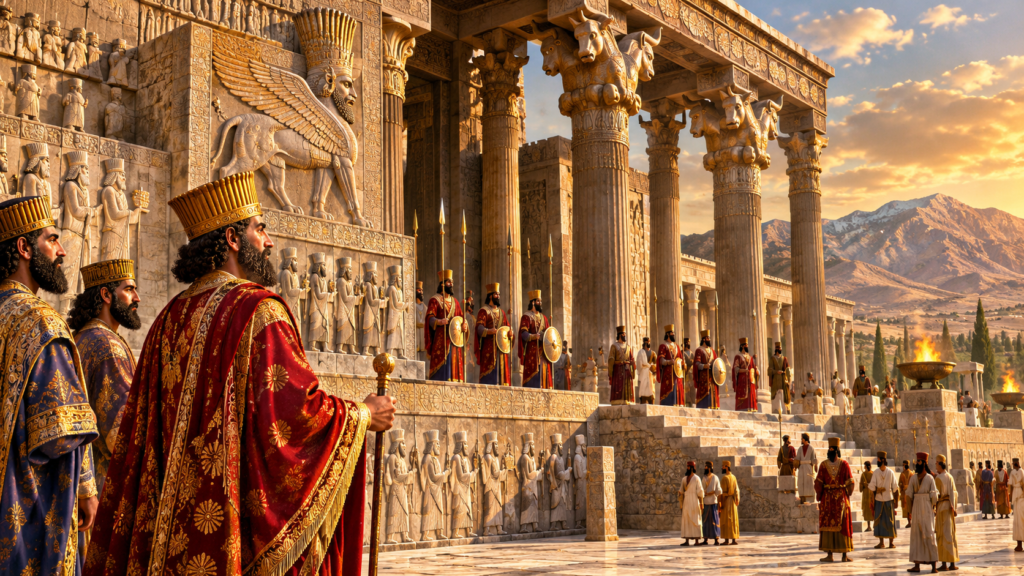
From a distance, the buildings rising on the terrace at Persepolis must have offered an extraordinary sight.
Imagine the girl accompanying a relative who had been allowed to approach an area associated with construction. She watches people moving stone and carrying equipment. A conversation she overhears concerns the sequence of tasks needed before another part of the work can begin.
She sees a small part of something that will extend beyond the lifetime of some of the people making it.
Darius began the monumental project at Persepolis around 518 BCE. Successive rulers continued and altered the architectural complex. Its remains include vast reception spaces, imposing staircases, columns and reliefs whose designs convey an elaborate image of royal authority.
The UNESCO description of Persepolis documents the scale and significance of this architectural landscape.
Among its most famous surviving images are the representatives of different peoples carrying objects toward the royal presence. Their clothing, gifts and visual arrangements invite consideration of how the monarchy represented its relationships with diverse populations.
The completed reliefs belong to a later stage of the project than some of the events imagined in this chapter. Our fictional girl should not be pictured walking through the fully developed complex familiar to visitors today.
The images also require interpretation. They show an ordered representation of the imperial world, not an impartial record of every interaction between the rulers and their subjects.
Military conquest, unequal obligations and political conflict existed alongside the forms of cooperation and exchange visible in imperial art.
Persepolis is compelling because it preserves both aspects of the historical problem: the astonishing material accomplishment of a monumental enterprise and the deliberate image of the political arrangements that made it possible.
The empire seen from the other end of the road
A traveler arriving near Persepolis might have passed through landscapes and communities whose circumstances were unknown to the girl’s household.
In Egypt, the relationship between Persian authority and local institutions had its own history. In the Greek-speaking cities of Anatolia, conflicts and alliances developed differently. The eastern territories connected the empire to Central Asia and the northwestern regions of the Indian subcontinent.
The wars between Achaemenid forces and Greek states in the early fifth century BCE occupy a prominent place in surviving Greek historical writing. Revolt in Ionia, the campaigns of Darius and Xerxes, and the battles associated with Marathon, Salamis and Plataea shaped the subsequent relationships between Persia and Greek political communities.
But those wars were only part of Achaemenid history. The empire survived for roughly another century and a half after the defeat of Xerxes’ expedition.
Greek accounts are invaluable evidence, yet their focus and perspectives cannot substitute for the experiences of every society under Persian rule. Administrative sources, archaeology and inscriptions broaden the picture, even as they introduce their own interpretive limitations.
A person living in the empire’s eastern regions might encounter its authority through a provincial official, an obligation to supply resources or the arrival of people traveling through a system connecting distant territories. Their concerns would not necessarily resemble those of a Greek author explaining the course of a war.
Modern histories must therefore resist the temptation to understand the entire empire through the experiences of only one of its neighbors.
When the roads outlived the dynasty
The girl of our story was long dead when Alexander of Macedon invaded the Achaemenid territories in 334 BCE.
The defeats suffered by the forces of Darius III, the loss of major royal centers and the king’s death in 330 BCE ended the Achaemenid dynasty’s rule over the empire.
Persepolis suffered destruction by fire during Alexander’s occupation. The circumstances and motivations associated with that event remain subjects of historical interpretation.
Yet the end of a dynasty did not erase the people, routes, languages and administrative knowledge accumulated over previous centuries.
Successor states developed across former Achaemenid territories. Many established their own relationships with the communities and institutions of the regions they governed. Later Iranian powers, notably the Parthian and Sasanian empires, belonged to further historical periods with distinctive political arrangements.
Those developments should not be treated as a single unchanged Persian system stretching across a millennium. Their rulers faced different conditions, adopted different institutions and inherited histories that included both continuities and disruptions.
The closing chapter of Volume 1, The Systems Humanity Never Outgrew, considered how problems of human coordination recur without requiring identical solutions. The Achaemenid experience illustrates how relationships created under one political order can remain significant after that order has disappeared.
A road can outlive the person who commissioned its construction. A language can continue to carry messages after the office that once used it has ceased to exist.
The stranger who left at dawn
Return to the storehouse where our narrative began.
The following morning, the travelers prepared their animals. One man thanked the people who had made it possible for the group to continue their journey.
The girl asked him whether they would return by the same route.
“Perhaps,” he said.
She watched them disappear along the road. They were carrying messages whose contents she did not know, traveling toward people whose faces she would never see.
Her uncle returned to his work. Another delivery required attention.
Thousands of years later, a monumental inscription can tell us how Darius represented his victories. A relief can show the royal vision of an ordered empire. A small tablet can preserve the record of supplies issued in the course of an ordinary transaction.
The sources tell different kinds of stories, and none is sufficient alone.
Ancient Persia’s achievement was not simply the acquisition of extensive territory. It was the creation and adaptation of arrangements capable of linking places, people and resources across extraordinary distances.
Those arrangements facilitated movement, communication and administration. They also enabled a ruling power to draw upon the labor, wealth and allegiance of many different communities, sometimes through coercion.
The distinction matters. A connection is not necessarily an equal relationship, and political stability does not guarantee the same experience for everyone living within it.
To understand the Achaemenid Empire, we must study not only the figures standing at the center of its monuments but also the people who made its journeys, kept its records, produced its food and carried out its ordinary work.
Our imagined girl never saw the boundaries of the empire.
But she knew how far a stranger could travel before someone opened a door for him.
Series navigation: Volume 2 index | Past to the Future. Direct links to neighboring chapters will be added when the drafts are published.