Past to the Future | Volume 2 | Part 3
Historical scope: Ancient Egypt from the formative dynastic period through the New Kingdom, with the central narrative set at Deir el-Medina in the twelfth century BCE, during the reign of Ramesses III. Hori, his wife Tia and their daughter Merit are invented characters. Their conversations and domestic experiences are imaginative reconstructions, while the historical events and archaeological objects discussed alongside them are documented.
The jar that was almost empty
Tia knew how much grain remained without lifting the lid. Each morning, the wooden scoop struck the bottom a little sooner.
She sat in the first light outside her house, sorting the last handful of emmer wheat on a shallow tray. Her daughter Merit watched a small beetle escape through a crack in the wall. Somewhere beyond the houses, a man called to his neighbor. The low desert hills were already gathering the color of the sun.
“Is Father bringing more?” Merit asked.
“He will ask again today.”
Tia did not say that he had asked yesterday.
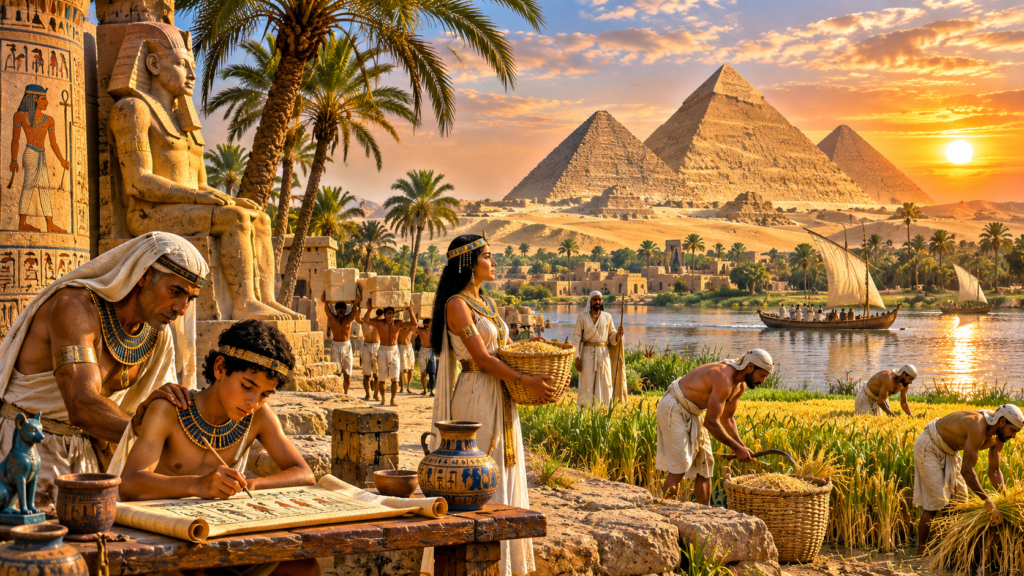
Their village lay on the western side of the Nile near ancient Thebes, tucked into a dry valley away from the cultivated land. Today we know it as Deir el-Medina. Its inhabitants included skilled workers responsible for creating and decorating the tombs of Egyptian kings.
Hori was one of those craftsmen in our imagined story. He understood how to follow a painted line across a rough wall and how to distinguish a surface ready for decoration from one still requiring preparation. His work contributed to structures intended to last beyond any ordinary human lifetime.
Yet his household could not eat the walls he decorated.
When he left that morning, Tia handed him a small piece of bread. He broke it in half, put one piece back on the tray and told Merit that he would eat the other at work.
The girl waited until he had disappeared before asking her mother why he had left so much behind.
Tia looked down at the tray. “Because he knows how much is left.”
The Nile was still flowing. The temples still stood. The king was still king. But in one small house, the ordinary relationship between labor and food was beginning to fracture.
The river that made a country
To understand how the family had come to depend on deliveries of grain, we must first leave the village and follow the river.
The Nile flows generally northward through Egypt toward the Mediterranean. This geography helps explain the apparently unusual names of Upper and Lower Egypt. Upper Egypt lies upstream, in the south, while Lower Egypt includes the northern delta. The names describe the direction and elevation of the river rather than the position of the regions on a modern map.
For much of ancient Egyptian history, the summer inundation brought water and sediment onto parts of the floodplain. The retreat of that water helped create favorable conditions for planting. Farmers organized agricultural activities around the changing relationship between river, soil and season.
University College London’s overview of food production in ancient Egypt explains the importance of this annual cycle before the construction of modern river dams. The traditional Egyptian calendar distinguished the seasons associated with inundation, emergence or growth, and harvest, conventionally called Akhet, Peret and Shemu.
These names represented a broad relationship between the river and the agricultural year. They should not be taken as identical modern calendar dates across all centuries of Egyptian history. The Egyptian civil calendar did not remain perfectly synchronized with the seasonal cycle.
Imagine Merit visiting relatives near the cultivated land. In our reconstruction, she walks between fields beside an older cousin who can distinguish a promising crop from a patch that has not received enough moisture. The cousin understands that a successful harvest begins long before grain is collected.
The river offers no guarantee. A season with insufficient flooding can limit the amount of land that receives water. Excessive flooding can damage settlements and fields. Successful cultivation also requires suitable land, seed, human labor and the ability to manage the timing of work.
Water alone does not make a secure food supply. The transformation of agricultural resources into household security depends on several additional steps: harvest, processing, storage and distribution. The earlier discussion of permanent settlement and the organization of stored resources helps explain why those steps became so significant in larger societies.
For Tia, living in a village beyond the fertile strip, the existence of productive land nearby meant little unless some part of its yield reached her door.
Long before Hori was born
The tomb worker and his family inhabited a country with monuments that were already ancient in their own time.
Political unification in Egypt is conventionally associated with the period around 3100 BCE, although the emergence of a unified state was a complex process rather than a single event whose exact circumstances can be recovered. Kingship, administrative practices, writing and regional connections developed across generations.
Egyptologists organize much of pharaonic history using dynasties and broader phases. The Old Kingdom is particularly associated with the construction of monumental pyramids, including those at Giza. The Middle Kingdom followed a period of political fragmentation and saw renewed central authority under rulers associated initially with Thebes. The New Kingdom began around 1550 BCE and included periods of extensive Egyptian power beyond the Nile Valley.
The Metropolitan Museum of Art’s chronology of Egypt between 2000 and 1000 BCE situates these changes alongside the history of Nubia, an important reminder that Egypt’s southern neighbors possessed their own societies and political traditions.
Hori’s lifetime, more than a thousand years after the Giza pyramids were constructed, belongs near the later end of the New Kingdom. He could not have witnessed their building. Nor did every institution he encountered operate in the same way as its counterpart during the Old Kingdom.
The distinction matters because ancient Egypt is often represented as a single timeless world. Its writing, architecture and religious imagery show remarkable continuities, but its political boundaries, economic arrangements and cultural practices changed considerably.
When we tell its story through individual lives, we must allow those individuals to belong to their particular historical moments.
A city built to build a monument
Centuries before Hori, people working at Giza had faced another set of organizational challenges. The great pyramid complexes required not only stone and technical skill but a continuous supply of labor, equipment and food.
Archaeologists from Ancient Egypt Research Associates have investigated Heit el-Ghurab, a substantial Fourth Dynasty settlement south of the Sphinx. The excavation project’s account of the Lost City of the Pyramids describes the archaeological investigation of facilities and living spaces associated with the construction projects.
The discovery helps shift attention away from the idea that pyramid building can be explained entirely by the method used to move stone blocks. A worker must be fed before a block can be moved. Tools must be obtained and repaired. Messages must be communicated across different parts of a construction site.
Even the identification of particular buildings requires careful research. Architectural layouts once interpreted as workers’ accommodation have sometimes been reassessed after excavation. Different structures may have served storage, production, residential or administrative functions.
The findings do not establish the precise legal or social condition of every person employed at Giza. They do, however, show why explanations relying on a simple image of an undifferentiated mass of enslaved pyramid builders fail to account for the complex archaeological evidence.
Hori’s own work centuries later took place in different arrangements, associated with royal rock-cut tombs instead of enormous stone pyramids. The challenges of provisioning and coordinating specialized labor nonetheless provide a point of comparison.
In both settings, a royal monument depended upon a population whose ordinary needs did not disappear simply because its work had a sacred or political purpose.
The grain that passed through many hands
Tia had an aunt who liked to tell stories about grain. She did not mean the heroic kind of story in which a god defeated an enemy or a king returned triumphant. Her stories were about the moment a farmer’s crop became someone else’s responsibility.
In one imagined conversation, she explains to Merit that a sack must be carried, measured and delivered before anyone can grind its contents into flour. The people counting grain and the people carrying it do not ordinarily perform the same work, although both activities affect what ultimately becomes available.
An object made approximately six centuries before Hori’s lifetime illustrates this organization beautifully. The Metropolitan Museum holds a wooden model of a granary with scribes from the tomb of Meketre, an important Middle Kingdom official. Its miniature figures show the physical handling of grain alongside the work of measuring and accounting for supplies.
It is a funerary model, intended to serve the deceased in the afterlife, not a photograph of a working institution. Nevertheless, it preserves a remarkable representation of activities considered important to the organization of stored food.
Its accountancy area directs attention toward a problem that is easily overlooked. A useful stock of grain must remain usable over time. An institution responsible for distributing it needs some way of knowing what has arrived, what has been removed and what obligations are still outstanding.
The benefits of a reserve depend on much more than its physical size. If the people requiring food cannot receive it, the existence of a reserve elsewhere may offer little immediate comfort.
The distinction is explored more imaginatively in A Letter from a Grain Distributor. That fictional companion piece is not an Egyptian historical document, but it asks a question relevant to the surviving evidence: what happens when decisions about the movement of food affect people whose circumstances are not visible where those decisions are made?
The wooden granary represents a world of coordination. Tia’s almost empty jar represents the consequences when coordination fails.
Inside a royal tomb
When Hori was working, the light inside the rock-cut passage did not resemble the sunlight outside. It was a smaller and more demanding kind of light, useful only within the space it illuminated.
He had learned to notice imperfections before they became part of a finished surface. An uneven section could interfere with a later stage of decoration. A misplaced mark might require additional labor. He and his companions depended on the sequence in which different tasks were undertaken.
The work required knowledge inherited through training and experience. It also demanded materials, provisions and the steady organization of a workforce.
Deir el-Medina is unusually important to Egyptologists because the remains of the village and the records connected with its residents make aspects of daily life visible that are much harder to recover in other ancient settlements. The Museo Egizio’s account of the village and the Strike Papyrus describes the community’s connection to the royal necropolis and the administration overseeing the workforce.
It was not a representative Egyptian village in every respect. Its proximity to royal projects and the unusually extensive evidence associated with its residents distinguish it from many agricultural communities. The lives of its workers should not be treated as a model for everyone in ancient Egypt.
Yet this specificity is what gives its history such power. The archaeological record allows us to see something of the requirements of highly skilled work undertaken on behalf of the royal household.
The idea of eternal monuments depended on people attending to tasks that lasted days, months and years. The contrast between their work and their own limited lifetimes is one of the most striking features of Egyptian funerary art.
The gods of a living country
One afternoon, Merit saw her father making a small repair to an object in their home. He was usually patient with her questions, and she asked why the king required so much work after death.
Hori did not have a philosopher’s answer. In this imagined exchange, he tells her that the living have duties toward the dead and that the dead remain part of the world of the living in ways a child may not yet understand.
Ancient Egyptian religion included many deities, rituals and traditions extending across different places and centuries. Its complexity cannot be reduced to an obsession with death. Religious practices were connected to healing, family life, political authority, natural cycles, protection and the maintenance of order.
The inundation and the emergence of fertile ground offered powerful images for accounts of creation and renewal. University College London’s discussion of ancient Egyptian creation traditions illustrates several of the distinct ways in which Egyptians represented the origins of the world.
Kingship also had a religious dimension. Royal representations expressed relationships between rulers and deities, and the king could be associated with the maintenance of order and the performance of rituals. The concept of maat encompassed ideas of truth, justice and proper order, although its meaning varied with context.
These beliefs had significance beyond political usefulness. To treat them merely as instruments invented by rulers would deny an essential aspect of ancient people’s experience. At the same time, religious institutions could possess land, employ workers and participate in the economy. Belief and material organization were often deeply intertwined.
Merit would grow up in a world where the distinction between a religious duty and an ordinary obligation did not necessarily resemble the categories familiar to a modern reader.
A woman whose words survived
Tia cannot speak to us from an ancient document because she is fictional. Another woman from Deir el-Medina, however, left evidence of a family decision during the later New Kingdom.
Her name was Naunakhte. The Ashmolean Museum preserves a record of her testamentary arrangements, in which she distinguished among her children according to the support she believed they had given her. The museum’s discussion of Naunakhte’s family dispute brings attention to one of the relatively rare surviving documents that preserve a woman’s expressed perspective from this world.
The document should not be taken to establish that all Egyptian women enjoyed the same economic security or practical control over property. Social standing, wealth and household circumstances mattered. Legal capacity and the ability to exercise it are not identical.
What Naunakhte’s record does establish is that a woman could have recognized interests in property and could express a decision regarding its distribution. Her concern about how her children had treated her makes the document unusually personal.
It also complicates any picture of ancient Egyptian women merely waiting inside houses while men made all consequential decisions. Households were places of production, negotiation and responsibility. Their members could participate in relationships that extended into the wider social and economic world.
In the imagined household at Deir el-Medina, Tia’s decisions concerning food, exchanges and family obligations are therefore not incidental background to Hori’s public work. They are part of the story of the labor that a royal institution required without necessarily recording it in full.
The day the tools were put down
At last, Hori came home earlier than expected.
Tia looked at his hands and saw no fresh coating of dust. She asked whether he was ill.
“No,” he said. “We have stopped.”
The answer sounded almost impossible. Work on the royal tomb carried obligations that neither of them regarded casually. The household also depended on the provisions connected with that work. Refusing to continue was not a decision without risk.
“What will happen?”
He sat beside the doorway.
“I don’t know. But we cannot keep working without food.”
The actual historical event inspiring this scene is recorded in the Turin Strike Papyrus, dated to the twenty-ninth regnal year of Ramesses III in the twelfth century BCE. The document was produced by the tomb scribe Amunnakht, whose name is also transliterated in other forms.
It describes workers interrupting their duties because provisions had not been delivered as expected. They gathered at locations within the Theban necropolis, appealed to authorities and demanded the overdue supplies. Deliveries addressed some grievances, but further protests occurred.
The museum’s catalogue of the original papyrus identifies its central subject as the failure of the arrangements that provided the workforce with its regular compensation in food.
Often described as the earliest documented labor strike, the episode is especially remarkable because the work stopped not at a modern factory but at the royal burial grounds of an ancient state. The label describes the surviving record; it does not prove that no earlier community ever engaged in collective withdrawal of labor.
Nor should a modern system of labor relations be projected directly onto the episode. The workers occupied a particular place in the royal administration, and their protest operated within the political and religious arrangements of their own time.
Nevertheless, the fundamental fact deserves to be understood. People whose skills were required for royal work collectively refused to continue when essential provisions failed to reach them.
The distance between a king and a household
The ruler whose tomb was being prepared possessed a title of enormous significance. Yet the arrangements on which his workers depended passed through many other people.
An agricultural producer harvested crops. Someone received or transported part of the produce. Others were responsible for retaining and distributing supplies. Officials had responsibilities concerning the workforce, while scribes recorded aspects of its activities.
A failure anywhere within such an arrangement could have consequences for people far from the place at which the problem originated. The surviving strike record documents the workers’ experience of shortages, but does not by itself supply a complete explanation of every underlying administrative or economic cause.
This distinction prevents us from giving the historical event a dramatic but unsupported villain. We do not need to invent a single dishonest official or claim that one identifiable poor flood caused the protests in order to understand what happened.
A complex institution can depend on many well-functioning relationships. The ability to commission impressive work is different from the ability to meet every recurring obligation to the people performing it.
The modern reflection An Open Letter to the People Who Keep Things Running asks readers to notice such relationships in contemporary life. Ancient Egypt’s institutions were profoundly different from ours, but the difficulty of recognizing an organization’s reliance on ordinary human effort provides a meaningful comparison.
A monument can make a ruler visible centuries after death. The daily work needed to complete that monument may survive only in fragments.
What Merit remembered
In the final imagined scene, Merit stands beside her mother as Hori returns with grain. Tia lifts the lid of the jar and lets him pour. The sound is soft at first, then heavier as the grain gathers against the bottom.
The girl puts a hand on the jar. There is no great celebration. Her mother must still grind the wheat, prepare food and consider what will be needed tomorrow.
“Does this mean they will always bring it now?” Merit asks.
Her father looks toward the entrance of the house.
“It means we have enough for today.”
Outside their village, water continues to move through the valley. Farmers prepare their land. Boats carry people and goods along the Nile. At the royal necropolis, unfinished surfaces wait for those who know how to complete them.
The family is ours to imagine. The labor protest is not. The surviving papyrus allows us to approach a historical moment in which the relationship between royal ambition and the needs of workers became visible through collective action.
The long history of Egypt contains many such relationships, though comparatively few have left equally direct accounts. Its monuments testify to extraordinary technical and artistic achievement. Its objects, settlements and documents also offer glimpses of the labor and material arrangements that sustained those achievements.
The conclusion of Volume 1, The Systems Humanity Never Outgrew, distinguished recurring problems of human organization from the institutions through which particular societies addressed them. Ancient Egypt adds a vivid historical example: religious devotion, royal authority and administrative capacity coexisted with the continuing vulnerability of households.
The Nile helped make an enduring civilization possible. It did not make its people immune to uncertainty. Understanding the country requires looking at both the river that sustained it and the people who transformed that possibility into everyday life.
In the next chapter, we travel east to the Indus civilization, whose cities offer a different archaeological record and a different set of questions about urban planning, trade, water and authority.
Series navigation: Volume 2 index | Past to the Future. Previous and next article links will be added when the neighboring drafts are published.