
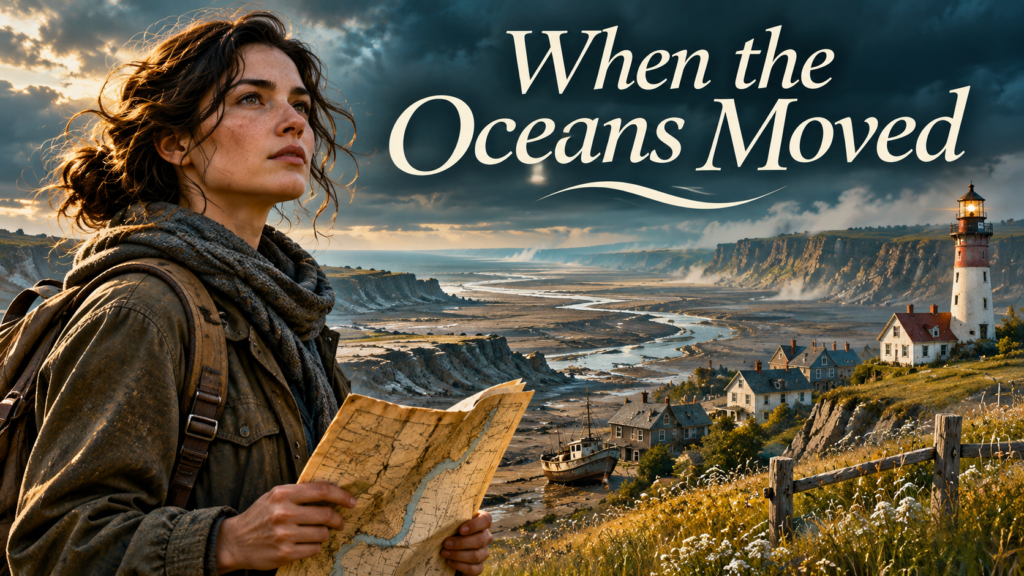
The first house to move was not the one nearest the water.
It stood on a ridge above the harbor, three streets from the seawall and sixty-seven meters above the old tide marks. Its owner, Mrs. Damar, was making tea when the crockery slid sideways in the cupboard. She caught the sugar bowl with both hands and felt the floor shift beneath her slippers, not violently, but with the grave, deliberate movement of a ship changing course.
Outside, the apple tree leaned toward the sea. Its roots made a noise like cloth tearing.
At the harbor, the fishing boats were rising. Their mooring ropes stretched taut, then slackened, then stretched again as the water climbed the pilings. There was no wind. There had been no storm warning. A gull hung over the breakwater, beating its wings furiously against air that seemed to offer no purchase.
By the time Mrs. Damar reached the street, the church clock had stopped at 6:14.
Far below her, on the harbor wall, a young woman in an orange survey coat was staring at a tide gauge that had just reported a number it was not built to display.
Mina Vale had spent the previous three years learning how to distinguish a broken instrument from an impossible measurement. The distinction was usually comforting. A broken instrument could be repaired, and an impossible measurement could be ignored until a better instrument arrived.
The harbor gauge read minus twelve.
The water was rising.
She struck the casing with the flat of her palm. The digits flickered and returned to minus twelve. The backup gauge on her tablet showed the same value, accompanied by a red triangle and the words REFERENCE DATUM UNAVAILABLE.
Behind her, a fisherman named Coren shouted, “Are you going to tell us what it means?”
“Not yet.”
“That is a terrible answer.”
“It is the only one I have.”
She looked beyond the harbor mouth. The horizon had changed. It was a small alteration, the kind a person might mistake for poor eyesight, except Mina had studied that horizon from the same wall every morning for eleven years. There should have been a narrow black line where the eastern shoal broke the surface. The shoal was gone. In its place, a pale band of water curved toward the open sea.
Mina called the regional monitoring station. No signal.
She called the emergency service. A recorded voice told her all operators were assisting other callers.
She called her father.
He answered on the fourth ring, sounding annoyed to have been awakened. “Mina? What has happened?”
“Go to the upper road. Take your medicine and the blue folder.”
There was a pause. “Why the folder?”
“Because you will argue with me if I say the house is moving.”
Her father had been a civil engineer before his hands began to tremble. He understood buildings, soil, and the limits of what a daughter might say to avoid frightening an old man. “How much?” he asked.
“I don’t know.”
“Then you must find out.”
“Please go.”
“I will go,” he said. “But you will find out.”
The call ended.
Mina was still holding the phone when the harbor water dropped three meters in less than a minute.
Boats settled into the mud with a succession of cracking sounds. A fish lay twisting in a puddle beside a tire. The water withdrew through the harbor mouth, dragging ropes and nets after it, exposing a floor of black stones no one in Bellport had seen in living memory.
Coren started down the steps toward his boat.
“Don’t,” Mina said.
“My engine is down there.”
“Leave it.”
“It is everything I own.”
“Then let it be everything you still own tomorrow.”
He looked at her, offended by the certainty in her voice. She was not certain. She was frightened by how much of the shoreline was visible, and by the fact that the retreating water did not rush outward like an ordinary surge. It moved in a smooth sheet, as though someone were pulling a tablecloth from beneath the sea.
Mina grabbed the harbor loudspeaker. It had not been tested since the autumn flood drills.
“Everyone off the lower streets,” she said. Her voice emerged thin and distorted. “Move inland and uphill. Do not enter the exposed harbor. Do not wait for another announcement.”
A man on a bicycle stopped to listen. Two children began running before she had finished.
The water did not return.
At 6:22, the first radio message came through on a private fishing frequency. It was a woman speaking from the town of South Reach, eighty kilometers down the coast.
“Our water is going east,” she said. “The whole bay is going east. Is anyone receiving?”
Mina answered. “Bellport receiving. We have a withdrawal. What do you mean, east?”
“I mean the sea is leaving us. I can see the old wrecks.”
Another voice broke in, rough with static. “North Cape here. The water is coming over the road. We have no wind. Repeat, no wind.”
Then another. “Grayhaven. The channel markers are moving.”
And another, farther away, speaking a different language. Mina recognized only three words: water, people, help.
She wrote each report on the back of a tide chart, along with the times. Her pencil broke. She sharpened it with the small knife her father had given her when she started fieldwork.
At 6:29, a distant sound rolled across the exposed harbor.
It was not thunder. Thunder had edges, beginnings and endings. This was continuous, a deep frictional groan that seemed to come from under the earth and beyond the horizon at once.
Mina felt it through the soles of her boots.
The water was not behaving like a tide, a storm surge, or a tsunami. Those things had causes she understood, even when their consequences were terrible. What she saw now looked less like water traveling across a fixed world than like the world itself changing its relation to the water.
She knew how absurd that thought was.
She wrote it down anyway.
By seven, Bellport’s mayor had opened the school gymnasium as an evacuation center. Mayor Soren Kade had once been a school principal and still gave instructions as though everyone might improve if they listened more carefully. He stood beside the basketball court with a paper map pinned to a noticeboard and a marker in his fist.
“Tell me which streets are safe,” he said.
“I can tell you which streets were safe yesterday,” Mina replied.
“That is not helpful.”
“Neither is pretending the old flood map applies.”
The gym was filling. Parents held children who had left their homes without shoes. A baker arrived with trays of warm rolls and set them beside the first-aid station. Someone had brought a cage of finches. The birds were silent.
Kade lowered his voice. “People need something solid.”
“Then give them the upper school, the water tanks, and a place to register missing relatives. Those are solid.”
He studied her for a moment, then handed the marker to a volunteer. “Do it.”
Mina marked the upper roads, the two footpaths that crossed the ridge, and the disused rail tunnel connecting the school to the inland district. She had inspected the tunnel after the winter landslide. Its supports were old but sound.
“Keep the tunnel open,” she said. “If the lower bridge goes, it will be our only route.”
“Goes where?” asked a boy sitting on the floor.
Mina almost said nowhere. Instead she knelt so that she could meet his eyes.
“I don’t know yet,” she said. “But we are making sure you have more than one way home.”
The boy considered this. “My home is near the water.”
“Then we are making sure you have more than one way to somewhere safe.”
He nodded. Children sometimes accepted uncertainty more readily than adults, provided no one disguised it as reassurance.
At the far end of the gym, Mina saw her father seated beside a window. He wore his old gray coat and held the blue folder on his knees. When she approached, he lifted one hand to show her he had remembered his medication.
“You were right,” he said.
“About leaving?”
“About the house.”
He opened the folder. Inside were photographs, survey plans, and a yellowed engineering report bearing the seal of the National Coastal Commission. Mina had seen the folder many times but never understood why he kept it so close.
Her father tapped a photograph. It showed a line of concrete pillars on a beach, each bearing a numbered metal plate.
“Those are the old reference stations,” he said. “Built before the new satellite network. We used them to measure whether the land was rising or falling.”
“I know what benchmarks are.”
“You know what the manuals say they are.”
She looked up.
He took a breath. “When I was young, we found a discrepancy between stations. Not a little discrepancy. The sea level appeared to change by nearly a meter between points that should have agreed.”
“That could be land movement.”
“We thought so. We checked the rock. The rock had not moved. We checked the instruments. They were sound. We checked the clocks.”
“And?”
“The clocks agreed.” He closed the folder. “We were told to call it a calibration error.”
“Who told you?”
“The Commission. A man named Dr. Sen.”
“Is he still alive?”
“I don’t know.”
Mina felt the old irritation of being given a story only after its usefulness had nearly expired. “Why didn’t you tell me?”
“Because I thought we were wrong. Because I wanted us to be wrong.”
Outside the gym, the ground shivered. The finches erupted against the bars of their cage.
A volunteer hurried through the doors. “The lower bridge is lifting.”
Mina and Kade ran to the western windows. The bridge was visible beyond the rooftops, a long span crossing the estuary. At first she saw nothing unusual. Then the nearest support column rose from the riverbed. Water streamed from its sides. The roadway tilted, carrying a line of abandoned cars with it.
The bridge was not collapsing.
It was being raised.
A white delivery van slid backward, struck the guardrail, and stopped. The column continued upward until the roadway stood at an angle no vehicle could climb.
Kade whispered a word Mina had never heard him use.
“The bridge is closed,” she said.
“It was closed before you said it.”
“Then close the roads leading to it. People will still try.”
He nodded and ran.
Mina remained at the window. On the opposite bank, trees leaned toward the exposed estuary. The entire shoreline appeared to be drawing itself into a new shape, slowly enough that the eye struggled to follow it, quickly enough to make every familiar distance untrustworthy.
She understood then why her gauge had read minus twelve. Its reference point was not merely failing. The relation between the reference point and the water had ceased to remain constant.
The water was moving, but so was the land.
A voice behind her said, “You should come to the radio room.”
It belonged to Tessa Quill, the school’s science teacher, who had taught Mina how to use a microscope when she was eleven. Tessa had a narrow face, a practical haircut, and a gift for speaking quietly in emergencies.
“We have a satellite call,” Tessa said. “A research vessel. They asked for you by name.”
The radio room was a storage cupboard with a desk, a transmitter, and three boxes of obsolete textbooks. Tessa had connected the school generator to a marine receiver. A green light blinked beside the speaker.
“This is Dr. Imani Sen aboard the research vessel Pelagic,” a woman said. “I am trying to reach Mina Vale.”
Mina looked at her father, who had followed them into the room.
“Sen?” she said into the microphone. “Your name is in an old Commission report.”
A short silence followed.
“Then your father kept the records,” the woman said.
“Where are you?”
“Two hundred kilometers offshore, though that distance is no longer reliable.”
“What is happening?”
“We have measurements from six continents. The water is not simply rising or retreating. Entire ocean basins are shifting relative to the continental margins. We do not yet know the mechanism.”
Mina leaned against the desk. Hearing the impossible spoken plainly by another scientist was both a relief and a new kind of terror.
“Is it an earthquake?” she asked.
“No global seismic pattern supports that. The movement is coherent across distances too large for a conventional wave. We are testing other explanations.”
“Can you stop it?”
“We are trying to understand it before we promise anything.”
The speaker hissed.
Dr. Sen returned with a different tone. “Mina, I need the old coastal benchmarks. The ones your father surveyed. Do they still exist?”
“Some do.”
“Find three on stable bedrock, as far apart as you can manage. Measure their elevations relative to one another, not relative to the sea. Use whatever instruments you have. We need to know whether the ground is changing shape or changing position.”
“Position relative to what?”
“That,” said Dr. Sen, “is the question we are afraid to answer.”
The connection failed.
For a moment no one spoke. Then Mina’s father opened his folder to a map of the headland. He pointed to three small circles marked in faded red.
“These,” he said. “North quarry, lighthouse hill, and the old fort. All bedrock. All accessible by the upper paths.”
“You can’t walk that far,” Mina said.
“I can tell you where the marks are.”
“And I can measure them,” Tessa said.
Mina looked at her former teacher. “The north quarry path is unstable.”
“It was unstable last month. We will check it again before we use it.”
The distinction made Mina smile despite herself.
They gathered a surveying level from the municipal depot, two measuring rods, a spool of line, a compass, and a field notebook. Kade assigned them a pair of volunteer firefighters. One was a woman named Jori, who carried a medical pack. The other, Pell, had spent twenty years repairing roads and knew which slopes would hold after heavy rain.
They left the school by the north gate shortly before nine.
Bellport had become a town of open doors. People stood in yards watching the sea. Others carried blankets and plastic bags uphill. A man dragged a refrigerator on a handcart, its door tied shut with string. A little girl walked beside him holding a potted fern.
The sight was so ordinary in its stubbornness that Mina had to look away.
At lighthouse hill, the first benchmark stood beneath a rusted protective cap. Her father had remembered its exact position. Tessa brushed away grit and read the number aloud. Mina set up the level and recorded the first sighting.
They worked slowly. The ground trembled twice, and each time they waited for the instrument to settle before repeating the measurement. A measurement taken in fear was still a measurement, but it had to be made honestly.
At the old fort, they found the second mark half hidden under ivy. The fort’s stone wall had cracked along a mortar seam. Pell tested the ground before allowing them near it.
By the time they reached the quarry, clouds had gathered over the open sea. There was no wind to move them. They seemed to thicken in place.
Jori stopped at the path entrance. “Listen.”
The quarry should have been full of the sounds of loose stones and distant birds. Instead a low humming rose from its floor. Mina recognized the vibration from the harbor, but here it had a higher note, almost musical.
The third benchmark stood on a shelf of granite above the pit. Its brass plate was warm.
Tessa placed a hand near it, then drew back. “That isn’t sunlight.”
Mina set the level on a flat patch of stone and took the final readings. She checked the notebook. She checked the instrument. She asked Tessa to repeat the measurements without looking at hers.
Their figures agreed.
The distance between the fort and the quarry had changed by eighteen centimeters.
Not the distance on a map. Not a change inferred from sea level. A direct difference between fixed marks in the same body of rock, measured against a third point.
Mina crouched beside the brass plate. “That can’t be right.”
Tessa said nothing.
Pell, who had been watching the quarry floor, said, “You should come see this.”
They approached the edge cautiously. Far below, a narrow fissure had opened in the granite. Water was flowing upward through it, dark and perfectly smooth. It did not spray or bubble. It rose in a column until it reached the level of the quarry floor, then spread into a shallow pool.
Within the pool, a line of pale stones began to emerge.
Mina knew those stones. They were old harbor cobbles, rounded by generations of tides. The quarry was miles inland and far above the water.
The humming deepened.
Jori took Mina’s arm. “We have to go.”
Mina pulled free only long enough to take a photograph. Then the ground beneath them tilted.
They scrambled toward the path. A chunk of granite broke away behind Pell, striking the quarry floor with a sound like a door slammed in a vast empty house. The water rose to cover it. Mina felt the earth shift again, and this time she could not tell which direction was downhill.
Pell caught Tessa by the collar before she slid over the shelf. Jori seized the survey tripod. Mina dropped to her knees and crawled toward a patch of grass that still looked level.
When the movement stopped, the path they had used was no longer continuous. A new crack divided it from the ridge.
For several seconds all four of them breathed without speaking.
Then Tessa began to laugh. It was not a happy sound.
“Eighteen centimeters,” she said.
Mina looked back toward the benchmark. It had vanished into the widening crack.
“We have the numbers,” Mina said.
“And what do they mean?”
Mina stared at the sea. From the quarry ridge, she could see beyond Bellport to the western horizon. The water there had risen into a long, shining swell that did not break. It looked like a fold in a sheet of metal. Farther north, another fold ran in the opposite direction.
“They mean the map is becoming a memory,” she said.
They reached the school shortly after noon by a circuitous route through the orchard district. Kade met them at the gate. He had a strip of plaster over one eyebrow and the exhausted look of a man who had been asked the same question a hundred times.
“The eastern hospital has lost its ground floor,” he said. “The upper wards are intact. We are moving patients through the rail tunnel.”
“Keep that tunnel staffed,” Mina said. “Not just open. Staffed.”
“Why?”
“Because if the ground shifts again, someone needs to know exactly who went in and who came out.”
He took the warning without argument.
Inside, Mina spread her field notes across the radio desk. The satellite connection returned in fragments. Dr. Sen listened while Mina read the measurements, including the uncertainty and the repeated checks.
When she finished, the speaker remained silent for so long that Mina thought the link had failed.
Then Dr. Sen said, “We have similar readings from the Andes and from an island station in the Indian Ocean.”
“What does that tell you?”
“That the changes are not local.”
Mina waited.
Dr. Sen continued, “We are seeing a pattern. It is too early to explain, but the ocean boundaries appear to be reorganizing. Some coastal regions are being lifted, others lowered. The water is responding to those changes. There may be a larger cycle.”
“A cycle with a period of what?”
“We don’t know.”
“Hours? Days?”
“We don’t know.”
Mina closed her eyes. Every answer that mattered had become the same.
Behind her, the school bell rang for lunch. Someone had kept the ordinary timetable, though there were no lessons. Children began lining up for soup. A boy carried two bowls, one for himself and one for his younger sister.
Dr. Sen’s voice softened. “What is the condition of your town?”
“Still here.”
“That is not what I asked.”
“It is what I can tell you.”
Outside the window, the sea glittered beyond the roofs. It was beautiful in a way that made Mina angry. People had trusted its beauty for centuries. They had built harbors, named currents, painted boats, buried relatives above the high-water mark. They had made promises about where land ended and water began.
Now the boundaries were moving, and every promise made to a map was being called into question.
Her father appeared in the doorway, leaning on his cane. He had heard the transmission.
“You found the marks,” he said.
“We found enough.”
“Good.”
“Nothing about this is good.”
“No,” he agreed. “But knowing is better than guessing.”
Mina wanted to tell him that knowledge had not saved the bridge or the hospital, had not explained the quarry water or the impossible horizon. Instead she showed him the photograph of the rising pool.
He studied it for a long time.
“I saw something like that once,” he said.
Mina looked up sharply. “Where?”
“On a survey vessel. We were crossing a calm channel. The water rose around us, but the ship stayed level. We thought it was an optical illusion.” He rubbed his thumb along the edge of the blue folder. “We were told not to speak of it.”
“Why?”
“Because the people who gave the order did not understand it either.”
Mina felt a coldness that had nothing to do with the weather. “How many times has this happened?”
“I only know of one.”
“And you never told anyone?”
“I told the Commission. I told your mother.”
At the mention of her mother, the room seemed to narrow. Mina’s mother had died when Mina was fourteen, after an illness that had consumed their savings and left her father afraid of any change he could not repair.
“She believed you?” Mina asked.
“She said that if the sea could surprise us once, we had no right to assume it would never surprise us again.”
Mina sat down.
For years she had thought of her mother’s caution as a personal habit: always keeping extra batteries, always asking where the nearest exit was, always insisting on learning the names of neighbors. Now she wondered whether those habits had been a kind of inheritance, a response to knowledge never fully spoken.
Kade entered with a message from the coast guard. Three boats were missing. A passenger ferry had grounded on a newly exposed ridge, and rescue teams were trying to reach it before the water returned.
Mina looked at the measurements. They did not tell her how to rescue a ferry. They did not tell her whether Bellport would be underwater tomorrow.
But they told her something essential: the ground itself could not be trusted to remain where it was.
She stood.
“We need to move the evacuation center to the inland rail depot,” she said. “The school is high, but it sits on a slope. The depot is on the old plateau.”
Kade frowned. “That means moving four hundred people.”
“Yes.”
“Some of them cannot walk.”
“Then we move them first.”
He looked at the map, then at her father, then at the crowded gym. His face settled into a decision.
“All right,” he said. “We begin now.”
By late afternoon, the first group was crossing the ridge. Volunteers carried blankets, medicine, water, and the finches. The baker walked at the rear, handing out the last of the rolls. Mina remained near the school gate, counting people as they passed.
At 5:41, the sea returned to Bellport.
It did not come as a wall. It arrived in a long, advancing rise that filled the empty harbor and continued up the streets. Boats lifted from the mud. The old seawall vanished. Water entered the fish market through the doors and came out through the broken windows.
From the ridge, the town looked like a model being slowly lowered into a basin.
Mina counted the last children through the gate. Her father stood beside her, holding the blue folder under his coat.
The church clock, which had stopped at 6:14, began to strike.
It struck once, then twice, then a third time. The hands had not moved. The bell rang without anyone pulling its rope.
Far offshore, the shining folds in the water converged.
Mina felt a tremor pass through the ground, deeper than the earlier movements. She looked toward the old quarry, now hidden beyond the ridge, and remembered the warm brass plate, the rising pool, the eighteen centimeters that should not have existed.
Then her radio crackled.
Dr. Sen spoke through a storm of interference. “Mina, if you can hear me, listen carefully. We have located the center of the first displacement.”
Mina raised the microphone. “Where?”
The reply arrived in fragments.
“Not in the ocean,” Dr. Sen said. “Under it.”
The connection dissolved into static.
Beyond the harbor, a dark line appeared on the water. It lengthened toward the horizon, too straight to be a wave and too vast to be the shadow of a cloud.
Mina watched the line grow.
For the first time that day, she understood that Bellport was not merely losing its coastline.
Something beneath the oceans had begun to move, and the water was following.


