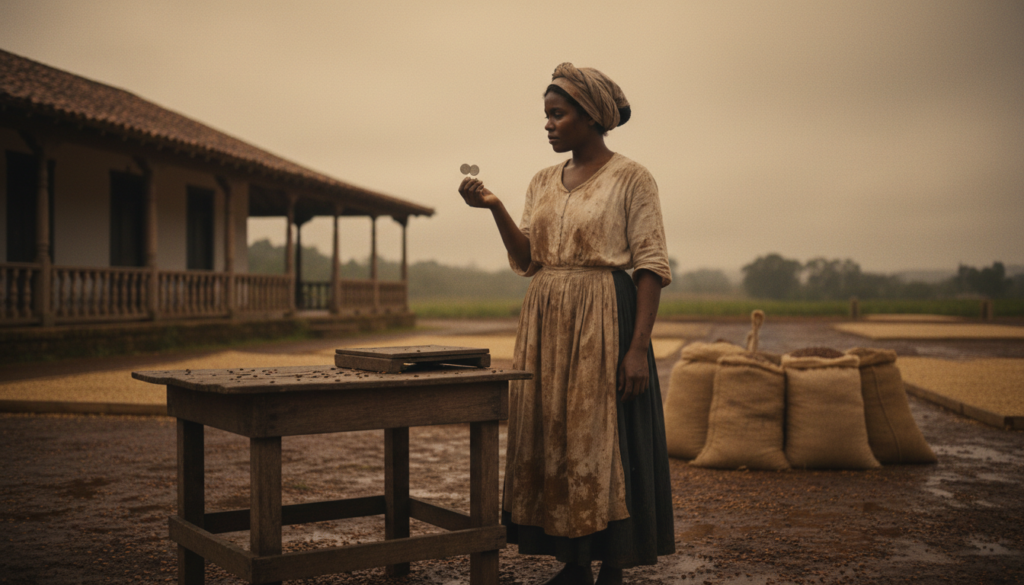
On Monday, May 14, 1888, the coffee weighed exactly the same as it had on Saturday.
The people sorting it did not.
Luzia knew this before anybody told her that the law had changed.
The morning air smelled of dust and damp earth. The sky was pale. A thin mist lay over the fields beyond the drying yard of Fazenda São Bento, a coffee estate in the countryside near Campinas, in the Brazilian province of São Paulo.
Luzia stood beside the weighing table with her sleeves rolled up.
She was thirty-eight.
She had lived on the estate all her life.
She knew how to judge whether coffee beans had dried properly by their feel, the sound they made, and the way they moved across the tray.
She could recognize a damaged sack by the uneven tension of its stitching.
She could repair a drying screen.
Sort the beans by quality.
Estimate the weight of a filled basket before placing it on the scale.
She knew the work better than most of the men who had been paid to supervise it.
But until that morning, she had never received wages for any of it.
She was enslaved.
Born to an enslaved mother.
Raised under the authority of people who claimed the right to own her labor, control her movements, and determine what happened to the hours of her life.
She had been made to work from childhood.
Punished for mistakes.
Ordered about by people whose knowledge of the work was smaller than her own.
When she grew older, she learned to perform difficult tasks well enough that the estate’s managers depended upon her.
That dependence did not give her freedom.
It gave them another reason to insist she remain.
At six o’clock, the foreman arrived.
His name was Torquato Vilela.
He wore a faded waistcoat, carried a small notebook, and had spent years mistaking his ability to issue orders for evidence of intelligence.
He stopped beside the weighing table.
“Luzia. Open the storehouse.”
She looked at him.
For a moment, she said nothing.
Then asked:
“How much will you pay me?”
Torquato stared.
“What?”
“For opening it.”
His face hardened.
“Don’t be ridiculous.”
She looked toward the eastern fields.
The sun was beginning to rise.
Several workers had stopped sorting.
Others continued, though more slowly.
They were listening.
Luzia looked back at Torquato.
“How much?”
He stepped closer.
“Open the storehouse.”
She felt her heart pounding.
She had known this man for seventeen years.
She knew his temper.
The threats he favored.
The way he could make ordinary work dangerous by deciding someone had disobeyed him.
She knew what might have happened if she’d asked the same question the previous week.
But on Sunday, May 13, 1888, in Rio de Janeiro, Brazil’s princess regent, Isabel, had signed the law abolishing slavery.
Word had reached the district.
A cart driver brought it late the previous evening.
Then another traveler confirmed it.
The law was short.
Two articles.
Slavery was declared extinct in Brazil from the date of the law.
Contrary provisions were revoked.
No detailed plan for the people who had just been freed.
No land.
No money.
No homes guaranteed.
No reliable assurance that the men who had controlled their lives would suddenly accept the change.
But the legal institution of slavery had ended.
Luzia looked at Torquato.
Then asked again:
“What is the wage?”
He stared at her.
For a long time, neither moved.
Then the foreman turned.
Walked toward the main house.
And left the storehouse closed.
Behind Luzia, somebody began laughing.
Not loudly.
A short, astonished sound.
Then another.
Luzia didn’t laugh.
Her hands were trembling.
She placed them against the edge of the weighing table.
Waited until the shaking eased.
Then looked at the other workers.
Most were watching her.
A few looked frightened.
One man shook his head as though she had done something foolish.
A younger woman named Celina smiled.
“What happens now?” Celina asked.
Luzia looked toward the closed storehouse.
She did not know.
That was the difficulty.
For years, she had imagined freedom as a door.
A person opened it.
The people inside walked out.
The story ended.
Now the door had opened.
And beyond it lay fields, roads, towns, employers, hunger, prejudice, unfamiliar choices, and questions she had never been allowed to answer for herself.
Luzia took a breath.
Then said:
“First, we find out what they’re offering.”
A man near the sorting tables frowned.
“And if they offer nothing?”
Luzia looked toward the road.
“Then we find out what else is possible.”
Cândida Ferreira arrived shortly before nine.
She drove a small mule cart carrying sacks of flour, cloth, two crates of household goods, and a portable scale that she guarded more carefully than anything else she owned.
Cândida was a free Black woman.
She had gained her freedom years earlier and now earned a living through trade and transport between the countryside and Campinas.
She was not wealthy.
Her cart needed repairs.
Her mule was aging.
She had known weeks when business was poor enough that she counted coins before buying food.
But she controlled her work.
She negotiated prices.
Made decisions.
And, when someone tried to cheat her, she possessed an extraordinary ability to remember the precise terms of the previous conversation.
Luzia trusted her.
Not completely.
She trusted very few people completely.
But Cândida had never asked Luzia to do work without acknowledging its value.
That mattered.
Cândida stopped the cart beside the drying yard.
Looked toward the closed storehouse.
Then smiled faintly.
“What’s happened here?”
Luzia folded her arms.
“We’re waiting to learn whether the owner understands that yesterday happened.”
Cândida laughed.
Then looked around.
The workers had begun gathering beneath a large tree near the yard.
Some remained at their tasks.
Others watched the main house.
Nobody seemed certain what the rules were now.
Cândida climbed down from the cart.
“Well,” she said, “the law is real.”
Luzia nodded.
“We heard.”
“I saw the notice in town. People are celebrating.”
“Good.”
“And arguing.”
“Better.”
Cândida grinned.
Then her expression changed.
“They’ll try to tell you that nothing has changed.”
Luzia looked toward the house.
“They’ve begun.”
Cândida nodded.
She knew the pattern.
Many enslaved people had struggled for freedom long before the law was signed.
Some escaped.
Some secured manumission.
Some pursued legal claims.
Some organized collectively.
Abolitionists, including Black activists and free and formerly enslaved people, had challenged slavery through years of political work and direct resistance.
Freedom was not something that had suddenly occurred to the people in power on a pleasant Sunday afternoon.
It had been demanded.
Fought for.
Made increasingly impossible to deny.
But the law’s arrival did not erase the social and economic power of former enslavers.
Cândida leaned against the cart.
“Has he offered a contract?”
“Not yet.”
“Good.”
Luzia frowned.
“Why good?”
“Because a bad agreement can be made in a hurry.”
The older woman took out a small notebook.
Its corners were worn.
The cover stained.
Inside were columns containing numbers, dates, goods, and payments.
Luzia examined it.
She recognized the form of the records.
The estate used similar books.
But these belonged to Cândida.
They recorded her own business.
Cândida pointed toward an entry.
“This is what I paid for loading work last week.”
Luzia studied the figure.
She understood numbers.
Weights.
Measures.
Sums.
She had learned them because errors in the coffee accounts could bring punishment to the workers blamed for them.
But she was not practiced at reading a written contract.
Cândida turned another page.
“This is the rate for a day’s work at the yard outside town.”
Luzia looked up.
“Would they hire us?”
“Some of you, perhaps.”
“How many?”
“Not everybody.”
The answer hurt.
But Luzia was grateful it was honest.
Cândida continued.
“There are people looking for workers. But there’s also discrimination, exploitation, and more labor than some employers want to pay for. Don’t imagine the town is waiting with open arms.”
Luzia nodded.
She had not imagined that.
She had imagined roads.
Choices.
Places she had never been allowed to go without permission.
But she knew a road could lead to hunger just as easily as employment.
Cândida looked around.
“Are you all making the same decision?”
Luzia shook her head.
“Not yet.”
“Good.”
“Why do you keep saying that?”
The trader smiled faintly.
“Because freedom includes the possibility of disagreeing about what to do next.”
Luzia considered.
Then looked toward the other workers.
There were people who wanted to leave immediately.
Others who had family members nearby and hoped to stay close.
Some who feared losing their homes.
Some who were old.
Some who had small children.
Some who knew nothing of the roads beyond the estate.
Others who knew them too well.
It would be tempting to demand that everyone make the same choice.
But Luzia didn’t want to become another person telling them where they were allowed to go.
She looked at Cândida.
“What do you suggest?”
“Ask for clear wages. Ask what happens to the houses. Ask about deductions and payment dates. Don’t accept promises nobody will put into words.”
Luzia nodded.
“And if they refuse?”
Cândida looked toward the road.
“Then the next question is how you leave safely and what work or shelter you can arrange.”
She paused.
“Not everyone will have the same answer.”
Luzia looked toward the weighing table.
Then toward the people gathered beneath the tree.
The day was already growing warm.
Coffee lay on the drying screens.
Work remained unfinished.
But for the first time in her life, she was being asked to think about labor as something that could be offered, negotiated, or withheld rather than something another person owned.
The thought was exhilarating.
It was also frightening.
She looked toward Cândida.
“Will you stay?”
The older woman nodded.
“For a while.”
“Why?”
Cândida smiled.
“Because I happen to know what a day’s work is worth.”
At eleven, the owner summoned the workers.
His name was Álvaro Matos.
He was sixty-two, owned the estate, and had spent most of the previous night insisting that the new law would destroy the agricultural economy.
Luzia had heard him from the yard.
He complained about politics.
About the government.
About the people who had pushed for abolition.
About property.
About the injustice of losing something he believed belonged to him.
She had listened.
Then returned to her sleeping quarters.
Because there was nothing useful to be gained from arguing with a man who described the end of other people’s captivity as a personal injury.
Now he stood on the veranda wearing a white shirt and a furious expression.
Torquato waited beside him.
The workers gathered below.
Some stood near the steps.
Others remained farther back.
Luzia stood beside Cândida.
Álvaro looked over the crowd.
Then announced that the estate would continue operating.
He said everyone was free.
That no one would be held in slavery.
That the law would be respected.
Then he explained that those wishing to remain in the workers’ houses must continue performing their usual duties while new arrangements were considered.
Wages, he said, could be discussed after the harvest accounts had been settled.
Housing and supplies would be taken into consideration.
Luzia listened carefully.
Then raised her hand.
Álvaro looked toward her.
“What?”
“What is the daily wage?”
He stared.
“The matter is being considered.”
“When will we be paid?”
“After the accounts are settled.”
“How much will be taken for housing?”
His expression hardened.
“That will be determined.”
“And can we leave the estate?”
He looked angry.
“Of course.”
Luzia nodded.
“Then we need terms before deciding whether to stay.”
A murmur moved through the group.
Álvaro stepped forward.
“Luzia, you’ve worked here all your life.”
“Yes.”
“You know the estate needs labor.”
“Yes.”
“Then you understand the importance of continuity.”
She looked at him.
For a moment, she considered the word.
Continuity.
Such an elegant way to describe a world in which his position remained secure and hers did not change.
She took a breath.
“I understand that the coffee needs sorting.”
He nodded.
“Exactly.”
“And that the workers need food, shelter, and payment.”
He frowned.
“Nobody has said otherwise.”
“Then let us discuss those things.”
Álvaro looked toward Cândida.
His expression changed.
“You’ve been encouraging this.”
The trader folded her arms.
“I’ve been answering questions.”
“This is a private estate.”
“Then I won’t enter the house.”
He glared.
Cândida waited.
Finally, Álvaro turned toward the workers.
He announced that anyone unwilling to accept the temporary arrangements could leave the estate.
But they could not expect to remain in company housing without working.
Luzia felt the threat settle over the gathering.
It was not the old legal claim of ownership.
But it was a powerful one.
The house where she slept belonged to the estate.
The land beneath it belonged to the estate.
The fields.
The storehouses.
The tools.
The access to food and supplies.
Nearly everything around her was controlled by the man standing on the veranda.
The law had ended slavery.
It had not redistributed his land.
Luzia looked toward the others.
A man named Bento stood near the front.
He was fifty-six and had spent decades working in the fields.
His knees were damaged.
He walked with difficulty after long days.
He looked toward the houses.
Then toward Álvaro.
“If we stay,” he asked, “can our families remain while we work for wages?”
Álvaro hesitated.
“That would depend on the arrangement.”
Bento nodded slowly.
He looked frightened.
Luzia understood.
A person could be free to leave and still have nowhere safe to go.
That was not a contradiction.
It was the shape of the problem.
Then Celina spoke.
She was twenty-one, with bright eyes and a voice that grew sharper whenever someone tried to interrupt her.
“I want to go to town.”
Several people turned.
Álvaro frowned.
“Then go.”
Celina looked toward Cândida.
“Will you help me find work?”
The trader considered.
“I can introduce you to people who may be hiring. I won’t promise what I cannot guarantee.”
Celina nodded.
“That’s enough to begin.”
Luzia looked toward her.
Then toward Bento.
Two people.
Two different choices.
Both trying to survive freedom in the circumstances they actually had.
Álvaro grew impatient.
“Well?”
Luzia took a breath.
“We’ll talk among ourselves.”
He stared.
“About what?”
“About the work you’re offering.”
A silence followed.
Then Torquato stepped forward.
“There’s no need for a meeting.”
Luzia looked at him.
“Then you don’t need to attend.”
Somebody laughed.
Torquato’s face reddened.
Álvaro raised a hand.
The laughter stopped.
For a moment, the owner seemed about to order them back to work.
Then he looked toward the drying yard.
The open screens.
The sacks.
The coffee waiting.
He had lost the power to claim their labor as property.
But he still needed their knowledge.
He looked at Luzia.
“How long?”
“Until after midday.”
He considered.
Then nodded sharply.
“Very well.”
The workers began moving toward the tree.
Luzia stayed behind for a moment.
She looked toward the veranda.
The owner stood beneath its shade.
Torquato beside him.
For years, she had been summoned to that spot and expected to listen.
Now she was walking away to speak with the people whose labor made the estate function.
She felt frightened.
She also felt, for the first time, the enormous responsibility of choosing what to do next.
Under the tree, nobody agreed.
This was the first difficulty.
Luzia had imagined that once the workers could speak freely about their choices, the right decision would become obvious.
It did not.
Celina wanted to leave before nightfall.
Bento wanted to negotiate for paid work and housing.
A younger man named Mateus believed they should refuse every offer from Álvaro, even a reasonable one, because he’d never trust the man who had claimed to own him.
Others were worried about food.
A woman named Teresa had two children and wanted to know where they would sleep if the family left.
An older man, Amaro, said he could no longer manage the journey to town on foot.
Someone argued that wages meant little if the owner could deduct the cost of every meal and every roof tile.
Someone else said the estate’s houses were familiar, and familiarity still mattered.
The conversation grew louder.
Then louder still.
For a moment, Luzia felt a strange fear.
All her life, disagreement had been dangerous.
The person in authority made a decision.
The rest obeyed.
Now the workers argued openly about their own futures.
No one had told them how to manage that freedom.
Luzia looked toward Cândida.
The trader sat on an overturned basket, listening.
She didn’t intervene.
She seemed remarkably comfortable with the disorder.
Finally, Luzia raised her hand.
“One at a time.”
Nobody listened.
She tried again.
“One at a time!”
The argument quieted.
Luzia looked around.
“We don’t need to make one choice for everyone.”
Mateus frowned.
“If some stay, the owner wins.”
Bento looked hurt.
“If I leave without work, what happens to my family?”
Mateus looked away.
Luzia turned toward them.
“Both of you have reasons.”
She paused.
“Neither of you has the right to choose for the other.”
The words surprised her.
She had never said anything like them before.
Cândida smiled slightly.
Luzia continued.
“We can agree on what we ask from him today. Then each family can decide whether the terms are worth accepting.”
Teresa nodded.
“Clear wages.”
“Yes.”
“Payment dates.”
“Yes.”
“No promises about deductions nobody explains.”
“Yes.”
“And if we leave?”
Luzia looked toward Cândida.
The trader nodded.
“I can help arrange introductions in town. Some may find work. Others may need more time. We should make sure nobody travels without knowing where they might stay.”
Bento raised a hand.
“What about people who can’t travel?”
Luzia considered.
“Then we ask whether short-term paid work and temporary lodging can be negotiated, without giving up the right to leave.”
Mateus frowned.
“He’ll never agree.”
Luzia looked toward the main house.
“Perhaps not.”
Then she looked at the workers.
“But at least we’ll know what he refused.”
The meeting continued.
Slower now.
More carefully.
Some people wanted wages paid daily.
Others preferred weekly payment.
Several wanted an agreement concerning housing that did not leave them vulnerable to sudden eviction without time to find somewhere else.
They debated.
Disagreed.
Changed their minds.
At one point, Celina stood and announced she would not remain another night regardless of what the owner offered.
Nobody tried to stop her.
Cândida promised to help her make a safe plan for the journey.
Bento said he wanted to stay for at least a while if paid work could be arranged.
Nobody called him a coward.
Mateus remained angry.
Luzia understood his anger.
She shared much of it.
But anger could not tell a family where its next meal would come from.
They needed something more.
Then a sound moved across the yard.
Low.
Distant.
Thunder.
Everybody turned toward the hills.
The sky had darkened.
Clouds were gathering over the fields.
A strong wind lifted dust from the drying yard.
Luzia stood.
She knew the weather.
Not because she could predict it perfectly.
Because she had spent years watching what sudden rain could do to coffee left exposed.
The drying screens needed covering.
Sacks needed moving.
The work would require many hands.
Quick decisions.
Knowledge of the yard and storehouses.
She looked toward the main house.
Álvaro was standing on the veranda.
Watching the clouds.
Torquato hurried toward the workers.
“The coffee must be covered!”
Nobody moved.
He stared.
“Now!”
Luzia looked at him.
Then toward the group.
For a moment, she felt the old instinct rise.
Drop everything.
Run.
Protect the crop.
Do what she had always been ordered to do.
She knew exactly how to organize the work.
Which screens could be covered first.
Which sacks could be moved.
Which shelter would remain dry.
Where the drainage needed clearing.
The knowledge rose in her automatically.
But for the first time, she stopped before acting.
The work had value.
And she could decide whether to offer it.
She looked at Cândida.
Then toward the workers.
Bento nodded slowly.
Teresa looked uncertain.
Mateus shook his head.
Celina stood apart from them.
Luzia turned toward Torquato.
“Ask the owner what he’ll pay.”
The foreman’s expression changed.
“There’s no time.”
“Then he should answer quickly.”
Thunder sounded again.
The wind grew stronger.
Torquato stared at her.
Then ran toward the veranda.
Cândida stood beside Luzia.
“Be careful.”
Luzia nodded.
She knew the danger.
A man who had controlled other people for decades might not accept the loss of that power simply because the law required it.
And a group bargaining under pressure could agree to something that left them worse off.
But she also knew the estate needed their labor at that moment.
The coffee was not going to protect itself.
Álvaro came down the steps.
He looked furious.
“You’re holding the harvest hostage.”
Luzia looked at him.
“No.”
“Then why aren’t you working?”
“Because we’re asking what the work is worth.”
He stared.
Rain began striking the broad leaves near the yard.
A few drops.
Then more.
Álvaro looked toward the exposed screens.
Then toward the workers.
“Name your price.”
Cândida opened her notebook.
She had brought examples of wages paid for comparable work nearby, though she warned that rates and conditions varied.
Luzia looked toward the group.
They had agreed on terms for the immediate work.
A daily wage.
A clear record of hours and tasks.
Payment in money.
No invented deductions from that day’s wages.
And a separate discussion about temporary housing arrangements for those wishing to stay.
Celina and anyone else choosing not to work would be free to leave.
Álvaro listened.
Then shook his head.
“Too much.”
Luzia nodded.
“Then we won’t work for that offer.”
Torquato swore.
Rain struck the roof.
The owner looked toward the yard.
The workers waited.
Luzia felt her heart pounding.
She did not know whether the man would agree.
She did not know what would happen if he refused.
She did know that returning to unpaid labor simply because he shouted would make it harder to establish different terms later.
Álvaro looked at Cândida’s notebook.
Then at Luzia.
“One day,” he said.
“A written record of the agreement,” Cândida replied.
He hesitated.
“Very well.”
“Payment today,” Luzia said.
He stared.
Then nodded sharply.
“After the work.”
Cândida wrote the terms.
Read them aloud.
Asked questions until the amounts and conditions were clear.
Álvaro signed.
Luzia and the workers who chose to participate made their agreement known, with Cândida helping record their names and the terms they accepted.
It was not a guarantee of future fairness.
A signature could be disputed.
A payment delayed.
An employer could break a promise.
The law alone did not make every agreement enforce itself.
But the workers had something they had never possessed under slavery.
A basis on which to say they had offered their labor under specified terms.
Luzia looked toward the yard.
The rain was strengthening.
She turned toward the workers.
“All right.”
Then she began giving instructions.
Not because the owner had ordered her.
Because the people who had agreed to work were looking to her to help organize it.
They moved quickly.
Covered screens.
Carried sacks.
Cleared drainage channels.
Worked together in the sudden rain.
Luzia knew where every load needed to go.
She directed the work without shouting at people for being too slow.
When someone slipped, she stopped the nearby movement until the person was safe.
When a basket broke, she found another.
When a section of covering came loose, she sent people to secure it.
The storm lasted less than an hour.
It felt much longer.
By the time the rain eased, much of the exposed coffee had been protected, although some was damaged.
The yard was muddy.
The workers were soaked.
Everyone was tired.
Luzia stood beside the storehouse, water dripping from her sleeves.
She looked toward the covered sacks.
Then at the people around her.
They had worked hard.
The same way they had worked for years.
But something essential had changed.
They had negotiated the day’s labor.
They knew the rate.
And they expected payment.
It was not enough.
Not nearly enough.
But it was not nothing.
At sunset, Álvaro paid the workers who had completed the agreed work.
Cândida helped check the amounts against the written terms.
Some payments required correction.
The owner grew impatient.
The workers insisted on the amounts that had been agreed.
Eventually, the accounts were settled for the day.
Luzia stood beside the weighing table.
A small amount of money lay in her palm.
She looked at it.
For a moment, she felt no triumph.
Only disbelief.
She had worked on the estate for decades.
Sorted coffee.
Carried sacks.
Repaired screens.
Completed tasks that made other people wealthy.
The amount in her hand was payment for one day’s work.
It did not compensate her for the years taken from her.
It did not replace the childhood she had lost.
It did not provide land, housing, or protection against every form of exploitation she might encounter tomorrow.
But it was money she had earned under an agreement she had chosen to enter.
She closed her hand around it.
Then looked toward Cândida.
The trader was preparing her cart.
Celina stood beside it carrying a small bundle.
Luzia approached.
“You’re leaving?”
Celina nodded.
“Yes.”
“Where will you go?”
“To town first. Cândida knows a household looking for paid laundry work. I’ll see whether the terms are fair.”
Luzia nodded.
She wanted to tell the younger woman to be careful.
To avoid people who made promises too easily.
To keep money somewhere safe.
To ask questions.
Then she stopped herself.
Celina knew many of those things.
She had lived through slavery too.
Luzia smiled.
“Write if you can.”
Celina laughed.
“To where?”
The question caught her.
Luzia looked toward the houses.
She had no address that was securely hers.
Only a place where she had been allowed to sleep while her labor was claimed by somebody else.
She looked back at Celina.
“Leave word with Cândida.”
The younger woman nodded.
Then embraced her.
For a moment, Luzia held her tightly.
Then let her go.
Celina climbed onto the cart.
Cândida took the reins.
Before leaving, the trader turned toward Luzia.
“What will you do?”
Luzia looked toward the estate.
She could remain temporarily if reasonable terms were negotiated.
She knew the work.
The land.
The paths.
The seasons.
But she wanted to find out who she could become somewhere else.
“I’d like to leave,” she said.
Cândida nodded.
“Then we’ll talk about what work is available.”
“Will there be a place to stay?”
“Not a comfortable one, at first. I can help you explore the arrangements.”
Luzia considered.
Then nodded.
“I’ll need to speak with the others.”
“Of course.”
Cândida looked toward the darkening yard.
Then smiled faintly.
“There’s time to make a plan.”
Luzia watched the cart disappear down the road.
For a moment, she felt frightened.
The future was enormous.
And unlike a basket of coffee, it could not be measured in advance.
She looked down at the money in her palm.
Then toward the little house where she had slept for so many years.
A place that held memories both precious and terrible.
She would need to decide what belongings she could take.
What work she could find.
Which people she wanted near her.
What to do if the town offered fewer opportunities than she’d hoped.
There was no guarantee that she would make the right choices.
But they would be choices she had a legal right to make.
She put the money away.
Then walked toward the houses.
Tomorrow, there would be more questions.
For that evening, she wanted to eat with the people who had worked beside her.
And discuss where they might go.
Luzia left São Bento eight days later.
She did not leave alone.
Three others traveled with her to Campinas, where Cândida had helped them identify possible paid work and temporary accommodation.
Not everybody went.
Bento remained on the estate under a negotiated employment arrangement, hoping to secure enough money to support his family before deciding whether to move.
Teresa stayed for a while because relocating with her children required more preparation.
Mateus left in a different direction.
Others changed their minds more than once.
Luzia understood.
Freedom did not require them to make identical decisions.
It required that their decisions no longer be subject to another person’s claim of ownership over them.
The journey to town was uncomfortable.
The cart was crowded.
The road uneven.
They traveled with bundles of clothing and a few belongings they could call their own.
Luzia carried a wooden measuring stick she had made years earlier for checking the depth of filled baskets.
It had small notches along one edge.
The wood was smooth from use.
She had kept it because it was useful.
Now she kept it because she liked the feeling of holding something she had made for herself.
In Campinas, work did not appear as readily as she hoped.
One employer offered wages so low that the journey to the work site would have consumed much of what she earned.
Another promised payment but refused to explain deductions.
A third spoke to Cândida as though Luzia were incapable of answering questions about her own labor.
She refused those arrangements.
Not because she could afford to refuse everything.
Because she had learned to listen carefully when someone made a promise.
Eventually, she found paid work handling and sorting coffee at a commercial yard.
The hours were long.
The supervisor impatient.
The wages modest.
But the agreement was clearer, and the workers could leave when their employment ended.
Luzia shared a rented room with Celina.
It was small.
The roof leaked near the window.
The landlord complained about noise.
Sometimes the food was insufficient.
Sometimes work was irregular.
There were days when Luzia wondered whether she had made a mistake.
She missed people who remained on the estate.
The familiarity of the countryside.
The knowledge that came from understanding every part of a place.
But she did not miss being owned.
That distinction was simple.
Even on difficult days.
She saved what she could.
Learned more about reading written agreements.
Helped younger workers understand the weight records.
And became known for identifying mistakes before a dishonest supervisor could turn them into a reason to reduce somebody’s pay.
She did not win every argument.
Sometimes she lost work.
Sometimes people refused to listen.
The law had changed.
The power of wealth, prejudice, and discrimination had not disappeared with it.
But she continued.
A year after abolition, on May 13, 1889, Luzia sat outside the room she shared with Celina.
The evening was warm.
A few voices carried from the street.
Some people were marking the anniversary with celebrations.
Others were working.
Still others had little reason to feel that the promises of freedom had been fulfilled.
Luzia held her wooden measuring stick across her knees.
Beside her sat a little girl named Dina, the daughter of a woman who worked in a nearby laundry.
Dina was eleven and had recently begun attending lessons where children and adults could learn to read and write.
She was fascinated by numbers.
Especially large numbers.
She liked counting sacks.
Windows.
Steps.
The number of tiles in a roof.
She had once counted every button on Cândida’s coat and announced that there were forty-three.
Cândida replied that if the child counted them again, she might discover that two were missing.
Dina had immediately begun a second inspection.
Now she looked at Luzia.
“Is today the day slavery ended?”
Luzia considered.
“In Brazil, the law was signed on May thirteenth last year.”
Dina nodded.
“So it ended then.”
“The law ended it.”
The girl frowned.
“Isn’t that the same thing?”
Luzia looked toward the street.
She thought about the people who had fought for freedom before 1888.
The people who had escaped bondage.
The people who had secured release through legal claims or manumission.
The people who had resisted and organized.
The people who had died before abolition arrived.
Then she thought about those who were still struggling to obtain land, education, decent wages, safety, and equal treatment.
She looked back at Dina.
“Ending the law was necessary,” she said. “Very necessary.”
The child nodded.
“But it didn’t make every injustice disappear.”
Dina considered.
“Then what do we do?”
Luzia smiled faintly.
“We keep working on the things that remain.”
The girl looked toward the measuring stick.
“What’s that?”
Luzia handed it to her.
Dina examined the notches.
“Did you make it?”
“Yes.”
“What does it measure?”
“The depth of a filled basket.”
The child turned it over.
“Does it still work?”
Luzia smiled.
“Of course.”
Dina looked pleased.
Then held it against the doorstep.
She began counting the marks.
Luzia watched her.
For years, that stick had been used to help measure crops whose sale benefited the people who claimed her labor.
Now a child was using it to learn numbers.
The wood had not changed.
Its purpose had.
Luzia thought about that.
Then stood.
She had an early shift the next morning.
Work to prepare for.
Food to cook.
A letter to send to Bento through Cândida.
An employment offer to consider.
A life that remained difficult and uncertain, but no longer belonged to someone else under the law.
Dina looked up.
“Can I keep this for tonight?”
Luzia considered.
The stick was useful.
She still needed it.
But the girl was holding it carefully, looking at the notches with genuine curiosity.
“Bring it back tomorrow.”
Dina grinned.
“I promise.”
Then she ran home.
Luzia stood watching.
The street was noisy.
Somebody was singing.
A cart rattled past.
A woman called to a neighbor.
The city continued around her.
On May 13, 1888, Brazil had abolished slavery.
The date was real.
The law was real.
The victory was real.
So were the years of struggle that had made it possible.
And so was the difficult work that remained.
Luzia did not need to pretend otherwise.
She looked down at her hands.
The same hands that had sorted coffee before freedom.
The same hands that had counted weights, repaired sacks, and learned to recognize when something was missing from an account.
They were older now.
Scarred.
Strong in some ways.
Tired in others.
She had never needed a law to become a human being.
She had always been one.
The law had finally ended the claim that another person could own her.
That difference mattered beyond anything the scales could measure.
Luzia went inside.
Closed the door.
And began preparing for a morning she would meet on her own terms.
The End.
Editorial Historical Accuracy Note
When did slavery end? There is no single worldwide date. Different countries abolished legal slavery at different times. In Brazil, Princess Regent Isabel signed Law No. 3,353, the Lei Áurea or Golden Law, on May 13, 1888. It had only two articles and did not provide formerly enslaved people with land or a comprehensive program of economic support. Brazil was the last independent country in the Americas to abolish legal slavery. In the United States, the 13th Amendment was ratified on December 6, 1865, abolishing slavery and involuntary servitude except as punishment for a crime after conviction. The British 1833 Slavery Abolition Act took effect in much of the empire in 1834, with apprenticeship delaying full emancipation for many until 1838. Legal abolition did not immediately end racial injustice, economic exploitation, or forced labor; forms of modern slavery persist. The abolition movement included decades of resistance by enslaved people and Black abolitionists, as well as legal and political campaigns. Luzia, Cândida, Fazenda São Bento and all individual events are fictional.