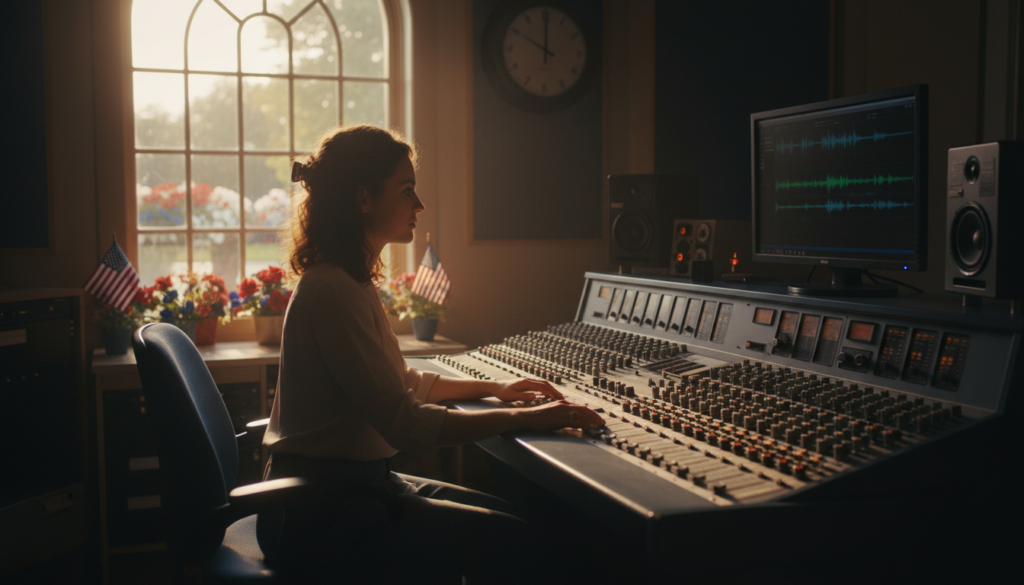
At 2:41 p.m. on Memorial Day, Mags Otero discovered that sixty seconds of silence had a price.
Four hundred and eighty dollars.
That was what the local furniture company had paid for the advertising slot scheduled to begin at exactly three o’clock.
The advertisement involved a man shouting about mattresses.
Mags disliked it intensely.
Not because there was anything wrong with mattresses.
She believed they were among civilization’s more successful inventions.
But the man shouted as though his listeners were being rescued from a burning building rather than invited to buy discounted bedding.
She had spent forty minutes mixing the advertisement the previous Thursday.
The client wanted the voice louder.
Then the music louder.
Then the words BIGGEST SAVINGS OF THE YEAR louder than everything else.
Eventually, Mags explained that sound equipment had physical limits, and that making every element louder was not the same as making an advertisement more effective.
The client said he understood.
Then asked whether she could make the voice a little louder.
Now the finished commercial sat in the radio station’s schedule.
3:00:00 P.M. — BEDFORD’S HOLIDAY SALE — 60 SECONDS.
Beneath it was a note from the programming director.
DO NOT MOVE. PREMIUM SLOT.
Mags stared.
Then looked toward the wall clock.
2:41.
Nineteen minutes.
The National Moment of Remembrance was observed at 3 p.m. local time on Memorial Day, inviting Americans to pause for one minute to remember those who died in military service.
It was a voluntary observance.
Not an instruction to shut down every road, factory, shop, or radio station.
But Mags had proposed that their small community station participate.
Her manager had agreed in principle.
Then apparently forgotten that somebody had sold the minute to a mattress company.
She picked up her headset.
Called the commercial office.
“Cal.”
A voice answered.
“What?”
“We have a problem.”
“Can it wait until Tuesday?”
“No.”
A pause.
“Those are my least favorite kinds.”
Mags looked at the clock.
“The three o’clock spot.”
“What about it?”
“It’s Memorial Day.”
“I know. That’s why the ad costs more.”
She closed her eyes.
“Cal.”
“What?”
“The remembrance minute.”
Silence.
Then:
“Oh.”
Mags stared.
He continued.
“Oh, dear.”
She looked at the schedule.
The shouting mattress salesman seemed to be grinning at her from the little waveform displayed on the screen.
“Can we move the advertisement?”
Cal hesitated.
“It’s contractually scheduled.”
“Can you ask?”
Another pause.
“Twenty minutes before airtime?”
“Nineteen.”
He sighed.
“Mags.”
She waited.
Then he said, “I’ll call them.”
The line went dead.
Mags looked toward the control-room window.
Outside, the town of Bellweather moved through a sunny holiday afternoon.
People walked along the main street.
Cars traveled toward the lake.
A little parade had finished an hour earlier.
Some families were heading to barbecues.
Others were visiting cemeteries or attending services.
Children rode bicycles beneath the trees.
The day was ordinary in many ways.
A public holiday.
A long weekend.
The unofficial beginning of summer for people whose lives followed the American school calendar.
But Memorial Day was also something else.
A day established to honor people who had died while serving in the United States military.
For some families, that meaning was intimate and immediate.
For others, it was distant.
For many, the day contained both remembrance and ordinary pleasure.
Mags understood the distinction in theory.
She did not know how to put it into sound.
And that was a problem.
Because sound was her job.
Mags was twenty-nine and worked as the audio engineer at WBRY, a small independent radio station housed above a pharmacy.
The studio contained two microphones, three computers, an aging mixing desk, several shelves of recording equipment, and a potted fern that had survived despite receiving almost no sunlight and considerable unsolicited advice.
The fern was called Bernard.
Nobody remembered why.
Mags had worked there for six years.
She began as a weekend technician.
Then became responsible for live broadcasts, recording, editing, audio restoration, and keeping equipment functioning long after the manufacturer suggested replacing it.
She loved sound.
Not only music.
All sound.
The small click a radiator made before warming.
The different noises shoes produced on wood and concrete.
The way a person breathing in before answering a question could communicate more than the answer itself.
She could identify several local buses by their engine sounds.
She knew when rain began hitting the studio window before anybody looked outside.
And she could recognize a particular caller simply from the pause before he began complaining.
Her colleagues found this peculiar.
Mags considered it useful.
She had a collection of recordings on her home computer.
Not for broadcast.
For herself.
Rain moving across the metal roof of her childhood home.
A crowded railway station at midnight.
Her mother’s kitchen during a family gathering.
The mechanical rhythm of a laundromat.
The sound of a basketball bouncing in an empty gymnasium.
She liked listening to ordinary places after everyone had left them.
Sound, she believed, made time feel less like a series of photographs and more like something that continued moving.
Her mother had once asked why she recorded such strange things.
Mags answered that photographs showed what a place looked like.
Recordings reminded her what it felt like to be there.
Her mother considered.
Then said, “That’s lovely, dear. But please stop recording me washing dishes.”
Mags agreed.
Mostly.
At WBRY, her colleague Jo Ellis hosted the afternoon community programme.
Jo was forty-eight, warm, quick-witted, and possessed the extraordinary ability to make a caller feel important while gently preventing them from speaking for twenty consecutive minutes about a broken sidewalk.
She was preparing the Memorial Day broadcast.
The morning programme had covered local ceremonies.
A reporter had interviewed the organizer of the town’s commemorative service.
Another had spoken with volunteers helping maintain veterans’ graves.
The station had aired a historical feature explaining that Memorial Day grew out of post-Civil War traditions of decorating the graves of those who had died in war.
The national observance known as Decoration Day was established in 1868, following earlier local commemorations.
Over time, the remembrance expanded beyond Civil War dead to include those who died in military service in later conflicts.
Since 1971, the federal holiday has been observed on the last Monday in May.
Jo had explained all of this calmly.
Without treating the day as an argument.
Without telling listeners exactly how they were supposed to feel.
Now the afternoon broadcast was approaching three.
The station wanted a minute of remembrance.
Mags wanted to produce it without turning grief into background music.
Jo entered the control room holding a sheet of paper.
“How’s the piece?”
Mags looked up.
“What piece?”
“The one-minute memorial.”
“I haven’t finished it.”
Jo frowned.
“I thought you had the recording.”
“I have the recording.”
“Then?”
Mags turned toward the screen.
An audio file lay open.
Sixty seconds long.
A collection of interviews.
Several voices speaking about people they’d lost.
A short musical passage.
An ambient recording made at the town’s memorial garden that morning.
Mags had been working on it for days.
It was technically beautiful.
The voices were clear.
The music subdued.
The transitions careful.
Every word audible.
She hated it.
Jo leaned closer.
“What’s wrong?”
Mags considered.
“Everything.”
Jo stared.
“That’s helpful.”
She pointed toward the timeline.
“Listen.”
Mags pressed play.
A woman’s voice began.
My brother loved terrible jokes.
Then a man’s voice.
She was always the first one to help somebody.
A soft string melody rose.
Another person spoke.
I miss the way he laughed.
Then the music swelled.
A final voice said:
We remember.
The recording faded into silence.
Jo looked toward Mags.
“That’s beautiful.”
Mags shook her head.
“It sounds like an advertisement.”
Jo frowned.
“What?”
“A very respectful one. But still an advertisement.”
“That’s unfair.”
“Maybe.”
Mags replayed the final twenty seconds.
The music rose exactly when the last speaker mentioned grief.
A small pause followed.
Then the final line.
Perfectly placed.
Perfectly mixed.
Mags looked at Jo.
“I’ve made people’s memories behave like a story I already knew how to tell.”
Jo was quiet.
Mags continued.
“Someone said they missed their brother’s terrible jokes. Someone else talked about the way a friend helped people. Those were real things they chose to share.”
She gestured toward the screen.
“Then I put strings underneath them so listeners would know they were supposed to be sad.”
Jo considered.
“You’re right that music shapes emotion. That doesn’t always make it wrong.”
“I know.”
“Then what do you want?”
Mags looked toward the clock.
2:46.
Fourteen minutes.
She took a breath.
“I don’t know.”
Jo smiled faintly.
“Excellent timing.”
Mags laughed.
Then stopped.
She looked toward the window.
Outside, a church bell began ringing.
Not loudly.
Just a few distant notes.
A truck passed.
Somebody shouted for a child to slow down.
The little sounds of a town continuing through a holiday afternoon.
Mags listened.
Then looked toward Jo.
“What if we don’t make a piece?”
Jo frowned.
“What do you mean?”
“What if we let the minute be itself?”
For a moment, Jo stared.
Then she smiled.
“That sounds like something you’ve been wanting to do for years.”
Mags looked toward the clock.
2:47.
Thirteen minutes.
She picked up her headset.
“We need to talk to Cal.”
Cal Drummond arrived at 2:49 carrying two telephones and an expression of nearly religious dissatisfaction.
He was fifty-five, had worked in commercial radio since he was nineteen, and understood the station’s finances well enough to become frightened whenever somebody described an idea as “artistically important.”
He entered the control room.
“Good news and bad news.”
Mags looked up.
“Good first.”
“The furniture company will let us move the advertisement to 3:01.”
She smiled.
“Excellent.”
“The bad news is that they want it mentioned again before the hour.”
Jo frowned.
“During the memorial programme?”
Cal sighed.
“I said we’d discuss it.”
Mags looked at the clock.
2:50.
Ten minutes.
“We’re not doing an extra sales announcement in the middle of the remembrance.”
Cal held up a hand.
“I know.”
“Do you?”
“Yes.”
He looked offended.
“I’ve already explained that to them.”
Jo smiled.
“Thank you.”
Cal rubbed his forehead.
“What exactly are we putting on at three?”
Mags hesitated.
Then said, “A minute of the town.”
He stared.
“What?”
“Ambient sound.”
“From where?”
“The memorial garden.”
He frowned.
“No speech?”
“We’ll introduce the minute.”
“No music?”
“No.”
“No names?”
“Not during the minute.”
Cal looked toward Jo.
“Is she serious?”
Jo nodded.
“I think so.”
Mags turned toward the screen.
She opened another recording.
It had been made that morning beside the memorial garden, after the formal ceremony.
There was a light breeze.
A distant bell.
Footsteps on gravel.
Birds.
A small rustle of leaves.
Somebody coughing softly.
Nothing arranged.
Nothing dramatic.
Cal listened for twenty seconds.
Then frowned.
“It sounds like nothing.”
Mags considered.
“That’s not the same as silence.”
He stared.
“People will think the station’s broken.”
“We can introduce it clearly.”
“They’ll turn the radio up.”
“Then we tell them what they’re hearing.”
He looked toward the clock.
2:52.
Eight minutes.
“This is the most expensive minute of our broadcast day.”
Mags nodded.
“I know.”
Cal studied her.
Then asked, “Why does it matter so much to you?”
The question surprised her.
She looked down.
For a moment, she felt the temptation to offer a convenient personal story.
A relative who served.
A dramatic memory.
Some private grief that would make her request sound more legitimate.
But she did not have one.
Her grandfather had served in the military and returned home.
Her aunt had been an officer and was now retired.
She had friends whose families had experienced wartime loss, but she would not borrow their stories to strengthen her argument.
She looked toward Cal.
“Because we’re asking people to remember those who died in service.”
He nodded.
“And?”
“I don’t think we need to fill every second with something we made.”
Cal looked toward the screen.
The little waveform of wind and footsteps rested below the louder, sharper shape of the mattress advertisement.
He considered.
Then said, “What if the recording feels empty?”
Mags nodded.
“Then it might.”
“What if people don’t like it?”
“Some won’t.”
“What if somebody complains?”
Jo smiled.
“Somebody will. They always do.”
Cal looked toward her.
She continued.
“We can explain what we intended, why we chose it, and respect that not everybody experiences remembrance the same way.”
Mags looked toward the clock.
2:54.
Six minutes.
Cal sighed.
Then nodded.
“All right.”
Mags stared.
“All right?”
“Yes.”
He pointed toward the schedule.
“But make sure the advertisement runs at 3:01. We gave the client another position, and we need to honor it.”
“Agreed.”
He turned toward the door.
Then stopped.
“One more thing.”
Mags closed her eyes.
“Of course.”
He looked toward the recording.
“Don’t make it sound prettier than it was.”
Mags smiled.
“I won’t.”
Cal nodded.
Then left.
Jo turned toward her.
“Well.”
Mags looked at the clock.
2:55.
Five minutes.
The station was about to broadcast sixty seconds of wind, footsteps, and ordinary life.
For the first time all afternoon, she felt nervous.
Not because the technology was difficult.
Because she had decided not to hide behind it.
At 2:59, Jo settled in front of the microphone.
The red light came on.
She looked through the glass toward Mags.
Then she began speaking.
“Today is Memorial Day, the last Monday in May. This day honors the people who died while serving in the United States military.”
She paused.
“At three o’clock, Americans are invited to observe a National Moment of Remembrance.”
Mags watched the clock.
The hands moved.
Jo continued.
“Every family remembers differently. Some gather at graves. Some speak names aloud. Some sit quietly. Others carry their memories through an otherwise ordinary day.”
She glanced toward Mags.
“For the next minute, we’re sharing an unedited recording from Bellweather’s memorial garden, made earlier this morning after the ceremony. No music. No speech. Just the sounds of a place where people came to remember.”
Mags placed her hand on the control.
The clock reached three.
She started the recording.
At first, there was wind.
Soft.
Barely audible.
Then footsteps.
Somebody walking slowly across gravel.
A bird calling.
A distant engine.
The small movement of leaves.
Nothing dramatic.
No music telling listeners what to feel.
No speech explaining what the people in the garden ought to mean.
Just a minute in a place where remembrance had happened that morning.
Mags watched the sound levels.
The waveform moved gently across the screen.
She had spent years being paid to remove small imperfections.
A breath before a sentence.
A cough in the background.
A passing car.
The tiny noises that made recordings feel less polished.
Now she let them remain.
At fourteen seconds, a bird called again.
At twenty-eight, footsteps approached the microphone.
At thirty-nine, a quiet voice somewhere in the distance said something too faint to understand.
At fifty-one, a gust of wind brushed the microphone.
Mags felt her old instinct rise.
Reduce the noise.
Clean the recording.
Smooth it.
Make it beautiful.
She kept her hands still.
At sixty seconds, the recording ended.
Jo opened her microphone.
“Thank you for spending that minute with us.”
A pause.
“We return now to our afternoon programming.”
The advertisement began.
A man shouted:
“BIGGEST MATTRESS SAVINGS OF THE YEAR!”
Mags closed her eyes.
The change was so absurd that she almost laughed.
Jo looked through the glass.
Her mouth twitched.
Cal, standing beside the door, shook his head.
“That is an unfortunate transition.”
Mags began laughing.
Quietly at first.
Then helplessly.
She covered her mouth.
Jo lowered the studio microphone.
“I warned you about the furniture company.”
Mags laughed harder.
Cal looked toward the clock.
Then smiled despite himself.
For a moment, the three of them stood in a control room above a pharmacy, laughing at an advertisement none of them particularly liked.
Mags wondered whether laughter was inappropriate.
Then decided that the day did not require everybody to remain solemn for every minute.
People could remember the dead and still laugh.
They could gather with families.
Eat lunch.
Enjoy sunshine.
Go home tired.
The distinction was not between grief and happiness.
It was between acknowledging what the holiday meant and pretending it was only a sales opportunity.
She looked toward the recording.
Sixty seconds.
No music.
No speeches.
No attempt to turn a community’s losses into one polished emotion.
She felt relieved.
Then her telephone rang.
The first complaint arrived at 3:04.
A listener wanted to know why the station had aired what sounded like an open microphone.
Mags explained.
The caller said he didn’t like it.
She thanked him for the feedback.
At 3:07, another caller said he’d appreciated the quiet.
At 3:11, somebody complained that the footsteps were too loud.
At 3:14, a woman called to say the recording had reminded her of the garden where she visited her father’s grave.
She didn’t want to speak on air.
She simply wanted the station to know.
Mags listened.
Thanked her.
Then ended the call.
She sat quietly for a moment.
The room was full of familiar equipment.
Cables.
Headphones.
Microphones.
A mixing desk.
The fern named Bernard.
Everything exactly where it had been that morning.
Yet she felt something had shifted.
Not because the broadcast was universally loved.
It wasn’t.
Not because the station had suddenly solved the question of how to observe Memorial Day.
It hadn’t.
Because sixty seconds had been allowed to remain complicated.
One listener heard emptiness.
Another heard peace.
Another heard footsteps that reminded her of someone she missed.
The recording was the same.
The people listening were not.
Later that afternoon, Jo brought Mags another message.
It was from Erin Cole.
They had interviewed her earlier in the week.
Her sister, Lieutenant Iris Cole, had died while serving in the military several years before.
Erin had spoken about Iris with a mixture of affection, sadness, and irritation.
She remembered a sister who ate orange marmalade directly from the jar, sang television advertisements terribly, and had once spent three hours repairing a bicycle rather than admitting it was beyond saving.
Jo had asked what Erin most wanted people to remember.
Erin said she’d like them to know that Iris was a whole person.
Not only a uniform.
Not only a photograph.
Not only the circumstances of her death.
A person who had lived.
Mags had originally included a short part of Erin’s interview in the musical tribute.
Then decided not to broadcast the montage.
She had worried that Erin might feel her contribution was being ignored.
Now Jo handed her the message.
It read:
Thank you for letting the minute be quiet.
Mags stared.
Then read the rest.
I liked hearing the footsteps. It sounded like someone arriving with flowers. I don’t know who it was, and I don’t need to.
If you have time later in the week, I’d still like people to hear more about Iris. The ridiculous things as well as the important ones.
Mags felt her throat tighten.
She looked toward Jo.
“Can we do that?”
Jo nodded.
“Of course.”
“Not a one-minute montage?”
“No.”
“A proper conversation?”
“Yes.”
Mags smiled.
They arranged a follow-up interview, subject to Erin’s wishes and consent.
Not because one family could represent every family that had experienced military loss.
Because Erin had something she wanted to share.
And the station had time to listen.
That evening, Mags walked to Bellweather’s memorial garden.
The formal ceremony was over.
The flowers remained.
Small flags moved in the breeze.
A few people walked among the memorial stones.
Some stopped.
Others continued.
There was no crowd.
No microphone.
No music.
The garden looked ordinary beneath the late afternoon light.
Mags stood beside a path.
She had recorded sound here many times.
Birdsong.
Footsteps.
The distant clock from the courthouse.
The rustle of branches.
She knew the acoustic shape of the place.
But she had rarely visited without equipment.
Now she stood with empty hands.
She thought about the holiday.
Why it was observed.
Why the date moved from year to year.
Why Memorial Day fell on May 31 in 2027, rather than the same numerical date every year.
A calendar could establish the day.
A law could define the observance.
A broadcast could invite people to pause.
But no one minute could contain everything a person might remember.
She thought of Erin’s sister.
A life she knew only through a brief interview.
A woman who loved orange marmalade and couldn’t sing jingles properly.
Mags smiled faintly.
Then felt sad.
Not in the neat, timed way her earlier music had attempted to create.
Just sad.
She sat on a bench.
A man walked past carrying a small bunch of flowers.
He nodded to her.
She nodded back.
A car moved along the road.
Somewhere nearby, a child laughed.
The sounds continued.
Mags did not record them.
She didn’t need to.
At three o’clock that afternoon, she’d broadcast one minute of a place.
Now she was simply present in it.
After a while, she stood.
Walked toward the garden entrance.
Then stopped and looked back.
The flowers moved in the wind.
The flags shifted.
The sunlight lowered across the paths.
Nothing was perfectly silent.
Nothing ever had been.
But the day had made room for remembrance.
Not all day.
Not for everybody in the same way.
Just honestly.
And for that evening, Mags thought, that was something worth carrying home.
The End.
Editorial Calendar and Historical Note
When is Memorial Day?
In the United States, Memorial Day is a federal holiday observed on the last Monday in May. In 2025, it was May 26; in 2026, May 25; in 2027, it falls on Monday, May 31; in 2028, May 29; and in 2029, May 28. Memorial Day specifically honors U.S. military personnel who died while serving. It differs from Veterans Day, November 11, which honors military veterans more broadly. Its roots lie in Civil War-era practices of decorating soldiers’ graves. In 1868, John A. Logan established a May 30 Decoration Day observance for the Grand Army of the Republic. Various communities held earlier observances, and claims to the first observance have a complex history. Since 1971, the federal holiday has been observed on the last Monday in May. The National Moment of Remembrance, established by federal law in 2000, invites Americans to pause at 3 p.m. local time. WBRY, Bellweather, Mags, Erin, and Lieutenant Iris Cole are fictional.