Past to the Future | Volume 5 | Part 2
Historical scope: Indigenous societies of the Caribbean and wider Americas before and after the first voyages of sustained European colonization, with a central fictional scene in a Taíno community on Hispaniola shortly before 1492. The characters Yara, Baire, Anani and their conversations are fictional; they are not named historical figures or invented eyewitness testimony. Archaeology, historical records, living Indigenous testimony and museum research support the wider discussion. Taíno is used here as a conventional modern description for several related Caribbean Indigenous communities, not a claim that all islands shared one identical culture or political order. Dates, population estimates, terminology and some aspects of the earliest contact remain disputed.
The path that was already there
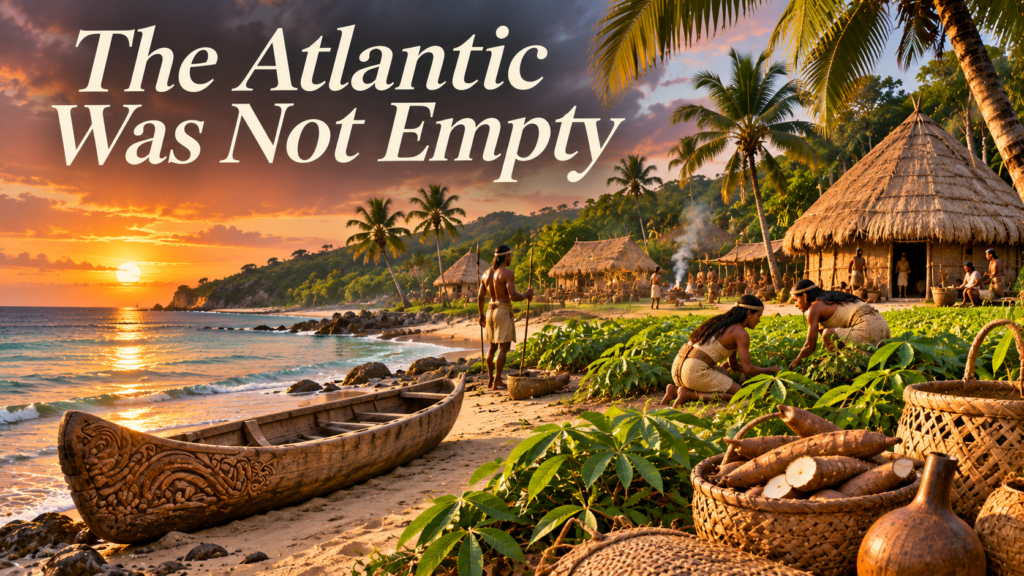
The path from the garden to the shore was narrow, but it had been walked so often that the ground had grown firm beneath the trees.
Yara carried a basket with cassava that had been carefully prepared earlier in the day. Her younger brother Baire followed, pausing when he heard voices from a nearby clearing. At the edge of the settlement, someone was repairing a canoe. The sound of the tool against wood mixed with the calls of children.
“Does the path belong to anyone?” Baire asked.
“It belongs to the people who need to use it,” Yara said, then corrected herself. “And to the people who keep it clear.”
He considered the correction as though it were a puzzle.
They were living on the island now called Hispaniola in a community imagined for this chapter. The girl and her brother are fictional, and no record preserves the words of such a conversation. But the central fact they help us notice is not invented: Caribbean islands possessed histories, settlements, agricultural knowledge, political relationships and networks of exchange before European ships reached them in 1492.
The ocean beyond the shore was not an empty boundary waiting for the first European sails. Its islands had been reached by Indigenous mariners long before Columbus. People had built houses, cultivated crops, fashioned tools, traveled, governed and made decisions that affected generations.
A visitor might encounter a path and not know its history. That ignorance would not make the path new.
For someone growing up near it, the question was how to care for a place others would need tomorrow. For a historian looking back, it is how to avoid beginning that person’s world only when strangers approached from the sea.
An island within an older world
The Greater Antilles and surrounding Caribbean islands were not isolated places without relationships. Archaeological evidence documents generations of Indigenous settlement and interaction. Communities developed particular ways of farming, fishing, producing objects, organizing political life and maintaining connections across water.
The National Museum of the American Indian’s collections describe Caribbean Indigenous maritime activity long before Columbus and objects whose forms demonstrate wider regional connections. Such evidence does not make every island community identical, but it prevents a simple picture of people whose lives began with the arrival of Europeans.
Many communities associated with Taíno histories cultivated cassava and other crops, lived in settlements of varied size and organized relationships through leaders, households and networks of obligation. Indigenous material culture and cultural practice were diverse across time and place.
The names used in European documents are not transparent windows onto how every community described itself. Taíno became a broad label in later writing. The term can be useful when handled carefully, but it must not erase the specific histories of different islands or the choices of their inhabitants.
Earlier in this series, The Medieval Americas: Civilizations Flourishing Beyond the Oceans examined societies that developed cities, political systems and intellectual traditions independently of medieval Europe’s categories. The Caribbean adds another part of that history: maritime settlements and social worlds whose complexity was expressed in forms other than the monuments outsiders often expected.
The absence of a particular European institution did not mean the absence of institutions. The absence of an alphabetic book did not mean the absence of memory.
People knew the names of places and relationships that a foreign visitor could not immediately understand. Historical humility begins by recognizing that a stranger’s inability to read a society is not evidence that there is nothing to read.
The garden, the canoe and the obligations between
Baire watched an older neighbor examine a young plant that had bent under a heavy rain. The neighbor moved the soil gently and supported it. The boy wanted to know whether the plant would survive.
“We shall see,” the neighbor answered.
The work was familiar and yet never guaranteed success. Cultivation depended on attention to soil, weather, planting and harvesting. Skilled farming could sustain settlements and exchanges over time without eliminating risk.
Cassava was especially important across many Caribbean Indigenous communities. Preparing it safely required detailed knowledge. The fact that a plant could become staple food through appropriate processing is evidence of accumulated skill, not a quaint detail in the preface to someone else’s history.
Canoes likewise were not incidental props. Traveling among islands required seamanship, knowledge of coastal conditions and the physical work of making and maintaining vessels. The Library of Congress exhibition on Columbus and the Taíno treats the peoples encountered in 1492 as established inhabitants of an interconnected Caribbean world.
The community imagined here would also have disagreements. Someone might neglect a duty or challenge an instruction. Relationships of authority were not the same everywhere, and no entire people should be reduced to either an idyllic community or an endlessly violent one.
The purpose of reconstructing an ordinary morning is not to claim we know each person’s thoughts. It is to restore proportion to the story. The coming voyage across the Atlantic was historically consequential. It arrived amid lives already crowded with work, affection, obligations, argument and possibilities.
For the people who lived there, that morning was not merely the day before Europe’s story began. It was a day within their own history.
The words discovery can conceal
In 1492 Christopher Columbus crossed the Atlantic under Spanish sponsorship and reached islands in the Caribbean. His expedition helped begin sustained contact that reshaped Europe, Africa and the Americas in profound ways. That chronology is important, but the language used to describe it affects what the reader understands.
Discovery might accurately describe the experience of an individual navigator encountering a place previously unknown to him. It does not accurately suggest that a place lacked inhabitants, histories or meanings until that moment.
To write that Columbus discovered a populated island without explaining the perspective is to invite a mistaken conclusion. Europeans were discovering something about their own knowledge of the world. Caribbean Indigenous peoples did not need Europeans to reveal the existence of their homes.
Historical narratives often make one event into a universal starting point because that event generated records that later became influential. A ship’s log survives; an Indigenous person’s entire life may not. The result can be an imbalance in which we know far more about the visitors than about the people whose land they visited.
The imbalance is a property of the surviving evidence, not a measure of whose experience mattered.
We should take the journey seriously as an event in Atlantic history while refusing to let it swallow the histories of the people encountered. Maps, ships and court documents tell part of the story. Archaeological materials, language, living Indigenous communities and careful interpretation tell other parts.
The Smithsonian’s Taíno heritage exhibition places pre-contact history beside the persistence and revival of Taíno identity in the contemporary Caribbean. That perspective is essential whenever a narrative treats colonial descriptions as a final authority over Indigenous existence.
The meeting that did not have equal consequences
Early meetings between Indigenous communities and European newcomers included acts of observation, negotiation, exchange and misunderstanding. Participants could evaluate one another’s behavior without sharing the same intentions or expectations.
Yet the power that followed was never confined to conversation. European expeditions soon became connected with attempts to claim territory, compel labor, extract wealth and enforce political control. In the Caribbean, colonization brought violence, exploitation, displacement and disease.
We should not romanticize the encounter as a meeting of equal strangers simply because an initial scene may involve gifts or mutual curiosity. An exchange can occur at the beginning of a relationship that later becomes coercive.
We must also avoid inventing a single Indigenous response. Different people and leaders made decisions under changing circumstances. Alliances and resistance could coexist, and positions shifted as communities learned more about colonial ambitions.
Anani, an imagined adult in Yara’s settlement, had a habit of asking what a promise would require after the person making it had gone away.
“If someone gives you a beautiful object,” she told Baire, “you still need to know what they expect in return.”
Those words are fictional. They summarize no documented Taíno speech. But they help frame a historical distinction: an apparent agreement should not be confused with informed consent to a system of domination that those involved had no reason to foresee.
The recorded claims of colonial authorities often emphasize their own rights, needs and accomplishments. Indigenous accounts of constraint or resistance may be harder to recover. The historian should acknowledge that imbalance rather than treat silence as consent.
The beginnings of the Atlantic colonial world were not simply a succession of voyages. They were the making of new and deeply unequal relationships of power.
How a disease becomes part of political history
New transoceanic connections moved far more than goods. Over time, pathogens unfamiliar to populations on one side of the Atlantic caused devastating outbreaks on the other. Indigenous American communities suffered catastrophic losses through multiple diseases and processes, often compounded by warfare, displacement, forced labor and disrupted food systems.
A single numerical estimate should not be presented as settled for the entire Caribbean, still less for all of the Americas. Scholars debate the size and distribution of pre-contact populations and the timing and interaction of causes of decline. What is not in doubt is the enormous human cost of colonization and epidemic disease.
Biology alone cannot explain the political choices that shaped vulnerability. An illness spreads under conditions in which people live, travel, work, seek care and maintain access to food. When a community is subjected to forced labor or displacement, its ability to respond to danger can be weakened.
The OpenStax discussion of the Columbian Exchange describes how plants, animals and diseases moved through expanding Atlantic connections. The exchange was not a balanced set of equivalent gifts; some movements brought new crops, while others caused suffering that no gain can cancel.
Yara and Baire could not have understood microbes in modern scientific terms. Nor would it be legitimate to assign them imagined testimony about diseases whose later course a historian reconstructs from incomplete evidence.
Their fictional scene ends before those changes. The larger historical discussion must then explain what followed without pretending the people in the scene knew their future.
The effects of contact were not an inevitable moral lesson. They were the consequences of biological movement interacting with deliberate human actions, institutions and forms of coercion.
Resistance is part of the record
Colonial accounts sometimes portrayed Indigenous people chiefly as subjects to be administered or as obstacles to an expanding empire. Such framing can make them appear passive when the historical record contains resistance, negotiation, refusal and survival.
Resistance did not always take the form of a battle. People could relocate, maintain practices, protect family members, reshape relationships or persist through cultural forms not easily visible in official documents. Some responses involved armed opposition; others sought survival within increasingly constrained circumstances.
Neither category should be romanticized. Choices made under violence are not the same as choices made under freedom. A person deciding how to protect children or food supplies in a colonial setting may have had options that were all costly.
The Smithsonian’s account of Taíno perseverance explicitly challenges the notion that Caribbean Indigenous histories ended with colonization. Contemporary identities, scholarship and community work require a narrative in which Indigenous people continue to act in the present.
The declaration that a people disappeared can become part of the mechanism that makes their descendants invisible. Colonial categories may obscure a changing population whose members developed new languages, relationships and ways of expressing identity under conditions of great pressure.
A careful history neither assumes an unchanged cultural form across five centuries nor treats change itself as proof of extinction.
It asks which people were silenced, who maintained knowledge, and how communities understand their own relationship to their past.
Those questions cannot be answered by European voyage records alone. They demand attention to living people as well as surviving objects.
The rest of the Americas was not one society
The Caribbean is a starting place for this chapter, not a representative picture of every American society. Before 1492, the Americas included many languages, political systems, urban and rural settlements, ecological adaptations and intellectual traditions.
In Mesoamerica, complex cities and traditions of writing, calendrical knowledge, cultivation and political authority developed over long periods. In the Andes, communities built systems that responded to mountainous environments, using forms of agriculture, organization and communication suited to their circumstances.
The earlier chapter Ancient Mesoamerica: The Civilizations Beyond the Ocean traced some of those histories. Ancient Andean Civilizations: The People Who Built Above the Clouds examined others. Their significance is not that they resembled European societies closely enough to be considered advanced. It is that they developed their own complex worlds.
The word Indigenous cannot erase the differences among them. Nor should a continental map produce a story in which every society experienced contact at the same time.
Some communities encountered Europeans early; others remained outside sustained direct contact for much longer. The development of colonial control, disease and political transformation varied across regions and centuries.
The period label early modern is therefore uneven. In Europe it often refers to developments in states, religion, learning and overseas expansion. Used globally, it must remain a tool for comparing processes rather than an announcement that all societies began a common chapter in 1500.
The Atlantic was not empty, and the American continents were not uniform.
The history behind a single object
Museum objects provide a different route into this past. A ceremonial seat, a carved figure or a vessel may reveal practices, aesthetic choices and networks of influence that a European travel narrative scarcely understood.
An object does not speak without interpretation. Archaeologists and historians examine its materials, context, date and relationships to other evidence. Contemporary Indigenous communities may also bring important knowledge and critique to the way collections are classified, displayed and described.
Museums once presented certain objects as signs of vanished cultures. More recent work asks whether such labels falsely separate the objects from people who identify with living traditions.
The National Museum of the American Indian’s Caribbean collection includes material that shows long histories of craftsmanship and exchange. Its objects are not illustrations of a voyage; they are evidence of people making and using things within their own societies.
The challenge is to avoid two opposite mistakes. We should not imagine that an object preserves the complete life of its maker. We should also not dismiss the people it represents because we lack a written account equivalent to a European archive.
Yara’s fictional basket is not a recovered artifact. It is an imagined object placed within a broadly supported agricultural setting. An actual basket, if preserved, would require its own careful evidence before we could say where and how it had been used.
Such distinctions may appear restrictive. They make the narrative more trustworthy. The freedom to imagine a human perspective must be paired with honesty about what cannot be known.
Who gets to name an ending?
By the middle of the sixteenth century, some colonial officials described Taíno people as extinct. The statement was powerful because it made Indigenous presence seem finished, even though later cultural and genealogical histories tell a more complicated story.
The Smithsonian’s contemporary exhibitions emphasize that people who identify as Taíno continue to claim, study and revitalize heritage across the Caribbean and its diasporas. This does not erase the demographic catastrophe of colonialism. It refuses to let colonial descriptions decide that descendants no longer exist.
The language of extinction may be appropriate for some biological subjects; when applied carelessly to human communities it can conceal mixture, displacement, survival and the politics of identity.
We should not replace one absolute declaration with another. Not every historical custom remained unchanged. Language shift, migration and violence reshaped lives profoundly. Present-day identity must be taken seriously without pretending that five centuries left no transformation.
The Smithsonian’s Indigenous Caribbean resistance exhibition directly addresses colonial claims of disappearance and the movement insisting on continuing presence.
A responsible account holds two truths together: the devastating impact of colonization and the endurance of people, memory and cultural connections despite it.
This is also a lesson in the politics of the archive. The power to record an event can become the power to define what counts as history. We must ask who wrote the record and who was unable to answer it on equal terms.
The last word about a people should not automatically belong to the institution that claimed authority over them.
The same shore under a different name
In the fictional settlement, Baire found Yara near the path as evening approached. He had spent part of the day helping to clear branches after a rain. His hands hurt, but he wanted her to see that the path was easier to cross.
“Tomorrow it will need work again,” she said.
“Then someone will walk it tomorrow.”
The conversation does not attempt to predict the future of one imagined family. There are no surviving records for them, and it would be misleading to turn their lives into an invented tragedy designed to supply an easy emotional ending.
What we can say is that Indigenous Caribbean societies had histories before European contact and continued to have histories afterward, though conquest, disease and coercion made those histories profoundly different.
The Atlantic encounter changed the scale of relationships among continents. It did not give the Americas their first people, their first agriculture, or their first political decisions.
A voyage can connect distant worlds while also becoming the means through which one group claims authority over another. Its consequences depend on institutions, force and the choices that follow the initial meeting.
Part 1 of this volume began in The Ocean Was Already Connected, where Portuguese fleets reached an established Indian Ocean trading world. The Atlantic requires the same discipline: describe the arrivals without reducing the destinations to empty space.
In the next chapter we will follow what crossed the ocean after contact, from plants and animals to pathogens and labor systems. We will examine the changes in global diets and economies without treating them as equivalent to the human losses that accompanied colonization.
For now, the shore belongs to the people whose lives were already unfolding there.
A historian should begin by listening for them.
Next chapter: The Columbian Exchange — crops, animals, pathogens, ecology and unequal consequences in an Atlantic world transformed after 1492.
Series navigation: Volume 5 Part 1 | Volume 5 index | Past to the Future.