
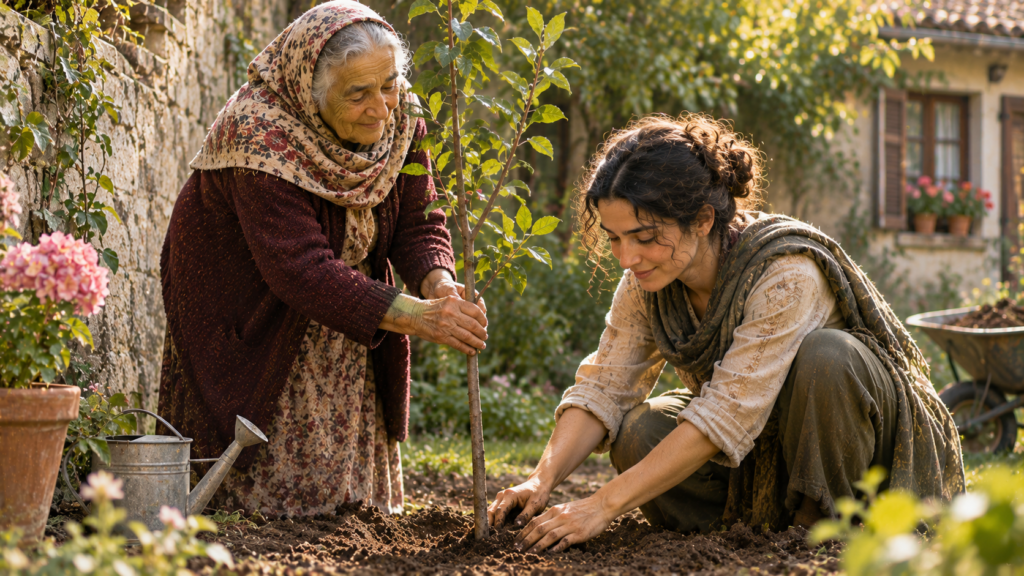
The nursery owner told them that the pear tree might take several years to produce a worthwhile crop.
Nadia looked at her aunt, who had been examining the young tree with considerable interest.
“Wouldn’t you rather buy something that flowers this year?”
Her aunt smiled. She was eighty-two. The small garden behind her house already contained several plants she could scarcely remember choosing, and she had begun asking for assistance with tasks that once required little effort.
“I think this one will do.”
On the way home, Nadia wondered whether her aunt had considered the time it might take for the tree to produce fruit. She did not want to ask the question directly. There seemed something unnecessarily cruel about measuring the remaining possibilities of another person’s life against the anticipated growth of a plant.
They found a place for it near the garden wall.
Her aunt asked Nadia to help with the digging. Then she stood beside the little tree and considered how much light it would receive during the summer.
There was no certainty that she would taste a pear from its branches. There was no certainty that Nadia would either. Yet the two women spent the afternoon preparing a place for something whose future lay beyond their knowledge.
The thought of limited time often leads us toward a particular kind of question: what would we do differently if we knew exactly how long we had left?
But perhaps there is another question worth asking. What would still be worth doing if we knew that we might not be present to experience its eventual result?
The imagined calendar of our remaining years
Suppose we were handed a calendar containing every day still available to us.
We could turn through its pages and discover where the final date appeared. All the years we had regarded as abstract possibilities would acquire a precise limit.
At first, the knowledge might seem extraordinarily useful.
We could decide which ambitions deserved our attention, which obligations could reasonably be declined and which relationships we wished to nurture. We might become less willing to devote years to arguments whose significance diminished when measured against the time they consumed.
Yet the calendar would not explain how to use a single afternoon.
It could tell us how many dates remained without telling us whether an evening spent reading was more worthwhile than one spent talking to a friend. It could identify the time available for a difficult undertaking without revealing whether the undertaking deserved to be pursued.
Knowing the quantity of time and understanding its value are different kinds of knowledge.
A person approaching the final day on such a calendar might become extraordinarily attentive to the people around them. Another might find the knowledge so overwhelming that much of their remaining time became occupied by fear.
Even the most precise information would not eliminate the complexity of deciding how to live.
There is a temptation to believe that certainty about our mortality would solve the difficulty of distinguishing important things from unimportant ones.
But some of the things we value cannot readily be compared. The time required to care for a parent may conflict with an opportunity to pursue an ambition that has mattered to us for decades. The need for rest may conflict with our desire to be present for somebody experiencing difficulty.
The calendar would make those decisions more urgent. It would not necessarily make them simpler.
Perhaps the knowledge we actually possess is already sufficient to begin examining them.
We know there are limits.
We do not know where those limits will be encountered.
Not every hour must become extraordinary
Imagine a man who decides to live each day as though it were his last.
On the first morning, the idea gives him an unusual sense of clarity. He telephones someone he has been meaning to call, goes somewhere he enjoys and sets aside a task that suddenly seems less important.
But suppose he continues applying the same principle literally.
He may become reluctant to spend time learning a difficult skill whose benefits will take years to emerge. He may question the value of saving money, maintaining equipment or carrying out work necessary to support the people around him.
He might feel disappointed whenever a day contains ordinary responsibilities rather than an experience that appears worthy of a final day.
An awareness of mortality has become another demanding standard against which every hour must be justified.
In The Beauty of an Ordinary Life, we explored the importance of experiences that do not require a dramatic purpose to establish their value. The knowledge that our days are limited should not make those experiences less deserving of our time.
A person preparing meals for the coming week is participating in life. So is someone sleeping after a demanding shift, learning a complicated subject or accompanying a child through the slow process of acquiring a skill.
Much of what makes life meaningful could not exist without the willingness to invest time in things that will not produce immediate satisfaction.
We need not continually attempt to manufacture memorable experiences in order to respect the time available to us.
Sometimes the most generous attitude toward a limited life is to permit an ordinary day to remain ordinary.
The commitments that deserve the years they take
A young woman wants to learn to play the cello.
After several lessons, she discovers that producing even a relatively pleasant sound requires more attention than she anticipated. Her teacher explains that some difficulties will become manageable only through repeated practice.
She wonders whether she is beginning too late.
There are other things she wants to do. She has responsibilities at work and a household whose arrangements already occupy considerable time. If her progress will be slow, perhaps the instrument will never become the source of satisfaction she imagined.
But what if learning the instrument is not valuable only at the point when she becomes accomplished?
The practice itself could offer enjoyment, concentration and the experience of discovering something unfamiliar. A few years spent developing modest competence can belong to a meaningful life even if they do not produce a musician of exceptional ability.
This distinction applies to many of our commitments.
We may devote years to a friendship without establishing a particular final achievement. We may study something whose importance lies partly in the questions it continues to generate. We may care for a garden whose condition can never be considered permanently complete.
To know that time is limited is not necessarily a reason to choose undertakings of shorter duration.
It may be a reason to choose more carefully the undertakings to which we are willing to give a substantial part of our lives.
The difference becomes visible when we distinguish an activity whose rewards are perpetually postponed from one whose ongoing practice already possesses meaning.
The woman might never perform before an audience.
But the evenings during which she learns to play will be actual evenings of her life, not simply payments made toward the arrival of a more worthwhile future.
The things we cannot choose without leaving others behind
There is a difficult consequence to treating time as something finite: the acceptance of one possibility often requires the abandonment of another.
A person cannot spend the same year living in two distant places under entirely different circumstances. A decision to devote substantial attention to one undertaking reduces the attention available for others. Even when several commitments can coexist, their demands may not always be compatible.
We sometimes respond to this difficulty by attempting to preserve every possibility.
We maintain interests we have little time to pursue, accept responsibilities whose demands we have underestimated and continue making plans for experiences that remain indefinitely beyond the reach of our resources.
There is something understandable about the reluctance to give them up. A possibility may matter because of the person we imagine becoming through it.
Yet the effort to keep every future available can prevent us from participating adequately in any of them.
In Why Are We Always Waiting for Tomorrow?, we considered the way a postponed intention can remain attractive because it has never had to encounter the limitations of an actual day.
A finite life makes those limitations especially consequential.
We may need to acknowledge that some ambitions will not be pursued, that certain opportunities are less important to us than we once believed and that another person’s expectations cannot always determine our priorities.
There is often sadness in such decisions. An unchosen life can retain an appeal even when we remain committed to the one we have chosen.
The aim is not to become incapable of imagining what might have been.
It is to become sufficiently willing to invest ourselves in the things we have decided matter.
A meaningful commitment does not prove that every alternative was meaningless.
It establishes that we have made room for something by allowing other possibilities to remain possibilities.
When time is controlled by somebody else
An awareness of limited time can sound very different to a person who has little authority over the arrangement of their days.
Consider a worker whose schedule changes without warning, a parent who has no reliable access to childcare or somebody waiting for a medical appointment that will influence their future capabilities.
Their lives may contain important ambitions and relationships. But their opportunities to act upon those commitments depend upon circumstances they cannot determine alone.
The suggestion that we should spend our limited time only on things we genuinely value becomes difficult to apply when earning enough to survive requires accepting arrangements we would never freely choose.
Even choices made out of love may include considerable sacrifice.
A woman caring for her father through a prolonged illness might value the relationship deeply while still wishing she had more time for friendships, education or uninterrupted rest.
Acknowledging those wishes does not diminish her devotion.
It reveals a need that her devotion cannot satisfy by itself.
We should be careful not to transform the recognition of mortality into another demand placed on people already carrying more than their circumstances reasonably allow.
The conditions under which people spend their lives deserve attention because the time consumed by an unnecessarily burdensome arrangement cannot subsequently be returned.
A fair division of household responsibilities can give someone an evening they would otherwise never possess. Reliable services can allow families to make plans without spending months in administrative uncertainty. Decent working arrangements can create opportunities to develop relationships beyond the place of employment.
Such changes may appear modest when described as improvements to a schedule.
From the perspective of a person with only one life to inhabit, their importance can be immense.
The apology that requires more than a deadline
Imagine that knowledge of our remaining time persuades us to contact someone with whom we have had a serious disagreement.
We might wish to apologize, express affection or ask whether a relationship could continue in another form.
The desire can be valuable. In The Things Time Cannot Return, we considered how reconciliation can change a relationship’s future without restoring the years that have already passed.
But awareness of mortality does not automatically transform every attempt at reconciliation into an act of kindness.
A person who has caused harm cannot demand forgiveness because they have become anxious about the amount of time available to them. Someone who wishes to reconnect must recognize that the other person has a history, needs and limits of their own.
There may be reasons a relationship cannot safely resume. There may be forms of repair that remain possible without renewed contact.
An apology motivated partly by our awareness of life’s limits still needs to be concerned with the person receiving it.
Otherwise, we risk using our sense of urgency to impose another burden upon them.
The same consideration applies to many expressions of affection.
We may wish to tell people how much they mean to us. We should also be willing to listen to what matters to them, rather than assuming that our desire to make a moment significant establishes how they are required to experience it.
The recognition that our own time is limited might help us become less possessive of another person’s time.
Their days are limited too.
The danger of making decisions out of fear
A person becomes increasingly conscious of the passage of years and begins to feel that they must make an important change immediately.
They consider abandoning an occupation, ending a longstanding commitment or using resources they have carefully accumulated to pursue a long-delayed ambition.
The desire may point toward something that genuinely deserves attention. Perhaps they have been maintaining an arrangement whose cost they had not fully recognized. Perhaps their circumstances have changed, making a different direction possible.
But a heightened awareness of time does not necessarily provide reliable guidance about which decision to make.
A frightening possibility can make our present circumstances appear intolerable even when a more considered examination would reveal aspects worth retaining.
An irreversible choice made to escape the feeling of urgency may create difficulties extending far beyond the period in which that feeling was strongest.
In The Fragility of Everything We Love, we explored the difference between taking reasonable action in response to uncertainty and allowing imagined future losses to consume the experiences available to us.
Mortality can produce a similar tension.
It can invite us to reconsider commitments that no longer reflect our values. It can also produce a pressure to make every decision quickly, as though deliberation itself were a waste of time.
There is no contradiction between recognizing the importance of a decision and taking sufficient care in making it.
A person might begin exploring alternatives without immediately abandoning existing responsibilities. They might obtain advice, discuss their concerns with the people affected or identify a limited experiment through which an imagined change becomes clearer.
The time spent understanding a consequential choice is itself part of a life.
It is not necessarily time lost.
The future in which we will not appear
A few weeks after helping her aunt plant the pear tree, Nadia returned to the garden.
The tree looked much as it had before. There was no fruit and very little evidence of the eventual shape it might acquire.
Her aunt asked whether the soil was still moist beneath the surface.
They talked about how the tree would need to be cared for during the warmer months.
Nadia began to understand something about the decision to plant it.
Her aunt had not necessarily expected the garden to remain hers forever. She had developed an affection for the place through years of living beside it, and she had discovered an opportunity to leave something there that might become meaningful to someone else.
The decision did not depend on knowing who that person would be.
We encounter similar possibilities in education, public life, family relationships and the preservation of the natural environment.
A person may teach somebody a skill whose later uses they will never witness. A community may establish a library that will benefit children not yet born. People may protect a landscape whose future inhabitants will have no knowledge of the individuals responsible for its survival.
These undertakings involve a relationship with time extending beyond personal experience.
They are not made valuable solely by the prospect of being remembered.
The child who eats fruit from a tree does not need to know the name of the person who first placed it in the ground in order for that person’s work to have mattered.
There is an important distinction between wanting to leave evidence of ourselves and wanting to leave conditions in which other people can live well.
The first may produce a lasting monument.
The second may produce something as unremarkable as a little shade on a warm afternoon.
Both belong to possible ways of responding to the knowledge that we will not always be here.
A day that does not need to know its place
We cannot usually identify which of our remaining days will become the most consequential.
An apparently insignificant conversation may influence a decision made years later. A carefully planned event may leave less lasting impression than a small incident nobody anticipated.
We may eventually regret some uses of our time. Others will become valuable in ways impossible to recognize while they are happening.
This uncertainty does not invalidate the effort to make thoughtful choices.
It does mean we cannot demand complete assurance that we are spending every hour in the best possible way.
Nadia’s aunt eventually went indoors to prepare tea. The two women sat near the window and discussed matters that had nothing to do with age or mortality. A relative was coming to visit. Something in the house needed repairing. There was news about somebody they both knew.
The tree remained outside.
Perhaps her aunt would have the pleasure of eating its fruit. Perhaps another person would discover it already growing in the garden.
Neither possibility made the afternoon they had spent planting it less real.
If we knew how little time we had, we might reconsider many of the things to which we give our attention. We might become more willing to express affection, establish boundaries, pursue a neglected interest or acknowledge the importance of an ordinary experience.
We might also discover that some of the most worthwhile uses of our time are the ones whose full consequences we will never see.
We do not need to know the date on which our lives will end to take seriously the fact that they are happening now.
Nor do we need to turn every day into a final farewell.
There are things to maintain, people to love, decisions to reconsider and possibilities to prepare for.
Outside the window, the young tree was beginning to establish its roots.
There was work to do tomorrow.
And tomorrow, whether or not it belonged to them, was worth caring about.


