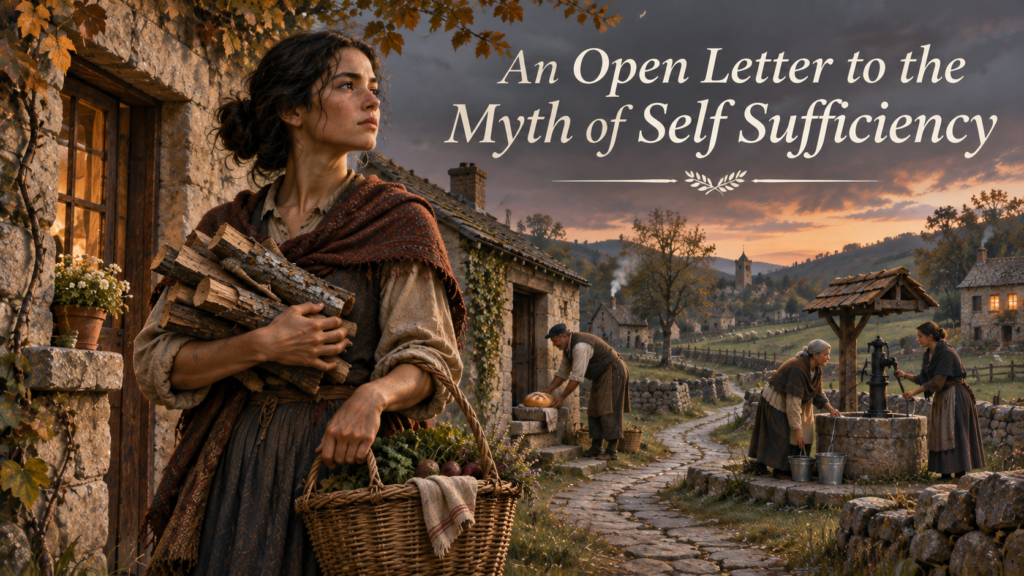
Dear self sufficiency,
I know the weight of a bundle of firewood before I lift it. I know which basket will hold enough vegetables for three days and which corner of the roof begins to leak when the wind drives rain against it. These are things I have learned through years of attending to a small house near the edge of a village. For a long time I described that house as the place where I had proved I could live without depending on anyone.
I am a fictional woman in an imagined rural community, not a witness to a particular historical village. My circumstances belong to a story about independence, and the story begins on an evening when I carried wood through the gate and discovered that the path beneath my feet had been repaired.
The stones had been uneven after a period of wet weather. I had noticed the difficulty every time I returned with a heavy basket, and I intended to address it when I had enough time. Apparently several neighbors had spent their afternoon repairing the roughest parts of the shared path. They had worked beyond the point where their own houses stood.
I walked home more easily because of something I had not done.
The experience would have remained an unremarkable kindness if I had not recently been telling a young woman about the importance of establishing an independent life. She had asked whether I ever regretted living alone. I said that I liked deciding how my days would be arranged. I was proud of the work necessary to maintain my household, and I valued the freedom of being able to make decisions without seeking another person’s permission.
I still value those things. What I would now change is the explanation I supplied for their existence.
Consider the knife I used to prepare supper that evening. I had purchased it with money earned through my own work. I knew how to care for it, and I had learned to recognize when its edge needed attention. I could reasonably take responsibility for the way I used it. I could not claim responsibility for the knowledge through which its maker had learned to produce it, the material from which it was made, or the arrangements that had allowed it to reach the village.
The same observation applied to the vegetables in my basket. I had grown some of them myself. Others came from a neighbor whose patch of ground was better suited to a particular crop. We exchanged things according to circumstances, sometimes without settling the exchange immediately. The garden gave me a useful degree of independence. It also made me attentive to the variety of conditions on which my daily life depended.
I began an experiment with a notebook. I wrote down the activities I normally described as things I did for myself. Beside each I tried to identify the contributions of other people that made the activity possible. The second column soon became much longer than the first. It included people whose names I knew, people I had never met, and people whose contributions belonged to the history of the village rather than its present life.
What interested me was not the discovery that I had received assistance. I had never denied receiving assistance when someone brought me a particular thing. I had failed to recognize how much assistance was contained in the ordinary conditions within which I made decisions. A repaired path had no need to ask whether I wanted help each time I crossed it. Its usefulness remained available to me after the people who repaired it returned home.
I recognize that kind of contribution in the inheritance of advantage. Some benefits arrive in the form of visible possessions. Others arrive as reliable knowledge, familiar arrangements, or resources available before a person begins the work by which they later define themselves. The recipient may still perform exceptionally demanding work. Recognizing the conditions of that work does not make the effort imaginary.
Dear self sufficiency, I suspect some of your appeal comes from a genuine fear of dependence. I have seen arrangements in which a person offering assistance expected the recipient to surrender a substantial part of their freedom in return. A woman could be told that the household supporting her had acquired the right to determine whom she visited. A worker could become reluctant to question an unfair arrangement because the person responsible for it controlled the means of finding another position.
Those are important reasons for wanting greater independence. Help is not admirable merely because somebody calls it help. Its terms matter. A society in which assistance is distributed according to personal loyalty can make otherwise ordinary needs into instruments of authority. People need ways of securing essential resources without continually demonstrating obedience or gratitude to an individual who could withdraw them.
But the answer to that difficulty need not be the abolition of dependence. It may be the establishment of fairer relationships among people who depend upon one another. The useful distinction is between having needs, which nobody entirely escapes, and being exposed to another person’s arbitrary control because of those needs.
When my neighbor Mira injured her wrist, I carried several things from the market for her. She had previously helped me repair a fence, and I was glad to perform work she temporarily found difficult. We did not need to establish that the value of my contribution precisely equaled the value of hers. We did need to respect the limits of one another’s time. If the arrangement had continued indefinitely without discussion, it might eventually have become unfair to both of us.
That is a lesson I would not want the language of community to conceal. Mutual assistance cannot reasonably require a particular person to remain available whenever another person encounters a difficulty. Some circumstances demand resources and expertise beyond what neighbors can supply. Praising their willingness to help should not become a reason to neglect the arrangements that would allow them to continue living their own lives.
The distinction matters in the language of resilience, where admiration for the way people manage difficult conditions can obscure their continuing need for support. A village may possess extraordinary habits of cooperation and still require a bridge that can be crossed safely, dependable access to essential services, and a fair way of allocating the work that maintains shared resources. Its kindness is not evidence that those obligations have disappeared.
We have sometimes been too generous in our praise of the person who never asks for anything. In my own case, the praise made me reluctant to describe difficulties before I could resolve them. I worried that requesting assistance would diminish the independence for which I was known. I occasionally spent several unnecessary hours attempting something that another person could have helped me accomplish without much trouble. The time mattered. It belonged to the life I was supposedly protecting.
I also became less attentive to the difference between declining someone’s assistance because I did not need it and declining because I feared what accepting it would say about me. The first decision could be a sensible exercise of judgment. The second gave considerable authority to an imagined observer whose opinion ought not to have occupied so much of my day.
The reflection on the idea of personal failure helps explain the difficulty. If a person regards every adverse circumstance as a verdict upon their competence, the ordinary need for another person’s contribution can begin to resemble an accusation. It becomes harder to ask for advice, admit uncertainty, or reconsider a demanding undertaking. The performance of independence may then interfere with the very judgment that makes independent action valuable.
There is no virtue in cultivating dependence merely to avoid learning something useful. I want the young woman who visited me to acquire practical knowledge, understand her obligations, and make decisions she can defend. I want her to recognize what she can reasonably do without assistance. I also want her to recognize the value of establishing relationships and supporting public arrangements that make her choices more meaningful.
The village provides a modest illustration of that possibility. Several households share equipment that would be expensive for each to maintain separately. They have agreed on what happens when a tool needs repair and how to resolve disagreements about its use. Nobody is required to borrow it. The arrangement increases the range of work an individual household can undertake while reducing the amount every household must purchase independently.
Its existence does not depend entirely on affection. We have needed rules, contributions, and repeated conversations about what counts as a fair share. Some people have different amounts of time available, and some have knowledge that others lack. The arrangements are not always comfortable. Yet the discomfort of discussing shared responsibilities is sometimes much smaller than the difficulties each household would encounter if the shared resource were allowed to disappear.
I think of the settlement built on dependence and the question of what happens when the necessities of a life become tied to arrangements larger than the individual. Those arrangements can create vulnerability. They can also create capacities no single person could easily acquire. The important question is not whether we have escaped every relationship of dependence. It is whether those relationships permit us to participate with dignity, exercise judgment, and challenge unfair conditions.
When the young woman next visits, I will show her the notebook. I will not give it to her as proof that she should stop wanting an independent life. I will tell her that I want precisely that for her. Then I will explain why the paths, tools, knowledge, and relationships surrounding her deserve a place in her account of how that life becomes possible.
Dear self sufficiency, you may remain a useful name for some of the capacities I have developed. But you cannot describe the whole of the house, the village, or the person returning with a basket. I have earned much of what I possess. I have received much that I could not have earned without first receiving something else. The two observations belong together.
Tomorrow I intend to repair a loose stone near my gate. It will probably be a small task. Someone passing later may not notice the change, and I hope their journey will be easier because of it.
With respect for the freedom we exercise and the work that allows us to exercise it,
A woman grateful for the path beneath her feet