To the people who will inherit a place and be told that loving it means keeping it unchanged,
We are the village of Vey. You will not find us on your maps. The river took the road first, then the eastern granaries, then the names from the signs above our doors. What remains of us is easier to describe than what happened to us: a set of foundations in a floodplain, a millwheel buried in silt, and a story the survivors tell differently depending on who asks.
We write because people have called us stubborn. They say we were a community that could not adapt. It is a neat verdict, which is exactly what makes it dangerous. It turns a hundred decisions, a thousand small fears, and several preventable mistakes into a defect of character. We want to tell you what was actually difficult.
At the beginning, our certainty had evidence behind it. For generations, the river rose in the wet months and withdrew before planting. Our houses stood above its usual reach. The mill fed us, and the miller bought flour from villages upstream when our harvest fell short. We were not foolish to trust what had worked.
Our mistake was believing that a history of survival had become a law of nature.
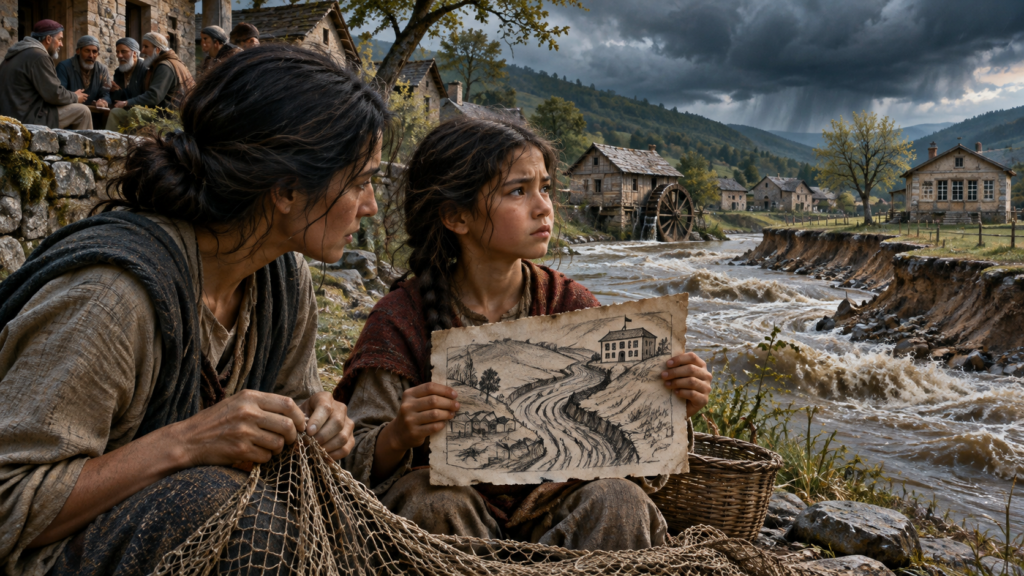
The first warning came from a child who helped her mother mend fishing nets. She noticed that the spring current had begun carving a new channel toward the school. She drew it with charcoal on the back of an old account sheet. Her mother brought the drawing to the council. The council praised the child’s sharp eyes and asked the miller whether he had seen the same thing.
He had not. The meeting moved on.
We remember that moment because it reveals something our later disaster concealed. We were willing to hear a warning only after it had passed through the people whose authority we already recognized. The child’s evidence was treated as a suggestion. The miller’s absence of evidence was treated as reassurance. No one intended to be cruel. The difference still mattered.
That year we reinforced the old embankment. We knew how to do that. Each household sent workers, the stonecutters supplied material, and the council kept a careful register of hours. It was an impressive display of cooperation. When we finished, the embankment looked stronger than before. We took photographs beside it. We celebrated the ability of our community to come together.
We did not ask whether we had protected the right bank.
On the northern slope, the land rose gently above the flood line. It was less convenient for the mill and farther from the market road. A few families suggested moving the grain stores there. The plan required changing the route of deliveries, negotiating access across private fields, and accepting that the centre of our daily life might shift. Everyone agreed the slope was safer. Then everyone explained why relocation should wait until the following season.
The trouble was not that we lacked a workable alternative. The trouble was that the alternative redistributed inconvenience. The people who could authorize it would bear the immediate cost; the people who would suffer most from doing nothing had little influence over the decision.
Our poorest households lived closest to the water. They had settled there because the ground was less expensive and because people who transported sacks, cleaned equipment, and worked irregular hours needed to remain near the mill. For those families, a safer grain store meant more than a better harvest. It meant a better chance of receiving food if the road vanished.
During the second wet season, the eastern footbridge broke. Nobody died. We repaired it in eleven days, faster than anyone thought possible. The council recorded those eleven days as proof of our resilience. The families cut off from the market remembered eleven days of missed wages, spoiled medicines, and bread bought on credit.
One event, two accounts of what success meant.
Afterward, every official report described the bridge as restored. No report recorded which households had exhausted their savings while it was unusable. Once the timbers stood straight again, the emergency was considered over. We mistook the restoration of an object for the restoration of a community.
We should have changed how we counted the cost.
The girl with the charcoal drawing was older by then. She was apprenticed to a carpenter and had begun measuring the river each week. She placed reeds at the bank to mark its movement. Her marks showed that the current was not merely rising higher. It was moving sideways, finding a route the old embankment could never block.
Her measurements did not fit the column on the council’s forms. Those forms had places for rainfall, water height, labour days, and repair expenses. They had no place for a changing riverbed. A clerk suggested recording the new observation in the remarks section. When the next report was copied, the remarks were left out to save space.
We were not destroyed by paperwork. We were weakened by a system that could carry familiar information farther than unfamiliar truth.
Some people did try to leave. The first were traders who had relatives on the hills. We called them impatient. Then a teacher accepted work elsewhere, and we called her disloyal. Then the baker proposed a second oven beyond the floodplain, and we asked why he had so little faith in the village that had supported him.
Notice what happened: departure became a moral question. We had turned a practical decision about safety into a test of belonging.
The people with property could wait. The people without savings could not easily afford to move. Yet our public language treated everyone as equally free to stay or go. We praised the loyal and mocked the cautious, while the price of leaving rose with every season.
By the third wet season, our arguments had become rituals. The miller spoke first. The council requested more evidence. The same households volunteered to repair the same wall. The most vulnerable families asked for a temporary food store uphill. They were promised a committee. A committee was formed. Its first meeting was postponed because the eastern road needed repairs.
We were busy, and busyness resembled responsibility.
Then came the rain that did not stop when the calendar said it should. We remember the sound before the water: a long, low splitting noise as the soil beneath the mill shifted. By dawn, the new channel cut across the lane to the school. The grain store remained standing for three more days, an extraordinary monument to the wrong kind of strength.
When it finally fell, the sacks scattered in brown water, and the people who had kept our books could no longer say precisely how much grain had been lost. The records were in the building beside it.
We will not pretend that any single change would have prevented the flood. Rivers have more power than committees. Some losses would have come even if we had listened early, moved quickly, and planned wisely. Adaptation is not the promise that nothing bad will happen.
It is the capacity to change a course while change is still possible.
That capacity is not just courage. It requires permission to question a decision, resources to try another method, and rules that do not punish the first person who notices a problem. It requires leaders able to say that the last successful solution may now be dangerous. It requires records that include costs borne by people who do not sit in the room.
Most of all, it requires a community to distinguish continuity from loyalty. We thought preserving our buildings meant preserving our bonds. We discovered, too late, that the bonds were the only things worth carrying.
The people who climbed to the northern slope that night shared blankets and boiled what grain they had saved. The miller’s son served food beside the young carpenter who had drawn the channel years earlier. Nobody asked whose family owned the pots. Nobody checked the council’s register. In the worst hour of our history, we became more flexible than we had been in all our prosperous years.
There is grief in knowing we possessed that ability all along.
Do not turn our story into a sermon about abandoning tradition. The old mill taught people a craft. The market road connected families. The council settled disputes that might otherwise have divided us. Institutions preserve knowledge, and places make memory possible. We did not need to despise what we had built. We needed to stop asking it to remain exactly as it was.
We think often of another letter, A Letter From the Last Season of Movement, which remembers a time when leaving was easier. Our failure was different. We could imagine leaving, but we had made it socially shameful and materially expensive.
We think, too, of An Open Letter on Adaptation and Survival. Endurance can keep people alive, but it can also hide the moment when the environment itself must change. We called our capacity to endure proof that our decisions were sound. We were wrong.
If your community is facing a future unlike its past, begin with a question more useful than whether people are resilient: what must be true for someone to suggest a different path without losing their place among you?
Give the person nearest the danger a voice before the danger reaches the council chamber. Treat a new kind of evidence as a reason to revise the form, not a reason to discard the evidence. Measure the price of a delayed decision in lost wages, frightened children, and exhausted neighbours, not only in broken bridges and damaged walls.
Build an exit that does not require exile. Make room for a second method before the first one fails. Ask whether the people praised for holding everything together are the same people who pay most when nothing changes.
Above all, resist the comforting idea that a community fails because its people were insufficiently strong. Strength is not a substitute for listening, planning, or sharing the cost of change. A village can be full of brave people and still organize itself toward disaster.
We know, because ours was.
The survivors did not rebuild Vey on the old floodplain. They built a smaller settlement on the slope. The first public structure was not a mill or a council house. It was a covered table where anyone could leave a drawing, a measurement, or a warning. The rule was simple: no observation could be removed from the record because the council did not yet know what to do with it.
We do not know whether that new settlement will keep its promise. Communities forget. Procedures harden. The next generation may mistake its successful choices for eternal ones. We can offer no guarantee.
We can leave a testimony.
We were a community that could not adapt until adaptation was no longer a decision we could postpone. Please do not wait for the river to teach you what you could have learned from one another.
With the affection that remains when the buildings are gone,
The people of Vey, a community once certain the river would remember its place