
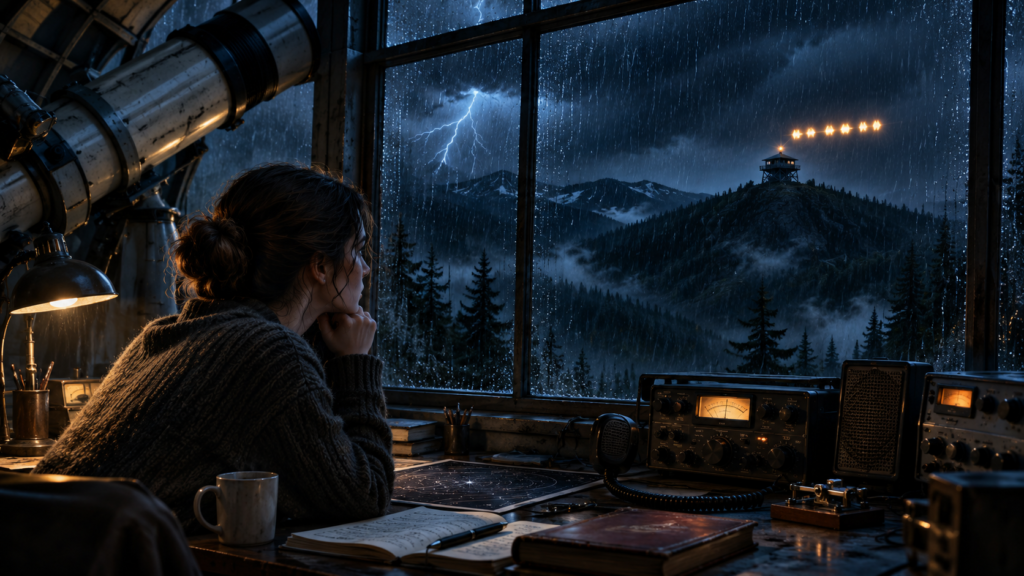
The mountain flashed three times.
Then three times more.
Then three times again.
And somewhere beneath the darkness, a person was waiting to die.
At 11:46 p.m., twenty-year-old Vesper Saye pressed her face against the cold glass of the observatory window and counted the flashes a second time.
Three short.
Three long.
Three short.
She knew the pattern.
Almost everybody had seen it somewhere, in a film, a book, or an old photograph of ships sending messages across stormy seas.
But Vesper had learned it from an entirely different source.
Her grandmother used to send it with the kitchen light when she wanted Vesper to come inside for supper.
“Isn’t that a distress signal?” Vesper had asked when she was eight.
“Yes,” her grandmother replied.
“Then why are you using it?”
“Because the situation is desperate. Your soup is getting cold.”
Now, twelve years later, there was nothing funny about the light blinking across the Blackthorn Valley.
Vesper stood alone inside the Meridian Ridge Observatory. Rain struck the windows. The electricity had failed twice since sunset, and the telephone line sounded as though someone were crushing gravel against the receiver.
The beam had appeared on the opposite mountain, roughly three kilometers away, near the ruins of an old fire lookout.
A building that had been abandoned for nineteen years.
No electricity.
No working road.
No reason for anyone to be there.
Yet the flashes came again.
Three short.
Three long.
Three short.
Vesper reached for the radio.
“Ridge Station to Valley Control. Come in.”
Static.
She adjusted the frequency.
“Valley Control, this is Meridian Ridge Observatory. Possible distress signal on the western slope. Do you copy?”
For several seconds, nothing answered.
Then a man’s voice crackled through.
“Meridian, this is Control. Say again?”
“Possible SOS signal from Blackthorn Lookout.”
“Blackthorn Lookout?”
“Yes.”
A pause.
“That station’s closed.”
“I know.”
“There’s nobody up there.”
Vesper stared through the window.
The light flashed again.
“Somebody disagrees.”
“Are you certain it’s Morse code?” the dispatcher asked.
“Yes.”
“Could be lightning.”
“Lightning doesn’t usually pause politely between groups of three.”
The dispatcher didn’t answer.
Vesper continued. “Three dots, three dashes, three dots. SOS. It’s an international distress signal.”
“Save Our Souls?”
“That’s what people say, but it isn’t what the letters originally stood for. They were chosen because the pattern was distinctive and easy to transmit.”
A crackle of static filled the room.
“Are you telling me somebody is sending an emergency signal from an abandoned mountain?”
“That’s exactly what I’m telling you.”
Another silence.
Then the dispatcher said, “This is Sol Marr, Valley Control. I’m contacting mountain rescue. Stay on this frequency.”
The radio clicked.
Vesper exhaled.
She reached for the observatory’s spotting scope and adjusted it toward the western ridge.
Blackthorn Lookout stood on a narrow outcrop above a steep forested slope. In daylight, it resembled a broken matchstick against the skyline. At night, it was little more than a darker shape against the mountains.
Her grandmother had taken her there once, years before the final access road was closed.
Vesper remembered a rusted staircase, a faded warning sign, and a view so enormous that she had felt the world opening beneath her feet.
Her grandmother had pointed toward the distant mountains.
“See those?” she’d asked.
“Yes.”
“People used to watch for fires from up here. They could see smoke rising fifty kilometers away on a clear day.”
“Couldn’t they just telephone someone?”
“Not always. You’d be surprised how often people have had to find ways to communicate without a telephone.”
Then her grandmother had taught her how to send messages with a flashlight.
Short flashes.
Long flashes.
Spaces between them.
A language made from light.
Now Vesper adjusted the scope until the western slope filled her vision.
The mountain emerged through a curtain of rain.
A crooked pine.
An exposed band of pale rock.
The skeletal remains of the lookout tower.
And beneath it, a trembling point of white light.
She held her breath.
The signal began again.
Three short.
Three long.
Three short.
Then darkness.
Vesper checked her watch.
11:52 p.m.
She opened the observatory logbook.
Possible SOS signal. Western slope, near Blackthorn Lookout. Repeated at 11:46 and 11:52.
She paused.
Then added:
Source appears below tower, exact position uncertain.
The radio crackled.
“Meridian, this is Sol. Rescue Team Four is responding. They are preparing to approach from the northern service trail.”
“How long?”
“Conditions are difficult. The road’s been damaged by the storm. It’ll take time.”
“How much time?”
“Can’t give you a reliable estimate.”
Vesper looked out the window.
The clouds moved lower across the valley.
Rain streamed down the glass.
“Sol, can you send a helicopter?”
“Not in this weather.”
“What about a drone?”
“The rescue team will determine what they can use. Right now, we need an exact location.”
“I think it’s below the lookout.”
“How far below?”
“I don’t know yet.”
“Find out if you can. Don’t leave the station or put yourself at risk.”
The radio clicked off.
Vesper returned to the scope.
The light flashed once.
Twice.
Three times.
Then stopped.
The three long flashes followed.
She counted carefully.
One.
Two.
Three.
Then the final three short flashes.
The pattern was perfect.
Whoever was sending it knew what they were doing.
Vesper wrote down the time.
11:58.
Six minutes since the previous signal.
She watched for another.
Nothing.
Outside, thunder rolled across the mountains.
The observatory lights flickered.
For a moment, Vesper saw her own reflection in the glass.
A young woman with dark hair tied badly behind her head, an oversized wool sweater, and enormous shadows beneath her eyes.
She had applied for the Meridian internship because she wanted to study atmospheric optics.
Not because she enjoyed working alone on a mountain in the middle of the night.
She loved the way light could lie.
A star could appear to shimmer because Earth’s atmosphere disturbed its path.
A distant ridge could seem closer in certain weather.
A reflection could convince the eye that something existed where there was nothing.
Light, her professor liked to say, was both evidence and illusion.
The trick was knowing how to question what you saw.
Vesper looked again.
The flashing point seemed to hover near the lookout.
But something about the alignment bothered her.
The tower was to the right of a distinctive split pine tree.
The light appeared just left of it.
She checked the old topographical map hanging beside the equipment cabinet.
Blackthorn Lookout sat on the highest part of the western ridge.
Directly below it was a steep gully marked with closely spaced contour lines.
No building.
No trail.
Nothing.
Yet the light was coming from that area.
She pulled out her phone and photographed the map.
Then she returned to the scope.
12:04 a.m.
The signal began again.
Vesper reached for the notebook.
As the first three flashes appeared, she marked their position relative to the forked pine.
The next three arrived slightly farther to the left.
She frowned.
She checked the scope mount.
Still locked.
The final three flashed farther left again.
She stared.
The light wasn’t fixed.
Someone was moving.
And whoever it was appeared to be descending the mountain.
She grabbed the radio.
“Sol, I have an update.”
Static.
“Go ahead, Meridian.”
“The signal source is moving. It may not be coming from the lookout at all.”
“What do you mean?”
“I’ve watched it shift across the slope.”
“Could be branches moving in the wind.”
“No, I checked against stationary landmarks. The source itself appears to be changing position.”
“How much?”
“Not far. But enough that I noticed through the scope.”
Sol was quiet.
Then he said, “I’ll pass that to the rescue team. Can you keep tracking it?”
“Yes.”
“Good. They’ve reached the northern trailhead.”
Vesper checked her watch.
12:09.
The rain intensified.
And the light disappeared.
For the next eleven minutes, nothing moved across the western mountain except clouds.
Vesper watched until her eyes ached.
She tried the radio twice.
Both times, Sol told her the team was progressing slowly.
At 12:21, the signal returned.
But this time it wasn’t nine flashes.
There were only five.
Three short.
Two long.
Then darkness.
Vesper waited.
One minute.
Two.
Three.
Nothing.
She checked the scope, adjusted the focus, and stared at the dark slope.
Her fingers felt numb.
She tried to imagine what was happening on the other side.
Perhaps the person had fallen.
Perhaps the flashlight battery was dying.
Perhaps the rain had damaged it.
Or perhaps someone had simply stopped trying.
She refused to settle on any explanation without evidence.
But the possibilities crowded her thoughts anyway.
At 12:29, she called Valley Control.
“The signal is weakening.”
Sol’s voice sounded different now.
Less skeptical.
More tired.
“Rescue Team Four is approaching the lookout ridge.”
“Tell them to look below the tower.”
“They know.”
“There’s a gully beneath the southern side. They should check it.”
“I’ll relay that.”
Vesper stepped away from the scope.
Her eyes needed rest.
She crossed the room, filled a glass of water, and stood beside the old observatory map cabinet.
It contained decades of survey charts, weather records, and photographs of the surrounding mountains.
Most of the papers hadn’t been touched in years.
She opened the bottom drawer.
A stack of aerial photographs lay beneath a yellowed geological survey.
Vesper pulled out the survey.
BLACKTHORN RIDGE: 1978.
She spread it across the table.
The old lookout appeared near the northern edge.
Beneath it was the gully.
But unlike the modern map, this one showed something else.
A thin black line crossing the mountainside.
Vesper leaned closer.
It was labeled:
Old drainage inspection route.
The line ended at a small square beside the gully.
Stone maintenance shelter.
Vesper looked up sharply.
A shelter.
There had once been a building below Blackthorn Lookout.
Not marked on modern maps.
Perhaps demolished.
Perhaps buried.
Perhaps still standing, concealed by trees and decades of landslides.
She photographed the survey and called Sol.
“I found something.”
“Go ahead.”
“There’s an old stone maintenance shelter below the lookout. It’s on a 1978 survey, but not on the current maps.”
“Are you certain?”
“I have the original survey in front of me.”
“Can you give me a location?”
She read the map reference and described the route.
Sol repeated the details to confirm them.
Then he said, “Hold the line.”
Vesper heard voices behind him.
Someone was talking about a ridge crossing.
Another voice mentioned unstable ground.
After nearly a minute, Sol returned.
“Team Four has the information. They believe the old shelter could be accessible from a lower path.”
“Have they found the signal?”
“Not yet.”
A burst of static.
Then a new voice came over the radio.
“Meridian Observatory, this is Team Four leader, Tarek Wynn. Can you hear me?”
“Yes.”
“I’m at the upper ridge. The lookout is empty.”
Vesper closed her eyes.
She had known it.
“There was a light below you.”
“We’re looking for access. The southern slope is unstable.”
“There’s a stone shelter.”
“Sol gave us the coordinates. We’re checking the old drainage route.”
Vesper glanced toward the western window.
A faint white flash appeared.
She ran to the scope.
“There! I see it!”
“Location?”
“Below the forked pine, left of the lookout. Very close to the exposed rock band.”
“Can you keep the light in view?”
“Yes.”
“Tell me if it moves.”
Vesper watched.
One flash.
Then another.
A third.
Then a longer burst.
But the beam was no longer white.
It had taken on a weak yellow color.
The light was dying.
“Team Four,” she said, “the signal is getting weaker.”
“We’re moving toward the shelter.”
“Please hurry.”
“We’re moving as safely as the terrain allows.”
Vesper bit her lip.
She knew Tarek was right.
Rushing into unstable ground could turn one emergency into several.
Still, the minutes felt unbearable.
At 12:47, the light disappeared again.
This time, it did not return.
At 1:02, Tarek’s voice returned.
“Meridian, we’ve reached the old shelter.”
Vesper sprang toward the radio.
“Did you find them?”
A pause.
“No.”
She stared.
“What do you mean?”
“The shelter is empty.”
“That’s impossible.”
“We’ve checked the interior and the surrounding rock.”
“But I saw the light.”
“I’m not disputing that.”
“Then they have to be nearby.”
“We’re searching.”
Vesper looked through the scope.
The lower slope lay in darkness.
Rain swept across it in silver sheets.
She tried to reconstruct the signal’s movements.
The light had appeared near the lookout.
Then shifted left.
Then left again.
Not downward.
Left.
She had assumed someone was descending the mountain, but perhaps that was wrong.
From her position across the valley, movement along the slope could look different from movement on a map.
She returned to the old survey.
The drainage route did not travel directly downhill.
It crossed the gully along a narrow ledge before turning toward the maintenance shelter.
And beyond the shelter, it continued along the cliff before ending at a small mark.
Vesper brought the survey closer to the lamp.
The mark had a label she had overlooked.
Overflow exit.
She looked at the map’s contour lines.
Then at the weather report.
The drainage system had been designed to carry water away from the high ridge during heavy rain.
Tonight, the storm had poured hours of water into the mountain.
If the old channel had flooded, anyone sheltering nearby might have been forced to move along the ledge.
Toward the overflow exit.
And the edge of the cliff.
She grabbed the radio.
“Tarek, there’s another opening beyond the shelter. West of your position. An overflow exit.”
“How far?”
“About one hundred and eighty meters on the old survey.”
“Can you see it?”
“Not clearly.”
He hesitated.
“The terrain’s badly eroded. We need to check whether there’s a safe way across.”
Vesper looked through the scope again.
Nothing.
She adjusted the focus.
The forked pine emerged from the darkness.
Then the pale band of rock.
Then the narrow scar of the old drainage route.
Something moved.
Not a light.
A shadow.
Vesper leaned closer.
The shadow shifted again.
It was barely visible against the rock.
A dark shape near the cliff.
Then, impossibly, a small white flash appeared.
Only one.
She almost shouted.
“There! I see something!”
“Where?”
“Near the overflow exit. Lower than the shelter. There’s a light.”
“Is it signaling?”
“Not yet.”
The beam vanished.
Vesper held her breath.
Five seconds passed.
Ten.
Then the light returned.
Three short flashes.
A pause.
Three long flashes.
A pause.
One short.
Two.
The eighth flash faded into darkness.
Vesper waited for the ninth.
Nothing came.
She whispered, “Come on.”
Still nothing.
Through the radio, Tarek spoke to someone beside him.
Then he returned.
“We have a possible visual on a ledge. Two shapes. One appears to be lying down.”
Vesper pressed the radio button.
“I saw eight flashes. They were trying to send SOS again.”
“We’re approaching from the east.”
“Please don’t lose them.”
“We have their approximate location now. Stay with us.”
The minutes stretched.
The storm moved over the ridge, swallowing the mountain in cloud.
Vesper could see nothing.
She heard Tarek instructing his team over the radio. Equipment clinked. Boots scraped against stone. Someone reported unstable ground.
Then a long silence.
At 1:24, the radio crackled.
“Team Four to Control. We have contact.”
Vesper froze.
Another burst of static.
“Two casualties located on the ledge. One conscious, one injured. Requesting additional extraction support.”
She gripped the edge of the desk.
Sol’s voice answered immediately.
“Copy, Team Four. Additional support being coordinated. Are both alive?”
A pause.
Then Tarek replied.
“Both alive.”
Vesper sat down so suddenly that her chair rolled backward.
She covered her mouth.
For several seconds, she could not speak.
Outside, the mountain remained dark.
The rain continued.
The lights in the observatory flickered once more.
But somewhere across Blackthorn Valley, two people were alive.
And somebody had finally reached them.
The extraction took the rest of the night.
The injured person had a suspected broken leg and could not walk. The second survivor was exhausted and dangerously cold.
The rescuers stabilized them, arranged a rope-assisted evacuation from the ledge, and brought them down to a safer trail where additional personnel could help.
Vesper stayed at the observatory until daylight.
She listened to the radio.
Recorded the times.
Made fresh coffee she never drank.
At 4:51, Sol confirmed that both survivors had been transported for medical assessment.
Neither was believed to have life-threatening injuries.
At 5:08, Vesper finally took off her headphones.
The sky beyond the windows had begun to lighten.
The western mountains emerged slowly from the darkness.
First the peaks.
Then the trees.
Then the narrow ridges that had seemed so impossibly distant during the night.
Blackthorn Lookout stood silent against the pale sky.
Vesper examined it through the scope one final time.
In daylight, the terrain was easier to understand.
She could see the old maintenance shelter.
The narrow ledge.
And, farther down, the drainage exit beside the cliff.
What had looked like a single point in the darkness was an entire landscape of hazards.
She thought about the tiny light moving across it.
Someone had been trying to communicate.
Not beautifully.
Not perfectly.
But desperately.
And she had almost lost them.
At six, her supervisor arrived.
Professor Elian Thorne was a broad man with unruly gray hair, a collection of terrible neckties, and a deep suspicion of anyone who claimed to enjoy waking before sunrise.
He found Vesper sitting beside the window.
“Why are you still here?”
She handed him the logbook.
He read it.
Then read it again.
Finally, he looked toward the western mountain.
“Good heavens.”
Vesper nodded.
“That was roughly my reaction.”
He studied the survey spread across the table.
“You found the old drainage route?”
“Yes.”
“I didn’t even know that map was still here.”
“Neither did I.”
He looked at the observations she had written during the night.
The flash times.
The changing positions.
The approximate alignments.
Then he looked at her.
“You did excellent work.”
Vesper was too tired to answer.
Elian placed a hand on the back of the chair.
“Go home. Sleep.”
“I have the atmospheric photography review at nine.”
“I’ll handle it.”
“But…”
“Vesper.”
She looked up.
“You can miss one review.”
She glanced toward the telescope.
“I suppose so.”
“Besides,” he said, “you’ve spent the night observing something considerably more important than atmospheric distortion.”
He switched off the desk lamp.
“Come back when you’ve slept.”
Three days later, Vesper received a telephone call.
The woman introduced herself as Marlowe Kestrel.
She was twenty-eight, a botanical field researcher, and one of the two people rescued from Blackthorn Ridge.
Vesper sat up straight.
“You’re the person with the flashlight?”
“Yes.”
“Are you all right?”
“Very tired. Very bruised. But all right.”
“And the other person?”
“My colleague, Dev. He broke his leg when part of the trail gave way. He’s recovering.”
Vesper closed her eyes briefly.
“I’m glad.”
Marlowe hesitated.
“They gave me your name.”
“Who did?”
“The rescue team. They said you were the one who spotted our signal.”
“I just happened to be looking in the right direction.”
“At nearly midnight?”
“Yes.”
Marlowe laughed softly.
“That’s a very fortunate coincidence.”
Vesper smiled.
“Sometimes that’s what astronomy is. Looking in the right direction and waiting for something to happen.”
There was a pause.
Then Marlowe said, “Can I tell you what happened?”
“Of course.”
The two researchers had been completing a permitted botanical survey on a lower ridge trail. The storm had arrived earlier and more violently than forecast.
A sudden wash of loose rock had injured Dev and blocked their return route.
Marlowe had helped him reach the old drainage shelter.
But water began rising around the structure, forcing them out.
They moved along the narrow ledge because the route behind them had become impassable.
Dev could barely stand.
Their satellite communication device had been damaged during the fall.
Their phones had no service.
Marlowe’s headlamp was the only working light they had left.
“I knew the lookout was somewhere above us,” she said. “I thought if I could get high enough, somebody might see the beam.”
“Why did you use SOS?”
“My father taught me Morse code when I was little.”
Vesper smiled.
“So did my grandmother.”
“Then you know the ridiculous games families play with it.”
“Unfortunately.”
Marlowe laughed.
“We used to send messages through our bedroom windows. Dad insisted I learn the distress signal first.”
She paused.
“When we got trapped, I couldn’t remember most of the alphabet. I couldn’t remember the code for where we were or what had happened.”
“But you remembered SOS.”
“Yes.”
She became quiet.
“I kept thinking about how simple it was. Three short. Three long. Three short.
That was all I could manage.”
“That was enough.”
Marlowe exhaled.
“I was afraid nobody would understand.”
Vesper looked toward the western mountains.
“I understood.”
For a moment, neither woman spoke.
Then Marlowe said, “Do you know why the signal kept moving?”
“I think you were following the ledge.”
“Yes, I couldn’t leave Dev, so I helped him along a little at a time. Whenever we stopped, I tried the light again.”
Vesper remembered the changing position.
The weak yellow beam.
The eight unfinished flashes.
“What happened at the end?” she asked.
“The battery was almost dead. I couldn’t keep it on for long enough to finish the pattern.”
“The ninth flash never came.”
“No.”
Marlowe’s voice trembled slightly.
“I tried. I kept pressing the button, but nothing happened.”
Vesper could hear her breathing.
“Then I saw a light above us. A rescuer’s headlamp. I thought it might be another star at first.”
She gave a small laugh.
“I know that sounds ridiculous.”
“It doesn’t.”
“For a few seconds, I thought I was imagining it. Then somebody shouted.”
Marlowe fell silent.
When she spoke again, her voice was very quiet.
“I’d never been so happy to hear a stranger’s voice.”
Vesper wiped her eyes with the sleeve of her sweater.
Neither woman mentioned the possibility of what might have happened if the signal had gone unnoticed.
They didn’t need to.
A week later, Marlowe visited the observatory.
She arrived carrying a small cardboard box tied with blue string.
Vesper met her at the entrance.
Marlowe was taller than she had imagined and walked with the careful stiffness of someone still recovering from a frightening ordeal.
She wore a green jacket and had a purple bruise fading along her cheek.
They shook hands awkwardly.
Then Marlowe hugged her.
Vesper hugged her back.
Neither said anything for several seconds.
Inside the observatory, Vesper showed her the spotting scope and the window from which she had first seen the flashing light.
Marlowe looked across the valley.
“That’s where we were?”
Vesper pointed to the exposed rock below Blackthorn Lookout.
“There. Near the old overflow exit.”
Marlowe studied the distant slope.
“It looks so small from here.”
“It looked even smaller at night.”
Marlowe shook her head.
“I can’t believe you saw us.”
“Neither can I, sometimes.”
They stood together in the afternoon sunlight.
Then Marlowe remembered the box.
“I brought you something.”
Vesper accepted it.
Inside was a flashlight.
Small.
Scratched.
Its plastic casing cracked along one edge.
The battery compartment was secured with a strip of gray tape.
“The one I used,” Marlowe explained.
Vesper lifted it carefully.
The flashlight was surprisingly ordinary.
Something a person might buy at a camping shop and forget in a kitchen drawer.
It had no special technology.
No expensive lens.
No emergency transmitter.
Just a switch and a small bulb.
“Does it still work?” Vesper asked.
“Barely. I replaced the batteries, but the switch is damaged.”
Vesper turned it over in her hands.
“Why are you giving it to me?”
Marlowe looked toward the mountain.
“Because it’s the reason I’m here.”
Vesper shook her head.
“No, you’re here because you kept trying.”
“And because you were looking.”
She smiled.
“I thought maybe the observatory would like it.”
Vesper glanced around the room.
At the telescopes.
The computers.
The monitors tracking things millions of kilometers away.
At the sophisticated instruments designed to measure light that had traveled across space for thousands of years.
Then she looked at the cracked flashlight in her hands.
A piece of plastic that had sent one of the most important signals she would ever receive.
“I think we can find a place for it,” she said.
Marlowe looked relieved.
Before leaving, she walked once more to the window.
“There’s something I’ve been wondering,” she said.
“What?”
“Does SOS actually stand for Save Our Souls?”
Vesper smiled.
“No, that’s a phrase people attached to it afterward. The original signal doesn’t stand for a particular set of words.”
“Then what does it mean?”
“It means distress. Someone is in serious danger and needs immediate assistance.
The Morse pattern is three dots, three dashes, and three dots, sent as one continuous signal.”
Marlowe considered that.
“So all those nights my father made me practice it…”
“He was teaching you how to ask for help in a way other people might recognize.”
Marlowe looked at the distant ridge.
“I used to think it was a silly thing to learn.”
“Not anymore?”
“Not anymore.”
They smiled at each other.
After Marlowe left, Vesper placed the flashlight in a glass display case near the observatory entrance.
Beside it, she put a copy of the old survey and a photograph of Blackthorn Ridge.
She did not add a grand quotation.
She did not write a lesson about courage or destiny.
She simply placed a small label beneath the flashlight.
BLACKTHORN RIDGE RESCUE
11:46 P.M.
THREE SHORT. THREE LONG. THREE SHORT.
That evening, a group of schoolchildren visited the observatory.
They came to see Saturn.
They asked a thousand questions about moons, black holes, comets, and whether the Sun would ever stop shining.
As they passed the display case, one boy stopped.
He was about ten, with untidy red hair and a backpack covered in dinosaur stickers.
“What’s that?” he asked.
“A flashlight,” Vesper replied.
“Why is it in a museum?”
“Because it helped save two lives.”
He looked impressed.
“Really?”
“Really.”
He examined the label.
“What’s three short, three long, three short?”
Vesper crouched beside him.
“It’s a signal. Would you like to learn it?”
He nodded eagerly.
She picked up a small demonstration light from the reception desk.
Then she showed him.
Three short flashes.
Three long flashes.
Three short flashes.
The boy watched carefully.
“That’s easy.”
“It is.”
He asked if he could try.
Vesper handed him the light.
His first attempt was too fast.
His second was uneven.
On the third, he got it right.
Nine distinct flashes.
Then he looked at her.
“What happens if somebody sees it?”
Vesper thought of the long night at the observatory.
Of the empty lookout.
The forgotten survey.
The tiny beam shifting across a mountain.
Of the eighth flash that had faded before the ninth could appear.
And the rescue team finding two people in the darkness.
“That depends on where they are and what help is available,” she said. “But if someone recognizes a real distress signal, they can alert emergency services and give them the location.”
The boy nodded solemnly.
Then he returned the demonstration light.
A teacher called the children toward the main telescope.
Soon the boy was asking whether Saturn’s rings could ever fall off.
Vesper followed the group into the observation dome.
The lights dimmed.
The great telescope turned slowly toward the evening sky.
Above them, beyond the open dome, the first stars had begun to appear.
Vesper adjusted the instrument and invited the children to look.
They crowded around the eyepiece, whispering excitedly.
Behind her, through the observatory window, the western mountain darkened.
Blackthorn Lookout became a black outline against the horizon.
No light flashed from the slope.
No message crossed the valley.
For once, the silence was exactly what everyone hoped for.
The End.
Editorial note — factual background and original fiction
SOS is the internationally recognized Morse-code distress signal written as … — …, transmitted as a continuous sequence. It does not originally stand for “Save Our Souls” or “Save Our Ship.” The signal was selected for its simple, distinctive pattern. This is supported by the International Maritime Organization’s historical account and the International Telecommunication Union’s history of telecommunications.
Blackthorn Valley, the observatory, the rescue, and the characters are fictional.


