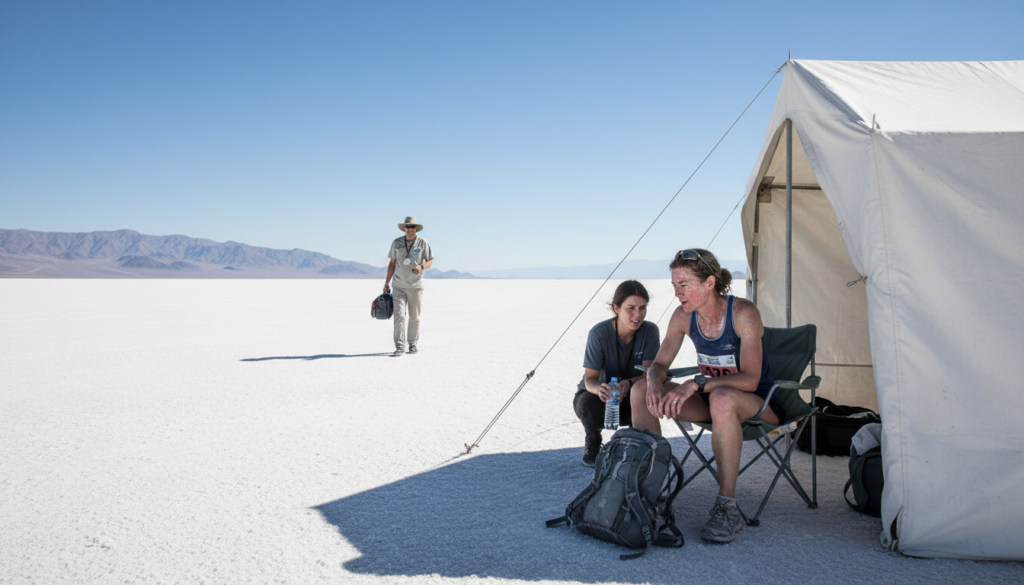
The woman arrived at Aid Station Seven with an empty water pack and a headache she could no longer describe.
Her name was Bex Ardin.
She was thirty-nine.
She had been running for almost eight hours across the Saltwake Plain, an immense stretch of white mineral flats bordered by dry mountains.
She had trained for nine months.
Completed several shorter races.
Studied the route.
Prepared her equipment.
And followed what she believed was an excellent hydration strategy.
Now she stood beneath a canvas shelter, staring at a folding table as though she had forgotten what tables were for.
“What’s your number?” asked the volunteer.
Bex looked at the bib pinned to her shirt.
Then back at him.
“Forty…”
She stopped.
Her number was clearly printed across her chest.
418.
The volunteer, a nineteen-year-old named Nico Rell, smiled.
“Four-one-eight. There you go.”
Bex nodded.
Then looked toward the water containers.
“Need a drink,” she whispered.
Nico reached for a cup.
Then stopped.
He wasn’t a clinician.
He had completed the event’s volunteer briefing, which included recognizing warning signs, calling the medical team, and avoiding improvising treatment for unwell participants.
He had been instructed not to assume that every exhausted runner needed the same thing.
Most runners passed through the station quickly.
They drank.
Ate.
Asked about distances.
Complained about blisters.
Then continued across the white plain.
Bex was different.
She seemed unable to follow a simple conversation.
Her hands trembled.
Her face looked swollen around the eyes.
She stared at the cups, then closed her eyes tightly.
Nico set the cup down.
“Bex, are you feeling confused?”
She frowned.
“No.”
A pause.
“Maybe.”
“Have you been sick?”
She nodded.
“Twice.”
“Are you having a headache?”
“Yes.”
“How bad?”
She stared.
Then whispered, “Everything is too loud.”
Nico felt fear move through him.
He looked toward the medical tent.
“Stay here. I’m calling the medical team.”
Bex reached toward the cup.
“Just water.”
Nico gently moved it aside while keeping the area calm.
“I don’t want to guess what’s making you ill. The medics are just over there.”
She looked angry.
Then confused.
Then suddenly exhausted.
Nico called for help.
The event physician, Dr. Liora Senn, came from the adjacent tent with a medical team member.
She knelt beside Bex.
Asked questions.
Checked her condition.
Requested the information the station had recorded about her arrival.
Nico answered what he knew.
Runner 418.
Arrived walking.
Headache.
Vomiting.
Confused.
No obvious injury reported.
Liora looked toward Bex’s water pack.
Then asked, “How much have you been drinking?”
Bex closed her eyes.
“A lot.”
“How much?”
She tried to answer.
Couldn’t.
The physician turned toward Nico.
“Do we have her support plan or intake record?”
He checked the event information.
Runners had been encouraged to avoid rigid drinking targets and follow individualized guidance appropriate to conditions and activity, with medical support available at aid stations.
Bex had a personal hydration note attached to her race file.
Nico opened it.
Read the amount she’d planned to drink every hour.
Then looked toward the physician.
Liora’s expression changed.
“That’s a high planned intake.”
She looked back at Bex.
“Have you been forcing yourself to drink even when you weren’t thirsty?”
Bex nodded weakly.
“Didn’t want to get dehydrated.”
The physician spoke to her colleague.
They continued the assessment and activated the event’s emergency transport process.
Nico listened.
He recognized one word.
Hyponatremia.
He had heard it during the medical briefing.
A potentially dangerous reduction in the sodium concentration of the blood.
It could occur when someone took in more water than their body could safely handle, including during prolonged exercise.
The symptoms could overlap with other heat-related illnesses.
And treating every unwell runner with additional fluid could make some situations worse.
He looked at the empty water pack.
Then at Bex.
She had spent hours trying to prevent dehydration.
Now the possibility of too much water had become part of the emergency.
Nico felt a cold wave move through him.
The physician was still working.
Bex was becoming less responsive.
Nico stepped back.
For the first time in his life, he understood that an empty bottle did not necessarily mean a body needed more water.
Three months earlier, Bex Ardin stood in her kitchen measuring water into a row of bottles.
Her apartment was small.
Bright.
Full of running shoes.
Her refrigerator contained more magnets from races than actual food.
On the wall hung photographs of deserts, mountains, and trails.
She loved endurance running.
Not because she enjoyed suffering.
She didn’t.
She hated blisters.
Disliked sore knees.
Considered running in cold rain a form of unnecessary self-punishment.
But she loved the strange, quiet satisfaction of traveling a long distance using nothing but her own body.
At thirty-nine, Bex worked repairing laboratory instruments.
Most days, she spent hours at a bench examining equipment that measured tiny changes in pressure, temperature, and electrical signals.
She enjoyed precision.
Numbers reassured her.
If a machine behaved unpredictably, she could test it.
Compare readings.
Identify a fault.
Replace a component.
Then measure again.
Running was less cooperative.
She could train carefully and still have a terrible day.
Sleep well and feel sluggish.
Eat properly and discover her stomach objected to the plan.
The body was a complicated system that refused to perform identically every time.
That uncertainty frustrated her.
It also made long-distance running fascinating.
The Saltwake Hundred was the hardest event she’d attempted.
A course crossing mineral flats, low ridges, and remote desert trails.
The race was known for its immense white landscape and severe exposure to sun and wind.
It was not something participants were supposed to attempt casually.
The organizers required documented qualifying experience, carried out safety briefings, and established aid stations, medical support, and communication procedures along the course.
Bex qualified.
Trained.
Prepared.
Then began collecting information about hydration.
She read articles.
Watched videos.
Asked experienced runners.
Spoke with a sports dietitian.
Most of the advice emphasized that fluid and electrolyte needs varied according to weather, intensity, body size, sweating, and other individual factors.
She was told not to use an arbitrary drinking target without considering her own needs.
Bex understood.
At least, she believed she did.
Then she downloaded a training spreadsheet from an online discussion group.
It contained columns for body weight, temperature, planned running pace, and hourly fluid intake.
The suggested number looked impressively precise.
She entered her details.
The spreadsheet produced a plan.
Bex liked plans.
She liked numbers even more.
Over the following weeks, she began treating the calculated amount as a requirement rather than an estimate that needed evaluation.
If she didn’t finish the planned fluid, she drank the rest before the hour ended.
If she felt full, she drank anyway.
If her stomach sloshed, she told herself it meant she was doing a good job staying ahead of dehydration.
She did not test the plan sufficiently during long training sessions.
She had intended to.
But the weather changed.
Work became busy.
One training run was shortened because of a storm.
Another because she needed to attend a family event.
She told herself she would be fine.
Bex’s closest friend, an amateur trail runner named Devra Sol, worried about her approach.
They were eating lunch one Saturday when Bex showed her the spreadsheet.
Devra examined it.
“That’s a lot to drink.”
“It’s calculated.”
“From what?”
“Several variables.”
“Which ones?”
Bex pointed.
Devra studied the screen.
Then looked up.
“Have you checked whether it matches what your own body needs during a run?”
Bex frowned.
“That’s what the calculation is for.”
“Not quite.”
She looked irritated.
Devra continued.
“It’s a model. Your body isn’t the spreadsheet.”
Bex laughed.
“Very philosophical.”
“I’m serious.”
“So am I.”
Devra put down her fork.
“What happens if the target is wrong?”
Bex considered.
“Then I’ll adjust.”
“When?”
“During the race.”
Devra looked dissatisfied.
Bex smiled.
“You’re worrying.”
“Yes.”
“Don’t.”
Devra sighed.
“I hate it when you say that.”
Bex laughed.
Then changed the subject.
She was not careless.
That was the trouble.
She had planned so thoroughly that she began mistaking the presence of a plan for proof that it was sound.
The night before the race, she placed her filled water pack beside the door.
Checked her shoes.
Charged her headlamp.
Reviewed the route.
Then called Devra.
“Wish me luck.”
Devra laughed.
“Good luck.”
A pause.
“Listen to the medical briefing.”
“I did.”
“And don’t treat the spreadsheet like a commandment.”
Bex rolled her eyes.
“Yes, Mother.”
Devra became quiet.
Then said, “Bex. Promise me you’ll pay attention if something feels wrong.”
Bex looked toward her running gear.
She wanted to say yes.
Of course she did.
But she knew that during long races, many things felt wrong.
Feet hurt.
Legs ached.
Stomachs complained.
Fatigue made ordinary thoughts difficult.
Part of endurance sport was learning which discomforts could be managed and which required stopping.
She had always prided herself on continuing when other people gave up.
“Of course,” she said.
Devra sighed.
Then wished her luck again.
The next morning, Bex crossed the starting line before sunrise.
The desert opened before her.
White.
Endless.
Beautiful.
And she began running toward the horizon.
The first three hours went well.
Bex moved easily.
The air was cool.
The light soft.
Other runners traveled in small groups, their footsteps crunching against the hard mineral surface.
The landscape looked like another planet.
Low mountains rose beyond the plain.
The sky stretched without interruption.
There were moments when Bex felt so small that she laughed aloud.
At Aid Station Two, she checked her pace.
Ate.
Refilled her supplies.
Then drank enough to meet the amount she’d written in her plan.
At Aid Station Three, the temperature had begun rising.
She drank again.
By the fourth hour, her stomach felt heavy.
She blamed the food.
Changed snacks.
Continued.
At the fifth hour, she had a headache.
She blamed the sun.
Pulled her hat lower.
Continued.
At the sixth hour, she began feeling nauseated.
She stopped briefly.
Then walked.
The nausea passed for several minutes.
She drank more water, believing she needed to stay ahead of dehydration.
A runner overtook her.
Asked whether she was all right.
Bex smiled.
“Fine.”
The runner continued.
At the seventh hour, she vomited beside the trail.
She stood staring at the ground afterward.
Frightened.
Then angry.
This was not how the race was supposed to go.
She had trained.
Prepared.
Followed her plan.
She thought about turning back.
Then looked toward the next aid station marker.
The distance wasn’t far.
If she could reach the shelter, perhaps she’d recover.
She continued.
The world became strange.
The mountains seemed flatter.
The light too bright.
She couldn’t remember when she’d last eaten.
She looked toward her watch.
The numbers made no sense.
She tried calculating her pace.
Forgot what she was calculating.
Then she saw the canvas roofs of Aid Station Seven.
Relief rose through her.
She walked toward the volunteers.
Her head hurt.
She was thirsty.
Or perhaps she was simply frightened.
She could no longer tell.
“Water,” she whispered.
A young man looked at her.
Asked her number.
She stared.
And the race she had planned so carefully became a series of events she would later remember only in fragments.
A folding chair.
The smell of hot canvas.
A woman’s voice.
A radio.
Somebody asking her name.
Her body seemed to be moving farther away from her.
Then the memory stopped.
Nico stood outside the medical tent while the emergency team arranged Bex’s transfer.
He was frightened.
Not only for her.
Because he had nearly handed her another cup of water.
His hand had been on it.
He remembered the cold plastic.
The way he’d reached automatically because that was what volunteers did.
Runners arrived tired.
You offered water.
It seemed simple.
He had stopped because Bex was confused.
Because her face looked wrong.
Because the briefing had told him that some symptoms required immediate assessment rather than routine aid-station care.
Now the physician was treating her condition as a possible medical emergency, including exercise-associated hyponatremia.
Nico stood beside a crate of supplies.
The bottles looked suddenly different.
Water.
Electrolyte drinks.
Snacks.
Everything that had seemed reassuring an hour earlier now carried a question.
An older volunteer named Marin approached.
He was fifty-six, a retired geography teacher who had worked at the race for four years.
“You all right?”
Nico shook his head.
“I almost gave her water.”
Marin looked toward the medical tent.
“Then you stopped.”
Nico stared.
“What if I hadn’t?”
The older man considered.
“That’s why we have procedures and training.”
Nico looked at him.
“I thought water was always the answer.”
Marin shook his head.
“Not always.”
He sat beside the supply crate.
Nico joined him.
For a while, they watched the pale landscape.
Then Nico asked, “What exactly are electrolytes?”
Marin considered.
He wasn’t a clinician either.
But he remembered enough chemistry to begin with the basics.
“Minerals that carry an electrical charge when they’re dissolved in body fluids.”
Nico frowned.
“Like batteries?”
“Not exactly. The comparison only goes so far.”
Marin picked up a bottle.
“Sodium, potassium, chloride, calcium, magnesium, and others help the body regulate fluids and support nerves, muscles, and a lot of important chemical processes.”
Nico looked toward the tent.
“So the issue is that she lost too much salt?”
“Not necessarily. With hyponatremia, the important measurement is the sodium concentration in the blood. Drinking more water than the body can handle can dilute that concentration, even when the person hasn’t simply run out of sodium.”
Nico considered.
“That’s why more water might make things worse.”
“Yes, in some circumstances. That’s why the medical team needs to assess and treat her rather than us guessing.”
Nico looked toward the racecourse.
Other runners were still moving across the plain.
Some tired.
Some cheerful.
Some suffering quietly.
He thought about the drinks lined along the table.
The brightly colored labels.
The way marketing made electrolyte replacement sound like a simple solution to every problem involving sweat.
Then he asked, “Would an electrolyte drink have prevented this?”
Marin shook his head.
“Not necessarily. Many sports drinks contain electrolytes, but they aren’t a guarantee against overhydration or hyponatremia. The balance depends on more than the label.”
Nico nodded slowly.
He looked toward the medical tent.
“What happens now?”
Marin considered.
“The professionals are doing their job. The race team is supporting the transfer. We keep the station functioning and follow their instructions.”
Nico stared.
“That’s it?”
“That’s quite a lot.”
They sat quietly.
Then Marin stood.
“Come on.”
“Where?”
“The next runners are arriving.”
Nico looked toward the trail.
Three figures moved across the flat.
Dust rose beneath their shoes.
Marin checked the aid-station checklist.
Nico took a breath.
Then returned to work.
Not pretending he was a doctor.
Not assuming the same response suited everyone.
Simply paying more attention to what the runners told him and what he could observe.
When somebody needed routine support, he provided it according to the event’s procedures.
When somebody needed medical assessment, he called the team.
And when he didn’t know the answer, he stopped trying to invent one.
Bex woke in a hospital room the following morning.
At first, she thought she was still on the racecourse.
The walls were too white.
The light too bright.
And the ceiling panels resembled the pale, flat landscape she’d spent hours crossing.
She tried to sit up.
A nurse approached.
“You’re in hospital.”
Bex blinked.
Her head hurt.
Not as badly as before.
But enough that she closed her eyes again.
“What happened?”
“You became unwell during the race. The medical team transferred you here for assessment and treatment.”
Bex looked down.
A hospital identification band circled her wrist.
Her race watch was gone.
Her running shoes stood beside the bed.
They were covered in fine white dust.
She stared at them.
Then whispered, “Did I finish?”
The nurse looked at her kindly.
“No. Your health needed attention.”
For a moment, Bex felt a sharp disappointment.
Then the memory returned.
The headache.
The nausea.
The folding table.
A young volunteer asking her number.
She tried to remember what happened afterward.
There was almost nothing.
She swallowed.
“Was I dehydrated?”
The nurse explained that the clinical team would discuss the findings with her.
Later, the treating physician came to the bedside.
He reviewed what had happened.
Bex’s blood tests had shown a dangerously low sodium concentration, consistent with symptomatic exercise-associated hyponatremia.
She had required urgent, closely monitored treatment.
The clinicians had also assessed for other possible contributors and complications.
Bex listened.
Then looked at him.
“But I was drinking water.”
“Yes.”
“A lot of water.”
“That may have been part of the problem.”
She stared.
The physician explained the distinction between the body’s total amount of water and the concentration of sodium in the blood.
The kidneys regulated water excretion through complex hormonal and physiological mechanisms.
During prolonged exertion, those processes could be affected by stress and other factors.
If fluid intake exceeded what the body could safely handle, the sodium concentration could fall.
A person could therefore develop dangerous hyponatremia without simply being dehydrated.
Bex stared at the blanket.
She thought of the spreadsheet.
The neat columns.
The hourly target.
The reassurance of watching herself complete the planned amount.
She felt foolish.
Then frightened.
“What if I’d kept running?”
The physician was quiet for a moment.
“Severe symptomatic hyponatremia can become life-threatening. It’s fortunate that the volunteers recognized you needed urgent assessment.”
Bex closed her eyes.
For a long time, she said nothing.
Then asked, “When can I run again?”
The physician explained that her immediate recovery and follow-up came first, and that a return to endurance exercise should wait until she had received individualized medical clearance and reviewed the circumstances that led to the event.
She nodded.
The answer frustrated her.
She had always approached a setback by making a new plan.
A date.
A sequence of tasks.
An opportunity to prove she’d learned something.
But she couldn’t schedule recovery according to her wishes.
Her body had already demonstrated that it was not obliged to obey her spreadsheet.
Later that afternoon, Devra arrived.
She carried a paper bag.
Inside were a clean shirt, toothbrush, phone charger, and a paperback novel.
Bex looked at the bag.
“You’re prepared.”
Devra sat beside the bed.
“One of us had to be.”
Bex managed a weak smile.
For a while, they said nothing.
Then Devra asked, “How are you feeling?”
“Embarrassed.”
Devra looked at her.
“That’s not a medical symptom.”
“It feels like one.”
She smiled faintly.
Then her face changed.
“I was so sure.”
Devra waited.
Bex stared toward the window.
“I had everything calculated.”
“I know.”
“The temperature. The pace. The hours.”
“I know.”
She swallowed.
“And I was wrong.”
Devra didn’t answer immediately.
Then she said, “You made a mistake. A serious one. That’s different from being wrong about everything.”
Bex looked toward her.
Devra continued.
“The race team followed the emergency plan. You got the care you needed. Now you can work with qualified people to understand what happened and how to avoid repeating it.”
Bex looked down.
“I should have listened.”
Devra sighed.
“Maybe.”
She leaned forward.
“But I also wish you’d listened to yourself when you started feeling unwell.”
Bex stared.
Devra continued.
“You told me the plan mattered. I think somewhere along the way, you decided following it mattered more than noticing what was happening.”
The words hurt.
Because they were true.
Bex had been nauseated.
Her stomach heavy.
Her head aching.
Her thoughts becoming confused.
Yet she kept reaching for the next scheduled drink.
She had mistaken obedience to a number for responsibility.
She looked toward Devra.
“Why do I do that?”
Her friend considered.
“Because numbers make you feel safe?”
Bex stared.
Then laughed sadly.
“Probably.”
Devra nodded.
“They’re useful. Until they aren’t.”
Bex looked toward the white hospital wall.
The race had been important to her.
Not only the distance.
The proof.
That she could train for something enormous and complete it through preparation and determination.
At work, she spent her days correcting instruments.
At home, she organized bills and calendars.
Running had become another system she believed she could master.
She wanted one area of life where effort would produce an exact result.
She had never said that aloud.
Now it seemed embarrassingly obvious.
She looked at Devra.
“I think I wanted the plan to stop me being afraid.”
Her friend nodded.
“Did it?”
“For a while.”
“And then?”
Bex looked toward her shoes.
White dust clung to the soles.
“Then I was afraid of disobeying it.”
Devra took her hand.
They sat together.
Neither tried to turn the hospital room into a place for inspirational speeches.
It was simply a room where Bex was recovering after a dangerous medical event.
She had survived.
She was grateful.
And she was frightened by how close a seemingly sensible plan had brought her to serious harm.
Six weeks later, Bex returned to Saltwake Plain.
Not to race.
Not to prove anything.
She had been medically reviewed and was following her recovery plan. She was not resuming endurance competition.
She went because Nico had written to her.
The race organizers had passed along his letter with her permission after she asked about the aid-station team.
It was short.
Dear Bex,
I hope you’re recovering well.
I was the volunteer at Station Seven. You probably don’t remember me.
I’ve been thinking about that afternoon. I’m grateful our medical team was there and that we followed the emergency procedures.
I hope you have better days ahead.
Nico.
Bex read the letter several times.
Then wrote back.
She thanked him.
Told him she remembered the table, the shade, and someone asking her number.
She said she was recovering.
Then asked whether he would like to meet for coffee sometime, if he was comfortable doing so.
Nico agreed.
They met at a small roadside café near the plain.
He arrived wearing a university sweatshirt and carrying a notebook.
Bex smiled.
“You’re not going to interview me, are you?”
He looked horrified.
“No.”
She laughed.
“I’m joking.”
He relaxed.
They ordered drinks.
Sat beside the window.
For a while, they talked about ordinary things.
His studies.
Her work.
The town.
The strange way white mineral dust managed to get into every part of a car.
Then Nico became quiet.
“Can I ask you something?”
Bex nodded.
“Of course.”
“Did you know what hyponatremia was before the race?”
She considered.
“I’d heard of it.”
“And?”
“I didn’t think it could happen to me.”
He nodded.
She looked toward the plain.
Then continued.
“I thought dehydration was the danger I needed to prevent. I treated drinking more as automatically safer.”
Nico looked at her.
“What changed your mind?”
Bex smiled faintly.
“Several hospital blood tests and a physician.”
He laughed nervously.
She continued.
“And the fact that I couldn’t remember my own race number.”
The younger man went quiet.
Bex looked toward him.
“I’ve thought about that a lot.”
“What?”
“How much work went into keeping me safe after I stopped being able to make good decisions.”
Nico looked down.
He seemed embarrassed.
Bex continued.
“The medical team. The transport crew. The nurses. The doctors. You.”
He shook his head.
“I didn’t do much.”
Bex considered.
“You noticed I wasn’t behaving normally.”
He shrugged.
“I was supposed to.”
“Yes.”
She smiled.
“And you did.”
He looked toward the window.
For a while, neither spoke.
Then Bex asked, “Why did you volunteer?”
Nico laughed.
“University application.”
She grinned.
“Really?”
“Partly. I wanted some experience helping at sports events.”
“Are you studying medicine?”
“Maybe. Or chemistry. I haven’t decided.”
Bex nodded.
He continued.
“I like understanding how things work. I thought the race would be interesting.”
“Was it?”
He considered.
“Very.”
Then he looked at her.
“But it was different from what I expected.”
“How?”
He stared at his notebook.
“I thought I needed to know all the answers.”
Bex smiled sadly.
“That sounds familiar.”
Nico continued.
“Then you arrived, and I had no idea what was wrong. I only knew you needed the medical team.”
He looked up.
“I think I learned that knowing when to ask for help is part of knowing what you’re doing.”
Bex nodded.
She thought of her laboratory instruments.
The measurements she trusted.
The tests she’d run.
The times she’d taken equipment apart because a reading didn’t fit the expected pattern.
She would never have told a technician to ignore an alarming measurement simply because a theoretical model predicted something else.
Yet she’d done exactly that with her own body.
She looked toward the plain.
White earth stretched beyond the café windows.
Beautiful.
Almost empty.
A few distant vehicles moved along the road.
She thought of the irony.
She had nearly developed a life-threatening imbalance while running across a landscape that looked as though it were made entirely of salt.
The appearance meant nothing about the concentration of sodium in her blood.
The body was not a desert.
It was not a bottle.
It was not a spreadsheet.
It was a living system, constantly balancing water, dissolved minerals, electrical signals, hormones, and countless other processes.
And its measurements could not be guessed from the color of a drink or the dryness of a landscape.
She smiled.
“What are you thinking?” Nico asked.
Bex looked at him.
“That I spent a very expensive weekend learning an important distinction.”
He laughed.
“Which one?”
She considered.
“Between following a plan and paying attention.”
Nico nodded.
Then smiled.
“That’s a good distinction.”
They finished their drinks.
Outside, the afternoon light moved across the flats.
Bex stood.
Her legs felt stronger than they had six weeks earlier.
But she was not there to test them.
She had arranged to meet Devra later for a short walk along a permitted trail, within the limits discussed with her healthcare team.
They would walk slowly.
Talk.
Perhaps stop to look at the mountains.
Perhaps do nothing particularly impressive.
Bex found herself looking forward to it.
Nico approached the café door.
Then turned.
“Bex?”
“Yes?”
“Do you think you’ll race again?”
She considered.
A month earlier, she would have answered immediately.
Of course.
Next year.
Better prepared.
Faster.
More careful.
She would have wanted the certainty of a promise.
Now she looked toward the white plain.
The place where she had been frightened, humbled, and helped.
“I don’t know,” she said.
Nico nodded.
She smiled.
“And for now, that’s all right.”
They said goodbye.
Bex stood beside her car.
The wind moved gently across the salt flats.
A thin line of dust traveled over the road.
The distant mountains appeared blue beneath the afternoon sky.
She had come here once to finish a hundred kilometers.
She hadn’t finished.
The number remained incomplete.
She knew that.
It still disappointed her.
But she no longer believed the unfinished distance erased the months of training, the joy of running, or the things she might choose to do next.
Devra’s car appeared along the road.
Bex raised a hand.
Her friend pulled into the lay-by.
Stepped out.
Then smiled.
“Ready?”
Bex looked toward the trail.
It was short.
Ordinary.
Barely worth measuring.
She smiled back.
“Yes.”
They began walking.
Not quickly.
Not toward a finish line.
Just across a small stretch of desert, with enough daylight left to turn around whenever they wanted.
The End.
Editorial Medical Accuracy Note
What are electrolytes? Electrolytes are substances that form electrically charged ions when dissolved in body fluids. Important examples include sodium, potassium, chloride, calcium, magnesium, phosphate, and bicarbonate. They help regulate fluid balance, nerve signaling, muscle contraction, and many essential bodily processes. Most healthy people get adequate electrolytes from normal food and drinks, and do not need special sports beverages for everyday activities. Levels can become too low or high because of fluid losses, excess water, illnesses, medication effects, or other causes. Exercise-associated hyponatremia is dangerously low sodium concentration in the blood during or after exertion; drinking more fluid than the body can handle is an important risk factor. Symptoms may include headache, nausea, vomiting, confusion, and severe neurological problems. Electrolyte sports drinks do not reliably prevent this condition if someone overdrinks. Confusion, seizures, collapse or serious illness during exercise requires emergency medical care—do not guess at treatment using unmeasured water or salt. Saltwake Plain, the race, runner, and characters are fictional.